The Funeral Director Just Handed You a Contract. You Have No Idea What Is Legally Required and What Is a $3,000 Upsell. You Have 48 Hours to Decide, and Nobody Taught You How Ontario Funeral Law Actually Works.
You are sitting across from a funeral director, and they are walking you through a price list that assumes you will say yes to everything. The casket they are recommending costs more than your first car. They mentioned embalming as though it were mandatory. They presented a package called "traditional service" and never explained that you can remove half the line items. And when you asked about cremation, they said the coroner needs to be involved — which sounded like something had gone terribly wrong.
Nothing has gone wrong. That is how Ontario funeral law works. But nobody told you that before this moment, and the funeral director is not obligated to explain the difference between what the province requires and what the funeral home profits from. They gave you a booklet from the Bereavement Authority of Ontario. It is 24 pages of regulatory language that does not tell you which fees you can refuse, does not explain what happens if your family disagrees about burial versus cremation, and does not mention that you might qualify for $5,000 in government benefits that offset the entire bill.
Meanwhile, the clock is running. The body is in refrigerated storage and the daily shelter fee started this morning. The municipal clerk's office needs forms you have never heard of before they will issue the Burial Permit. Your brother wants a burial, your mother wants cremation, and nobody knows who actually has the legal authority to decide. And in the back of your mind: can I even scatter ashes at the family cottage, or is that illegal?
The Ontario Funeral Laws & Consumer Rights Guide is a Consumer Defence Roadmap — every Ontario-specific law, right, fee, form, and financial benefit that sits between the moment of death and final disposition, organized in the order you actually face them. Not a funeral home brochure. Not a 24-page BAO compliance document written for regulators. A structured manual that tells you what the funeral director is legally required to disclose, what you are legally allowed to refuse, and exactly how much the government will pay toward the funeral if you know where to apply before you sign anything.
What's Inside the Consumer Defence Roadmap
A 13-chapter guide, a printable consumer rights checklist, and four standalone reference sheets — covering legal authority, required paperwork, consumer protections, disposition options, financial assistance, prepaid contracts, transport rules, and the complaint process, built specifically for Ontario's FBCSA, Vital Statistics Act, and the Bereavement Authority of Ontario:
Who Has the Legal Right to Make Funeral Decisions
This is the question that fractures families. Under Ontario common law, the named Estate Trustee (executor) has absolute authority over the body and all funeral decisions — outranking the surviving spouse, the adult children, and every other family member. If there is no will, a statutory hierarchy drawn from the Estates Act and the Succession Law Reform Act determines who decides. And here is the part that catches nearly everyone: if you held a Power of Attorney for Personal Care and made every medical decision for years, your authority ended the instant they died. Permanently. This chapter gives you the legal hierarchy, the case law that backs it, and practical scripts for asserting your authority without fracturing the family.
The Paperwork Before Anything Can Happen
No burial, cremation, or alkaline hydrolysis can occur in Ontario without a specific chain of documents completed in a specific order. The Medical Certificate of Death (Form 16), the Statement of Death, death registration with the municipal clerk, the Burial Permit, and — for cremation only — the Coroner's Cremation Certificate ($75.00, routine, not an investigation). This chapter lays out who completes each form, who receives it, what each one costs, and the BAO's mandatory $30.00 consumer protection fee that appears on every invoice.
Your Consumer Rights Under the FBCSA
The Funeral, Burial and Cremation Services Act, 2002 is one of the strongest funeral consumer protection laws in North America. It gives you the right to an itemized price list showing minimum required services versus optional additions. It prohibits funeral homes from refusing a casket you purchased elsewhere. It forces providers to disclose commissions and kickbacks from third-party vendors and ownership of other facilities within 100 km. And it mandates that every provider hand you the BAO Consumer Information Guide before drafting a contract — refusal is itself a regulatory violation. This chapter translates those legal protections into the specific questions you ask and the specific answers you demand.
What Is NOT Legally Required — the Upsells You Can Refuse
Embalming is not required by Ontario law. An expensive casket is not required for cremation — a basic rigid cardboard container is legally and operationally sufficient. You are not required to purchase a service package. You may supply your own casket, urn, or merchandise from any third-party source, and the funeral home cannot charge a handling fee for accepting it. When a funeral director says something is "required," this chapter tells you whether they mean required by law or required by their pricing model.
Disposition Options — Burial, Cremation, Alkaline Hydrolysis, and Ashes
Ontario offers three legally recognized methods of final disposition plus detailed rules for cremated remains. Full-body burial must occur in a licensed cemetery — never private property. Cremation requires the Coroner's Certificate. Alkaline hydrolysis (water cremation) is legal in Ontario under the same regulatory framework, with one key difference: pacemakers do not need surgical removal. Ashes may be scattered on Crown land (87% of Ontario), private property with consent, or kept at home indefinitely. But burying an urn on your own property sits in a legal grey area — and allowing repeated scatterings on one property triggers a $165,000 cemetery licensing requirement that most families have never heard of.
Family-Led Death Care, Costs, Benefits, Prepaid Contracts, Transport, and Complaints
The remaining chapters cover your right to handle the body yourself without hiring a funeral director (and the institutional resistance you will face), the full fee schedule for every government charge, the 16-week ServiceOntario death certificate backlog and how to work around it using the funeral director's Proof of Death, the CPP Death Benefit ($2,500 base plus up to $2,500 top-up under the new January 2025 rules), the CPP Survivor's Pension (up to $905/month), the Ontario Works funeral benefit ($2,250 — but only if you apply before signing any contract), prepaid contract protections and the 30-day cancellation window, transporting remains across provincial and international borders, religious time pressures for 24-hour burial, the Estate Administration Tax quick overview, and the step-by-step process for filing a formal complaint with the BAO when a funeral provider violates your rights.
Who This Guide Is For
- The executor who just sat down with a funeral director and realized they have no idea what is legally required versus what is an optional add-on — who needs the FBCSA consumer rights framework translated into plain questions they can ask before signing a contract that could cost thousands more than it should
- The surviving spouse making funeral decisions alone for the first time — who needs to know that embalming is not required, that they can refuse package pricing, and that delaying the CPP Survivor's Pension application permanently forfeits money because Service Canada caps retroactive payments at 12 months
- The adult child arranging a parent's funeral with no money — who needs to apply for Ontario Works funeral coverage ($2,250) before signing any contract, claim the CPP Death Benefit ($2,500 to $5,000), and understand that direct cremation with a basic container is a legal, dignified option that costs a fraction of the "traditional" package
- The family torn apart by disagreement over burial versus cremation — who needs to know that Ontario case law gives the executor absolute authority over the remains, that the funeral home will freeze all proceedings if there is a dispute, and what the legal escalation path looks like before it bankrupts everyone emotionally
- The family member wondering about scattering ashes at the cottage or on Crown land — who needs to know exactly what Ontario law permits, what it prohibits, and what sits in the grey area between the statute and reality
- The caregiver reviewing a parent's prepaid funeral contract — who needs to know whether the contract is guaranteed, whether the trust fund is properly held, what the 30-day cancellation window means, and what happens if the funeral home was sold to a corporate chain since the contract was signed
- The immigrant family navigating repatriation or a 24-hour religious burial — who needs the Coroner's Out-of-Province Body Shipment Certificate, airline regulations for transporting remains, and the emergency death registration process for when Ontario's bureaucracy clashes with religious obligation
Why Free Resources Will Not Get You Through This
The information exists. It is scattered across the Bereavement Authority of Ontario, ServiceOntario, Service Canada, the Office of the Chief Coroner, and a dozen funeral home websites that each reveal just enough to funnel you toward their services. Here is what you actually encounter when you try to navigate Ontario funeral law using free sources alone:
- The BAO Consumer Information Guide is a compliance document, not a consumer strategy. It lists your rights under the FBCSA but never tells you how to use them. It does not explain how to audit a funeral director's price list, does not address family disputes over the body, does not cover ash scattering rules on Crown land, and deliberately avoids estate law — stating it is "not intended to act as a substitute for legal advice." It informs you that protections exist. It does not show you how to exercise them in an arrangement meeting.
- Funeral home content marketing tells you what they want you to know. Companies like Cleo Cremation publish excellent articles on death certificate delays and cremation documentation. But they are commercial providers funnelling you toward their specific services. They omit traditional burial disputes, cemetery by-law costs, and the financial assistance programs that would reduce how much you spend with them.
- Law firm blogs make it sound impossible without a lawyer. Estate firms publish precise, case-law-rich breakdowns of executor authority, intestacy rules, and funeral disputes. They are explicitly designed to convince you the process requires professional representation starting at several thousand dollars. For contested estates, that is true. For the majority of straightforward funerals, the answer costs a fraction of what an attorney charges.
- Government portals are accurate but fragmented. ServiceOntario explains the death certificate. Service Canada explains the CPP Death Benefit. The Chief Coroner's office explains Form 4. Municipal social services explain Ontario Works. None of them reference each other. None of them sequence the steps. None of them warn you that signing a funeral contract before applying for Ontario Works funding can permanently disqualify you from the benefit.
- The Funeral Advisory and Memorial Society charges $40 for membership before you see the good stuff. FAMS offers genuine consumer advocacy, but their most useful tools — pricing surveys, the Death Care Planning Form — sit behind a lifetime membership paywall. Their focus leans heavily toward pre-planning, not the at-need crisis management you need right now.
Free resources give you fragments from sources that do not talk to each other. The Consumer Defence Roadmap puts every Ontario-specific law, right, fee, form, benefit, and deadline into one document, in the order you actually face them — and tells you how to use each one, not just that they exist.
— Less Than the BAO's Mandatory Fee on a Single Funeral Transaction
An average Ontario funeral costs $5,000 to $10,000. A single line item you did not know you could refuse — embalming, a premium casket for cremation, a bundled "traditional" package — can add $1,500 to $3,000. A missed CPP Death Benefit top-up leaves $2,500 on the table. An Ontario Works application filed after signing the contract disqualifies you from $2,250 in coverage. This guide costs less than the BAO's own $30.00 consumer protection fee and shows you how to avoid every one of those losses.
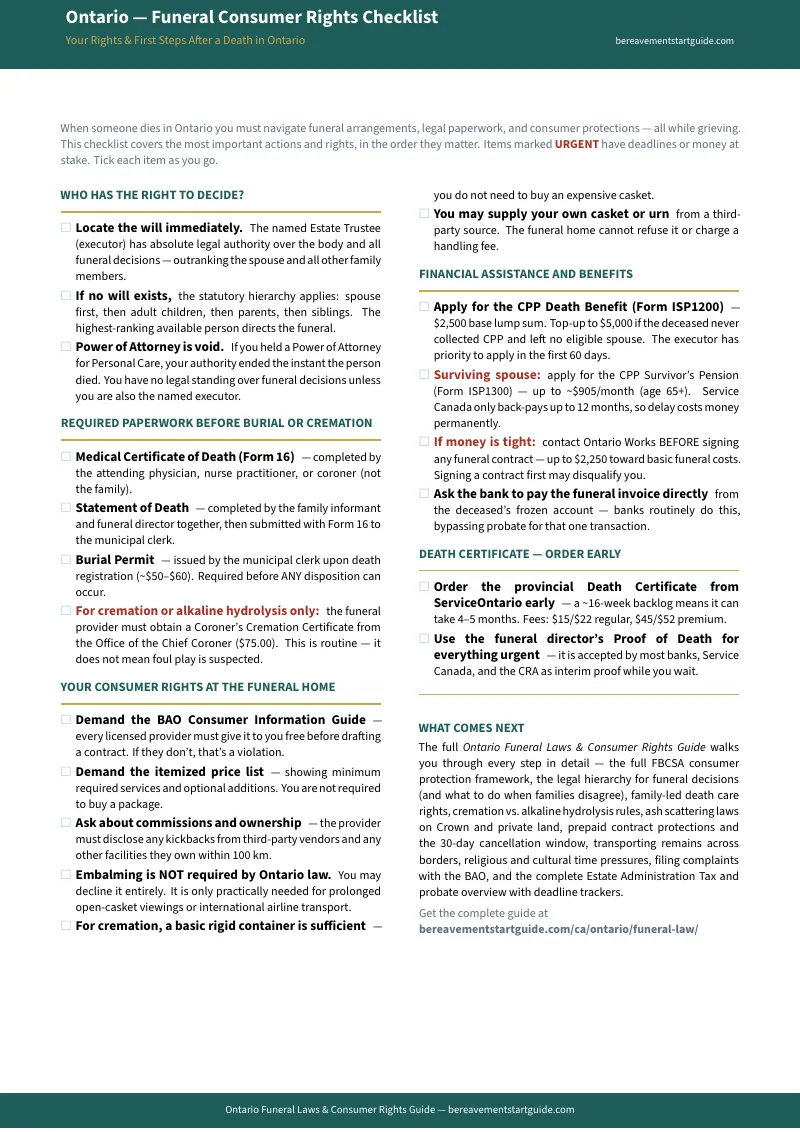
Your download includes the complete 13-chapter guide covering every stage from the legal authority decision through filing a BAO complaint, plus the standalone Ontario Funeral Consumer Rights Checklist, a Disposition Authority Hierarchy reference, a Financial Assistance Reference card, Funeral Negotiation Scripts, and a Forms, Fees, and Contacts Quick Reference — all printable and ready to bring to the funeral home. Plus a money-back guarantee, no time limit. If the guide does not give you clarity on your rights and confidence that you are not being overcharged, email us for a full refund. No questions asked.
Not ready for the full guide? Download the free Ontario Funeral Consumer Rights Checklist — covering who has the legal right to decide, the paperwork required before any disposition, the consumer rights you can exercise at the arrangement meeting, and the financial assistance available if you apply in time. It is enough to walk into the funeral home knowing what you can say no to.
You should not have to learn funeral law while grieving. But the funeral director already knows it — and now you will too.