Someone You Love Just Died in Prince Edward Island. The Bank Froze the Accounts. The Supreme Court Wants Three Different Petition Forms and You Have No Idea Which One Applies. And You Just Discovered That PEI Is One of the Only Provinces in Canada Where a Surviving Spouse Has No Preferential Share of the Estate.
You are standing in a place nobody prepared you for. Maybe you were named executor in a will you barely remember reading, and now the bank is telling you they cannot release a single dollar without a "Grant of Probate" from the Supreme Court of Prince Edward Island. Maybe there was no will at all, and because you are the surviving spouse or the eldest child, everyone is looking at you for answers you do not have. Maybe the funeral director just finished their part and handed you a stack of paperwork with a single suggestion: "Contact a lawyer." And you are staring at a funeral invoice, a frozen bank account, and a house that needs its oil tank filled before the next cold snap.
You are grieving and exhausted, but the bureaucracy does not wait. PEI Vital Statistics in Montague needs a death certificate order. Service Canada needs notification to stop CPP and OAS payments before the government claws back overpayments from the estate. You went to Access PEI to cancel the driver's license and assumed that would cancel the health card too, but it does not --- Health PEI runs on an entirely separate system, requiring a different form mailed to a different PO Box in Montague. Then you searched for probate forms and found Forms 65A, 65B, and 65C, with no explanation of which one applies when there is a will versus when there is not, or what happens when the named executor cannot serve. The Supreme Court's website gives you blank PDFs. It does not tell you how to fill them in.
And then came the discovery that changes everything for families without a will: Prince Edward Island has no preferential share for surviving spouses. In Ontario, a surviving spouse receives the first $350,000 of the estate before anything is split with children. In Saskatchewan, it is $100,000. In PEI, it is zero. If your spouse dies without a will and you have one child, the estate is split exactly 50/50. If there are multiple children, you receive one-third and the children share two-thirds. That single rule has forced the sale of family homes across the province when adult children demanded their statutory share.
The When Someone Dies in Prince Edward Island --- Estate Settlement Guide is an Island Estates Settlement System for every legal, financial, and administrative step between the funeral home and final distribution. Not a law textbook. Not a generic Canadian checklist that does not know Prince Edward Island from British Columbia. A structured, PEI-specific manual built around the Probate Act, the Supreme Court Estates Section at the Sir Louis Henry Davies Law Courts, and the province-specific rules that make settling an estate here different from anywhere else in Canada --- so you stop guessing, stop panicking, and start working through this in the right order.
What's Inside the Island Estates Settlement System
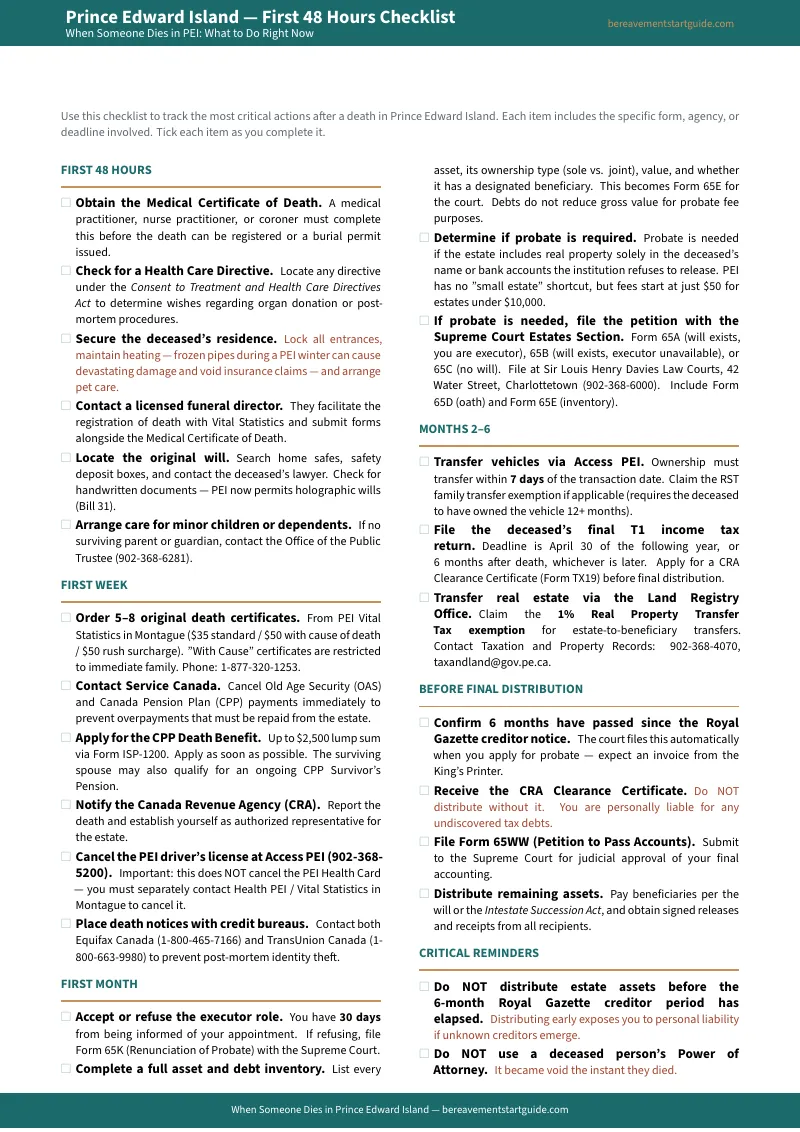
A 15-chapter guide and the First 48 Hours Checklist --- covering every stage from the moment of death through final asset distribution, built specifically for PEI legislation, the Supreme Court Estates Section, and the provincial agencies that an executor must navigate:
The First 48 Hours: The Authority Shift and Immediate Actions
The moment someone dies in Prince Edward Island, every Power of Attorney they granted becomes legally void under the Powers of Attorney and Personal Directives Act (Bill 21). If you managed their finances under a Power of Attorney, that authority ended instantly --- any attempt to use it at a bank or government office is unauthorized access. This chapter covers the authority shift, the Medical Certificate of Death, locating the original will (including holographic wills now permitted under Bill 31), securing the home and maintaining heat to prevent frozen pipes during PEI winters, your consumer rights with funeral providers under the Prearranged Funeral Services Act, and the single most important rule in this entire guide: do not pay any of the deceased's debts with your own money.
Week One: Notifications That Cannot Wait
Service Canada must be notified immediately to stop CPP and OAS payments --- overpayments will be clawed back from the estate. The CRA needs to know you are the estate's authorized representative. PEI Vital Statistics in Montague processes your death certificate orders ($35 standard, $50 with cause of death, plus $50 rush surcharge --- order 5 to 8 originals because banks and the court require originals, not copies). Access PEI handles driver's license cancellation, but the health card cancellation goes to Health PEI separately via a different process in Montague. Credit bureaus need a death alert to prevent post-mortem identity theft. The guide explains exactly which notifications go where, with phone numbers, addresses, and the documentation each agency requires.
The Estate Inventory and the Probate Decision
Before you can determine whether probate is required, you need a complete picture of what the deceased owned and how they owned it. This chapter walks through building the asset inventory --- real property, bank accounts, investments, vehicles, personal property --- with attention to the ownership type that determines everything: sole ownership versus joint tenancy with right of survivorship. PEI has no formal "small estate" shortcut or simplified affidavit process. Instead, the Probate Act uses a tiered fee structure: estates under $10,000 pay just $50, estates up to $25,000 pay $100, up to $50,000 pay $200, and up to $100,000 pay $400. Above $100,000, the fee is $400 plus $4 per additional $1,000. The guide includes the probate decision framework so you know whether filing is required before you start.
The Supreme Court Probate Process: Forms 65A Through 65K
This is the chapter that does not exist in any free resource in plain language. An executor must distinguish between three separate petition types, and choosing the wrong one means a rejected application and weeks of delay. Form 65A is the Petition for Probate when there is a valid will and you are the named executor. Form 65B is the Petition for Grant of Administration with Will Annexed --- used when a will exists but the named executor cannot or will not serve. Form 65C is the Petition for Grant of Administration --- used when there is no will at all. Each petition requires Form 65D (the executor's oath) and Form 65E (the estate inventory). The guide walks through every form, explains what triggers rejection at the Sir Louis Henry Davies Law Courts, covers the tiered probate fees, and addresses the detail that catches every first-time executor off guard: the Royal Gazette creditor notice. The court registrar automatically submits this notice when you file for probate, establishing a 6-month window for creditors to come forward --- but the King's Printer bills the estate separately, and that unexpected invoice causes deep confusion for families who do not realize the court initiated the charge.
The Intestacy Trap: What Happens Without a Will
PEI's intestacy rules under the Intestate Succession Act are among the harshest in Canada for surviving spouses. There is no preferential share --- no guaranteed upfront sum before the estate is divided among children. With one child, the estate is split 50/50 between spouse and child. With two or more children, the spouse receives one-third and the children share two-thirds. The revised Act (Bill 29, effective March 30, 2026) introduces new formulas for blended families. Common-law partners are recognized as equivalent to married spouses. This chapter explains the full distribution hierarchy, the blended family rules, and why intestacy in PEI can force the sale of the family home when adult children demand their statutory share.
Real Estate, Vehicles, Benefits, Taxes, and Everything Else
The remaining chapters cover real estate transfers through the Land Registry Office with the critical 1% Real Property Transfer Tax exemption for estate transfers (most executors do not know this exemption exists and panic about paying thousands in transfer taxes), vehicle transfers through Access PEI with the RST family transfer exemption, funeral cost assistance through the PEI Department of Social Development and Seniors (up to $6,000 plus HST for qualifying families), the CPP death benefit ($2,500 lump sum via Form ISP-1200) and CPP Survivor's Pension, the statutory debt priority order under Section 19 of the Probate Act, the terminal T1 return with deemed disposition, the CRA Clearance Certificate (Form TX19), executor compensation, the PEI Agency Contact Directory, and edge cases that require professional help.
Who This Guide Is For
- The surviving spouse whose partner just died and whose bank account was frozen this morning --- who needs to know which accounts stay accessible, which ones require a Grant of Probate, how to apply for the CPP Survivor's Pension, and why PEI's lack of a preferential share means intestacy could force the sale of the family home
- The adult child named as executor who has never navigated the Supreme Court of PEI and is terrified of making a mistake that triggers personal liability --- who needs the complete Form 65A through 65K sequence, the probate fee tiers explained, and a timeline that separates what is urgent from what legally cannot happen yet
- The family with no will who just learned that PEI intestacy rules give the surviving spouse no preferential share --- who needs to understand the distribution formulas, who has statutory priority to apply for a Grant of Administration (Form 65C), and what the revised Intestate Succession Act (Bill 29) changes for blended families
- The executor living outside Prince Edward Island who cannot walk into Access PEI or the Sir Louis Henry Davies Law Courts --- who needs to know which tasks can be handled by mail, how to manage death certificate orders from Montague remotely, and the exact documentation requirements for dealing with banks by phone
- The financially constrained family who cannot afford a funeral or a lawyer --- who needs to know about PEI Social Development funeral assistance (up to $6,000 plus HST), the tiered probate fees starting at just $50 for estates under $10,000, and the CPP death benefit application
- The rural PEI family outside Charlottetown and Summerside --- who needs to know which elements of estate settlement can be handled locally through Access PEI regional offices or by mail, and which tasks require a trip to the capital
Why Free Resources Will Not Get You Through This
The information exists. It is scattered across the PEI government's departmental pages, the Supreme Court forms repository, Vital Statistics in Montague, Access PEI, Health PEI, Service Canada, the CRA, and a half-dozen portals that do not talk to each other. Here is what you actually encounter when you try to settle an estate using free sources alone:
- Government pages are legally accurate but operationally useless. The Supreme Court provides Forms 65A through 65K as blank PDFs. It does not explain the difference between 65A, 65B, and 65C, or how to compile your financial data to populate Form 65E, or that the Royal Gazette creditor notice is filed automatically and the King's Printer will bill you separately. Vital Statistics explains death certificate fees but does not tell you how many originals you need based on the assets in the estate. Each department covers its own piece. None of them sequence the pieces together.
- Community Legal Information PEI is excellent but stops at education. CLI PEI publishes free guides that faithfully translate the Probate Act into plain English. They will thoroughly explain what an estate inventory must contain, but they do not provide a formatted checklist to actively track that data. They explain the intestacy rules but do not give you a tool to calculate how assets split in your specific family structure. Education without execution tools leaves you informed but still stuck.
- National estate platforms sell services, not standalone tools. ClearEstate and Eirene publish SEO-optimized articles about PEI probate fees and the "14 steps of estate settlement." Their content exists to funnel you into paying for premium estate administration services or national funeral packages. They frequently miss crucial localized details --- like the exact mailing address for Health PEI card cancellation in Montague, or the specific Access PEI office that processes driver's license returns, or the property transfer tax exemption for estate transfers.
- Estate software assumes tech-savvy executors. EstateExec offers comprehensive estate accounting for $199 per estate. It requires inputting sensitive financial data into a third-party cloud platform. For a 70-year-old surviving spouse whose partner always handled the finances, uploading asset data to a web application they have never heard of is not a solution --- it is another source of overwhelm.
- Law firm blogs highlight complexity to justify retainer fees. PEI estate lawyers publish accurate technical breakdowns of the Probate Act and Supreme Court procedures. Their content is designed to convince you the process is too dangerous to handle alone --- and that you need representation starting at $300 or more per hour. For contested estates, that is true. For the majority of straightforward estates, the answer costs a fraction of what an attorney charges.
Free resources give you fragments from a dozen sources that do not reference each other. The Island Estates Settlement System puts every PEI-specific statute, form, deadline, and procedure into one document, in the order you actually need them.
--- Less Than Fifteen Minutes With a PEI Estate Lawyer
A single consultation with a Prince Edward Island estate lawyer costs $300 or more per hour. Standard probate representation starts at several thousand dollars plus a percentage of the gross estate. This guide costs less than fifteen minutes of professional legal time and gives you the complete PEI-specific roadmap --- every statute, every form, every deadline, and the Supreme Court filing sequence that nobody explains in plain language.
Your download includes the complete 15-chapter guide, the First 48 Hours Checklist, and 8 standalone reference sheets you can print individually --- the Supreme Court Form Walkthrough, Probate Fee Calculator, Intestacy Distribution Rules, Real Estate Transfer Guide, Dual ID Cancellation Protocol, Asset Inventory Worksheet, Estate Settlement Timeline, and Agency Contact Directory. Print the checklist and the agency directory, pin them to your fridge, and work through the system one step at a time. Plus a money-back guarantee, no time limit. If the guide does not give you clarity on what to do next and confidence that you are doing it in the right order, email us for a full refund. No questions asked.
Not ready for the full guide? Download the free Prince Edward Island --- First 48 Hours Checklist --- covering everything that must happen in the first two days after a death in Prince Edward Island: the Medical Certificate of Death, the authority shift, securing the home, funeral arrangements, locating the will, and arranging care for dependents. It is enough to get through tonight and tomorrow.
You did not ask for this job. But you can do it. The guide shows you how, one step at a time.