The Funeral Director Says Embalming Is Required. The Prepaid Plan Your Mother Bought From Dawson Funeral Home Is Gone. Your Brother Signed the Contract Without Knowing That the Person Who Signs Assumes Full Personal Liability. And Nobody Told You That PEI Law Already Gives You the Right to Refuse Every Optional Charge on That Invoice.
You are sitting in a funeral home in Prince Edward Island with a body in refrigeration, a contract on the table, and a funeral director listing services as though each one is mandatory. Embalming: $900. Casket: $3,200. Professional services: $2,500. Viewing room rental. Transportation. Administrative fees. The total approaches $10,000 and nobody has explained which of these charges are legally required and which are optional services you can decline in writing.
Meanwhile, your family cannot agree on who has the authority to make decisions. Your brother says he does because he is the eldest son. Your sister-in-law says she does because she lived with your mother. The funeral director says nobody can proceed until someone confirms executor status — but nobody can find the will, and the estate sits frozen while daily storage fees accumulate. The Power of Attorney your sister held? It died the instant your mother did, under the Powers of Attorney and Personal Directives Act that took effect November 1, 2025.
And underneath all of this, a question that should be simple but is not: is the money safe? Because if your family purchased a prepaid funeral plan from Dawson Funeral Home in Crapaud, you already know the answer. Lowell Oakes was convicted of sixty-six counts of fraud after misappropriating over $425,000 in prepaid funeral trusts. Families recovered roughly one-third of what they paid. The province has since mandated $20,000 surety bonds and forty-five-day deposit timelines — but most PEI families have no idea these protections exist, let alone how to verify that their own prepaid plan complies.
The Prince Edward Island Funeral Laws & Consumer Rights Guide is a Consumer Defense System — a single document that translates every PEI funeral regulation, consumer right, fee schedule, and government benefit into clear, actionable steps you can follow from the moment of death through probate, benefits applications, and estate settlement. Not generic Canadian advice that confuses PEI's rules with Alberta's or Ontario's. Not a funeral home brochure written to generate appointments. A vendor-neutral manual built specifically for the province's unique regulatory landscape — including the cremation monopoly, the $50 Consumer Protection Fee, the Social Assistance cap, and the post-Dawson prepaid contract safeguards that no free source assembles in one place.
What's Inside the Consumer Defense System
A 14-chapter guide and the Funeral Consumer Rights Checklist — covering every step from the moment of death through probate and federal benefits, built specifically for Prince Edward Island's regulatory framework:
Chapter 1: Who Has the Legal Right to Make Funeral Decisions
PEI does not have a statutory priority list like British Columbia or Ontario. The province relies on common law: the executor named in the will holds absolute authority over the body. If there is no will, the family must agree on who steps forward as administrator — and that person assumes full personal financial liability for the funeral contract. This chapter covers the executor's supreme authority, what happens when families cannot agree (the body stays in storage, accumulating fees, until the Supreme Court of PEI appoints an administrator), and the critical fact that Powers of Attorney and Personal Directives terminate instantly on death.
Chapter 2: The First 48 Hours — Documents That Control Everything
Families routinely confuse three separate documents, and the confusion costs weeks. The Medical Certificate of Death (completed by the physician or coroner) is not the Statement of Death (completed by the funeral director with the family). Neither is the official Certificate of Death from Vital Statistics — the document banks, insurers, and the court actually require. The official certificate takes 8–12 business days by default. The $50 rush fee gets it in two days. The $100 emergency fee gets it in two hours. Most families do not learn about these options until after they have already waited two weeks with frozen bank accounts. This chapter maps the exact sequence.
Chapter 3: Your Consumer Rights at the Funeral Home
This is the chapter that pays for the entire guide. You have the legal right to an itemized price list before signing anything. You can decline embalming — it is not legally required in PEI. You can purchase services a la carte rather than accepting bundled packages. You can bring your own casket from a third-party vendor. The $50 Consumer Protection Fee mandated by the PEI Funeral Services and Professions Board should appear as a separate line item — it is a regulatory charge, not a discretionary funeral home add-on. This chapter includes scripts for declining non-mandatory services, requesting itemized pricing, and verifying every charge on the invoice against what PEI law actually requires.
Chapter 4: Cremation — Rules, Forms, and the Monopoly Problem
PEI does not permit standalone crematoriums. Families cannot bypass the funeral home and go directly to a cremation facility — they are legally required to engage a licensed funeral director. This mandated intermediation pushes PEI cremation costs well above what deregulated provinces charge. Until the legislature changes the law (actively debated since 2026), this chapter defines exactly which professional service fees are legally unavoidable under the current Funeral Services and Professions Act, which discretionary charges can be refused, and how to structure a direct cremation arrangement that keeps costs as low as the current regulatory framework permits.
Chapter 5: Burial — Cemeteries, Home Burial, and Green Burial
Cemetery plots in PEI range from $1,000 to $2,500 before perpetual care fees. Families considering burial on private farmland face strict regulations under the Cemeteries Act — setback requirements from aquifers and property lines, registration through the Minister of Justice and Public Safety, and permanent encumbrance on the property title. This chapter covers traditional cemetery burial, private land burial compliance, green burial options, and the exact regulatory process for each.
Chapter 6: Prepaid Funeral Plans — Protection After the Dawson Fraud
The 2025–2026 amendments to the Prearranged Funeral Services Act were a direct response to Lowell Oakes draining prepaid trust accounts for two decades. Funeral homes must now post a minimum $20,000 surety bond. They must deposit 90% of collected prepaid funds into a trust account within forty-five days. The financial institution must notify the purchaser in writing within thirty days of the deposit. This chapter translates these legislative safeguards into an actionable audit checklist: how to demand proof of the bond, verify trust deposits, understand the cancellation penalty structure (up to 12% within the first three years, full trust balance refund after three years), and protect your family's investment.
Chapters 7–14: Coroner Investigations, Body Transport, Social Assistance Benefits, Probate, Federal Benefits, Special Situations, Deadlines, and Contacts
The guide extends well beyond the funeral itself. Chapter 7 covers what happens when the coroner seizes the body and how long investigations take. Chapter 8 covers interprovincial and international transport — airline cargo regulations, known shipper requirements, and mandatory embalming for common carriers. Chapter 9 walks through the Social Assistance funeral benefit application: $2,500 base coverage, the strict $6,000 maximum total cost ceiling (including the $5,000 professional services cap and $1,000 grave opening limit), and the critical rule that crowdfunding donations are deducted dollar-for-dollar from the provincial benefit. Chapters 10–14 cover probate, federal benefits and tax obligations, edge cases (First Nations jurisdiction, religious accommodations, deaths of minors), a complete deadline summary, and every key contact you may need.
Who This Guide Is For
- The executor or next-of-kin in a funeral home right now being asked to sign a contract that could exceed $10,000 — who needs to know exactly which charges are legally required, which can be refused, and what to demand before signing anything
- The family in a dispute where siblings or relatives disagree on cremation versus burial and the funeral home has frozen all arrangements — who needs the common law authority hierarchy and a clear explanation of who holds the legal right to decide when there is no statutory priority list
- The adult child who no longer trusts the industry after the Dawson Funeral Home fraud — who needs the post-2025 legislative safeguards translated into a step-by-step prepaid plan audit they can perform before their parents' plan is ever activated
- The financially constrained family who received a funeral home quote exceeding every available dollar — who needs the Social Assistance application process, the $6,000 total cost ceiling, the crowdfunding clawback rule, and the cost-saving strategies that funeral homes are not financially incentivized to volunteer
- The out-of-province family member managing funeral arrangements from Ontario, Alberta, or outside Canada — who needs to understand PEI's death certificate process, the cremation monopoly's impact on costs, and how the coroner system works before coordinating remotely
- The advance planner reviewing a loved one's prepaid contract or documenting their own end-of-life wishes — who needs to understand the $20,000 bond requirement, the trust deposit timeline, and how to verify that their prepaid funds are actually protected
Why Free Resources Will Not Protect You at the Funeral Home
The information exists. It is scattered across PEI Vital Statistics, the PEI Funeral Services and Professions Board, the Department of Social Development and Seniors, Eirene Cremations, DFS Memorials, and a dozen funeral home websites designed to generate appointments rather than protect your wallet. Here is what you actually encounter when you try to piece together your consumer rights from free sources alone:
- PEI Vital Statistics publishes fees and forms but reads like a regulatory filing. Accurate and authoritative — and written for compliance officers, not for a grieving family trying to understand the difference between a Medical Certificate of Death and the official Certificate of Death before the bank freezes the estate.
- The PEI Funeral Services and Professions Board regulates the industry it represents. Despite its consumer protection mandate, the board is structurally aligned with funeral directors. It does not provide negotiation scripts, cost-saving strategies, or guidance on declining non-mandatory services.
- Funeral home websites answer questions that funnel you toward their services. They explain what embalming involves. They do not explain that you have the legal right to refuse it. They display their casket selection. They do not mention that you can bring your own from any vendor.
- Google surfaces the wrong province constantly. PEI families searching "funeral consumer rights Canada" routinely see British Columbia's CIFSA hierarchy, Alberta's cancellation windows, or the US FTC Funeral Rule — which has zero legal force in Canada. Acting on out-of-jurisdiction advice during a time-sensitive funeral costs real money.
- News coverage of the Dawson fraud alarmed everyone but helped nobody. CBC's reporting on Lowell Oakes' conviction was thorough. It told PEI families their prepaid plans might be at risk. It did not provide a checklist for verifying trust account compliance or demanding proof of the mandatory surety bond.
Free resources give you fragments from a regulator that writes for compliance officers, funeral homes that write for sales, and search engines that cannot tell PEI from Alberta. The Consumer Defense System puts every PEI-specific right, form, fee, and script into one document, in the order you actually need them.
— Less Than One Line Item on a Funeral Invoice
The average PEI funeral costs between $7,000 and $10,000. Families who do not know their rights routinely pay hundreds more than necessary — on non-mandatory embalming, bundled service charges they could have purchased a la carte, and discretionary fees they could have declined in writing. This guide costs less than one item on a funeral invoice and gives you the legal knowledge to evaluate every line on that invoice before you sign.
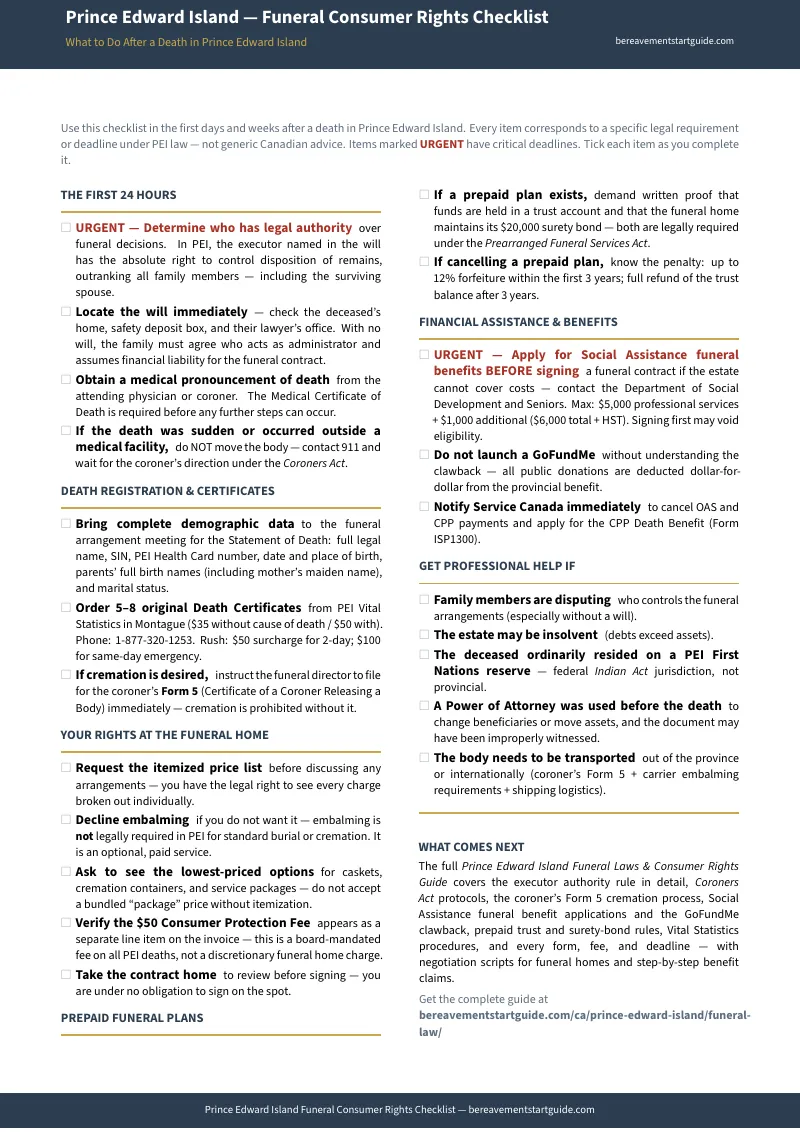
Your download includes the complete 14-chapter guide, the Prince Edward Island Funeral Consumer Rights Checklist (20 items covering the first days after a death), and six standalone printable tools — Consumer Rights Negotiation Scripts, Prepaid Plan Audit Checklist, Social Assistance Benefits Navigator, Death Certificate Document Sequence, Cremation Monopoly Cost Guide, and Authority Hierarchy Reference — plus a money-back guarantee, no time limit. If the guide does not give you clarity on your rights and confidence that you are making informed decisions, email us for a full refund. No questions asked.
Not ready for the full guide? Download the free Prince Edward Island Funeral Consumer Rights Checklist — 20 items covering who has legal authority, what to demand before signing any contract, when embalming can be refused, the $50 Consumer Protection Fee, and the critical difference between mandatory permits and optional services. It is enough to walk into a funeral home tonight knowing your rights.
You should not have to become an expert in the Funeral Services and Professions Act while you are grieving. But you should not have to overpay because nobody told you the law was already on your side.