You Were Named Executor. PEI's Supreme Court Requires Over 30 Forms in the "65 Series" — With No Published Instructions. The Court Automatically Posts a Creditor Notice in the Royal Gazette That You Did Not Know About Until the Invoice Arrived. And There Is No Small Estate Shortcut, So Even a $15,000 Bank Account Goes Through the Full Process.
Someone you loved has died, and now you are staring at PEI's probate forms — Form 65A, 65B, 65C, 65D, 65E, 65F — wondering which ones apply to your situation. The courts website has them all downloadable, but no instructions explaining which forms you need, what order to file them in, or what happens when you get one wrong. Form 65A is for named executors, 65B is for substituted executors, 65C is for intestate estates — but nothing tells you this except the form titles themselves. You need a sworn oath on Form 65D, but it cannot be self-administered. You need a witness to swear Form 65F proving the will is valid, but neither original witness lives on the Island anymore. The Estates Section clerk in Charlottetown cannot give you legal advice. You are on your own with a stack of forms and a frozen bank account.
You searched for help. The PEI Courts website lists the forms but publishes no filing guide. Community Legal Information PEI has a 14-page probate brochure — it covers the basics clearly, but offers no annotated form examples, no fee calculation worksheets, and no templates for bond waivers or beneficiary notices. Law firms in Charlottetown quote $1,500 to $5,000 for straightforward probate — for a process the Supreme Court explicitly designed for self-represented applicants. You checked Reddit. The top-voted answer applied Ontario's estate administration tax and Manitoba's small estate affidavit to your PEI question. PEI has neither.
Here is what nobody connects for you: PEI's probate fees are among the lowest in Canada — $400 plus 0.4% above $100,000 — which changes the cost-benefit calculation entirely. In high-fee provinces, people spend thousands avoiding probate. In PEI, voluntarily going through probate to get the court's protection and the automatic Royal Gazette creditor notice is sometimes the smarter financial decision. But you still need to know about the administration bond requirement for intestate estates and out-of-province executors (Form 65M or 65N), which adds real cost unless every single beneficiary signs a waiver. You need to know that the Royal Gazette notice is automatic — the court registrar submits it — but you will receive an invoice from the King's Printer for $35 to $65 that nobody warned you about. You need to know that the six-month creditor limitation period starts from that publication date, and distributing a single dollar before it expires makes you personally liable for any subsequently discovered debt. And you need to know that the real property transfer tax is 1%, but estate-to-beneficiary transfers are exempt — if you file the right affidavit.
The Prince Edward Island Probate Process Guide is a Court-Ready Filing System for the complete PEI probate process — from the initial question of whether probate is even required through the CRA clearance certificate and final distribution. Not a generic Canadian probate overview that confuses Ontario's percentage-based estate tax with PEI's flat-plus-percentage fee structure. Not a law textbook. A 14-chapter, PEI-specific manual built around the current Form 65 series, the Supreme Court's Estates Section procedures, and the Royal Gazette creditor notice system — so your application passes the court's review the first time.
What's Inside the Court-Ready Filing System
A 14-chapter guide with 3 appendices and a standalone Probate Quick-Start Checklist — covering every stage from the probate decision through final distribution, built specifically for PEI's Supreme Court as the forms and rules exist right now:
Chapter 1: How Probate Works in PEI
What makes PEI different from every other Canadian province: no small estate shortcut (even minor estates go through the full process), automatic Royal Gazette creditor notification (the court does it for you, but you pay the King's Printer), exceptionally low fees compared to the rest of Canada, and the Form 65 series that numbers over 30 forms — from 65A through 65AAA. Where to file (the Estates Section at 42 Water Street, Charlottetown), who has authority (executor vs. administrator vs. former Power of Attorney — which dies with the deceased), and how the PEI system differs from every neighboring Maritime province.
Chapter 2: Do You Need Probate?
The decision tree that saves you weeks of unnecessary work. Real property solely in the deceased's name: probate is mandatory — the PEI Registrar of Deeds will not transfer the title without a court grant. Joint tenancy property: passes automatically with a death certificate. Bank accounts: each institution sets its own internal release threshold — some will release up to $25,000 with an indemnity agreement, others demand a grant for any amount. The chapter walks through every scenario so you know within 15 minutes whether you need to file.
Chapter 3: Assembling Your Estate Inventory
The asset and liability inventory that becomes Form 65E — the document the court uses to calculate your probate fees. Estate assets versus non-estate assets: what bypasses probate entirely (joint accounts, beneficiary-designated RRSPs and TFSAs, life insurance with named beneficiaries) versus what must go through the court. How to contact each financial institution for date-of-death valuations. How to run a title search at the PEI Registry of Deeds — Charlottetown for Queens and Kings County, Summerside for Prince County. The Pecore presumption and why joint accounts with adult children may not be as straightforward as the bank told you.
Chapter 4: Filing for Probate — The Form 65 Series
This is the chapter that does not exist in any free resource. Which petition form applies to your situation: Form 65A if you are the named executor, Form 65B if the named executor cannot serve and you are stepping in, Form 65C if there is no will. Then the supporting forms: Form 65D (Executor's Oath, must be sworn before a commissioner of oaths), Form 65E (Estate Inventory with date-of-death values), Form 65F (Proof of Will requiring an original witness to swear an affidavit). What to do when neither witness is available. How to handle co-executors who decline to serve (Form 65K — Renunciation of Probate). Every form cross-referenced to the specific situation that triggers it.
Chapter 5: Administration Bonds — When Required and How to Avoid Them
The requirement that catches intestate estates and out-of-province executors by surprise. The court may require you to post a bond equal to the value of the estate — an insurance policy guaranteeing you will administer it faithfully. Forms 65M and 65N. The cost of obtaining a surety bond through an insurance company. And the workaround: if every single beneficiary signs a written waiver consenting to dispense with the bond, the court will typically waive it. But if any beneficiary is a minor, the Public Trustee (902-368-6281) must be involved, and bond waiver becomes more complex.
Chapter 6: Filing, Fees, and Court Processing
The exact fee math: $50 for estates up to $10,000, $100 up to $25,000, $200 up to $50,000, $400 up to $100,000, and $400 plus 0.4% on amounts above $100,000. Payment by bank draft or certified cheque payable to the Provincial Treasurer. How to assemble the complete filing package for submission to the Estates Section at 42 Water Street, Charlottetown. What the court clerk reviews. Current processing times: 8 to 16 weeks for a complete, error-free application — longer for deficient or contested applications. The court issues Letters Probate (Form 65U) or Letters of Administration once satisfied.
Chapter 7: After the Grant — The Royal Gazette and Creditor Notice
The automatic system that distinguishes PEI from most Canadian provinces. When your grant is issued, the court registrar submits a notice to the Royal Gazette of PEI — you do not have to arrange this yourself. But you will receive an invoice from the King's Printer for the insertion fee ($35 to $65). The mandatory Form 65X notice to all beneficiaries within 30 days of the grant. The six-month creditor limitation period that starts from the Royal Gazette publication date. Why distributing assets before this period expires makes you personally liable for any subsequently discovered debts — not the estate, you.
Chapter 8: Intestacy — When There Is No Will
PEI's intestacy hierarchy under the Intestate Succession Act. The surviving spouse's preferential share and how it is calculated. Who has priority to apply for a Grant of Administration. The difference between the court appointing an administrator (which requires a bond) versus the executor appointment that comes from a will. How blended families, common-law partners, and children from previous relationships affect the distribution order. When the Public Trustee becomes involved.
Chapter 9: Real Estate Transfers and the Property Transfer Tax
PEI levies a 1% property transfer tax on real estate transactions — but transfers from an estate to a named beneficiary are generally exempt. The catch: you must file an Affidavit of Purchaser with the Registry of Deeds to claim the exemption, and the form and process are not publicized. How to transfer title after receiving the grant. The difference between selling to a third party (transfer tax applies) and distributing to a beneficiary (exempt with the right paperwork). Contact for Taxation and Property Records: 902-368-4070. The registry process for Queens/Kings County (Charlottetown) versus Prince County (Summerside).
Chapter 10: Tax Compliance and CRA Clearance
The terminal T1 return covering January 1 to the date of death. The deemed disposition rule that treats all capital property as sold at fair market value on the date of death — triggering potential capital gains tax. The T3 trust return if the estate earns income during administration. The Form TX19 Clearance Certificate application — allow 120 days for CRA processing. And the personal liability rule that every executor must understand: if you distribute estate assets before receiving the clearance certificate and the CRA later assesses additional tax, you are personally liable for the shortfall.
Chapter 11: Executor Compensation
PEI convention is 2.5% to 5% of the estate value — there is no statutory formula, and the amount is subject to court approval if beneficiaries object. When to discuss compensation with beneficiaries. How to document your time. The difference between taking a predetermined amount under the will's terms versus claiming a court-approved percentage. Tax treatment of executor compensation as income.
Chapter 12: Passing Accounts and Closing the Estate
Form 65WW — the Petition to Pass Accounts — and the judicial approval process for your final accounting. How to prepare a statement of accounts that balances to the penny. What triggers a court review versus what passes on consent. Obtaining signed releases from all beneficiaries before final distribution. The formal closing of the estate file with the court.
Chapter 13: Edge Cases and When to Hire a Solicitor
Not every probate situation belongs in a self-help guide. Contested wills and dependants' relief claims. Estates where the deceased ordinarily resided on a PEI First Nation reserve (federal ISC jurisdiction, not provincial court). Insolvent estates where debts exceed assets. Blended families with competing claims on the preferential share. Out-of-country executors with tax residency complications. This chapter draws the clear line between what you can handle yourself and what genuinely requires professional help — so you are not paying a lawyer for routine filing work, but also not stumbling into a contested matter without representation.
Chapter 14: Probate Avoidance Strategies for Future Planning
For readers who are administering one estate and want to make sure their own estate does not require the same process. Joint tenancy with right of survivorship. Beneficiary designations on registered accounts and insurance. The multiple-will strategy. PEI-specific considerations given the low fee structure — in some cases, probate avoidance costs more than simply going through the process.
Appendices: Form Reference, Key Contacts, and Timeline Summary
Appendix A: the complete Form 65 series reference — every form number, what it does, and when you need it. Appendix B: every government office, court registry, and agency referenced in the guide with current phone numbers and addresses. Appendix C: the consolidated timeline from the date of death through final distribution, with every deadline and waiting period mapped.
Who This Guide Is For
- The overwhelmed grieving spouse whose partner's bank accounts are frozen and who needs to know exactly what steps to take right now — before grief gives way to financial paralysis, before the mortgage payment bounces, and before the credit union starts asking for documents you have never heard of
- The organized adult child executor managing the estate while juggling siblings who want answers about timelines — who needs a step-by-step filing system to follow, a clear timeline to share with family, and authoritative documentation that the 8-to-16-week processing time and 6-month creditor period are legal requirements, not evidence of delay
- The out-of-province executor who lives in Ontario, Alberta, or British Columbia and has been named executor for a parent's PEI estate — who needs to know that non-resident executors face a bonding requirement, which steps can be done remotely, and which require someone on the Island
- The budget-constrained administrator handling an intestate estate — a death without a will — who cannot afford the $1,500 to $5,000 that a Charlottetown law firm quotes for straightforward probate, and who needs to know that the Supreme Court does not require legal representation for uncontested estates
- The forward-planning caregiver who is watching a parent's health decline and wants to understand the process before it begins — so the estate is organized, the right designations are in place, and the executor's job is as simple as the law allows
Why Free Resources Will Not Get You Through This
The information exists. It is scattered across the PEI Courts website, Community Legal Information PEI, the Registry of Deeds, Service Canada, and the CRA. Here is what you encounter when you try to assemble the process from free sources alone:
- The PEI Courts website publishes the forms but not the filing instructions. Every Form 65 variant is available as a downloadable PDF. What is not published: which forms apply to your specific situation (executor vs. substitute executor vs. administrator), the order in which they must be completed, which supporting documents are required with each form, or the common errors — incorrect oath administration, missing witness affidavits, wrong fee calculations — that cause the Estates Section to return your application. The forms are there. The instructions to use them correctly are not.
- Community Legal Information PEI explains the law, not the workflow. CLI PEI's 14-page probate brochure is the strongest free resource on the Island. It covers the basics clearly and accurately. But it does not include annotated form examples, editable worksheets for the estate inventory or fee calculation, templates for bond waiver letters, or operational guidance for the dozens of decisions that arise between "do I need probate?" and "how do I close the estate." It educates. It does not operate.
- Law firm blogs explain the complexity to justify retainer fees. PEI probate lawyers publish articles answering specific questions — fee structures, timeline expectations, executor duties. Each article concludes with a call to book a consultation. For contested estates, that advice is appropriate. For uncontested estates with a clear will and cooperative beneficiaries, the same work costs a fraction of a legal retainer — and the Supreme Court designed the process to be accessible to self-represented applicants.
- Reddit applies the wrong province's rules. The most common error on r/PersonalFinanceCanada and r/legaladvicecanada is answering PEI probate questions with Ontario or British Columbia rules. Ontario has a percentage-based estate administration tax that PEI does not. BC has a mandatory 210-day distribution lock that PEI does not. Manitoba has a small estate affidavit process that PEI does not. PEI has an automatic Royal Gazette creditor notice that no other province has. Wrong-province advice applied to a PEI estate means either overpaying a lawyer for work you could handle yourself, or missing PEI-specific requirements that other provinces do not share.
- Bank and wealth management guides are national, not provincial. Scotiatrust, RBC Wealth Management, and TD Trust all publish executor checklists. They are generic pan-Canadian documents that do not reference PEI's Form 65 series, the low fee structure, the automatic Royal Gazette notice, the bonding requirement for non-resident executors, or the property transfer tax exemption for beneficiary transfers. They are marketing collateral for wealth management services, not PEI-specific filing instructions.
Free resources give you forms without filing instructions, legal education without operational tools, and advice from the wrong province. The Court-Ready Filing System puts every PEI-specific form, fee, deadline, and filing step into one document, in the order the Supreme Court's Estates Section actually requires them.
— Less Than One Hour With a Charlottetown Probate Lawyer
A single consultation with a PEI probate lawyer costs $200 to $350 per hour. Standard probate representation starts at $1,500 for a simple estate and reaches $5,000 for anything that requires additional court appearances or bond arrangements. This guide costs less than one hour of professional legal time and gives you the complete PEI-specific filing system — every Form 65 variant matched to your situation, every fee calculated, every Royal Gazette and creditor deadline mapped, the bond waiver process explained, and the property transfer tax exemption documented.
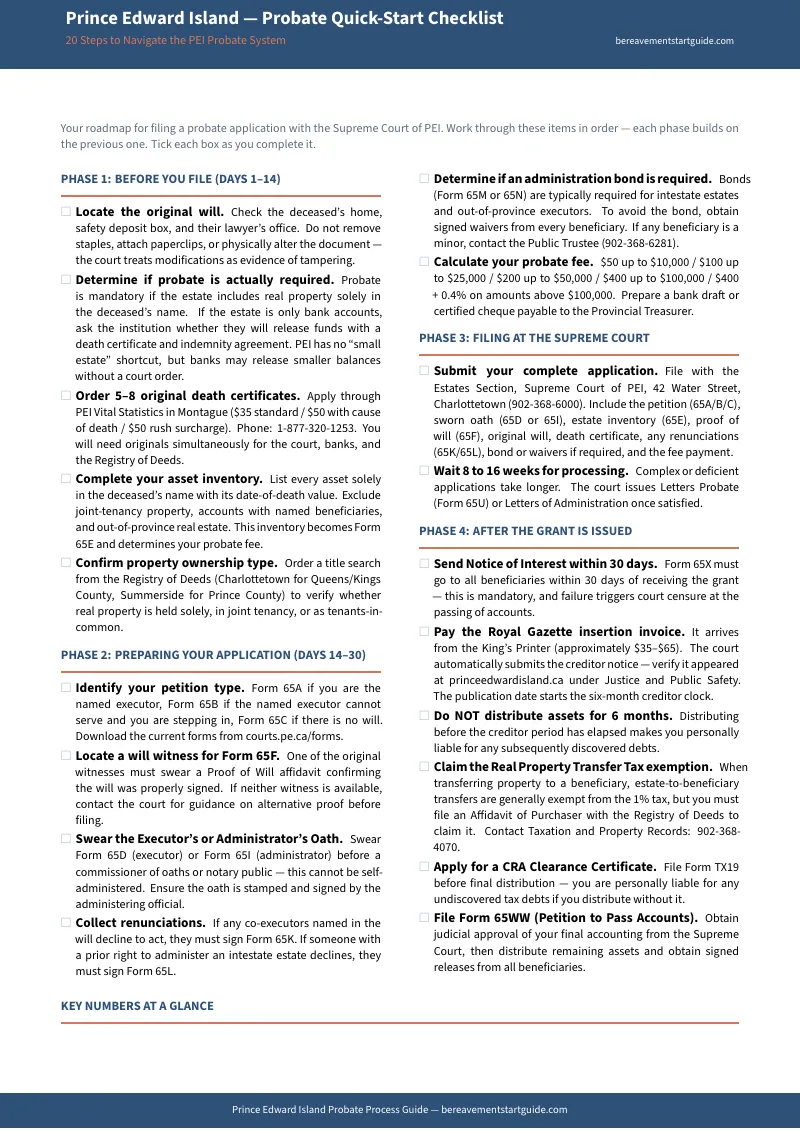
Your download includes 2 PDFs: the complete 14-chapter guide with 3 appendices and the standalone Probate Quick-Start Checklist (20 items across 4 phases). Plus a money-back guarantee, no time limit. If the guide does not give you clarity on what to do next and confidence that your application will pass the Estates Section's review, email us for a full refund.
Not ready for the full guide? Download the free Prince Edward Island — Probate Quick-Start Checklist — 20 items covering the full process from ordering death certificates and assembling your estate inventory through filing your application and closing the estate after the grant is issued. It is enough to see the full picture and start gathering what you need.
You did not choose to be the executor. But the court does not wait, the bank accounts stay frozen, and the carrying costs on a vacant house do not stop. The guide makes sure you do not miss any of it.