Someone You Love Just Died in Quebec. The Bank Froze Every Account Under Bill 103. The Notary Wants $300 an Hour to Explain the RDPRM. And You Just Learned That Distributing a Single Dollar Before Two Separate Clearance Certificates Arrive Makes You Personally Liable for Four Years.
You are standing in a place nobody prepared you for. Maybe you were named liquidator in a notarial will you barely remember signing in front of witnesses, and now the bank is telling you they cannot release a cent — not even from the joint chequing account your spouse used to pay groceries — until you produce a death certificate, a will search receipt, and proof of your authority as liquidateur. Maybe there was no will at all, and because Quebec's Civil Code does not recognize common-law partners as heirs, the person who shared your home for fifteen years has no legal claim to anything. Maybe the funeral director is waiting for a decision on burial or cremation, hydro and heating bills are piling up, and everything you search online leads to pages written in French for a legal system you have never encountered.
You are grieving and exhausted, but Quebec's succession law does not pause for grief. The Directeur de l'état civil needs a death registration. Service Canada needs notification to stop CPP and OAS payments before overpayments are clawed back. You searched for information on settling an estate and discovered that Quebec operates under an entirely different legal system from the rest of Canada — civil law, not common law — with its own terminology, its own registry, its own mandatory steps that do not exist anywhere else. The RDPRM. The mandatory inventory. The Notice of Closure. Tacit acceptance. Terms that mean nothing to you now but could mean personal liability if you get them wrong.
And in the back of your mind, the question that will not stop: if I take possession of property before completing the inventory, use estate funds without proper authority, or distribute assets before both the CRA and Revenu Québec issue their clearance certificates — am I personally on the hook for debts I did not create?
The short answer: the succession pays its own debts, not you. But the long answer — the one that involves a mandatory succession inventory you must publish to the RDPRM for $59 before a 60-day creditor period even begins, a single-portal will search costing $17.25 that queries both the Chambre des notaires and the Barreau du Québec, a Bill 103 banking rule that freezes joint accounts until the surviving co-holder files a statutory declaration, dual clearance certificates from both the CRA (Form TX19) and Revenu Québec (Form MR-14.A-V), and a tacit acceptance doctrine that can saddle you with all of the deceased's debts simply because you used their car — that answer is what separates families who settle a succession in months from families who spend years trapped in a system they never understood.
The When Someone Dies in Quebec — Estate Settlement Guide is a Civil Code Settlement System for every legal, financial, and administrative step between the funeral home and final distribution. Not a law textbook. Not a generic Canadian checklist that does not know Quebec from Ontario. A structured, Quebec-specific manual built for the Civil Code of Québec, the RDPRM, and the province's unique succession rules — separating what must be done in the first 48 hours from what legally cannot happen until both governments issue clearance — so you stop guessing, stop panicking, and start working through this in the right order.
What's Inside the Civil Code Settlement System
A 12-chapter guide and the First 48 Hours Checklist — covering every stage from the moment of death through final distribution, built specifically for Quebec's Civil Code, the RDPRM, and the province-specific rules that make settling a succession here fundamentally different from anywhere else in Canada:
Understanding Your Role and the Legal Landscape
Quebec is the only province in Canada that operates under civil law, not common law. Everything is different — starting with the words. An estate is a succession. An executor is a liquidator. Property is patrimony. An heir who accepts the succession without completing the mandatory inventory does not merely face a risk of liability — they face a legal certainty of it through tacit acceptance. This chapter maps the entire Civil Code framework onto plain English, including a terminology table translating every Quebec legal term you will encounter into its common-law equivalent, so you stop feeling lost every time a notary, bank officer, or government form uses a word you have never seen before.
The First 48 Hours: Advance Directives, the Attestation, and Securing Property
The moment someone dies in Quebec, you need to verify whether advance medical directives exist, obtain the attestation of death from the attending physician, and secure the deceased's property — home, vehicles, valuables — before anyone else accesses it. This chapter covers the critical first actions, why securing property is essential but must not cross the line into "taking possession" that triggers tacit acceptance of the succession's debts, and the exact sequence for the first two days.
Week One: DEC Registration, Funeral Contracts, and the QPP Death Benefit
The Directeur de l'état civil needs the death registered. Quebec's Office de la protection du consommateur regulates funeral contracts and gives you specific consumer protections that funeral homes are not required to volunteer. The QPP death benefit — a lump sum of $2,500 with a 60-day priority window for the person who paid funeral expenses — must be applied for through Retraite Québec, not Service Canada. This chapter walks through each notification, each form, and the OPC protections that can save you thousands on funeral costs if you know to invoke them.
The Mandatory Will Search and Copies of the Act of Death
Before you can establish your legal authority as liquidator, you need two things: Copies of the Act of Death from the Directeur de l'état civil via the DEClic online portal (approximately $38.25 each), and a mandatory will search through Quebec's single-portal system ($17.25) that simultaneously queries both the Chambre des notaires and the Barreau du Québec. This search is not optional — it is a legal requirement before you can act. The guide covers how many Copies of the Act of Death to order based on the assets in the succession, the DEClic portal process, and the will search procedure.
Establishing Legal Authority: Probate and the Liquidator's Mandate
Quebec has three types of wills, and each one follows a different path to legal authority. Notarial wills — the most common in Quebec — are authentic acts that need no probate at all. Holograph wills (handwritten) and wills made in the presence of witnesses must be verified through homologation, which can be done either by the court or by a notary. The guide explains which path applies to your situation, the cost difference between court and notary homologation, what happens when there is no will at all, and how the liquidator's mandate works under the Civil Code.
The Succession Inventory: Your Shield Against Personal Liability
This is the chapter that does not exist in any free resource in plain language. Quebec law requires a mandatory succession inventory — and the consequences of skipping it are devastating. If you fail to complete the inventory, or if you take possession of property in a way that constitutes tacit acceptance, you become personally liable for all of the deceased's debts, even if those debts exceed the value of the succession. The inventory must be published to the RDPRM (Register of Personal and Movable Real Rights) using Form RG at a cost of $59, followed by a 60-day creditor notice period. The guide walks through building the inventory, the RDPRM publication process, the creditor period, and the specific actions that trigger tacit acceptance — so you protect yourself before it is too late.
Real Estate, Vehicles, and Asset Transfers
Real property transfers in Quebec require a Declaration of Transmission prepared by a notary and published to the Land Register — there is no DIY path. Vehicle transfers go through the SAAQ using Form 5992A. This chapter covers both processes, the fees involved, the documentation requirements, and the timeline for each transfer type.
The $12,000 Urgent Expense Safe Harbor
Quebec law allows you to pay up to $12,000 in urgent expenses — funeral costs, utilities, maintenance — from the succession without triggering personal liability or constituting tacit acceptance. But this safe harbor has strict boundaries. This chapter explains what qualifies, what does not, why you must track every receipt, and how to stay within the limit while keeping the lights on and the funeral paid for.
Final Tax Returns and Dual Clearance Certificates
Quebec is the only province where you must obtain clearance certificates from two separate governments before distributing assets. The CRA requires a terminal T1 return and issues clearance via Form TX19. Revenu Québec requires a terminal TP-1 return and issues clearance via Form MR-14.A-V. You may also need to file a Rights or Things return. Distributing assets before both certificates arrive makes you personally liable for any outstanding taxes for up to four years. The guide covers both filing processes, the Rights or Things election, and the timeline for each certificate.
Closing the Succession and Final Distribution
Closing the succession requires a Final Account rendered to all heirs, a Notice of Closure of the Liquidator's Account published to the RDPRM, and formal acceptance by the heirs. Only after these steps — and only after both clearance certificates are in hand — can you distribute assets. The guide covers the Final Account preparation, the RDPRM closure notice, heir acceptance procedures, and the liquidator's discharge.
Edge Cases, Professional Help, Compensation, and Deadlines
The final chapters cover when you need a notary or lawyer (contested successions, complex real estate, interprovincial assets), liquidator compensation under the Civil Code, and the complete timeline with every statutory deadline from Day 1 through final distribution.
Who This Guide Is For
- The surviving spouse whose partner just died and whose joint bank account was frozen this morning under Bill 103 — who needs to know how to file the statutory declaration to release their share, how to apply for the QPP Surviving Spouse Pension through Retraite Québec, and why two separate clearance certificates are required before any distribution can happen
- The adult child named as liquidator who has never navigated Quebec's civil law system and is terrified of personal liability — who needs the complete succession inventory process, the RDPRM publication requirements, and a clear explanation of tacit acceptance so they do not accidentally assume the deceased's debts
- The common-law partner who just learned that Quebec does not recognize de facto spouses in intestacy — who gets nothing from the succession itself but may qualify for the QPP Surviving Spouse Pension, and needs to understand exactly where they stand
- The Anglophone family in Quebec navigating a system built in French — who needs every Civil Code term, RDPRM form, and government portal explained in plain English so they can actually use them
- The family with no will who just learned that the Civil Code dictates everything — who needs to understand intestacy rules, who has priority as liquidator, and how the mandatory inventory works when nobody was formally appointed
- The executor living outside Quebec who cannot walk into a notary's office — who needs to know which tasks can be handled remotely, how the DEClic portal works, and the exact documentation requirements for dealing with financial institutions from another province
Why Free Resources Will Not Get You Through This
The information exists. It is scattered across Québec.ca, Revenu Québec, the Directeur de l'état civil, the RDPRM, Retraite Québec, Service Canada, the CRA, and a dozen portals that do not reference each other. Here is what you actually encounter when you try to settle a succession using free sources alone:
- Government portals are fragmented across agencies with no synthesis. Québec.ca covers the death registration. The RDPRM handles the inventory publication. Revenu Québec handles provincial taxes. Retraite Québec handles the QPP death benefit. The Directeur de l'état civil handles Copies of the Act of Death. Each agency covers its own piece. None of them sequence the pieces together or explain the dependencies between them — like the fact that you cannot file the Final Account until both clearance certificates arrive, or that the RDPRM inventory publication must happen before the 60-day creditor period can begin.
- Éducaloi explains the law clearly but provides no templates and explicitly disclaims legal advice. Their articles on succession law are accurate and well-written. They cover the concepts. They do not provide checklists, timelines, or step-by-step instructions for actually doing the work. Their pages end with "consult a professional" — which is where the process begins, not where guidance should stop.
- ClearEstate starts at $4,448 — built for families who want to outsource everything. Their managed settlement service is excellent for families who can afford it. For the majority of straightforward successions where a qualified liquidator can handle the process with the right guidance, $4,448 is not a reasonable starting point.
- Bank pages protect the bank, not the liquidator. Every major bank has a succession landing page. Every one of them explains why accounts are frozen. None of them explain how Bill 103 works from the surviving co-holder's perspective, what statutory declaration to file to release your share of a joint account, or what documentation actually satisfies the bank's requirements to begin releasing funds.
- Law firm and notary blogs are designed to sell $300-per-hour consultations. Quebec notaries and estate lawyers publish accurate summaries of succession law. Their content is calibrated to make the process feel dangerous enough to require professional representation. For contested successions, that is true. For the majority of straightforward successions, the answer costs a fraction of a professional retainer.
- Funeral home content stops after the ceremony. Bereavement packages cover the first 48 hours — the attestation of death, funeral arrangements, and what to bring to the funeral home. Their guidance ends with "consult a notary regarding the succession." That is where the hardest twelve months of settlement begin.
Free resources give you fragments from a dozen sources that do not reference each other. The Civil Code Settlement System puts every Quebec-specific statute, form, deadline, and procedure into one document, in the order you actually need them.
— Less Than One Hour With a Quebec Notary
A single consultation with a Quebec notary costs $300 to $500 per hour. Managed estate settlement through ClearEstate starts at $4,448. This guide costs less than one hour of professional time and gives you the complete Quebec-specific roadmap — every Civil Code rule, every RDPRM form, every deadline, and the succession settlement sequence that nobody explains in plain English.
Your download includes 5 files: the complete 12-chapter guide, the First 48 Hours Checklist, the Civil Code Terminology Reference Card, the Succession Inventory Worksheet, and the Key Deadlines Reference. Plus a money-back guarantee, no time limit. If the guide does not give you clarity on what to do next and confidence that you are doing it in the right order, email us for a full refund. No questions asked.
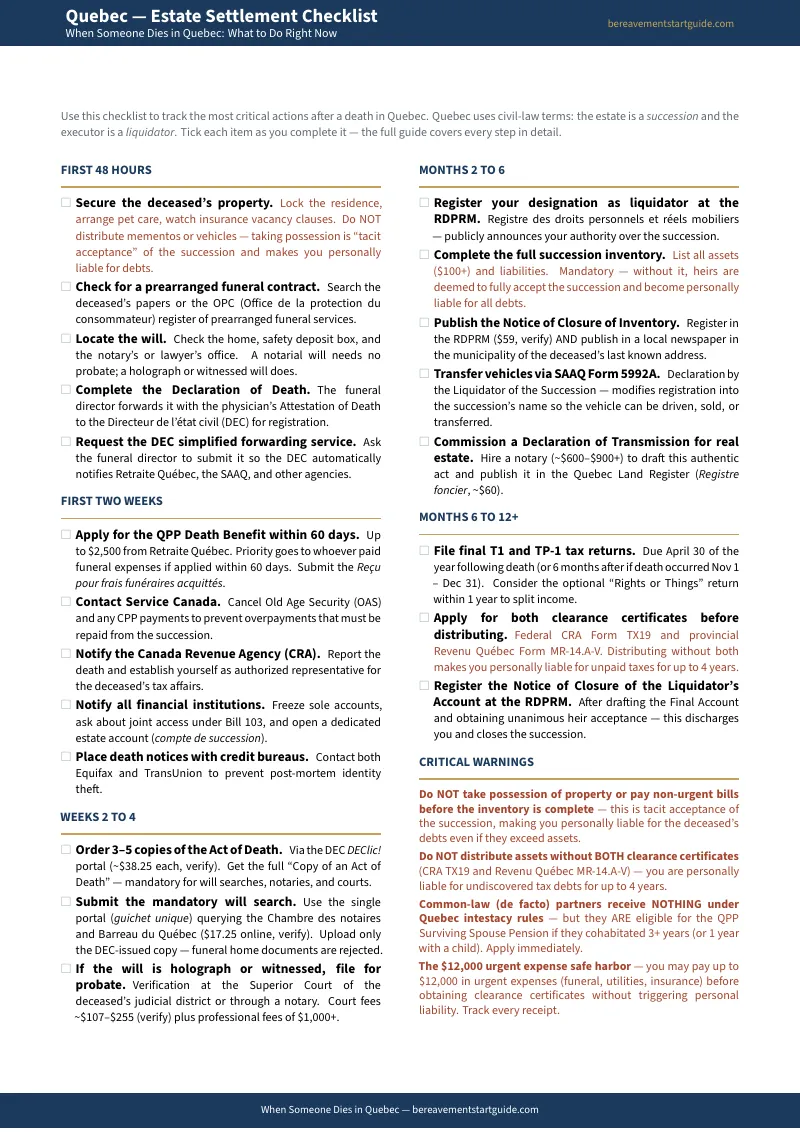
Not ready for the full guide? Download the free Quebec — First 48 Hours Checklist — 21 items covering everything that must happen in the first two days after a death in Quebec: the attestation of death, securing property without triggering tacit acceptance, the DEC simplified forwarding service, Service Canada notification, and the QPP death benefit application. It is enough to get through tonight and tomorrow.
You did not ask for this job. But you can do it. The guide shows you how, one step at a time.