You Were Named "Liquidator," Not Executor. Quebec Runs on Civil Law, Not Common Law. And If You Distribute the Estate Before You Register the Notice of Closure with the RDPRM and Publish It in a Newspaper, You Become Personally Liable for Every Debt the Deceased Ever Owed.
Someone you loved has died in Quebec, and within days you discover that almost nothing you assumed about settling an estate applies here. You are not the "executor" — you are the liquidator of the succession. There is no "probate fee" calculated on the value of the estate. There is no small-estate shortcut, so a $5,000 bank account requires the same legal process as a $5 million one. And the single most dangerous trap is one no other province has: under the Civil Code of Québec, if you pay out the heirs before you publish a Notice of Closure of the inventory in the RDPRM and in a local newspaper, an unpaid creditor can come after you personally for the money — even years later.
You searched for help. Québec.ca has the death-declaration steps, but the rules for the will search live with the Chambre des notaires, the court verification rules live with the Ministère de la Justice, the death benefit lives with Retraite Québec, the tax clearance lives with Revenu Québec and the CRA, and the liquidator's publication duties live in the Civil Code itself. Five ministries, none of which references the others. Éducaloi explains the law beautifully — but gives you no checklist, no timeline, no tracking tool, and no template for the publications you are legally required to make. The notary you called quoted $1,000 to $3,000 to handle the file. And every forum thread you opened was someone applying Ontario probate rules — estate administration tax, 1.5 percent of the estate — to a Quebec question where none of that exists.
Here is what nobody connects for you: most Quebec wills are notarial wills, and a notarial will does not need to be probated at all — it is already an authentic act, so you may have searched "Quebec probate" and not actually need court. But you cannot know that until you complete the mandatory dual will search — Quebec is the only province that requires you to search both the Chambre des notaires des notaires and the Barreau du Québec registers (about $17.25 combined online) to confirm which will is the last one. Only a holograph will (handwritten) or a will made before witnesses requires court verification — the vérification de testament. Get the will type wrong, and you either waste weeks filing a court application you never needed, or you distribute on a will that was later revoked.
The Quebec Probate Process Guide is a Civil Law Translation System for settling a succession in Quebec — the only guide built natively on the Civil Code of Québec rather than common-law executor advice with the names swapped out. It carries a common-law-to-civil-law bridge through all 18 chapters: every time Quebec does something the rest of Canada does not — the liquidator role, the RDPRM publications, the dual will search, the lack of a small-estate bypass, the personal-liability sequence — the guide flags it, explains why, and tells you exactly what to do and in what order, so you protect yourself and the heirs at the same time.
What's Inside the Civil Law Translation System
An 18-chapter guide, a standalone Probate Quick-Start Checklist, and 4 printable worksheets — covering every stage from the first death declaration through final distribution and tax clearance, built specifically for Quebec's civil law system as it exists right now, including the Bill 56 succession changes in force since June 30, 2025:
Chapter 1: How Quebec Succession Actually Works
The foundation everything else rests on. Why Quebec is a civil law jurisdiction governed by the Civil Code of Québec while every other province uses common law — and why that single fact invalidates almost every "Canadian probate" article you will read online. The liquidator role and how it differs from a common-law executor. What a "succession" is, who the heirs are, and the family-patrimony and matrimonial-regime rules that determine what is even in the estate before you distribute a dollar. The translation layer that makes the rest of the guide make sense.
Chapter 2: Death Certificates, Notifications, and the 30-Day Blackout
The death declaration to the Directeur de l'état civil, and why you will wait roughly 30 days for the certified copies and the copy of the act of death that every institution demands — a blackout period no one warns you about, during which accounts freeze and bills keep arriving. Which document each institution actually requires (the certificate, the copy of the act, or the attestation — they are not interchangeable), how many certified copies to order up front, and the first wave of notifications that stop pensions, benefits, and auto-payments before they cause overpayment clawbacks.
Chapter 3: Do You Need Probate?
The chapter that may save you weeks and a notary's retainer. In Quebec, notarial wills bypass court entirely — they are authentic acts and need no verification. Only holograph wills and wills made before witnesses require the vérification de testament. This chapter gives you the decision tree: identify your will type, determine whether verification is required, and recognize the intestate path if there is no valid will — so you do not file a court application you never needed, and do not skip one you did.
Chapter 4: The Mandatory Will Search
The step out-of-province liquidators never see coming. Quebec law requires you to search both the will register of the Chambre des notaires and the register of the Barreau du Québec — because a later will held by a different professional overrides the one in your hand. Roughly $17.25 combined for the online searches. How to request them, how to read the certificates, and why distributing before you have both in hand is one of the fastest ways to become personally liable to an heir who was cut out of the version you relied on.
Chapter 5: The Probate Process (Vérification de testament)
If your will type requires it: how to file for verification with the Superior Court, what the application contains, the supporting documents, and current court costs. Written for the liquidator handling it without a notary where the estate allows — and clear about the point where a contested or complex verification genuinely needs professional help.
Chapter 6: Fees, Costs, and Budgeting the Succession
There is no percentage-based probate tax in Quebec — but there is a stack of real, smaller costs nobody lists in one place. The dual will search. The RDPRM registration and publication fees (roughly $33 to $59). Newspaper publication for the Notice of Closure. Court verification costs if your will requires it. Notary fees if you choose to delegate. This chapter budgets the whole succession so you are not ambushed, and shows where you can legitimately do the work yourself instead of paying a $1,000-to-$3,000 retainer.
Chapter 7: Unlocking Frozen Accounts and Accessing Estate Funds
The liquidity crisis that hits grieving spouses first. Accounts freeze on death, but the funeral home wants payment and the mortgage is still due. Form MR-14 lets you obtain an emergency release of up to $12,000 from frozen accounts to cover urgent costs — this chapter walks through it line by line, plus how to open the dedicated estate bank account, what the bank requires before it will deal with you, and how to document every withdrawal so the inventory and final account reconcile cleanly.
Chapter 8: The Liquidator's Duties and Liability Protection
The heart of the guide — the sequence that keeps you personally safe. Your designation as liquidator must be published in the RDPRM. The inventory must be drawn up and its closure published in the RDPRM and in a newspaper. Only after the Notice of Closure is published and the legal waiting period passes can you safely distribute — because distributing early makes you personally liable for all the deceased's debts, even ones you never knew about. This chapter lays out the publication-and-distribution order step by step, with the exact registrations and notices in the sequence the Civil Code requires.
Chapter 9: Government Benefits After Death
The money the family is owed, with the deadlines that forfeit it. The Retraite Québec death benefit — up to $2,500 — must be claimed, and there is a 60-day priority window for the person who paid the funeral expenses before the right passes to the heirs. Plus the QPP survivor's and orphan's pensions, the federal CPP interaction for those with mixed work history, and how to claim each without triggering an overpayment clawback on benefits that should have stopped at death.
Chapter 10: Intestate Succession — When There Is No Will
How the Civil Code distributes an estate with no valid will — the spouse-and-children shares, the parentelic order when there are no descendants, and the rules that surprise families who assumed "everything goes to the spouse." Critically, this chapter covers Bill 56: since June 30, 2025, a de facto (common-law) spouse who has a child born or adopted with the deceased after that date now has succession rights — a change that rewrites the intestate math for a large group of Quebec families and that almost no online resource has caught up to.
Chapter 11: Taxation and Clearance Certificates
The double-government tax layer unique to Quebec. You must file final returns and obtain clearance from both Revenu Québec and the CRA before distributing — and distributing before clearance makes the liquidator personally liable for the tax debt. The terminal return, the deemed disposition of capital property at death, the estate return if the succession earns income, and the two separate clearance certificates you need in hand before the final payout.
Chapter 12: Real Estate Transfers
For most families the home is the largest asset and the main reason the file takes months. How title passes to heirs or to a buyer, the declaration of transmission, the role of the notary that Quebec law requires for the actual property transfer, and the timing rule that catches everyone: you can prepare and even list the property, but you cannot complete the transfer until the inventory, publications, and clearances are in place.
Chapter 13: Protection Mandates and Incapacity
The adjacent situation many liquidators are also handling: a parent who became incapable before death. The protection mandate (formerly "mandate in case of incapacity"), how it is homologated, and how an incapacity file transitions into a succession file when the person dies — so you are not running two processes blind.
Chapter 14: Insolvent Successions and Renunciation
What to do when the debts may exceed the assets. The liability shield that the inventory and publications provide, the right of heirs to renounce the succession before a notary, the deadline to do so, and how renunciation protects family members from inheriting debt. The single most important chapter for anyone who suspects the estate is underwater.
Chapter 15: Minor Heirs and the Curateur Public
When a beneficiary is a minor or a protected adult, the Curateur public and the tutorship council have a role you cannot skip. How sums owed to a minor must be handled and reported, the thresholds that trigger oversight, and the reporting duties that keep you compliant while the child's share is protected.
Chapter 16: Edge Cases and Escalation Triggers
The honest map of where a self-managed succession stops being safe. Contested wills and capacity challenges, foreign assets and heirs living abroad, business interests, blended families, and disputes between heirs. Clear escalation triggers so you know the exact moment to bring in a notary or litigation lawyer — and the much larger set of situations where you do not need one.
Chapter 17: The Complete Timeline
Every deadline and waiting period on one consolidated timeline keyed to the date of death: the 30-day certificate blackout, the 60-day death-benefit window, the will-search turnaround, the RDPRM publications, the newspaper notice, the clearance-certificate processing, and the safe-distribution point. The single reference you hand to impatient heirs to show that the wait is the law, not your delay.
Chapter 18: Frequently Made Mistakes
The costly errors this guide exists to prevent, collected in one place: distributing before the Notice of Closure (personal liability), skipping one of the two will registers, assuming a notarial will needs court, applying Ontario's probate tax, missing the 60-day death-benefit window, and forgetting that both Revenu Québec and the CRA must clear the file. Read it first as a warning, and again at the end as a final check.
Who This Guide Is For
- The out-of-province adult child suddenly named liquidator of a Quebec parent's estate, whose every common-law assumption — "executor," "probate fee," "small estate" — is wrong here, and who needs the civil-law translation in plain English before making a mistake that costs months or creates personal liability
- The grieving anglophone spouse staring at frozen accounts with the funeral bill due, who needs the Form MR-14 emergency release, the estate account, and the Retraite Québec death benefit explained in a language and a system that suddenly feels foreign
- The cost-conscious intestate heir with no will to work from, who wants to understand the Civil Code distribution and Bill 56 changes and handle as much as legally possible without a $1,000-to-$3,000 notary retainer
- The liability-averse liquidator who has heard the horror story about distributing too early and needs the exact RDPRM-and-newspaper publication sequence that shields them personally before a single dollar moves
- The low-income family that cannot cover funeral costs up front and needs the death-benefit claim, the 60-day priority window, and the emergency account release laid out clearly and fast
Why Free Resources Will Not Get You Through This
The information exists. It is scattered across Québec.ca, the Directeur de l'état civil, the Chambre des notaires, the Barreau du Québec, the RDPRM, Retraite Québec, Revenu Québec, the CRA, and the Civil Code itself. Here is what you actually find when you try to assemble a Quebec succession from free sources:
- Government sites are siloed across five ministries and never reference each other. The death declaration, the will search, the court verification, the death benefit, and the tax clearance each live on a different portal, in dense bureaucratic French-and-English, with fee schedules that contradict each other. Nothing tells you the order, and nothing warns you that the order is what protects you from personal liability.
- Éducaloi explains the law but hands you no tools. It is the best plain-language legal explainer in Quebec — and it stops exactly where you need to start. No checklist, no timeline you can work from, no template for the RDPRM publications or the newspaper notice, no tracking sheet for the inventory and final account. It educates. It does not operate.
- Law firms use fear to funnel you into a retainer. Notary and estate-lawyer pages describe the liability traps in vivid detail, then quote $1,000 to $3,000 to "take it off your hands." For a contested or insolvent estate that may be the right call. For a clean notarial will with cooperative heirs, you are paying retainer rates for a process you can run yourself with the right sequence in front of you.
- The SaaS tools are common-law products with a Quebec label. National estate-settlement platforms add a thin "Quebec" mode that is genuinely a common-law workflow with the terminology changed — they miss the RDPRM publications, the dual will search, and the no-small-estate-bypass reality, then funnel you into a paid subscription on top.
- Bank checklists are generic and national. Trust-company executor checklists are pan-Canadian marketing collateral that never mention the liquidator's publication duties, Form MR-14, the Retraite Québec window, or the dual-clearance requirement — and they steer you toward wealth-management services, not toward finishing the file.
- Forums apply the wrong province's rules. The single most common error online is answering a Quebec question with Ontario's estate administration tax, or with common-law "probate" advice that does not exist under the Civil Code. Following it means either overpaying for nothing or skipping a step — like the Notice of Closure — that leaves you personally on the hook.
Free resources give you law without tools, tools built for the wrong legal system, and advice from the wrong province. The Civil Law Translation System puts every Quebec-specific step, publication, deadline, and protection into one document, in the order the Civil Code actually requires — so you settle the succession without becoming personally liable for it.
— Less Than One Page of a Notary's Retainer
Settling a Quebec succession through a notary typically runs $1,000 to $3,000, and that is before any court costs. This guide costs a fraction of a single hour of that time and gives you the complete civil-law filing system — the liquidator's publication sequence, the dual will search, the Form MR-14 emergency release, the Retraite Québec death benefit with its 60-day window, the dual tax clearance, and the personal-liability protections — translated out of the Civil Code and into plain, ordered, do-this-next steps.
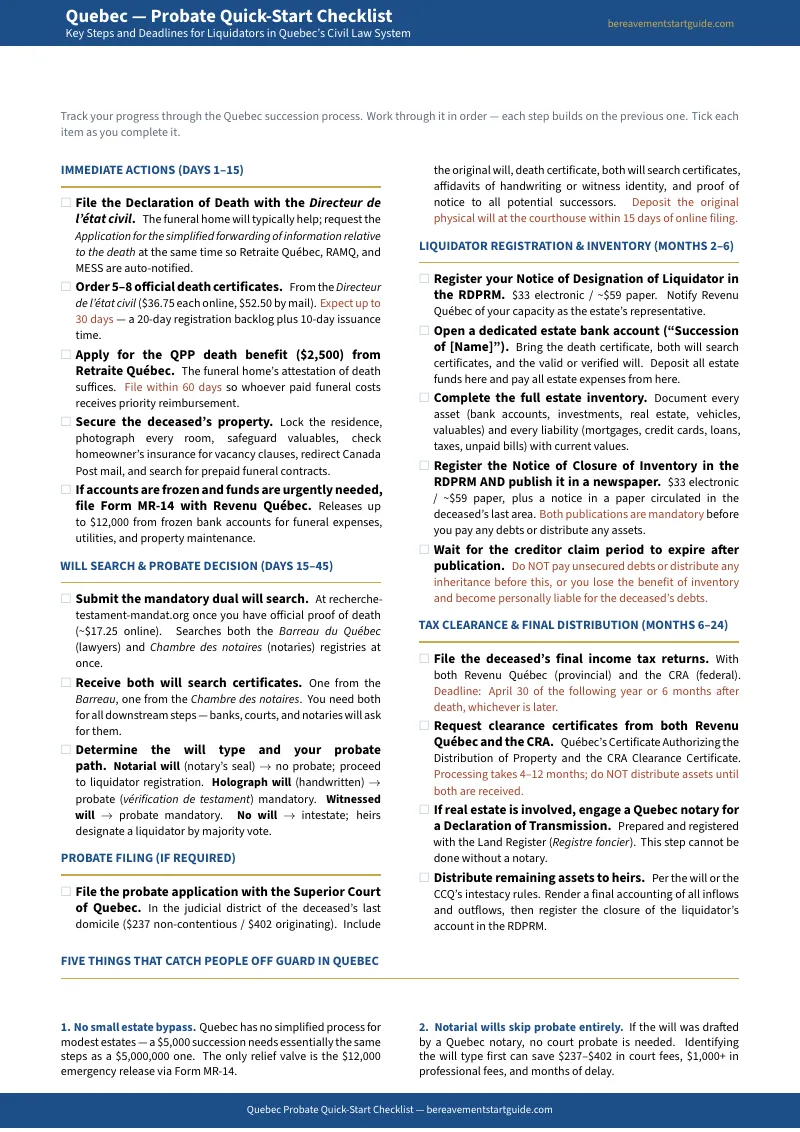
Your download includes the complete 18-chapter guide, the standalone Quebec — Probate Quick-Start Checklist (18 items across 5 phases, from the first death declaration through final distribution and clearance), and 4 printable worksheets — the Estate Inventory Worksheet, the Succession Fee Worksheet, the Liability Protection Sequence card, and the Succession Timeline — plus a money-back guarantee, no time limit. If the guide does not give you clarity on what to do next and confidence that you are protected from personal liability, email us for a full refund.
Not ready for the full guide? Download the free Quebec — Probate Quick-Start Checklist — the 18 critical actions across the five phases of a succession, from declaring the death and ordering certificates through the dual will search, the RDPRM registrations, and the final tax clearance. It is enough to see the whole shape of the process and start gathering what you need.
You did not choose to be the liquidator, and you did not choose to learn a different legal system in the worst week of your life. But the accounts are frozen, the death benefit has a 60-day clock, and the liability is real. The guide makes sure you handle every piece of it — in the right order, in the system Quebec actually uses.