Someone You Love Died in Quebec. The Bank Froze the Joint Account, the Government Keeps Paying a Dead Person, and You Just Learned That Distributing a Single Dollar Before Two Clearance Certificates Arrive Makes You Personally Liable for Every Tax Debt They Left Behind.
The QPP Death Benefit is $2,500 — but only if the person who paid the funeral costs applies within 60 days. The surviving spouse's pension pays up to $1,173.58 per month — but the combined cap with your own retirement pension may reduce it to almost nothing. The joint account froze the day you reported the death, and the bank has no idea that Bill 2 gives you the legal right to claim your share. And the clearance certificate from the CRA takes 14 months — during which the heirs pressure you daily to hand over their inheritance while you absorb personal liability for every dollar you release.
Retraite Québec covers pensions. Revenu Québec covers tax clearances. The Directeur de l'état civil covers death certificates. The RAMQ covers health insurance. The CNESST covers workplace deaths. The SAAQ covers motor vehicle deaths. The RDPRM covers legal publications. The Curateur public covers minor beneficiaries. None of these agencies tell you how they depend on each other. None of them sequence the steps. None of them warn you that moving the deceased's furniture to avoid storage fees permanently binds you to all their debts.
And none of this works like the rest of Canada. In Quebec, there is no executor — there is a liquidator. There is no estate — there is a succession. There is no probate — there is verification or homologation. Every guide written for Ontario or Alberta uses the wrong terminology, the wrong institutions, and the wrong procedures.
The Quebec Survivor Benefits Navigator is a Civil Code Succession System — every federal, provincial, and municipal benefit, liability, and administrative requirement that follows a death in Quebec, organized into a single chronological timeline built exclusively for the Civil Code of Québec, with exact form numbers, dollar amounts, agency contacts, deadlines, and the sequencing traps that cost families thousands of dollars when they act out of order.
What's Inside the Civil Code Succession System
A 7-chapter guide with 3 appendices, a printable quick-start checklist, and dedicated coverage of every benefit route, liability trap, and administrative bottleneck specific to Quebec in 2026:
The First 15 Days — Emergency Triage Before Overpayments Accumulate
The most expensive mistake happens in the first 48 hours. QPP retirement pension payments, RAMQ coverage, the solidarity tax credit — all of these continue depositing after the date of death unless you file the simplified forwarding of information through the funeral director immediately. Every dollar that lands becomes an overpayment the liquidator must track down and repay. This chapter covers the forwarding form, the RAMQ card cancellation (3-month deadline), and — most critically — the benefit routing decision that determines whether your case belongs with Retraite Québec, CNESST, SAAQ, or IVAC. Get this decision right, and you may access $100,000 or more in indemnities. Get it wrong, and you spend months at the wrong agency.
The Joint Account Freeze and Bill 2 — Unlocking Your Own Money
In the rest of Canada, joint accounts pass to the surviving co-holder automatically. In Quebec, the bank freezes the entire balance the moment a co-holder dies. Groceries, mortgage, utilities — all of it locked until the succession is settled. But Bill 2 compels the bank to release the surviving spouse's proportional share upon written request. Most bank tellers do not know this law exists. This chapter gives you the exact legislative reference, the written request procedure, and the escalation path when the branch manager says no.
QPP Benefits — Death Benefit, Surviving Spouse's Pension, and Orphan's Pension
The QPP death benefit is a $2,500 lump sum with a 60-day priority window for the person who paid the funeral costs. The surviving spouse's pension scales from $573.70 to $1,173.58 per month based on age and dependants — but the combined cap with your own retirement pension may reduce the actual increase to a fraction of that. De facto (common-law) spouses qualify if they cohabited at least three years, or one year with a child. If the deceased had insufficient QPP contributions, the family must pivot to the $2,500 special funeral expense benefit through the Ministère de l'Emploi et de la Solidarité sociale. This chapter maps every calculation, every form, and the difference between the two $2,500 benefits.
CNESST, SAAQ, and IVAC — the High-Value Benefit Routes Most Families Miss
If the death was work-related, CNESST pays a funeral indemnity of up to $6,612 and a spousal lump sum starting at $136,021 — scaling to $309,000 based on the deceased's income. If the death involved a motor vehicle accident, SAAQ pays up to $8,727 for funeral costs and a spousal lump sum starting at $172,914 — scaling to $512,500. If the death resulted from a criminal act, IVAC provides lump-sum compensation, funeral cost reimbursement, and income replacement. Each agency has different deadlines (CNESST: 6 months; SAAQ: 3 years) and different eligibility rules. This chapter includes the diagnostic decision tree that routes you to the correct agency on the first attempt.
The Liquidator's Liability Shield — Clearance Certificates, the $12,000 Exception, and the Inventory
Here is the trap that catches nearly every liquidator: you cannot distribute a single dollar of the succession until you receive clearance certificates from both Revenu Québec (MR-14.A, approximately 90 days) and the CRA (TX19, approximately 14 months). Distribute early, and you become personally liable for the deceased's undiscovered tax debts — out of your own pocket. But the succession still has bills — hydro, insurance premiums, urgent property repairs. The $12,000 urgent expense exception lets you pay these costs without triggering liability. This chapter walks through the inventory requirement, the RDPRM publication sequence, the two clearance certificate timelines, and the exact boundaries of safe distribution.
The Insolvency Trap — Renunciation, Tacit Acceptance, and the Six-Month Clock
If the deceased's debts exceed their assets, every heir must formally renounce the succession within six months — or within 60 days of the inventory closure. Renunciation requires a notarial act published in the RDPRM. But the real danger is tacit acceptance: using the deceased's vehicle, distributing family photographs, moving furniture from the residence to avoid storage fees — any of these acts can be interpreted as acceptance of the succession, permanently binding the heir to all debts. This chapter catalogues the specific acts that trigger tacit acceptance and provides the exact timeline and procedure for renunciation.
De Facto Partners, Minor Beneficiaries, Will Verification, and Property Tax Relief
De facto (common-law) spouses in Quebec have no automatic inheritance rights, no spousal support protections, and no protection of the family residence. This chapter maps every benefit a de facto partner can still access — QPP survivor's pension, CNESST, SAAQ, life insurance — and the evidentiary requirements for each. It also covers the Curateur public's mandatory oversight when a minor inherits over $40,000, the homologation process for holograph and witnessed wills ($3,000–$7,000 and months of delay), notarial will advantages, and the Grant for Seniors to Offset a Municipal Tax Increase.
Who This Guide Is For
- The newly designated liquidator — who just inherited severe personal liability under Quebec civil law and needs to know the RDPRM publication sequence, the inventory requirements, the $12,000 urgent expense exception, and the clearance certificate timelines before distributing a single dollar
- The surviving spouse whose bank account is frozen — who needs to invoke Bill 2 at the branch level, apply for the QPP surviving spouse's pension before the retroactivity window narrows, and stop overpayments from creating repayment obligations against the succession
- The de facto partner who just discovered they inherit nothing — who needs to identify every benefit they can still access under Quebec civil law, including the QPP survivor's pension (if they meet the cohabitation threshold), CNESST and SAAQ indemnities, and named life insurance proceeds
- The family that cannot afford the funeral — who needs to secure the $2,500 QPP death benefit within the 60-day priority window, or pivot to the $2,500 special funeral expense benefit if the deceased had insufficient QPP contributions, and who cannot afford to lose eligibility by paying out of pocket first
- Families dealing with a workplace or motor vehicle death — who are entitled to six-figure CNESST or SAAQ indemnities but do not know these systems exist, and who face strict filing deadlines that void their claims if missed
- Adult children managing a parent's succession from another province — who need the exact form numbers, agency addresses, and mailing requirements for Retraite Québec, the DEC, Revenu Québec, the CRA, and the RDPRM without flying to Quebec for every step
Why Free Resources Leave Money on the Table
The information exists. Retraite Québec publishes the QPP rules. Revenu Québec publishes the clearance certificate procedures. Éducaloi publishes excellent plain-language summaries. Funeral homes publish immediate-aftermath checklists. None of them connect the steps into a single timeline. Here is what that fragmentation costs you:
- Retraite Québec explains the QPP surviving spouse's pension but never maps the combined benefit cap clearly enough. Surviving spouses who are already receiving their own QPP retirement pension discover — weeks after filing — that the "survivor pension" they expected barely increases their monthly income. The Navigator shows you the exact math before you plan your budget around money that may not arrive.
- Funeral homes explain the $2,500 death benefit but never mention the Ministère de l'Emploi et de la Solidarité sociale alternative. If the deceased had insufficient QPP contributions, the Retraite Québec death benefit may be reduced. A separate $2,500 benefit exists through the social assistance system — but only if you know to apply. Families who accept a partial QPP benefit never learn about the alternative.
- Financial institutions explain the account freeze but not Bill 2. Banks default to locking the entire joint account balance. Surviving spouses who accept this are left without grocery money or mortgage payments for months. Bill 2 compels the bank to release the spouse's share — but only if you invoke it in writing.
- Éducaloi explains the liquidator's role beautifully but never provides the operational workflow. They describe what the inventory is. They describe what the RDPRM publication does. They never tell you the exact sequence, the $12,000 exception, or the 14-month CRA bottleneck that makes premature distribution catastrophically risky.
Free resources give you pieces from agencies that operate in silos. The Civil Code Succession System connects every federal, provincial, and municipal step into one sequence — so you never trigger personal liability, never miss a deadline, and never leave money unclaimed because you applied at the wrong agency.
— Less Than a Single Official Death Certificate From the DEC
The QPP surviving spouse's pension alone can be worth over $14,000 per year. A missed 60-day death benefit window complicates a $2,500 claim. An uninvoked Bill 2 leaves you without access to your own bank account for months. An unfiled CNESST claim forfeits a minimum $136,021 lump sum. Moving one piece of furniture from the deceased's home can bind you to every debt they left behind. And a premature distribution before the clearance certificates arrive makes the liquidator personally liable for the deceased's entire tax history.
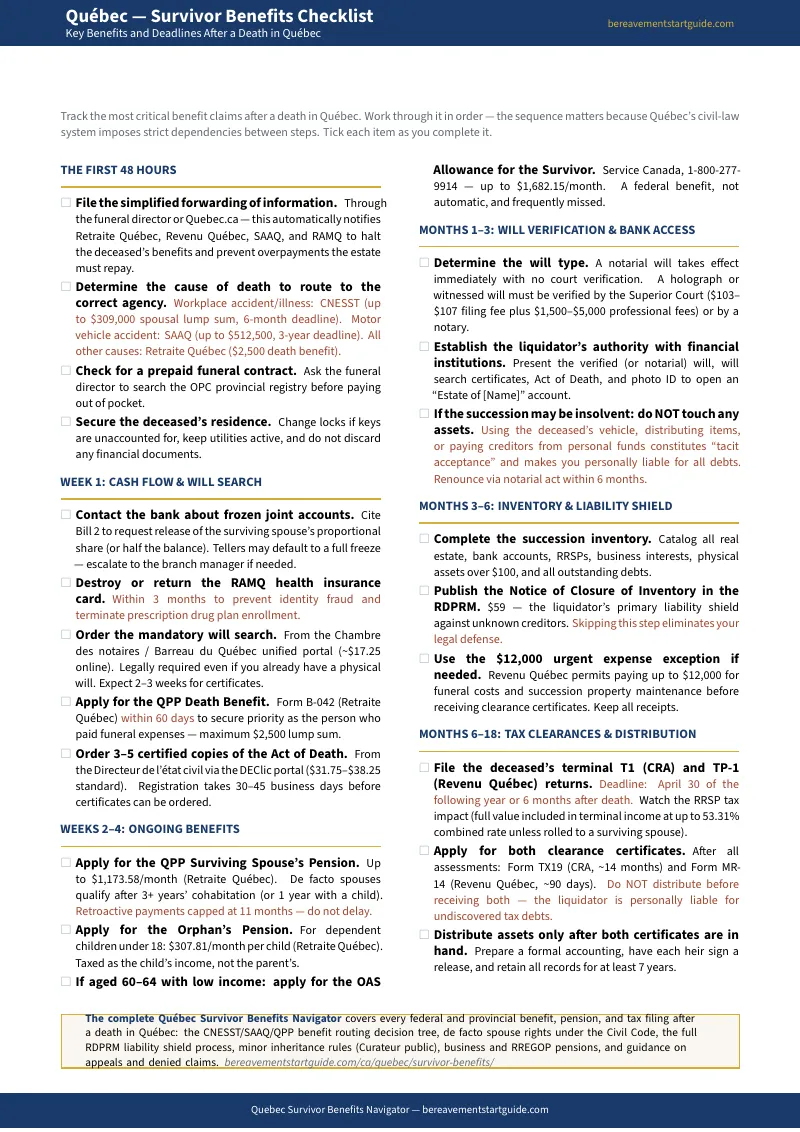
Your download includes the complete 7-chapter guide, three appendices, the printable Quebec Survivor Benefits Quick Start Checklist (20 critical actions by urgency), plus 7 standalone printable tools: the Benefit Routing Decision Tree (CNESST vs. SAAQ vs. IVAC vs. Retraite Québec flowchart), the Bill 2 Joint Account Release Letter (print-and-sign template for your bank), the Liquidator Liability Timeline (visual timeline from Day 0 through safe distribution), the Critical Deadlines Fridge Sheet, the Agency Contact Directory, the Tacit Acceptance Reference Card, and the De Facto Partner Benefit Map. 9 PDFs total. Plus a money-back guarantee, no time limit — if the Navigator does not give you clarity on what you are owed and confidence in the order of operations, email us for a full refund.
Not ready for the full guide? Download the free Quebec Survivor Benefits Checklist — covering the most time-sensitive actions, the key dollar amounts, the benefit routing decision tree, and the sequencing traps that cost the most when they catch you off guard. It is enough to know what to do first and what not to do yet.
The benefits do not arrive automatically. The clearance certificates take months. The joint account stays frozen until you invoke the law. And the liability follows the liquidator personally. This Navigator makes sure you claim every benefit, avoid every trap, and distribute assets only when it is legally safe to do so.