Someone You Love Just Died in Saskatchewan. The Bank Froze Every Account. The ISC Wants a Transmission Application Before You Can Touch the House. And You Just Discovered That Distributing a Single Dollar Before Six Months Could Make You Personally Liable.
You are standing in a place nobody prepared you for. Maybe you were named executor in a will you barely remember reading, and now the bank is telling you they cannot release funds without "Letters Probate" from the Court of King's Bench. Maybe there was no will at all, and because you are the surviving spouse or the eldest child, everyone is looking at you for answers you do not have. Maybe the funeral director is waiting for a cremation authorization, the SaskPower bill just bounced, and the one person who always handled the finances is the one who just died.
You are grieving and exhausted, but the bureaucracy does not wait. eHealth Saskatchewan needs a death registration. Service Canada needs notification to stop CPP and OAS payments before the government claws back overpayments. You searched for probate forms online and found a stack labelled Form 16-11A through Form 16-52 with no instructions on which to file first, or what happens if you skip the Certificate of No Infants. Then a law firm blog mentioned the ISC "double transfer" fee on real estate, and you realized that moving a $450,000 house from the deceased to you could cost $3,600 in land title fees alone. That number was not in any funeral home brochure.
And in the back of your mind, the question that will not stop: if I distribute too early, miss a deadline I did not know about, or assume that joint bank account is mine when the Supreme Court of Canada says it belongs to the estate — am I personally on the hook?
The short answer: the estate pays its own debts, not you. But the long answer — the one that involves a Supreme Court of Canada ruling called Pecore v. Pecore that presumes joint bank accounts with adult children are held in trust for the estate, a privatized land registry operated by the Information Services Corporation that charges 0.4% on every transfer, two separate small-estate thresholds ($15,000 and $25,000) that confuse even lawyers, and a strict six-month dependant relief period that blocks all distributions — that answer is what separates families who settle an estate in months from families who spend years untangling mistakes they did not know they were making.
The When Someone Dies in Saskatchewan — Estate Settlement Guide is a King's Bench Settlement Sequence for every legal, financial, and administrative step between the funeral home and final distribution. Not a law textbook. Not a generic Canadian checklist that does not know Saskatchewan from Ontario. A structured, Saskatchewan-specific manual that separates what must be done in the first 48 hours from what legally cannot happen until six months after the Grant of Probate is issued — so you stop guessing, stop panicking, and start working through this in the right order.
What's Inside the King's Bench Settlement Sequence
A 15-chapter guide, the First 48 Hours Checklist, a Probate Fee Calculator Worksheet, and a complete Agency Contact Directory — covering every stage from the moment of death through final asset distribution, built specifically for Saskatchewan's Court of King's Bench, the Information Services Corporation, and the province-specific rules that make settling an estate here different from anywhere else in Canada:
The First 48 Hours: The Authority Shift and Immediate Actions
The moment someone dies in Saskatchewan, every Power of Attorney becomes legally void. Under The Powers of Attorney Act, 2002, every Enduring Power of Attorney — whether for property or personal care — terminates instantly at death. If you managed the deceased's finances under a Power of Attorney, that authority ended the second they died. This chapter covers the authority shift, locating the original will (including Saskatchewan's recognition of holographic wills written entirely in the testator's handwriting), securing the home within the insurance vacancy clause window, emergency funeral funding through the Saskatchewan Assistance Program and Metis Nation programs, and the single most important rule in this entire guide: do not pay any of the deceased's debts with your own money.
Week One: Death Certificates, the Will, and Notifications That Cannot Wait
eHealth Saskatchewan issues two distinct documents, and ordering the wrong one costs you weeks. The standard death certificate costs $35 and works for banks and subscriptions. The Certified Copy of the Registration of Death costs $55 and is required by the ISC for land transfers — submit a standard certificate for a land transmission and the ISC will reject it. Standard processing takes 4 to 6 weeks; add the $30 courier fee for urgent needs. This chapter covers how many copies to order based on your estate's assets, the week-one notification sequence (Service Canada, CRA, SGI, Saskatchewan Health Services, credit bureaus), and the 60-day vehicle insurance transfer deadline that most families miss.
The Estate Inventory and the Probate Decision
Before you can determine whether probate is required, you need a complete picture of what the deceased owned and how they owned it. This chapter walks through building the asset inventory with attention to the ownership type that determines everything: sole ownership versus joint tenancy with right of survivorship versus tenancy in common. Non-estate assets — joint property, life insurance with named beneficiaries, RRSPs and TFSAs with designated beneficiaries — bypass probate entirely and are exempt from the $7 per $1,000 probate fee. The guide includes the probate decision framework so you know before you start filing forms.
Saskatchewan's Two Small-Estate Shortcuts
This is the chapter that prevents the most common mistake executors make in Saskatchewan. The province maintains two separate small-estate thresholds, and confusing them results in rejected court applications or thousands of dollars in unnecessary legal fees. Estates under $25,000 with no real property can use Form 16-36 and pay a flat $100 fee — no formal probate, no affidavits, no weeks of waiting. Estates under $15,000, even with real property, qualify for a simplified courthouse process at $300 plus the standard levy. The guide includes a diagnostic flowchart so you can determine in five minutes whether standard probate can be bypassed entirely.
The Pecore Trap: Joint Accounts That Are Not Yours
Families across Saskatchewan operate under a dangerous assumption: that adding an adult child's name to a bank account guarantees seamless right of survivorship and bypasses probate entirely. The Supreme Court of Canada's Pecore v. Pecore decision says otherwise. The law presumes the adult child merely holds the money in trust for the estate unless it can be definitively proven that a true gift was intended. Because the parent is deceased and cannot testify, this presumption leads to frozen accounts, bank demands for probate, and litigation between siblings. The guide explains how to determine whether the Pecore presumption applies to your situation and what evidence can rebut it.
The Court of King's Bench Probate Process: Form 16-11A Through Form 16-52
This is the chapter that does not exist in any free Saskatchewan resource in plain language. The Court of King's Bench requires a specific series of Form 16 documents — 16-11A (Application for Grant of Probate), 16-13A (Affidavit of Applicant), 16-14 (Statement of Property), 16-19A (Affidavit of Execution of Will) — and the official government website provides blank PDF forms with virtually zero narrative guidance on how to populate them. The guide walks through every form, explains what triggers rejection by the Local Registrar, covers holographic will verification with Form 16-19B, the $7 per $1,000 probate fee, and the critical detail that Saskatchewan does not use the eCourt system for King's Bench filings — everything must be filed physically at the Local Registrar's Office in the judicial centre nearest the deceased's last residence.
The ISC Double Transfer Problem
Real estate is where Saskatchewan estate settlement gets expensive, and generic guides do not warn you. The Information Services Corporation charges a 0.4% land title transfer fee on every transfer. When someone dies owning property solely, the house must first be transmitted to the executor, then transferred from the executor to the beneficiary — triggering the fee twice. A $450,000 house costs $1,800 to move into the executor's name and potentially another $1,800 to move to the heir: $3,600 in ISC fees alone. And if you submit the transmission packet without first obtaining a Certificate of No Infants from the Public Guardian and Trustee, the ISC will lock the title — blocking all future sales and transfers until the certificate is provided. The guide covers the entire ISC process, the name-matching rules that halt transmissions over a missing middle initial, and how to budget for these fees before the estate runs short.
Creditors, Taxes, Distribution, and Everything Else
The remaining chapters cover the Notice to Creditors (Form 16-48 via newspaper or NoticeConnect — the legally equivalent digital alternative since March 2021 that many older resources still do not mention), intestacy rules under the Intestate Succession Act, 2019 (including the $200,000 preferential share for surviving spouses in blended families), spousal and dependant protections under The Dependants' Relief Act and The Family Property Act, the six-month mandatory holding period before safe distribution, farm estate complexities (intergenerational rollovers, Lifetime Capital Gains Exemptions exceeding $1.25 million), filing the terminal T1 return, applying for the CRA Clearance Certificate (Form TX19), final accounting with Form 16-52, obtaining beneficiary releases, executor compensation, and the estate-closing sequence with every checkpoint from Day 1 through Month 18.
Who This Guide Is For
- The surviving spouse whose partner just died and whose bank account was frozen this morning — who needs to know which accounts stay accessible, which ones require Letters Probate, how to apply for the CPP Survivor's Pension, and why the six-month dependant relief rule means the timeline is longer than anyone warned you about
- The adult child named as executor who has never navigated the Court of King's Bench and is terrified of making a mistake that triggers personal liability — who needs the complete Form 16 sequence, the ISC transmission process explained, and a timeline that separates what is urgent from what legally cannot happen yet
- The family with no will who just learned that the Intestate Succession Act dictates everything — who needs to understand who has statutory priority to apply for Letters of Administration, what the distribution rules are for blended families, and why the $200,000 preferential share does not always protect the surviving spouse
- The rural family settling a farm estate who is dealing with multi-million-dollar land valuations, ISC transfer fees on multiple parcels, intergenerational rollover provisions, and the urgent need to maintain operational continuity across growing seasons — who needs to know the exact sequencing of land transfers before engaging a specialized agricultural tax accountant
- The executor living outside Saskatchewan who cannot walk into a Local Registrar's Office or bank branch — who needs to know which tasks can be handled remotely, how to manage eHealth death certificate ordering from another province, and the exact documentation requirements for dealing with centralized bank estate departments by phone
- The financially constrained family who cannot afford a funeral or a lawyer — who needs to know about the Saskatchewan Assistance Program funeral benefit, the Metis Nation program, the CPP death benefit, and whether the $25,000 threshold means they can settle the estate entirely without court
Why Free Resources Will Not Get You Through This
The information exists. It is scattered across the eHealth Saskatchewan portal, the Court of King's Bench forms repository, the Information Services Corporation, the Public Guardian and Trustee, Service Canada, the CRA, and a dozen agencies that do not talk to each other. Here is what you actually encounter when you try to settle an estate using free sources alone:
- PLEA is comprehensive but not actionable. The Public Legal Education Association of Saskatchewan accurately breaks down executor duties, the six-month dependant relief period, and the King's Bench tariff of costs. But the information is presented in dense legal paragraphs with no chronological sequence, no checklists, no templates for notifying banks, and no project-management framework. It is a legal textbook, not a workbook you can bring to the bank.
- Government pages are accurate but operationally useless. The Court of King's Bench provides Forms 16-11A through 16-52 as blank PDFs. It does not explain which to file first, what the Certificate of No Infants is for, or that the ISC will lock a property title if you skip it. eHealth Saskatchewan explains how to order death certificates but does not tell you how many you need based on the assets in the estate. Each ministry covers its own piece. None of them sequence the pieces together.
- Law firm blogs highlight complexity to justify retainer fees. Saskatchewan estate lawyers publish excellent technical breakdowns of the ISC fee increases, NoticeConnect implementation, and out-of-province asset resealing. Their content is explicitly designed to convince you the process is too dangerous to handle alone — and that you need representation at $1,500 plus 1% of the first $500,000 of the estate. For contested estates, that is true. For the majority of straightforward estates, the answer costs a fraction of what an attorney charges.
- Funeral home checklists stop after the ceremony. Funeral home resources cover the first 48 hours with high empathy — death certificates, initial notifications, who to call first. Their guidance ends with a single line: "Contact a lawyer regarding probate." That is where the hardest twelve months of estate settlement begin.
- Digital estate platforms gloss over local friction. Companies like Willful and ClearEstate publish clean, modern content. Because their business models scale nationally, they calculate the $7 per $1,000 probate fee accurately but fail to warn about the ISC double transfer fees, the two conflicting small-estate thresholds, or the eHealth processing delays. A nationally focused platform cannot match the precision of a guide built for Saskatchewan alone.
Free resources give you fragments from a dozen sources that do not reference each other. The King's Bench Settlement Sequence puts every Saskatchewan-specific statute, form, deadline, and procedure into one document, in the order you actually need them.
— Less Than Fifteen Minutes With a Saskatchewan Estate Lawyer
A single consultation with a Saskatchewan estate lawyer costs $250 to $400 per hour. Standard probate representation runs $1,500 plus 1% of the first $500,000 of the estate. This guide costs less than fifteen minutes of professional legal time and gives you the complete Saskatchewan-specific roadmap — every statute, every form, every deadline, and the Court of King's Bench filing sequence that nobody explains in plain language.
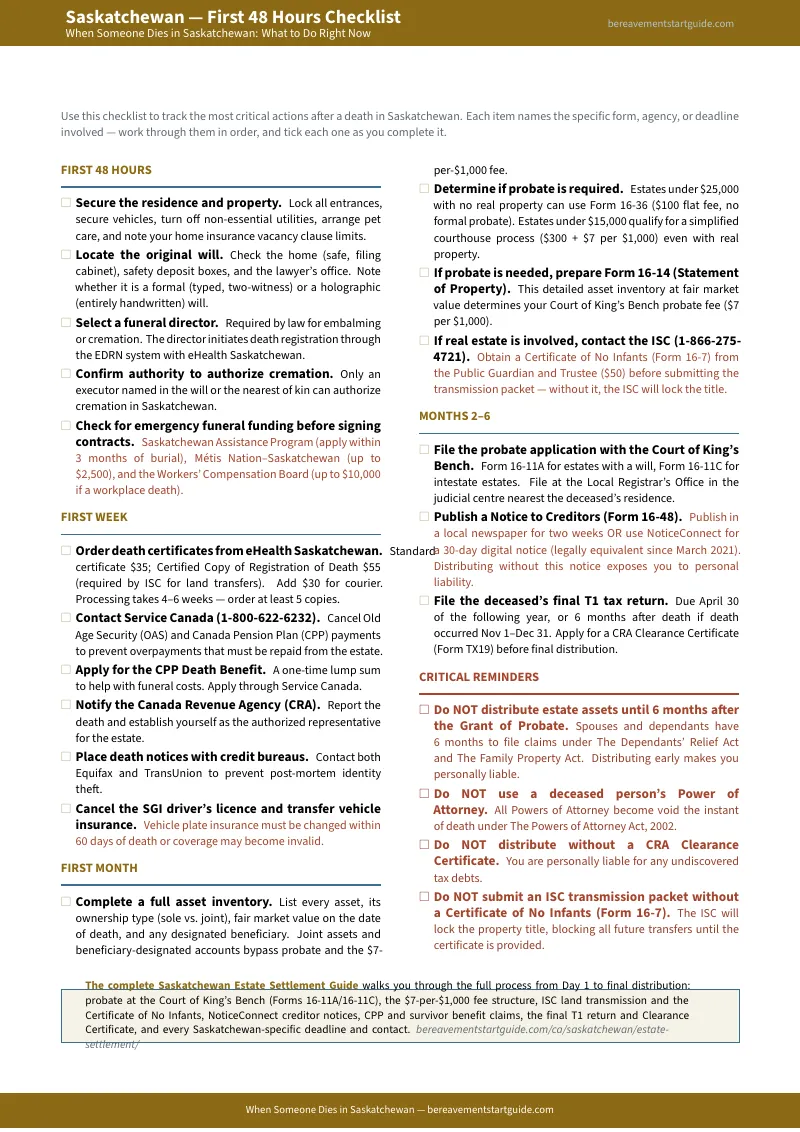
Your download includes the complete 15-chapter guide, the First 48 Hours Checklist, a fillable Probate Fee Calculator Worksheet, and the Agency Contact Directory with every phone number and website you need. Print the section you need and bring it to the bank, the courthouse, or the ISC. Plus a money-back guarantee, no time limit. If the guide does not give you clarity on what to do next and confidence that you are doing it in the right order, email us for a full refund. No questions asked.
Not ready for the full guide? Download the free Saskatchewan — First 48 Hours Checklist — covering everything that must happen in the first two days after a death in Saskatchewan: death certificates from eHealth, the authority shift, securing the home, emergency funeral funding, Service Canada notification, and what not to pay. It is enough to get through tonight and tomorrow.
You did not ask for this job. But you can do it. The guide shows you how, one step at a time.