The Funeral Director Just Handed You a Contract. You Have No Idea What You Are Legally Required to Pay, What You Can Refuse, and Whether Embalming Is Actually Mandatory. The Bill Is Already $7,775 and Climbing.
You are sitting in an arrangement room at a Saskatchewan funeral home, forty-eight hours after the worst phone call of your life. The director slides a contract across the table. There are line items for professional services, preparation, facilities, vehicles, and a casket that costs more than your first car. You are told embalming is required. You are told this particular vault is necessary for burial. You are not given a price list you can take home and compare. And because the person you loved most in the world just died, you sign everything, because what kind of person haggles over a funeral?
The kind of person who knows their rights under Saskatchewan law. That is who.
Here is what the funeral home is not going to volunteer: embalming is not legally required in Saskatchewan for standard burials or cremations, as long as the remains reach their final destination within the 72-hour window mandated by The Disease Control Regulations. You have the absolute right to purchase a casket from any third-party supplier and the funeral home cannot charge you a handling fee for accepting it. Every licensed funeral home in the province is legally required to provide you with a complete, itemized price list before you sign anything — not a summary, not a package price, but every individual service and product listed separately with its cost. And if three siblings are arguing over burial versus cremation and nobody can agree, the eldest sibling holds the legal trump card under Section 91 of The Funeral and Cremation Services Act.
You did not know any of this. Neither did your mother, your brother, or your best friend when they sat in that same chair. The Funeral and Cremation Services Council of Saskatchewan publishes the rules, but they are written for funeral directors, not for the grieving family sitting across the table with a pen in their hand.
The Saskatchewan Funeral Laws & Consumer Rights Guide is a Consumer Defense Framework for every legal right, financial protection, and bureaucratic requirement between the moment someone dies in Saskatchewan and the final disposition of their remains. Not a sympathy pamphlet. Not a generic Canadian overview that does not know the difference between the FCSCS and the FCAA. A structured, Saskatchewan-specific manual that tells you exactly what a funeral home can and cannot charge, what forms eHealth Saskatchewan requires before a single thing can happen, who holds the legal authority to make decisions when families disagree, and how to access every dollar of government assistance available — before you sign anything you cannot undo.
What's Inside the Consumer Defense Framework
A 12-chapter guide, the Funeral Consumer Rights Checklist, and a complete Agency Contact Directory — covering every stage from the first hours after death through final disposition of remains and financial settlement, built specifically for Saskatchewan's Funeral and Cremation Services Council, eHealth Saskatchewan, and the province-specific statutes that make navigating a funeral here different from anywhere else in Canada:
Chapter 1: The Saskatchewan Funeral Law Landscape
Three separate bodies govern different aspects of the process, and confusing them sends you to the wrong office at the worst possible time. The Funeral and Cremation Services Council of Saskatchewan (FCSCS) regulates funeral homes, consumer rights, and prepaid contracts. The Financial Consumer Affairs Authority (FCAA) regulates cemeteries under The Cemeteries Act, 1999. eHealth Saskatchewan handles death registration and vital statistics through the Electronic Death Registration and Notification (EDRN) system. This chapter maps which agency handles what, introduces the four key statutes (The Funeral and Cremation Services Act, The Cemeteries Act, 1999, The Vital Statistics Act, 2009, and The Disease Control Regulations), and explains how Saskatchewan differs from other provinces — including the flat probate fee from dollar one, the eldest-sibling tiebreaker that most provinces lack, and the robust prepaid contract protections that outperform much of the country.
Chapter 2: The First Hours — Death Registration and Documentation
Every death in Saskatchewan requires two separate documents before anything can move forward: the Medical Certificate of Death (completed by the attending physician, nurse practitioner, or coroner) and the Statement of Death (completed by the family or funeral director with the deceased's biographical details). Both feed into eHealth Saskatchewan's EDRN system. Without them, there is no Burial Permit — and without the Burial Permit issued under The Vital Statistics Act, 2009, no cemetery will accept the body and no crematorium will proceed. This chapter walks through the exact sequence, explains the coroner hold that delays everything when a death is unexpected, covers death certificate ordering (approximately $35 standard versus $55 for the certified genealogical copy), and addresses the 6-to-8-week processing delay that freezes estate access.
Chapter 3: Who Has the Legal Right to Decide — The 11-Step Hierarchy
This is the single most common source of family conflict after a death. Before any funeral contract can be signed, the legal authority to control the remains must be established. The Funeral and Cremation Services Act sets an 11-step priority hierarchy: executor, spouse, adult child, legal decision-maker, parent, adult sibling, grandparent, adult grandchild, adult uncle or aunt, adult nephew or niece, and any other adult next of kin. A funeral home cannot legally proceed without the highest-ranking person's written authorization. If siblings disagree, the eldest wins — full stop. This chapter also covers what does not give you authority (Powers of Attorney and Health Care Directives terminate absolutely at death), what to bring to the funeral home to establish your authority, and when the only option is applying to the Court of King's Bench for a judicial order.
Chapter 4: Your Consumer Rights at the Funeral Home
This is the chapter the funeral industry would prefer you never read. Saskatchewan consumers are protected by a robust set of provincial rules enforced by the FCSCS — rules that mirror the intent of the FTC Funeral Rule in the United States, though the FTC Rule does not apply in Canada. You are entitled to a complete, itemized price list before you sign anything. You may take it home and compare. No funeral director can pressure you into signing before you have reviewed it. Embalming is not legally required if the 72-hour transport window is met. You can supply your own casket from any third-party source without paying a handling fee. And if a funeral home violates any of these protections, the FCSCS has the authority to investigate and impose professional discipline. The guide gives you the specific language to invoke these rights in real time — not legal theory, but the words to say when you are sitting in that arrangement room.
Chapter 5: Prepaid Funeral Contracts — Portability, Cancellation, and Traps
If the deceased had a prepaid funeral contract — or if you are proactively purchasing one — Saskatchewan law provides strong consumer protections that most families do not know about. Prepaid contracts are fully portable: you can transfer to any other funeral home at any time. Cancellation fees are hard-capped by statute at the lesser of 10% of the contract value or $250 within the first year, rising to $500 after the first year. Pre-need funds must be held in trust or guaranteed through insurance. But the critical distinction most families miss is the difference between a guaranteed contract (price locked at time of purchase, no matter how costs rise) and a deposit contract (your payments accrue interest, but you owe the difference if prices increased). This chapter covers how to audit a decades-old contract, exercise your portability right, and calculate whether cancellation is worth the fee.
Chapter 6: Disposition of Remains — Burial, Cremation, and the Home Burial Question
Saskatchewan law restricts final disposition to two methods: burial in an approved, registered cemetery or cremation in a licensed crematorium. For cremation, the guide covers Burial Permit requirements, the continuous identification tracking system (a numbered metal disk follows the body through the entire process), the mandatory pacemaker removal rule, and why only the authorized decision-maker under the FCSA hierarchy can sign the cremation authorization. For burial, the guide covers minimum depth (76 centimeters below the surface), proximity rules (3 meters from a church, 2 meters from another building), and what to check in a cemetery contract. And then the question every rural family asks: can you bury a loved one on private farmland? The short answer is no — not without formally registering the land as a non-commercial cemetery through the FCAA, which requires a survey, municipal approval, and a $10,000-per-hectare care and maintenance fund. But scattering or burying cremated ashes on private property only requires the landowner's permission. This regulatory distinction is poorly understood and critically important.
Chapter 7: The 72-Hour Rule and Transporting Remains
Under The Disease Control Regulations, remains must reach their final destination within 72 hours. If the window cannot be met, the body must be embalmed or a medical health officer must provide written approval — refrigeration alone does not satisfy the requirement. Private transport within Saskatchewan by a family member is legal and common in rural areas. Out-of-province or international transport triggers additional requirements: a Burial Transit Permit, an Embalming Certificate mandatory for commercial air transport, and compliance with the receiving jurisdiction's own rules. This chapter is essential for families coordinating a repatriation from out of province.
Chapter 8: Paying for the Funeral — Costs, Benefits, and the Cash-Flow Gap
The average traditional funeral in Saskatchewan costs approximately $7,775 before cemetery expenses. The funeral home wants payment within 30 days. The deceased's bank accounts may be frozen. The death certificate takes 6 to 8 weeks from eHealth. And you need the death certificate to apply for probate, which unlocks the estate funds. This is the cash-flow gap that traps families. The guide covers bridge strategies (asking the bank's estate department directly, life insurance with named beneficiaries, joint accounts), plus every government benefit available: the Saskatchewan Income Support funeral benefit (up to $4,425 via Form 1244, with the critical 90-day application deadline), the CPP Death Benefit (up to $2,500, but clawed back from SIS), Workers' Compensation Board ($10,000 for workplace deaths), SGI ($8,342 to $12,784 for motor vehicle deaths), Metis Nation-Saskatchewan ($2,500), and Indigenous Services Canada on-reserve funding ($3,500 to $6,000). The guide includes the benefit priority hierarchy so you know which agency pays first when multiple benefits overlap.
Chapter 9: Estate Processing — Probate, Small Estates, and Fees
A compact but essential chapter covering how funeral costs interact with probate thresholds. Saskatchewan charges $7 per $1,000 of gross estate value with no exemption on the first portion — a flat tax from dollar one. The province maintains two small-estate shortcuts: under $25,000 with no real property ($100 flat fee, Form 16-36), and under $15,000 even with real property ($300 plus the levy). Joint tenancy assets, life insurance with named beneficiaries, and RRSPs/TFSAs with designated beneficiaries bypass probate entirely. The detail most families miss: funeral costs deplete the estate's gross value, potentially pushing a $27,000 estate below the $25,000 threshold and qualifying it for the cheaper process.
Chapters 10–12: Indigenous Estates, Special Situations, and Key Contacts
The remaining chapters cover on-reserve estates under the federal Indian Act (where Indigenous Services Canada holds jurisdiction and the provincial probate system may not apply), special situations including insolvent estates, the divorce-beneficiary trap (divorce revokes a spouse's will status but does not revoke beneficiary designations on insurance, RRSPs, or TFSAs), foreign assets requiring ancillary probate, religious and cultural funeral requirements within Saskatchewan's legal framework, and a complete agency contact directory with every phone number, website, and fee for eHealth Saskatchewan, the FCSCS, the FCAA, Court of King's Bench, the Public Guardian and Trustee, Ministry of Social Services, Indigenous Services Canada, Service Canada, and the CRA.
Who This Guide Is For
- The grieving spouse sitting in a funeral arrangement room right now — who needs to know which charges are legitimate, which are optional, and what consumer protections exist before signing a contract that cannot be unsigned
- The executor named in a will who must authorize a cremation or burial within days but does not know whether they or the surviving spouse holds the legal authority, or what happens if siblings disagree
- The adult child coordinating from another province who needs to know the exact permits required for transporting remains, the Burial Transit Permit and Embalming Certificate for air transport, and how to interface with eHealth Saskatchewan remotely
- The low-income family facing a $7,775 funeral bill with no savings — who needs the precise SIS benefit amounts, the Form 1244 application, the 90-day deadline, the CPP clawback calculation, and whether WCB, SGI, or ISC funding applies to their situation
- The proactive planner reviewing a prepaid funeral contract or purchasing one — who needs to understand portability rights, the guaranteed-versus-deposit trap, cancellation fee caps, and the Prepaid Funeral Services Assurance Fund
- The rural family who assumed they could bury a loved one on private farmland — who needs to understand the cemetery registration process, the $10,000-per-hectare fund, and the critical distinction between burying a body (prohibited without registration) and scattering cremated remains (permitted with landowner consent)
Why Free Resources Will Not Get You Through This
The information exists. It is scattered across the FCSCS website, eHealth Saskatchewan, the FCAA regulations, the Ministry of Social Services policy manuals, and funeral home brochures that have a financial interest in you not reading the fine print. Here is what you actually encounter when you try to protect yourself using free sources alone:
- The FCSCS is clear on the rules but governed by the industry. The Funeral and Cremation Services Council publishes excellent FAQs on prepaid contracts, the authorized decision-maker hierarchy, and price disclosure obligations. But the FCSCS is a regulatory body — it cannot ethically publish aggressive consumer negotiation tactics, scripts for refusing unnecessary services, or the plain-English phrase "you do not have to pay for this." The guide can.
- Government pages are technically accurate but operationally useless. eHealth Saskatchewan explains how to order death certificates but does not tell you how many you need based on your specific situation. The FCAA publishes the full text of The Cemeteries Act, 1999, written for commercial cemetery operators, not a grieving family trying to understand why they cannot bury their father on the family farm. Each ministry covers its own piece. None of them give you a chronological action plan.
- Funeral home websites highlight what you should buy, not what you can refuse. No funeral home advertises that embalming is optional, that you can bring your own casket, or that their price list must be provided before any contract discussion. Their websites offer warmth, professionalism, and an implicit message: trust us to handle everything. That trust can cost you thousands of dollars in services you did not need and were not required to buy.
- National estate platforms gloss over Saskatchewan-specific friction. Willful and ClearEstate publish clean, SEO-optimized content about Canadian funeral rules. Because their business models scale nationally, they accurately state that embalming is "generally not required" but fail to cite the specific 72-hour transport rule under Saskatchewan's Disease Control Regulations, the FCSCS consumer protections, or the FCAA cemetery establishment requirements. A nationally focused platform cannot match the precision of a guide built for Saskatchewan alone.
- PLEA is comprehensive but not actionable. The Public Legal Education Association of Saskatchewan provides excellent plain-English legal education. But PLEA is not a workbook. It does not give you a checklist for the arrangement room, a sequence of steps for the first 48 hours, or a benefit comparison matrix showing which government program pays first. It educates you on the law. The guide tells you what to do about it.
Free resources give you fragments from a dozen sources that do not talk to each other. The Consumer Defense Framework puts every Saskatchewan-specific statute, consumer right, benefit threshold, and action step into one document, in the order you actually face them.
— Less Than the Cheapest Casket Markup
A single casket markup at a Saskatchewan funeral home can run $1,000 to $3,000 above the wholesale cost. The SIS funeral benefit clawback on the CPP Death Benefit can cost a low-income family up to $2,500 if they do not understand which benefit to apply for first. A prepaid contract deposit shortfall discovered at the time of death can leave families scrambling for thousands of dollars they thought were already covered. This guide costs less than the cheapest casket markup and gives you the complete Saskatchewan-specific framework — every statute, every consumer right, every benefit threshold, every deadline, and the exact words to say when a funeral director tells you something is mandatory that is not.
Your download includes 7 print-ready PDFs: the complete 12-chapter guide, the Funeral Consumer Rights Checklist, and 5 standalone reference sheets you can print individually and bring to the specific appointment where you need them — the Disposition Authority Hierarchy for family meetings, the Government Benefits Reference for your Ministry of Social Services appointment, the Deadline Reference Table for your fridge, the Consumer Rights Negotiation Scripts for the funeral arrangement conference, and the Transport & Disposition Rules for families coordinating from out of province. Plus a money-back guarantee, no time limit. If the guide does not give you clarity on your rights and confidence that you are not overpaying, email us for a full refund. No questions asked.
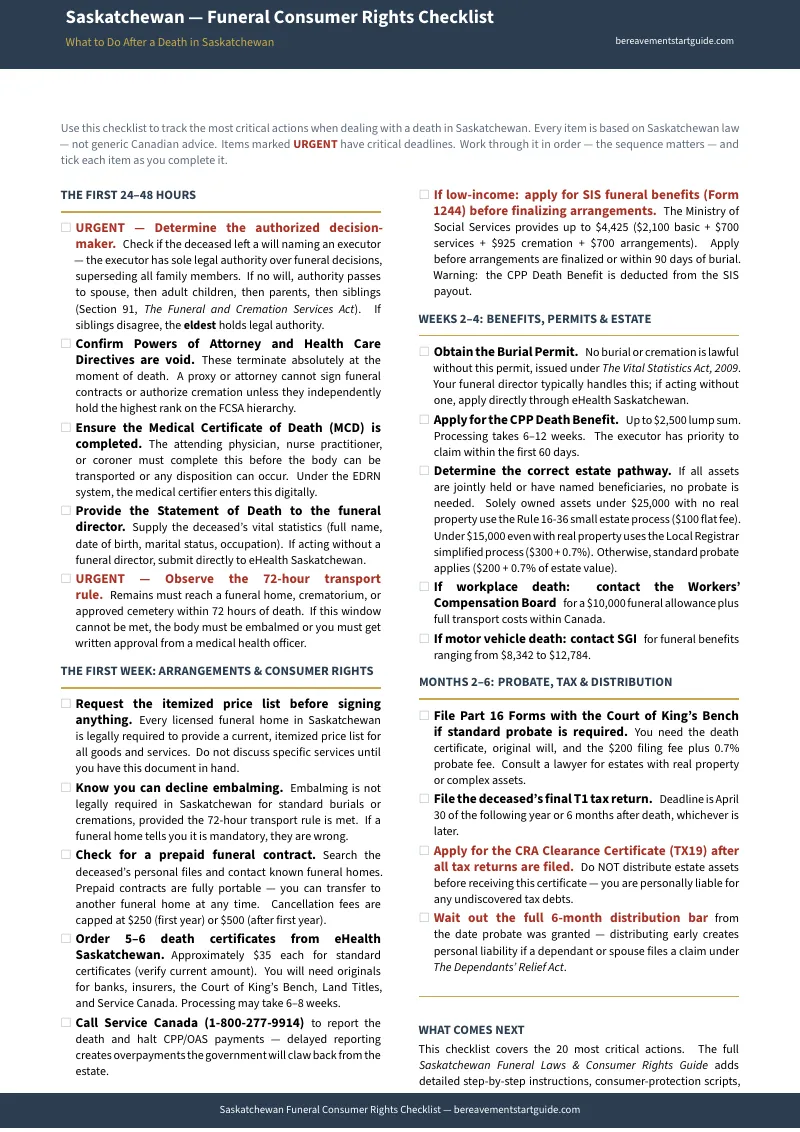
Not ready for the full guide? Download the free Saskatchewan — Funeral Consumer Rights Checklist — covering the 20 most critical actions in the first weeks after a death: establishing legal authority under the FCSA hierarchy, the 72-hour transport rule, death registration through eHealth, your right to an itemized price list, when embalming is actually required, and how to apply for SIS funeral benefits before the 90-day deadline. It is enough to protect yourself in the arrangement room tomorrow.
You should not have to learn consumer law while you are grieving. But the funeral home is not going to teach it to you. The guide will.