Saskatchewan Income Support Will Cover Up to $4,425 for the Funeral — but Only if You Apply Before Paying the Funeral Home. And if You Claim the CPP Death Benefit First, the Province Deducts It Dollar-for-Dollar from That Grant.
Your spouse or parent has just died in Saskatchewan, and you are now standing at the intersection of agencies that were never designed to communicate with each other. The Ministry of Social Services administers funeral assistance through Saskatchewan Income Support — but will not tell you that the $2,500 CPP Death Benefit you applied for yesterday will be deducted from your provincial grant. eHealth Saskatchewan issues death certificates — but will not explain which type the Court of King's Bench requires for probate versus which type ISC Land Titles needs for a property transfer. Service Canada processes the CPP Survivor's Pension — but will not mention that receiving it changes your Saskatchewan Seniors Income Plan calculation, or that every month you delay past the 12-month retroactive window is money permanently lost.
Meanwhile, the funeral director needs a deposit. The bank has frozen the accounts. The property tax deferral your spouse was enrolled in has a six-month continuation window that nobody told you about. Your siblings are asking when they get their share — but distributing the estate before six months after the Grant of Probate makes you personally liable for every dollar if a dependant files a claim. And the home your family lives in might need to go through ISC Land Titles, where a $12.50 administrative task routinely generates $1,000 in unnecessary legal fees because families do not know the correct form to file.
The free resources are not wrong. They are siloed. eHealth does not explain how to use the death certificate at ISC. Service Canada does not mention how the CPP survivor pension changes your SIP top-up. SIS does not explain the CPP clawback sequencing. Each agency gives you technically accurate information about its own piece of the puzzle while failing to mention any of the others — or the order in which you need to act so that one application does not accidentally disqualify another.
The Saskatchewan Survivor Benefits Navigator is a Cross-Agency Administration Bridge — one document that integrates federal, provincial, and institutional processes into a single chronological workflow. Not a government pamphlet repackaged with better formatting. Not a law firm blog designed to generate anxiety and billing hours. A structured, Saskatchewan-specific operations manual that tells you exactly which form to file, which agency to contact, which deadline will cost you thousands if you miss it, and which bureaucratic sequence to follow so that one application does not reduce or eliminate another.
What's Inside the Cross-Agency Administration Bridge
A 14-chapter guide with a 20-item chronological checklist — organized from the first 7 days through final estate closure, built specifically for Saskatchewan's unique combination of flat probate fees, ISC Torrens land titles, the 2019 intestacy rewrite, and the dual SGI/WCB accident compensation system:
The First 7 Days — Triage and Documentation
Register the death with eHealth Saskatchewan, order the right death certificates ($35 standard, $55 certified photocopy for foreign assets, $30 priority courier surcharge), understand who can legally order them and which boxes get applications rejected, and make the critical funeral funding decision before it is too late. This chapter covers the documentation sequence that everything downstream — banks, insurers, probate, property transfers — depends on.
Emergency Funeral Funding — and the Trap That Costs Families Money
Saskatchewan Income Support covers up to $4,425 for low-income families — but only if you apply before paying the funeral home. Pay out of pocket, even on a credit card, and the Ministry denies the claim. The CPP Death Benefit ($2,500 lump sum) is treated as an available resource and deducted from the SIS grant. This chapter maps the sequencing decision that preserves the maximum total funding: SIS, CPP, SGI ($12,784 No-Fault funeral benefit), WCB (burial grant from $10,000), and Metis Nation-Saskatchewan bereavement grants — with a decision flow table showing which route applies to your situation.
Immediate Income Replacement
The CPP Survivor's Pension (up to $904.59/month for survivors 65+, $803.54/month under 65), CPP Children's Benefit ($307.81/month per child), and the frequently missed Allowance for the Survivor (up to $1,682.15/month for spouses aged 60 to 64). Plus the Saskatchewan Seniors Income Plan recalculation that can increase your provincial top-up after a spouse's death — and the GIS/SIP/SIS acronym confusion that sends families to the wrong program entirely.
Health Coverage, Joint Assets, and the 6-Month Property Tax Trap
Update your eHealth health card, confirm Seniors Drug Plan continuation, take control of joint bank accounts, and file an ISC joint tenancy transfer for about $12.50 instead of paying a lawyer $1,000. The chapter that catches most families off guard: the Senior Property Tax Deferral continuation window. If the deceased was enrolled, the surviving spouse has exactly six months to apply — regardless of age — or the deferred taxes plus 3.949% interest become an immediate lien on the property.
SGI vs WCB — Two Entirely Separate Systems for Accident Deaths
If the death was a motor vehicle collision, SGI's Auto Fund pays up to $12,784 for the funeral under No-Fault or $8,342 under Tort — but first you need to know which coverage the deceased elected, because it changes everything including whether the estate can sue. If the death was a workplace accident, WCB pays 90% of net earnings to the surviving spouse plus a burial grant and dependent child benefits. The chapter most families need and cannot find anywhere: how CPP survivor benefits interact with WCB (half your CPP pension is offset after 12 months) and why you must report the CPP award to WCB or face a lump-sum repayment demand.
Provincial Pension Survivor Benefits
If the deceased was a teacher (STRP), public servant (PSPP), or municipal employee (MEPP), there may be a substantial survivor pension — but the 60% automatic benefit can be reduced or eliminated by a spousal waiver signed before retirement. MEPP requires three years of continuous cohabitation for common-law partners. This chapter explains what to verify in writing before electing a lump sum versus a monthly allowance, because these choices are often irreversible.
Probate at the Court of King's Bench
Saskatchewan charges $7 per $1,000 (0.7%) of the gross probatable estate from the first dollar — no exemption on any portion. Plus a $200 filing fee and $25 for the Certificate of No Infants. The application paperwork is notoriously rigid: the slightest error gets the packet rejected by the local registrar, adding months to the timeline. This chapter covers what to file, how to minimize the probatable estate by identifying assets that bypass probate, and the regulated legal tariff ($1,500 + 1% on the first $500,000) so you know what a lawyer should charge.
ISC Land Titles — The $12.50 Task Families Pay $1,000 For
How to search the ISC title to confirm joint tenancy versus sole ownership, file the Application for Transfer to Surviving Joint Tenant (about $12.50), handle mortgage discharges ($55 each), and execute a Transmission to Executor when probate is required (0.15% fee). The chapter that saves families the most money: understanding the exact forms and affidavits ISC requires so you do not hire a lawyer for what is an administrative filing.
Intestacy Under the 2019 Act
If there is no will, the surviving spouse gets the greater of $200,000 or one-half of the net estate. If all children are shared, the spouse inherits everything. If there are children from outside the relationship, the formula can force the sale of the family home. This chapter covers the full breakdown — including why common-law partners who cohabited for at least two years qualify as a "spouse" and what happens when a separated-but-not-divorced legal spouse and a current common-law partner both have claims.
The Six-Month Danger Zone
The executor cannot distribute any estate assets until exactly six months after the Grant of Probate — or face personal liability if a dependant claims under The Dependants' Relief Act. This chapter covers how to use those six months productively: filing the final T1 return, obtaining the CRA Clearance Certificate, completing ISC land transmissions, and preparing the closing accounting the Court expects within two years.
Edge Cases
Indigenous on-reserve estates (where jurisdiction shifts from the province to the federal government under the Indian Act), PGT rules for minor beneficiaries ($2,000 threshold, real property consent, the PGT's tariff of 7%/5%/4%), insolvent estates, the instant termination of Powers of Attorney at death, and the six-month accounting obligation for former POA holders.
Master Deadline Table and Fee Reference
Every statutory deadline on one page — from the 6-month property tax deferral window to the 2-year SGI claim bar — with consequences for missing each one. A complete fee reference covering eHealth certificates, Court of King's Bench probate, ISC land titles, and every survivor benefit rate for 2026.
Who This Guide Is For
- The surviving spouse whose household income just dropped and who needs to know exactly which pensions, supplements, and deferment programs are available — and the precise sequence to apply so that one benefit does not reduce another
- The out-of-province adult child managing a Saskatchewan estate from Alberta or BC — who needs the ISC forms, Court of King's Bench procedures, and agency contacts organized efficiently rather than scattered across a dozen government websites
- The low-income family that needs funeral assistance urgently and cannot afford to make the SIS/CPP sequencing mistake that forfeits provincial funding
- The rural or Indigenous family navigating both provincial and federal jurisdictions — where on-reserve estates follow the Indian Act while off-reserve assets still require provincial probate and ISC transfers
- The professional helper or caregiver assisting a family through the process — who needs to understand PGT notification requirements, executor liability rules, and compliance deadlines
Why Free Resources Leave You Exposed
Every fact in this guide exists somewhere on a government website. The problem is not accuracy — it is integration. Here is what you encounter when you try to assemble Saskatchewan survivor benefits guidance from free sources alone:
- Service Canada explains the CPP Death Benefit and survivor pensions in detail — but does not mention that receiving the survivor pension changes the Saskatchewan Seniors Income Plan calculation, or that the $2,500 death benefit is deducted dollar-for-dollar from the SIS funeral grant
- The Ministry of Social Services explains SIS funeral assistance eligibility — but does not tell you which eHealth death certificate variant the Court of King's Bench requires, or how to sequence the CPP claim so it does not reduce your provincial grant
- ISC Land Titles publishes transfer forms and fees — but does not explain how to confirm joint tenancy versus sole ownership, or that the $12.50 surviving joint tenant transfer bypasses the 0.7% probate fee entirely
- PLEA Saskatchewan provides excellent plain-language estate cost guides — but does not connect the probate process to the ISC property transfer sequence, the SIS funeral funding trap, or the SGI/WCB accident benefit coordination
- SGI and WCB each explain their own death benefits accurately — but neither mentions the other, and neither explains the CPP offset that can trigger a lump-sum repayment demand if you fail to report
The result: families either miss benefits they are legally entitled to, make sequencing errors that disqualify them from time-sensitive programs, or pay thousands in legal fees for administrative tasks they could have handled with proper instructions.
What You Get
The Saskatchewan Survivor Benefits Navigator includes:
- The complete guide (guide.pdf) — 14 chapters covering every federal, provincial, and institutional benefit, every Court of King's Bench probate procedure, every ISC property transfer process, the SGI vs WCB accident comparison, provincial pension survivor rules, intestacy under the 2019 Act, and edge cases specific to Saskatchewan
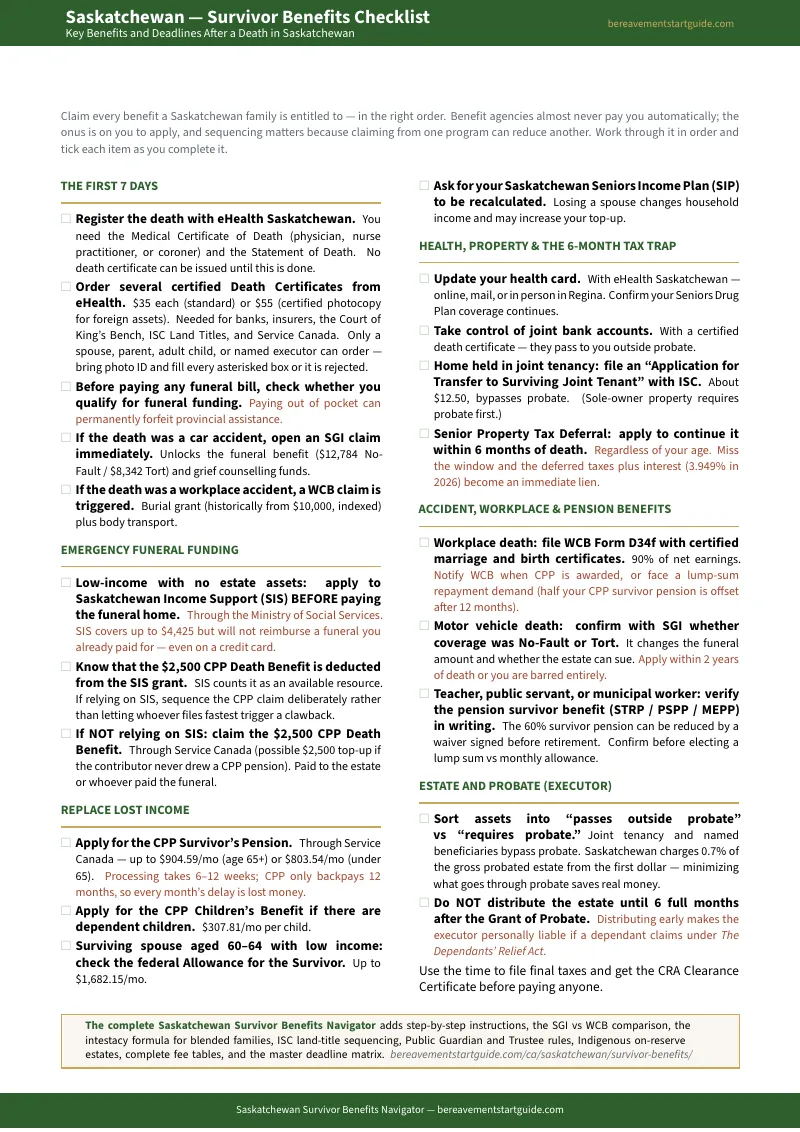
- The Quick Start Checklist (checklist.pdf) — a printable, chronological action list with 20 items from the first 7 days through final estate closure, with specific forms, deadlines, and agency contacts for each step
Plus 5 standalone printable tools — extracted from the guide so you can print and bring them to appointments, pin them to the wall, or hand them to a helper:
- Funeral Funding Decision Map (funeral-funding-map.pdf) — one-page flowchart showing which program pays (SIS, CPP, SGI, WCB, Métis Nation) based on your situation, with the SIS/CPP sequencing trap highlighted
- Master Deadline Table (deadline-table.pdf) — every statutory deadline on one page with a fillable "Your Date" column — pin this where you will see it
- Fees, Rates & Contacts Reference (fee-reference.pdf) — every registration fee, court fee, ISC fee, and survivor benefit rate for 2026, plus official agency URLs
- SGI vs WCB Accident Comparison (sgi-wcb-comparison.pdf) — side-by-side breakdown of No-Fault vs Tort funeral amounts, spousal income replacement, and the CPP offset warning
- ISC Land Title Transfer Guide (isc-property-transfer.pdf) — step-by-step instructions for the $12.50 joint tenancy transfer that bypasses probate, with the fee schedule and document checklist
For , you get the equivalent of what an estate lawyer would charge multiple billable hours to explain — organized in the order you actually need it, written in plain English, and specific to Saskatchewan's unique combination of federal, provincial, and institutional rules.
100% Satisfaction Guarantee
If the guide does not help you navigate Saskatchewan survivor benefits with more confidence and clarity than any combination of free resources, email hello@bereavementstartguide.com for a full refund. No questions, no forms, no waiting period.