Someone You Love Just Died in Yukon. The Bank Froze Their Accounts. The Supreme Court Is in Whitehorse. The Probate Fee Is $140 — But Nobody Has Told You How to Fill Out Forms 72, 73, and 74.
You are standing in a place nobody prepared you for. Maybe you were named executor in a will you barely remember reading, and now Heritage North is asking about arrangements while the bank tells you every sole account is frozen. Maybe there was no will at all, and because you are the surviving spouse or the eldest child, everyone is looking at you for answers you do not have. Maybe you live in Vancouver or Calgary and just learned that you are responsible for settling an estate in a territory where everything runs through Whitehorse, pandemic-era remote notarization has been revoked, and nobody at any government office will walk you through the process from start to finish.
You are grieving and sleep-deprived, but the paperwork does not wait. Heritage North — the sole funeral provider in the territory — needs decisions, and the costs are immediate: approximately $3,350 for basic cremation, $5,160 or more for a traditional service. Grey Mountain Cemetery charges $803.25 for a plot, $1,877 to $2,407 for interment, and an additional $2,029.80 winter surcharge if the death falls between October and April. Service Canada needs notification to stop CPP and OAS payments before overpayment clawbacks begin. The bank will not release a dollar from the deceased's sole accounts. And siblings or extended family are already asking about the house.
Meanwhile, the question that keeps circling in the back of your mind: if I pay the wrong bill, or distribute assets before the CRA Clearance Certificate arrives, or accidentally "intermeddle" with the estate before I have decided whether to accept the executor role — am I personally on the hook?
The short answer: the estate pays its own debts, not you. But the long answer — the one that involves Yukon's $140 flat probate fee (the lowest in Canada, versus $14,000 or more in Ontario), the $25,000 small estate threshold under Section 20 of the Estate Administration Act that banks routinely ignore, Supreme Court Forms 72, 73, and 74 that nobody explains how to fill out, the three-way jurisdictional split between territorial law, self-governing First Nations, and CIRNAC for Indian Act estates, the fact that there is no electronic filing and no remote notarization, and the Declaration of Authority form (YG7211HSS) that gives you the vocabulary to negotiate fund releases before probate — that answer is what separates families who settle an estate in months from families who spend years and thousands of dollars fixing mistakes they did not know they were making.
The When Someone Dies in Yukon — Estate Settlement Guide is a 90-Day Settlement Roadmap for every legal, financial, and administrative step between the funeral home and final distribution. Not a law textbook. Not a generic checklist from a national Canadian website that does not know Yukon from New Brunswick. A structured, territory-specific manual that separates what must be done in the first 48 hours from what legally cannot happen until the CRA issues a Clearance Certificate — so you stop guessing, stop panicking, and start working through this in the right order.
What's Inside the 90-Day Settlement Roadmap
A complete guide, the First 48 Hours Checklist, and standalone reference documents — covering every stage from the moment of death through final asset distribution, built specifically for Yukon statutes, the Supreme Court of Yukon, and the territory-specific rules that make settling an estate here different from anywhere else in Canada:
The First 48 Hours: Securing the Estate in the Territory
The moment someone dies in Yukon, every Enduring Power of Attorney they had in place is legally void. If you managed their finances under a POA, your authority ended at the moment of death. Any attempt to use it at a bank or government office exposes you to legal liability. This chapter covers securing the deceased's home and property, locating the original will, notifying Heritage North, and the single most important rule in this entire guide: do not pay any of the deceased's debts with your own money. It also covers the intermeddling trap — actions as simple as paying a utility bill or moving a vehicle can legally lock you into the executor role permanently, making it nearly impossible to renounce later.
Death Certificates: Vital Statistics Whitehorse and the Remote Problem
Yukon death certificates are processed through Vital Statistics in Whitehorse. Each certificate costs $10. Applications can be submitted by mail or in person, but the process takes time and you need multiple originals. Every bank, insurance company, court, and government agency will require one. The guide gives you the exact calculation based on the deceased's assets so you order the right number now. Coming back later means weeks of delay. If you are an out-of-territory executor, this chapter covers the remote application process — including the critical distinction between the government-issued death certificate and the funeral director's Proof of Death, which some institutions will accept and others will not.
The $25,000 Small Estate Threshold: When Banks Say No Anyway
This is the chapter that addresses the most frustrating contradiction in Yukon estate settlement. Under Section 20 of the Estate Administration Act, estates valued at $25,000 or less can theoretically be administered without a Grant of Probate — and the court filing fee is waived entirely. But in practice, Canadian banks routinely refuse to release funds without formal probate, even for account balances well below the threshold. Their internal risk policies override territorial law. This chapter walks you through the exact calculation for the threshold, explains which assets count and which do not (life insurance and RRSPs with named beneficiaries bypass the estate entirely), and gives you the Declaration of Authority form (YG7211HSS) — the bank negotiation tool that most families never learn exists. You get the document reference, the strategy for presenting it to branch staff, and what to say when they route you to a centralized corporate estate department in Toronto that has never heard of Yukon's small estate rules.
Standard Probate: Supreme Court Forms 72, 73, and 74
When the estate exceeds $25,000 or includes real property in sole ownership, standard probate through the Supreme Court of Yukon is required. The filing fee is $140 — a flat rate regardless of estate size. Compare that to Ontario, where a million-dollar estate generates over $14,000 in probate fees, or British Columbia's tiered system. The financial barrier is low; the administrative barrier is not. The guide walks through Form 72 (Affidavit of Executor — the massive sworn statement requiring a complete asset and liability inventory), Form 73 (Affidavit of Notice of Application — proving you served all beneficiaries and waited the mandatory 21-day notice period), and Form 74 (Affidavit of Proposed Administrator for intestate estates). Every form reference includes the common rejection reasons — white-out, mismatched names, unsigned exhibits, filing before the 21-day period has elapsed — so you do not waste weeks on rejected applications. All affidavits must be sworn in the physical presence of a Notary Public, Commissioner for Oaths, or court registry clerk. No remote swearing. No Zoom. No exceptions.
The Three-Way Jurisdictional Split: Territorial Law, Self-Government, and CIRNAC
This is the chapter that does not exist in any other resource. Yukon is unique in Canada because a significant number of its First Nations have signed self-government agreements, establishing them as independent legal entities with the power to enact their own inheritance and estate laws. When a First Nation citizen dies, the Supreme Court requires a supplementary affidavit confirming the deceased's membership status and whether their specific First Nation has enacted overriding estate legislation. If they have, those laws may supersede territorial statutes entirely. Conversely, for First Nations individuals who remain under the Indian Act and reside on reserve, CIRNAC retains total jurisdiction — bypassing the Supreme Court of Yukon completely. The guide maps the decision tree: territorial law, self-governing First Nation law, or federal Indian Act. You determine which jurisdiction applies before filing a single form.
Banking and Frozen Accounts: Getting Access When You Need It Most
This is the chapter that solves the most urgent crisis families face. The bank froze the accounts and you cannot pay the funeral, the mortgage, or the utilities. The guide explains which accounts stay accessible (joint accounts with right of survivorship), which transfer directly to named beneficiaries (RRSPs, TFSAs, life insurance), and which require a Grant of Probate. For accounts that are frozen, the guide covers the bank's internal process for releasing funds for small estates — the formal mechanism that branch staff rarely volunteer. You get the Declaration of Authority form (YG7211HSS), the exact steps, the documentation to bring, and what to say when the branch manager tells you to get probate for a $12,000 account that the law says does not require it.
No Electronic Filing, No Remote Notarization
During the pandemic, Ministerial Order 2020/39 temporarily allowed the remote swearing of affidavits via video link. Those provisions have been formally revoked. Yukon currently does not recognize the remote execution of affidavits — physical presence before a commissioner or notary is legally required. Electronic filing of probate applications is not supported. Original wet-ink signatures and the physical submission of the original will remain the standard. If you are an out-of-territory executor, this chapter covers your options: swearing documents before a notary in your home province (which is legally valid) and then arranging physical courier delivery to the Supreme Court registry in Whitehorse. The guide includes the logistics, the costs, and the timeline so you do not fly to Whitehorse only to discover you need a document you left in Calgary.
Funeral Costs, Government Benefits, and the Funding Gap
With Heritage North as the sole funeral provider and Grey Mountain Cemetery as the primary burial option, Yukon funeral costs are immediate and significant. The CPP Death Benefit provides a maximum of $2,500. Yukon Income Assistance may cover basic funeral costs for individuals who were receiving social assistance or had severely limited resources. The Last Post Fund covers qualifying veterans. This chapter centralizes every available benefit — eligibility criteria, application procedures, required documentation, and contact information — so you know within minutes whether financial assistance is available and how to apply before funeral costs become a crisis you absorb personally.
Real Property, Land Titles, and Settlement Land
The transfer of real property goes through the Yukon Land Titles Office in Whitehorse. Joint tenancy with right of survivorship allows the surviving owner to transfer title using a death certificate — no probate required, $10 filing fee. Sole ownership requires a Transmission Application with a Grant of Probate — $5 filing fee. This chapter covers both paths, the exact forms, and the fee calculations. It also addresses the issue that no generic Canadian guide covers: property on settlement land governed by First Nations self-government agreements, where different rules may apply and engagement with the relevant First Nation land administration body may be required instead of — or in addition to — the territorial Land Titles Office.
Intestacy, Timelines, and Final Distribution
When someone dies without a valid will in Yukon, the Estate Administration Act dictates everything. The surviving spouse receives a preferential share, and the residue is divided between the spouse and children according to statutory fractions. The executor must observe strict waiting periods: the court will not issue probate until 21 days after notice is served. The estate must not be distributed until six months after probate is granted (to allow dependants' relief claims). For intestate estates, the hold extends to one full year from the date of death. The guide closes with the CRA Clearance Certificate application (Form TX19), estate T3 returns, executor compensation, and the critical rule: distribute before clearance and you are personally liable for any tax shortfall.
Who This Guide Is For
- The surviving spouse whose partner just died and whose bank accounts were frozen this morning — who needs to know which accounts stay accessible, how the spousal preferential share works under the Estate Administration Act, and how to use the Declaration of Authority form (YG7211HSS) to negotiate fund releases before probate
- The executor living outside the territory who has been named personal representative in a will and must now navigate the Supreme Court in Whitehorse from Vancouver or Calgary — who needs the remote filing process, exact form references, courier logistics, and a month-by-month project management timeline for a jurisdiction with no electronic filing
- The family navigating First Nations jurisdiction trying to determine whether the estate is governed by Yukon territorial law, a self-government agreement, or the federal Indian Act through CIRNAC — who needs the decision tree before filing a single form with the wrong court
- The financially constrained family facing Heritage North's cremation costs and Grey Mountain Cemetery's winter surcharges — who needs the complete directory of CPP Death Benefit ($2,500), Yukon Income Assistance funeral help, and Last Post Fund eligibility, with application steps that could unlock funding worth many times the cost of this guide
Why Free Resources Will Not Get You Through This
The information exists. It is scattered across the Yukon Public Guardian and Trustee PDF guides, the Supreme Court registry, the Land Titles Office, Vital Statistics, the Department of Social Supports, Service Canada, the CRA, and the individual websites of every self-governing First Nation. Here is what you actually encounter when you try to settle an estate using free sources alone:
- Public Guardian and Trustee guides are accurate but legalistic and unsequenced. You can find the rules for closing an estate and download PDFs on executor duties. What you cannot find is a plain-English explanation of how to fill out Form 72's asset inventory schedule, which supporting documents to attach, or what order to tackle the dozens of steps between death and final distribution. The guides assume you already know the process. If you already knew the process, you would not be reading government PDFs at midnight.
- YPLEA explains the concepts without driving execution. The Yukon Public Legal Education Association provides excellent plain-language summaries of intermeddling, the Executor's Year, and insolvency rules. Their content defines legal terms — it does not give you spreadsheets, form-completion walkthroughs, or bank negotiation scripts. Understanding what intermeddling means is not the same as knowing which specific actions trigger it.
- Heritage North stops after the funeral. As the sole funeral home in the territory, they provide transparent pricing and compassionate support for the first few days. Their guidance ends after the burial or cremation. They do not cover probate, the $25,000 small estate threshold, Land Titles transfers, tax clearance, or executor liability. Their help ends where the hardest questions begin.
- National platforms miss Yukon depth entirely. Atticus, Cadence, and Eirene provide modern interfaces and good national overviews. One of them references obtaining an "Employer Identification Number" — an American tax term that does not exist in Canada. None of them mention the Declaration of Authority form (YG7211HSS), the First Nations affidavit requirements, the revocation of remote notarization, or the winter surcharge at Grey Mountain Cemetery. They are built for Ontario and British Columbia, with a territorial flag pasted on top.
- Whitehorse lawyers cost $300+ per hour — if you can get an appointment. With fewer than thirty lawyers in the entire territory, wait times are long and hourly rates are high. The YPLEA offers a $30-for-30-minutes initial consultation that is designed to funnel you into a full retainer. For contested estates, legal counsel is necessary. For straightforward estates, the answer costs a fraction of what one meeting with a lawyer costs.
Free resources give you fragments from a dozen sources that do not reference each other. The 90-Day Settlement Roadmap puts every Yukon-specific statute, form, deadline, benefit, and procedure into one document, in the order you actually need them — including the bank negotiation tools and jurisdictional decision trees that no other guide covers.
— Less Than One Hour With a Whitehorse Lawyer
A single consultation with a Yukon estate lawyer costs $300 or more per hour — if you can get an appointment. This guide costs less than one hour of professional legal time and gives you the complete Yukon-specific roadmap — every statute, every form, every deadline, and the territory-specific rules that the Supreme Court requires but nobody explains in plain language.
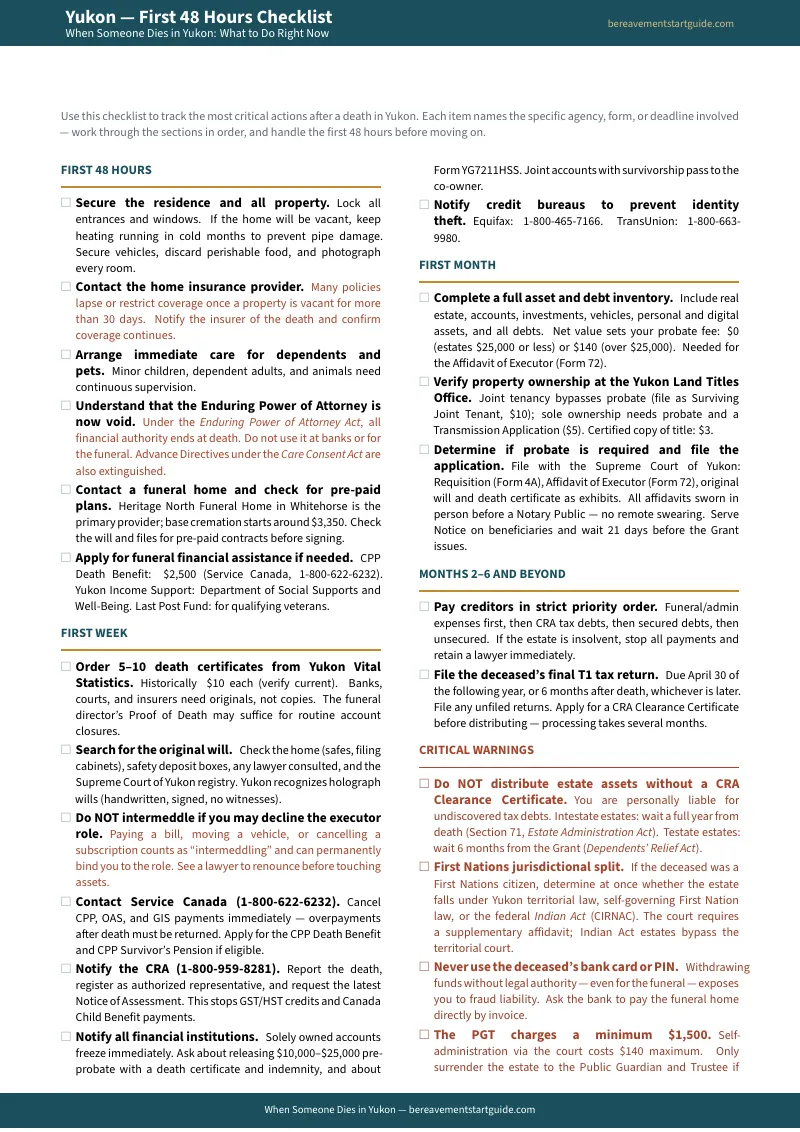
Your download includes the complete guide with the First 48 Hours Checklist and standalone reference documents covering the Small Estate Threshold Calculator, the Bank Negotiation Toolkit (including the Declaration of Authority form YG7211HSS), the Jurisdictional Decision Tree for First Nations estates, and the CRA Clearance Timeline. Plus a money-back guarantee, no time limit. If the guide does not give you clarity on what to do next and confidence that you are doing it in the right order, email us for a full refund. No questions asked.
Not ready for the full guide? Download the free Yukon — First 48 Hours Checklist — covering everything that must happen in the first two days after a death in Yukon: death certificates from Vital Statistics, securing the home, the intermeddling warning, emergency funeral funding, what not to pay, and what to gather. It is enough to get through tonight and tomorrow.
You did not ask for this job. But you can do it. The guide shows you how, one step at a time.