There Is One Funeral Home in the Entire Yukon. You Cannot Comparison-Shop. Embalming Costs $640 and Is Not Legally Required. And Nobody Told You That Signing a Contract Before Applying for Social Assistance Permanently Disqualifies You From Up to $3,500 in Funeral Funding.
Someone close to you died in the Yukon, and now you are the person making funeral decisions in a territory with a single full-service funeral home and crematorium. Heritage North in Whitehorse is the only provider. There is no competitor to call for a second quote, no alternative crematory, and no price comparison website that applies to your situation. When a funeral director hands you a package priced at $5,160 and says embalming is included, you have no way to know — unless someone tells you — that embalming is not required by Yukon law for standard burial or cremation, that a simple cardboard container is legally sufficient for cremation, and that declining optional services could save your family over a thousand dollars.
Then there is the funding trap. Yukon Social Assistance will cover up to $3,500 for funeral costs and up to $6,000 for repatriation of remains. But here is the rule that no one advertises on the application form: if you sign a funeral contract or pay any expenses out of pocket before receiving explicit approval from Social Assistance, your application is denied. Not reduced. Denied. The sequence matters more than the amount. And most families learn this after they have already signed.
There is the 48-hour cremation waiting period that has no exceptions. There is the fact that the Yukon has no forensic pathology facilities, meaning any death that triggers a coroner's investigation sends the body to Vancouver by air for autopsy — creating delays of days to weeks while the family waits. There is the ministerial permission required for private land burial and the flat prohibition on backyard burials within Whitehorse and Watson Lake city limits. There is the executor's absolute common-law right to control the remains, which supersedes the surviving spouse's wishes. And there are the 2025 Bill 49 amendments that changed unclaimed body protocols and the Public Guardian and Trustee's statutory duties in ways that affect families who delay collecting cremated remains.
The Yukon Funeral Laws & Consumer Rights Guide is a Monopoly Navigator — built for the reality that every Yukon family walks into the same funeral home with zero competitive leverage, and the only protection you have is knowing exactly what the law requires, what it does not, and where the money is before you sign anything. Not a national funeral planning template with "Yukon" swapped into the header. Not a sympathy card disguised as a legal resource. A chapter-by-chapter breakdown of every consumer right, every financial assistance program, every cremation and burial rule, and every paperwork requirement specific to the territory — written for the person who has days, not weeks, to make decisions that cost thousands of dollars in a market with no competition.
What's Inside the Monopoly Navigator
A complete 12-chapter guide, a Funeral Consumer Rights Checklist, and standalone reference worksheets — covering every stage from the first hours after death through filing complaints, built specifically for the Yukon's single-provider funeral market:
The Required vs. Optional Line-Item Decoder
Heritage North's published pricing starts at $930 for basic cremation and $1,500 for the administrative fee. Comprehensive packages run from $3,350 to $5,160. Embalming is listed at $640. Witnessed cremation adds $155. The guide maps every service Heritage North offers against the specific Yukon statutes that govern them, and tells you which are legally required and which are optional — service by service, line by line. You cannot comparison-shop in a monopoly market. But you can decline what the law does not require. That is where consumer power lives in the Yukon.
The Financial Assistance Sequencing Rules
Four separate programs can help pay for a Yukon funeral: Yukon Social Assistance (up to $3,500 for funeral costs, up to $6,000 for repatriation), the CPP Death Benefit (up to $2,500), Indigenous Services Canada funeral assistance (up to $3,500 plus $6,000 repatriation for individuals ordinarily resident on-reserve), and WCB fatality benefits ($15,000 lump sum for work-related deaths). The guide covers each program's eligibility criteria, application contacts, and the exact sequence in which they must be applied for — because Social Assistance is the funder of last resort and requires you to exhaust all other sources first. Get the sequence wrong and you lose the largest benefit available.
The 48-Hour Cremation Rule and Coroner Jurisdiction
Cremation cannot occur within 48 hours of the time of death. No exceptions. If the coroner takes jurisdiction over the remains — for any unexpected, unnatural, or suspicious death — the family loses all control until the investigation concludes and the body is released. Because the Yukon has no autopsy facilities, the body is flown to Vancouver under a joint agreement between the Yukon and B.C. Coroners Services. The guide explains the exact timeline for coroner involvement, what a temporary death certificate covers and what it does not, and how to begin funeral planning while the body is still in Vancouver.
Executor Authority and the Decision-Maker Hierarchy
Under Canadian common law, the named executor holds absolute authority over the disposition of remains. Not the surviving spouse. Not the eldest child. The executor. If there is no will, authority follows a strict statutory hierarchy under the Yukon Estate Administration Act — including recognition of common-law partners after just 12 months of cohabitation. When family members at the same priority level disagree, the funeral home halts all arrangements. The guide covers who holds authority in every scenario, what evidence establishes a common-law claim, and when disagreements require a Supreme Court application.
Private Land Burial — What Is Actually Legal
The Cemeteries and Burial Sites Act requires written permission from the Minister for any burial on private land. The land must be surveyed, the territorial government must grant a zoning exemption, and environmental and public health requirements must be met. Within Whitehorse and Watson Lake city limits, private land burial is flatly illegal — municipal bylaws restrict interment to designated, municipal-owned cemetery boundaries. Attempting an unauthorized burial triggers law enforcement intervention and, in serious cases, forced disinterment. The guide walks through the complete application process for rural private burial and identifies the circumstances where it is genuinely feasible.
Winter Burial Logistics
Ground freeze from roughly November through April makes earth burial impossible without specialized ground-thawing equipment. If a death occurs during winter, the body is held in refrigerated storage until spring. The funeral service can proceed on the family's timeline — only the physical interment is delayed. The guide covers the timeline for winter storage, the cost implications, how to coordinate a memorial service separately from the spring interment, and what to discuss with the cemetery authority before committing to a burial date.
Prepaid Funeral Plan Protections
If the deceased had a prepaid funeral contract — or if you are considering purchasing one — the Yukon Funeral Directors Act provides three statutory safeguards: a $100,000 bond requirement on the funeral director, a mandate that 100% of prepaid funds be held in a dedicated trust account with interest accruing to the consumer, and a $300 cap on cancellation fees. The guide includes a prepaid funeral audit checklist covering every verification item, plus the creditor protection under the modernized Exemption Act that shields prepaid funeral funds from seizure.
Bill 49 and the Unclaimed Remains Clock
The 2025 amendments to the Funeral Directors Act introduced a six-month clock for unclaimed cremated remains. If the family does not collect the ashes within six months, the funeral director is legally compelled to notify the Public Guardian and Trustee, who assumes control and directs permanent disposition. Once the PGT acts, the family's right to claim the remains is extinguished. The guide explains the notice requirements, how to request an extension in writing, and what happens when a distant relative surfaces after the PGT has already taken jurisdiction.
Who This Guide Is For
- The family member arranging a funeral with Heritage North who has never planned a funeral before, is being handed a package price between $3,350 and $5,160, and needs to know which services are legally required and which can be declined — before signing the contract
- The executor who holds legal authority over the remains but is being challenged by a surviving spouse or siblings who disagree with the disposition decision — who needs to understand that the executor's authority is absolute under common law and how to resolve disputes before the funeral home halts all arrangements
- The family that cannot afford funeral costs and needs to apply for Yukon Social Assistance, the CPP Death Benefit, Indigenous Services Canada funding, or all three — but has not yet signed any contract, and needs to know the exact application sequence that preserves their eligibility
- The out-of-territory executor or next of kin living in British Columbia, Alberta, or Ontario — who has a few days of bereavement leave to fly to Whitehorse and needs to know which tasks require physical presence, what documents the funeral home and Vital Statistics require, and how to manage the paperwork remotely
- The family navigating a coroner's investigation who just learned the body has been sent to Vancouver for autopsy and has no timeline for its return — who needs to understand the temporary death certificate process and how to begin funeral planning during the delay
- The person pre-planning their own funeral who wants to ensure their prepaid contract is properly bonded, their funds are held in trust, and their wishes are documented in a way the executor can legally enforce
Why Free Resources Will Not Get You Through This
The information you need exists. It is scattered across Yukon Vital Statistics, the Department of Community Services, the Funeral Directors Act and its regulations, the Cemeteries and Burial Sites Act, the Coroners Act, the Consumer Protection Act, the Care Consent Act, Service Canada, Indigenous Services Canada, and Heritage North's own price list. Here is what you encounter when you try to navigate a Yukon funeral using free sources alone:
- Heritage North's website lists services but not consumer rights. You can find approximate pricing for cremation packages and burial services. What you will not find is a clear breakdown of which services are legally required versus optional, what the law says about embalming, or the fact that a simple cardboard container is legally sufficient for cremation. The funeral home is a business. It is not incentivized to help you spend less.
- The Yukon government publishes statutes, not instructions. The Funeral Directors Act, the Vital Statistics Act, and the Cemeteries and Burial Sites Act are all available online. They are written for lawyers. They do not tell you in plain language which sections apply to your situation, how they interact with each other, or what happens when the coroner sends the body to Vancouver and you are left with no death certificate and no timeline.
- National funeral planning websites pretend the Yukon is a competitive market. Every Canadian funeral planning guide tells you to "comparison-shop between funeral homes" and "get at least three quotes." That advice is meaningless in a territory with one provider. The Yukon's consumer protection strategy is entirely different from Ontario's or British Columbia's — and no national guide accounts for that.
- Social Assistance eligibility rules are buried in policy manuals. The application-before-contract rule — the single most important fact for families who cannot afford funeral costs — is not prominently displayed on any government webpage. Families discover it when their application is denied.
- Bill 49 amendments are too recent for most online resources. The 2025 changes to unclaimed body protocols, PGT duties, and the six-month cremated remains clock are not reflected in any free guide published before mid-2025. Most online content about Yukon funerals predates these amendments entirely.
Free resources give you fragments from a dozen sources that never reference each other, and not one of them maps Heritage North's price list against the statutes that determine what you are and are not required to buy. The Monopoly Navigator puts every consumer right, every financial assistance program, every statutory deadline, and every required-versus-optional decision into one guide — in the order the funeral home, Vital Statistics, and the court actually require them.
— Less Than the Embalming You Do Not Legally Need
Heritage North charges $640 for embalming — a service that Yukon law does not require for standard burial or cremation. This guide costs a fraction of that single optional line item and covers every consumer right, every financial assistance program, and every statutory rule that applies to funeral arrangements in the territory. National funeral planning platforms charge $149 to $199 per year in subscription fees and do not account for the Yukon's single-provider market, its territorial statutes, or its unique winter burial logistics.
Your download includes the complete 12-chapter guide with the Funeral Consumer Rights Checklist and standalone printable worksheets — a required-versus-optional service decoder, a financial assistance decision tree with application contacts, a cremation procedures checklist, a burial options reference card, and a complaint filing guide. Plus a money-back guarantee, no time limit. If the guide does not give you clarity on your consumer rights and confidence in every decision you make at the funeral home, email us for a full refund. No questions asked.
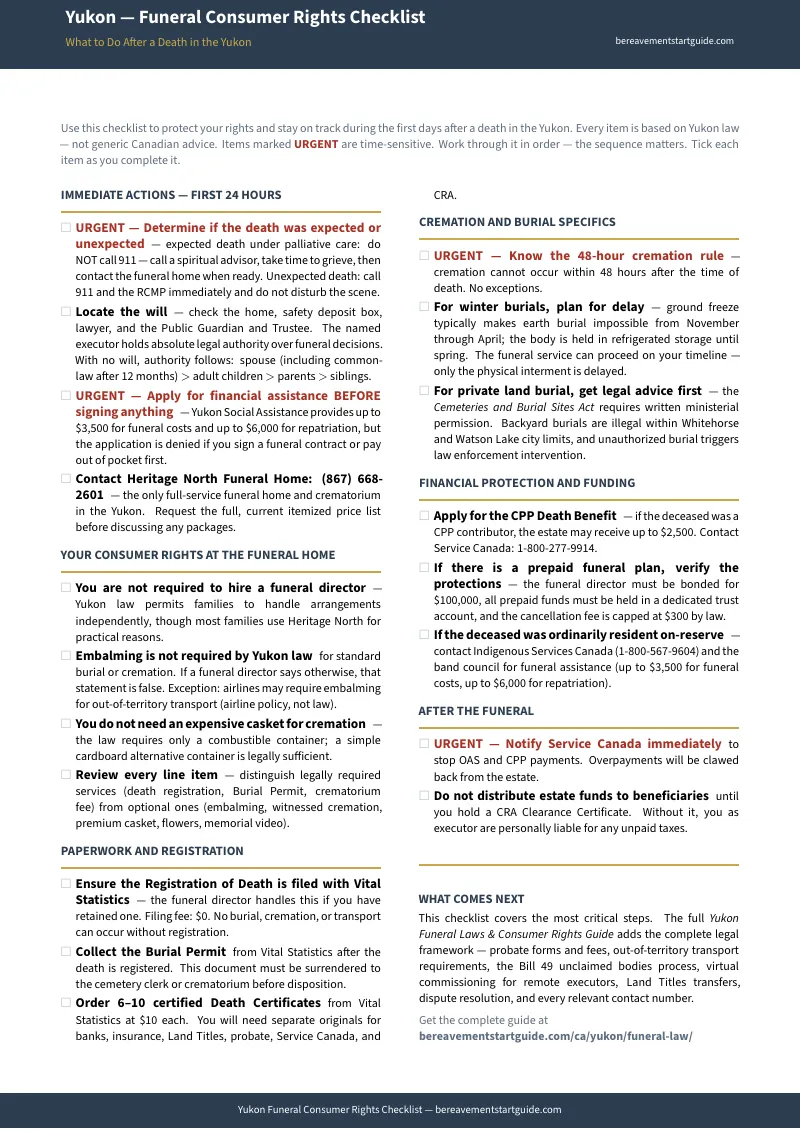
Not ready for the full guide? Download the free Yukon — Funeral Consumer Rights Checklist covering the critical first-day decisions: who holds legal authority over funeral arrangements, which services you can decline, how to preserve your eligibility for financial assistance, and the paperwork Vital Statistics requires before any burial or cremation can proceed. It is enough to walk into Heritage North knowing your rights.
You did not ask to be the one making these decisions. But the Yukon's funeral laws are knowable, your consumer rights are real, and the financial assistance exists — if you apply in the right order. The guide shows you how to navigate a market with no competition using the only leverage available: knowing what the law actually requires.