The Bank Said You Need a Grant of Probate. The Court Website Gave You Blank Forms and Rule 64. The Land Titles Office Wants a Transmission Application You Have Never Heard Of. And Somewhere in the Process, You Are Supposed to File a First Nation Affidavit That No Guide in Canada Explains.
Someone close to you died in the Yukon, and now you are the person standing between the frozen bank accounts and everyone who expects their inheritance. Maybe you were named executor in the will. Maybe there was no will and the responsibility fell to you because you are the surviving spouse or the eldest child. Either way, the funeral is over, the bank has locked everything down, and you are staring at Supreme Court of Yukon forms that assume you already hold a law degree.
Here is what nobody tells you upfront. The Yukon is marketed across Canada as a "probate haven" because the court filing fee caps at $140. That number is real. What is not mentioned is the Assurance Fund fee waiting for you at the Land Titles Office on Lambert Street when you try to transfer real property. That fee is calculated on the total value of the property and can exceed the court filing fee several times over. A $500,000 Whitehorse home costs $140 to probate through the Supreme Court and then another $510 at the Land Titles Office for the Transmission Application. The $140 cap is not the whole story. It is the opening line of a much longer invoice.
Then there is the banking freeze. When someone dies, banks lock every account held solely in the deceased's name. The official government line is that you need a Grant of Probate to release those funds. What the government does not advertise is the internal risk threshold that every major bank operates under. If the total balance across the deceased's non-registered accounts falls below roughly $50,000, the branch manager at RBC, TD, or CIBC in Whitehorse has the discretionary authority to release the funds directly to you — no court filing required — if you sign a Bond of Indemnity. That option saves you months of court delays and hundreds of dollars in fees. But you need to know it exists, and you need to know exactly how to ask for it.
And then there is the part that separates the Yukon from every other jurisdiction in Canada. Eleven of the fourteen Yukon First Nations operate under Self-Government Agreements — constitutionally protected agreements that give each First Nation the authority to pass its own inheritance and intestacy laws. Supreme Court Rule 64 requires every probate applicant to submit a sworn affidavit about the deceased's First Nation citizenship status. If the deceased was a citizen of a self-governing First Nation, you need to determine whether that First Nation has enacted laws that override the territorial Estate Administration Act. If the deceased owned property on Settlement Land, the inheritance rules may be entirely different from what the Yukon statute says. No national estate guide covers this. No free government PDF walks you through it. No online platform even acknowledges it exists.
The Yukon Probate Process Guide is a Jurisdiction Decoder — built for the reality that settling a Yukon estate means navigating three overlapping legal systems at once: the Supreme Court, the Land Titles Office, and the First Nation governance layer that no other resource in Canada addresses. Not a generic Canadian probate overview with "Yukon" pasted into the header. Not a collection of links to blank court PDFs. A step-by-step filing manual covering every Rule 64 form, the First Nation SGA affidavits, the $50,000 bank indemnity loophole, the Land Titles "shadow tax," and the exact scripts and checklists you need to settle the estate yourself — or know precisely when you need a lawyer instead.
What's Inside the Jurisdiction Decoder
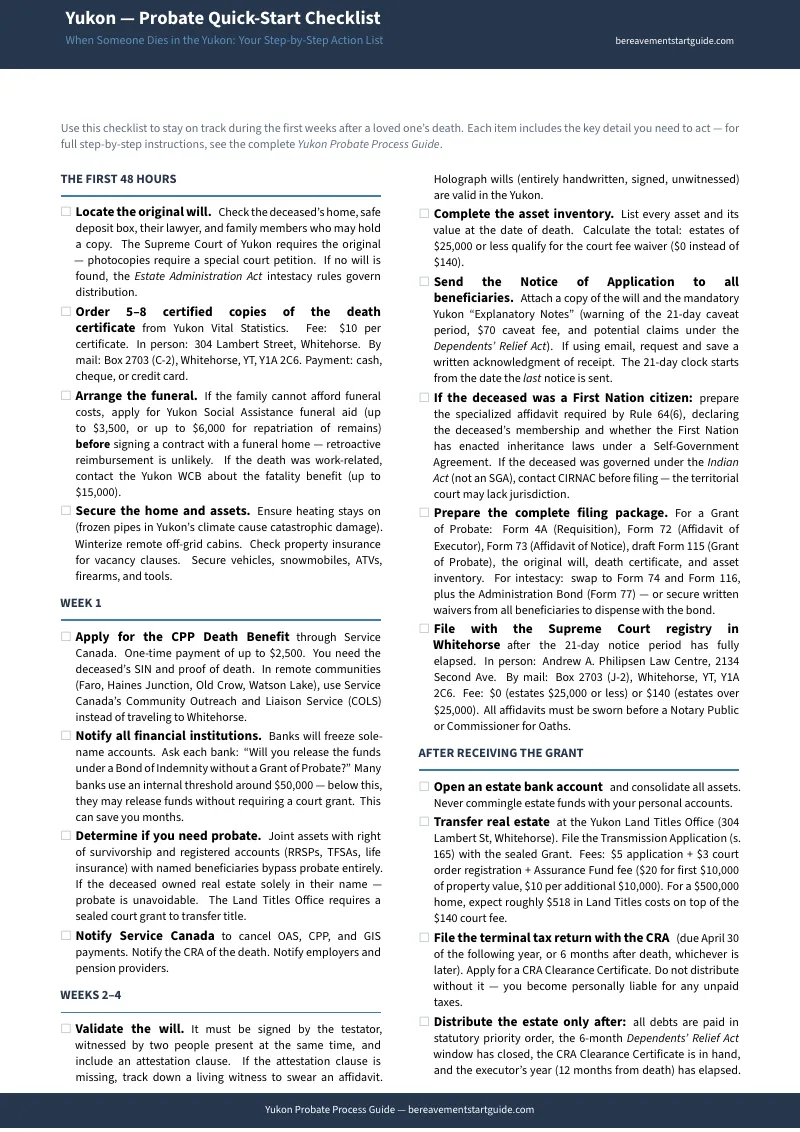
A complete guide, a Probate Quick-Start Checklist, and standalone printable worksheets — covering every stage from ordering death certificates through the final CRA Clearance Certificate, built specifically for the Yukon's unique intersection of territorial probate law, federal banking thresholds, and First Nation self-governance:
The $50,000 Bank Indemnity Loophole
When a Whitehorse bank freezes the deceased's accounts, most executors assume they must get a Grant of Probate before any money can be released. That assumption is wrong for estates below the bank's internal risk threshold. Major Canadian banks — RBC, TD, CIBC, BMO — maintain informal internal policies that allow branch managers to release funds from sole-name accounts without a court order if the total balance falls below approximately $50,000. The executor signs a Bond of Indemnity, which protects the bank from future claims, and the funds are released directly. The guide provides the exact questions to ask the branch manager, the documentation to bring to the meeting, and a negotiation script for when the first teller says "you need probate" but the branch manager has the authority to say otherwise.
First Nation SGA Affidavits and Settlement Land Restrictions
Supreme Court of Yukon Rule 64(6) requires every probate application to include a sworn affidavit declaring whether the deceased was a citizen of a self-governing Yukon First Nation. For eleven of the fourteen Yukon First Nations — including Kwanlin Dun, Ta'an Kwach'an, Champagne and Aishihik, and Kluane — this is not optional paperwork. It is a mandatory court filing without which the registry will reject your application outright. The guide explains which Form 74 or Form 75 to use, what information to include in the affidavit, who to contact within each First Nation government to verify citizenship and check for enacted inheritance laws, and what happens if the deceased owned a home on Settlement Land where First Nation housing policies may restrict non-citizen inheritance.
Supreme Court Rule 64 Forms — Plain-English Walkthroughs
The Supreme Court of Yukon publishes its probate forms as blank PDFs on the courts website. Form 4A is the Requisition. Form 72 is the Affidavit of the Applicant. Form 73 is the Notice of Application. Form 115 is the Grant of Probate itself. Form 116 is Letters of Administration for intestate estates. Each form has specific requirements that the registry clerk checks line by line. A name mismatch between the death certificate and the will, a missing exhibit, an incorrectly numbered affidavit — any of these sends the entire application back. The guide walks through every form that applies to your filing, shows you what the clerk looks for, identifies the most common rejection triggers, and explains in plain English what each legal term means.
The Land Titles "Shadow Tax"
When the estate includes real property — a house in Whitehorse, a cabin near Haines Junction, land anywhere in the territory — the Grant of Probate alone does not transfer title. You must file a Transmission Application under section 165 of the Land Titles Act at the Land Titles Office on Lambert Street. That filing triggers a mandatory Assurance Fund fee: $20 for the first $10,000 of property value, plus $10 for every additional $10,000 or portion thereof. A $300,000 property generates a $310 Assurance Fund fee on top of the $140 court filing fee. A $700,000 Whitehorse home costs $710. National estate planning websites never mention this fee because they report only the Supreme Court cap. The guide covers the exact calculation, the application process, and the critical distinction between joint tenancy (which bypasses probate entirely) and tenants-in-common (which requires the full Transmission Application).
Executor Liability and the Distribution Timeline
Beneficiaries will pressure you to distribute their inheritance immediately after the funeral. The law says otherwise. The Dependents' Relief Act gives spouses and dependents a mandatory six-month window from the date the Grant of Probate is issued to file claims against the estate. If you distribute assets before that period expires and a valid claim is filed afterward, you are personally liable for the distributed funds — out of your own pocket. The standard "executor's year" gives you a full twelve months from the date of death to gather assets and settle debts before beneficiaries can legally demand distribution. The guide provides a visual timeline you can show to impatient family members, shifting the blame for delays from you to the statutory framework.
Intestacy Under the Estate Administration Act
When someone dies without a will in the Yukon, the Estate Administration Act dictates who inherits and in what proportion. The surviving spouse receives a preferential share — the first portion of the estate — before the remainder is divided between the spouse and children according to statutory fractions that change based on the number of children. Common-law partners may have claims but face a different legal pathway than married spouses. The guide covers the complete intestacy distribution hierarchy, the procedure for applying for Letters of Administration using Form 116, the court's bond requirement and when it can be waived, and the role of the Public Guardian and Trustee when minor beneficiaries are involved.
The Public Guardian and Trustee
The PGT can intervene in any estate where there is no executor willing or able to act, where minor children are beneficiaries without a designated trustee, or where the estate is abandoned. When they do, they charge a 2.5% commission on capital receipts, 2.5% on disbursements, a 0.5% annual management fee, and a minimum base fee of $1,500. Understanding when PGT involvement is required — and when it is avoidable — can save thousands of dollars and years of processing time. The guide covers the exact intervention criteria and how to demonstrate to the court that you are a suitable administrator.
Immediate Cash Flow Sources
The estate may be frozen, but certain benefits are available immediately. The CPP death benefit pays up to $2,500 to the estate or surviving spouse. If the death was work-related, the Workers' Safety and Compensation Board provides a $15,000 fatality lump sum. Indigenous Services Canada's Income Assistance program covers up to $3,500 for funeral costs and up to $6,000 for repatriation of remains. The guide aggregates every available benefit into a single checklist with application contacts and timelines, so you know exactly where the first cash can come from while the bank accounts remain frozen.
Who This Guide Is For
- The executor staring at blank Rule 64 forms who has been told to file Form 4A, Form 72, and Form 73 with the Supreme Court registry at the Andrew A. Philipsen Law Centre — who needs to know what each form requires, how to avoid the clerical errors that trigger rejections, and whether a formal Grant of Probate is even necessary for this particular estate
- The remote adult child named executor from out of territory living in British Columbia, Alberta, or Ontario — who has a few days of bereavement leave to fly to Whitehorse, secure the property, locate the will, and initiate the court process before flying home, and who needs to know exactly which tasks require physical presence and which forms can be handled by mail or through a local notary
- The surviving spouse whose bank account was just frozen who assumed they would simply walk into the branch and withdraw funds — who just learned that the account was held solely in the deceased's name and the teller requires a Grant of Probate, and who needs to know about the Bond of Indemnity option before spending months and hundreds of dollars on a court application they may not actually need
- The executor navigating a First Nation estate who must complete the mandatory SGA affidavit for Rule 64 — who does not know whether the deceased's First Nation has passed laws that supersede the territorial Estate Administration Act, who to call within the First Nation government to find out, or what happens to Settlement Land property when the heir is a non-citizen spouse
- The administrator of an intestate estate who is dealing with no will, competing family claims, a court bond requirement, and the involvement of the Public Guardian and Trustee — who needs the exact forms for Letters of Administration and a clear explanation of the statutory distribution hierarchy before making a distribution error that creates personal liability
Why Free Resources Will Not Get You Through This
The information you need exists. It is scattered across the Supreme Court of Yukon, the Land Titles Office, the Public Guardian and Trustee, Yukon Vital Statistics, the Yukon Public Legal Education Association, eleven First Nation governments, and the websites of half a dozen national banks. Here is what you encounter when you try to settle an estate using free sources alone:
- The Supreme Court website is a form repository, not an instruction manual. You can download every Rule 64 form as a blank PDF. What you cannot find is a plain-English explanation of which forms apply to your situation, how to complete each one line by line, what supporting documents the registry clerk expects alongside each form, or which common errors cause applications to be returned weeks later. The Practice Directions for Rule 64 assume you already know the difference between a Grant of Probate and Letters of Administration Will Annexed.
- YPLEA stops at education. The Yukon Public Legal Education Association publishes excellent overviews of the Estate Administration Act and is the only free source that warns about Settlement Land restrictions. But YPLEA's mandate is strictly "legal information only." They provide broad hypothetical scenarios, not fillable checklists, not chronological project management tools, and not annotated form examples. They educate. They do not execute.
- National bank checklists pretend the Yukon is Ontario. RBC Wealth Management, TD, and Canada Life publish estate settlement guides that reference national averages for probate fees and completely ignore the Land Titles Assurance Fund, the PGT fee structure, and First Nation Self-Government Agreements. These guides are designed for southern provinces and collapse when applied to the Yukon.
- Online estate platforms swap the province name and move on. EstateExec generates a generic "YT" landing page that dynamically inserts "Yukon" into national boilerplate. Willful lists the $140 probate fee and says nothing about the Land Titles shadow tax. Neither platform mentions First Nation affidavits, Settlement Land, or the Bond of Indemnity. They are template products sold as territory-specific tools.
- Whitehorse law firms keep their expertise behind billable hours. Lamarche & Lang, Tucker Carruthers, and Austring Fairman & Fekete deeply understand Yukon probate. Their websites are marketing brochures designed to generate phone calls, not to explain how to fill out Form 72. Retainers start at $400 per hour. For contested or insolvent estates, that representation is absolutely necessary. For straightforward, uncontested estates, a step-by-step guide covers the same procedural ground for a fraction of one billable hour.
Free resources give you fragments from a dozen sources that never reference each other, and not one of them covers the First Nation SGA affidavits, the bank indemnity loophole, and the Land Titles shadow tax in the same document. The Jurisdiction Decoder puts every Yukon-specific form, statute, fee, threshold, and deadline into one guide — in the order the court, the bank, and the Land Titles Office actually require them.
— Less Than One Hour With a Whitehorse Lawyer
A single consultation with a Whitehorse estate lawyer costs $400 or more per hour — and that consultation will not come with printable worksheets, negotiation scripts for the bank, or a visual timeline you can hand to impatient beneficiaries. National estate platforms charge $149 to $199 per year in subscription fees. This guide costs less than one hour of professional legal time and gives you the complete Yukon-specific filing system for every court form, every Land Titles fee, every First Nation compliance step, and the bank indemnity workaround that could eliminate the need for a court filing entirely.
Your download includes the complete guide with the Yukon Probate Quick-Start Checklist and standalone printable worksheets — a probate decision flowchart, a court filing package checklist, a bank negotiation preparation sheet, an estate inventory worksheet, and a fee calculation reference card covering both Supreme Court fees and Land Titles Assurance Fund fees. Plus a money-back guarantee, no time limit. If the guide does not give you clarity on which forms to file and confidence that you are filing them correctly, email us for a full refund. No questions asked.
Not ready for the full guide? Download the free Yukon — Probate Quick-Start Checklist covering everything an executor needs to determine in the first week: whether the estate requires formal probate or qualifies for a bank indemnity release, which Rule 64 forms apply to your situation, what documents to gather, and how to order death certificates from Yukon Vital Statistics. It is enough to get oriented and take your first steps.
You did not ask for this responsibility. But the Yukon's probate system is knowable, the forms are finite, and the fees are among the lowest in Canada — once you account for the ones they do not advertise. The guide shows you the path through it, one form at a time.