
The hospital issued a death certificate in Chinese characters. The PSB wants the passport. The funeral parlour is pushing for cremation this week. And you cannot read a single form they have put in front of you.
When someone dies in China, the administrative machinery starts immediately — and it operates entirely in Mandarin. The Medical Death Certificate must be issued within one day. The Public Security Bureau must be notified within three days. Municipal funeral parlours in cities like Shanghai expect cremation within fifteen days. Meanwhile, every bank account is frozen the instant the death is registered, and using the deceased's card to withdraw cash — even for funeral costs — is a criminal offence under Chinese law.
The embassy will register the death and issue a Consular Report of Death Abroad. But they will not pay debts, translate documents, manage assets, or override local cremation mandates. The free resources that exist are scattered across outdated forum threads, vague government fact sheets, and law firm pages written in Mandarin for Chinese families. Nothing tells an English speaker what to do, in what order, with which documents, at which office.
The China Death Administration Roadmap — every deadline, every office, every Chinese term explained, in the order things actually happen
The Someone Died in China: English Speaker's Emergency Guide is a chronological administrative roadmap built for the specific situation of navigating Chinese death bureaucracy as an English speaker. It follows the actual sequence you will experience — from the first phone call to the final asset repatriation months later — not an alphabetical reference, not a glossary, but the order in which Chinese hospitals, police, funeral parlours, notaries, and banks expect you to act.
Every Chinese legal term appears with its pinyin romanization and English translation the first time it is used. Every deadline is flagged with its legal basis. Every government office is identified by its Chinese name so you can show it to a taxi driver. And every step tells you whether you can handle it yourself, whether your embassy can help, or whether this is the precise moment you need a Chinese lawyer or notary.
What's inside
- First 24 hours protocol and dual-track system — how to determine whether you are on Track A (natural death, hospital certificate route) or Track B (unnatural/sudden death, mandatory 15-working-day forensic hold by the PSB), because this single distinction changes every timeline and procedure that follows
- Medical Death Certificate walkthrough — how to get the Resident Medical Death Certificate (居民死亡医学证明) from the hospital, why the English name spelling must exactly match the passport, and what to do if the hospital gets it wrong
- PSB Exit-Entry death registration — the three-day notification deadline, how to cancel the deceased's visa or residence permit, and how to obtain the Foreigner's Death Certificate (外国人死亡证) that downstream processes require
- Representative authorization for remote families — how to appoint a local representative when you cannot fly to China, with notarized power of attorney templates, the difference between consular notarization and Chinese notary authentication, and which tasks require physical presence
- Cremation mandates and repatriation options — China's national cremation requirement, why burial on Chinese soil is systematically declined, the full-body international shipping process ($12,000–$28,000+ depending on destination), ashes repatriation ($1,100–$3,000), embalming and zinc coffin requirements, and how to get a funeral director who communicates in English
- Bank account freeze mechanics — how Chinese banks freeze foreign accounts immediately, why PIN withdrawals are prosecuted as fraud, the Notarial Bank Inquiry Letter process, and the two paths to fund release: the notary public Inheritance Right Certificate (amicable heirs) or civil court litigation (disputed claims)
- Digital estate and the SIM card emergency — how to preserve access to the real-name registered phone number before the carrier cancels it, why losing the SIM locks you out of WeChat Pay, Alipay, email, and banking verification codes, and how to request account-level inheritance transfers
- CRODA and the Consular Report of Death Abroad — the application process, 4–6 month issuance timeline, which embassy services are free and which are not, and how the CRODA integrates with your home country's estate proceedings
- Inheritance claims and the Chinese notary system — how the dang'an (personnel archive) system works, the post-November 2023 Hague Apostille rules that replaced consular legalization, how foreign wills are verified, Hukou cancellation procedures, and when a Chinese litigator is truly necessary
- Professional services decision matrix — the exact trigger points for a funeral director (always), your consulate (immediately), a Chinese notary public (uncontested estates), a Chinese litigation lawyer (disputed inheritance or banks refusing release), a cross-border tax adviser (real property), and travel/life insurers — so you never pay for professional help you do not need
Plus 7 standalone printable PDFs — document templates (consular notification email, letter of authorization, lease termination notice, bank deposit request), a document checklist with costs and processing times, a cremation vs. repatriation comparison worksheet, a bank freeze and fund release roadmap, embassy and emergency contacts reference card, an action log for tracking every interaction with Chinese authorities, and a critical mistakes reference card — each designed to be printed and used at the hospital, the PSB, the notary office, or the bank.
Who this is for
- Expats living in China whose spouse, partner, parent, or colleague has just died — who need to know what to do tonight, not after a week of research
- Family members abroad who received a call from a Chinese hospital, police station, or embassy — and need to manage everything from thousands of miles away
- Corporate HR managers handling the death of an expat employee in China — work permit cancellation, social insurance contributions, employer liability, and duty-of-care obligations
- Tour group leaders managing a tourist death on a group visa — decoupling the visa, coordinating with local PSB, and handing over personal effects to the correct legal proxy
- Anticipatory planners with an elderly parent, ill family member, or high-risk traveller heading to China — preparing the critical contacts and documents before a crisis
Why not just use the free resources?
The U.S. Embassy publishes a brief fact sheet. The UK FCDO has a generic "when someone dies abroad" page. Expat forums have threads from 2019 that reference pre-Apostille legalization rules China abandoned in November 2023. Chinese government resources explain the process in detail — in Mandarin, for Chinese families, referencing the Hukou system that does not apply to foreigners.
No single free source walks an English speaker through the full sequence from death to estate settlement under current Chinese law, with the actual Chinese terms you need when you are standing at the counter of a PSB office that does not operate in English. This guide does.
The cost of getting it wrong
- Using the deceased's bank card to pay funeral costs — then being investigated for fraud and having the transactions reversed
- Losing the deceased's SIM card before preserving it — permanently locking yourself out of their WeChat, Alipay, email, and every account tied to SMS verification
- Letting the cremation deadline pass without arranging repatriation — then discovering the remains have been cremated by the municipal funeral parlour under local disposal rules
- Presenting foreign documents that use the old consular legalization format instead of the post-2023 Apostille — and having the Chinese notary reject them, resetting a weeks-long process
- Assuming your embassy will manage the estate — then discovering that consular services are limited to a death certificate and a list of local funeral directors
- Hiring a Chinese litigation lawyer for an uncontested estate that could have been handled through a notary public at a fraction of the cost
Satisfaction guarantee
If the guide does not give you a clear path through Chinese death administration, email us for a full refund. No questions, no hoops. You are dealing with enough bureaucracy already.
Get the free checklist or the full guide
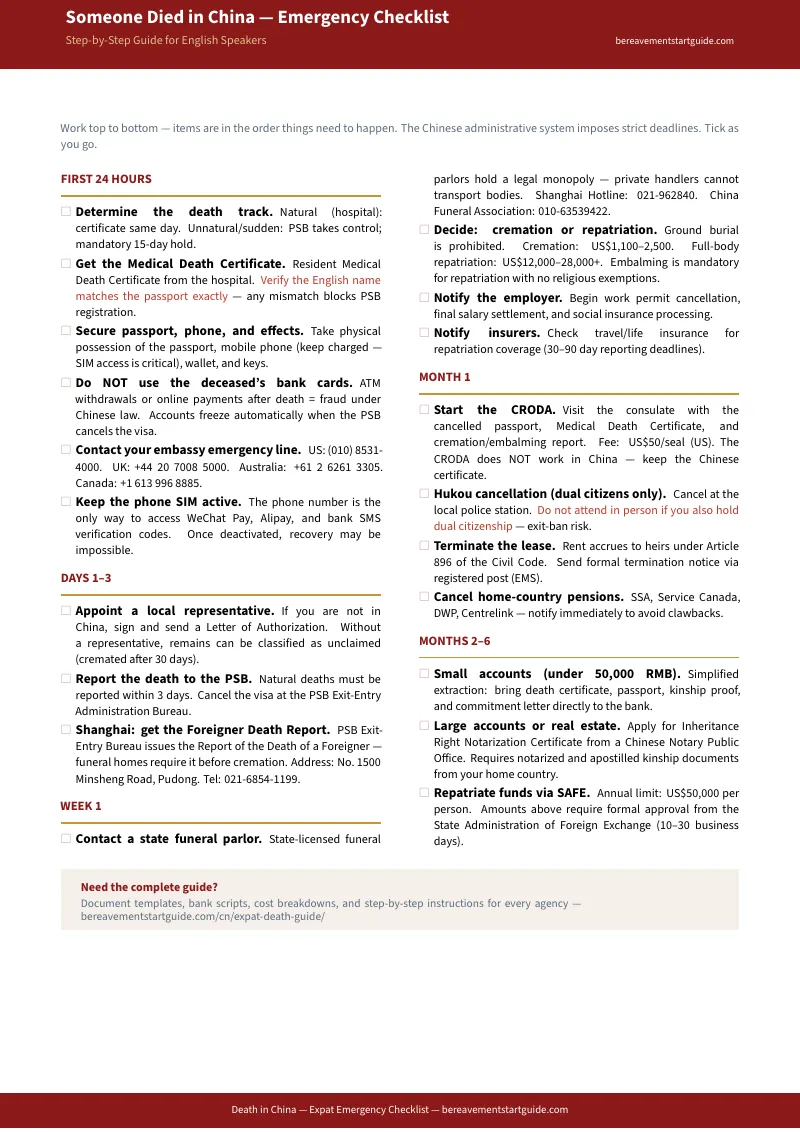
The free Emergency Checklist gives you the critical first steps — who to call, what documents to gather, and the key deadlines. It is the right starting point if you need to act tonight.
The full guide covers the complete process from death to estate settlement — dual-track classification, cremation mandates, bank freezes, digital estate recovery, inheritance claims, repatriation logistics, and professional services triggers — with fillable worksheets you can use at every stage. For , it replaces hours of fragmented research and potentially thousands of dollars in avoidable professional fees.
Frequently Asked Questions
What if the rules change after I buy?
We update the guide when the rules change. Email us any time, even years later, and we'll send you the current edition free.