The hospital gave you a form in Spanish. The bank froze the accounts. The Fiscalía took the passport. And Colombian law says you have 48 hours to register the death.
When someone dies in Colombia, the system does not slow down because you do not speak Spanish. The death must be registered at a local notary within 48 hours — miss that window and the process shifts to a police inspector, freezing funeral arrangements, repatriation, and everything downstream. The deceased's bank accounts are locked the moment the bank finds out. And if the death happened outside a hospital — an accident, a fall, a drowning, an apparent overdose — the Fiscalía takes immediate control of the body, confiscates the passport, phone, wallet, and credit cards as evidence, and sends everything to Medicina Legal for a mandatory autopsy you cannot prevent.
Meanwhile, you are trying to coordinate across Colombian notaries, prosecutors, forensic institutes, funeral homes, embassy officers, tax authorities, banks, and landlords — each operating in dense legal Spanish with their own rules about who they will talk to and what documents they require. And the power of attorney your family drafted from abroad? If it names the funeral home instead of a specific person with their Cédula number, every office in Colombia will reject it.
The English-language resources that exist are scattered across embassy pages that list phone numbers but no procedures, expat forum threads with outdated advice, and Colombian government sites that explain the law in technical Spanish but not how to actually execute it from abroad. No single source walks you through the full sequence — from the first phone call to estate closure — in plain English, with every Spanish term translated, every deadline flagged, and every form identified.
The Colombia Death Administration Roadmap — every deadline, every institution, every Spanish term explained, in the order things actually happen
The Someone Died in Colombia: English Speaker's Emergency Guide is a chronological administrative roadmap built for the specific situation of navigating Colombian death bureaucracy without fluent Spanish. It follows the actual sequence — not alphabetical topics, not a glossary, but the order in which the Fiscalía, notaries, banks, funeral directors, and inheritance law expect you to act.
Every Spanish legal term appears with its English translation the first time it is used. Every deadline is flagged with its legal basis. Every institution is identified with its full official name and what it can and cannot do. And the guide separates the two tracks — natural death and non-natural death — at every step, because the Colombian system treats them completely differently and the consequences of following the wrong track are severe.
What's inside
- First 60 minutes protocol — what to do depending on whether the death happened under medical care or not, how to secure the passport and Cédula de Extranjería, when to call emergency number 123, and the critical rule about never touching the deceased's bank accounts (any post-death withdrawal triggers criminal theft charges)
- Natural vs. non-natural death tracks — how the Fiscalía decides to take control, what happens when Medicina Legal classifies the cause as muerte por establecer (to be determined), why that classification blocks international insurance claims for up to a year, and how to petition for the final autopsy report
- 48-hour registration deadline — exactly what to bring to the notary, how to get the Registro Civil de Defunción, and what happens when you miss the window (a formal order from the local police inspector that delays everything)
- Power of Attorney template — a bilingual poder especial template that names a specific individual with their Cédula number, because generic POAs addressed to a funeral company are rejected at every Colombian office
- Forensic process walkthrough — scientific identification methods (fingerprints, dental, DNA), how long each takes, why visual identification by family is legally prohibited, cremation restrictions during active investigations, and the process for getting the body released
- Embassy capabilities and limits — what your embassy will do (open a case file, issue a CRODA), what they explicitly will not do (pay for repatriation, provide legal representation, intervene in judicial investigations), and the Consular Report of Death Abroad process for U.S. citizens
- Bank account freeze and direct release — why every individual account is locked on death notification, the Circular Carta 0058 de 2025 exemption that lets heirs access balances up to approximately COP $91.8 million without formal probate, and why cooperative capital contributions (aportes sociales) do not qualify for direct release
- Lease and property rights — your protections under Law 820 of 2003, the three legal options for handling the deceased's rental agreement, why the landlord cannot legally seize belongings or lock out heirs, and how to use judicial escrow at Banco Agrario if you cannot identify the correct landlord heir
- Estate succession and tax — how the sucesión ilíquida works, the DIAN notification threshold at 700 UVT (approximately COP $36.7 million in 2026), the 35% withholding tax for non-resident heirs on insurance payouts above 3,250 UVT, and the critical difference between notary succession (weeks, if all heirs agree) and judicial succession (months to years, if anyone objects)
- Repatriation logistics — embalming requirements for international transit, hermetically sealed casket specifications, approved carriers, the full apostille-and-translation chain through Colombia's Ministry of Foreign Affairs, and costs ranging from $10,000 to $30,000 depending on destination
- Same-sex partner rights — Colombia's legal protections since 2016, how to assert your authority when conservative family members challenge it, and the Constitutional Court rulings that protect your standing in succession proceedings
- Six mistakes that cost weeks and thousands — drafting the POA to the company instead of a named person, using the deceased's bank cards after death, missing the 48-hour registration window, not cancelling EPS and PILA billing, trying to fly with a metal urn, and assuming the embassy handles everything
Plus 8 standalone printable PDFs — a first-60-minutes triage sheet, bilingual power of attorney template, document checklist with costs, emergency contacts fridge sheet, Spanish legal terms glossary, 2026 financial thresholds card, international repatriation checklist, and bank account direct release guide. Print the one you need and bring it to the office, bank, or notary.
Who this is for
- Expats in Colombia whose spouse, partner, parent, or fellow resident has just died — and who need to know what to do tonight, not after a week of research
- Family members abroad who just received a call from a Colombian hospital, police station, or embassy — and have no idea how to navigate a system built entirely in Spanish
- Same-sex partners who need to assert their legal rights immediately — because the Colombian system may not recognize your relationship automatically without the right documentation
- Non-resident heirs managing a Colombian estate from the US, UK, Canada, or Australia — dealing with apostilled powers of attorney, certified translations, and an administrative system that operates in legal Spanish
- Anticipatory planners with a retired parent or long-term partner living in Colombia — preparing now so they are not blindsided later
Why not just use the free resources?
The U.S. Embassy in Bogotá publishes a fact sheet that lists consular services and funeral home contacts — but explicitly states it cannot assist with financial matters, legal representation, or the succession process. The Colombian government websites explain the law in technical Spanish with no practical guidance for foreigners. And the expat forums where people share first-hand experiences? The advice is fragmented, often legally wrong (like assuming Anglo-American probate concepts apply in a civil law country), and frequently outdated — tax thresholds and direct release limits change annually.
No single free source covers the full sequence from the first phone call to estate closure in plain English, with current 2026 legal thresholds, in the order things actually happen. This guide does.
The cost of getting it wrong
- Missing the 48-hour notary registration window and requiring a formal police inspector order that delays funeral arrangements by days or weeks
- Having your power of attorney rejected at Medicina Legal because it names the funeral home instead of a specific person — while the body sits in the forensic morgue
- A family member using the deceased's bank card after death, triggering criminal theft charges and permanently blocking the estate's accounts
- Paying a Colombian law firm tens of millions of pesos for a succession process you could have avoided entirely — because the bank balance was below the direct release threshold
- Waiting a year for the final autopsy report because nobody told you to file a formal petition through a lawyer while the investigation was still open
- A surviving same-sex partner losing access to the apartment, bank accounts, and personal effects because they did not know how to assert their Constitutional Court-protected rights
Satisfaction guarantee
If the guide does not give you a clear path through Colombian death administration, email us for a full refund. No questions, no hoops. You are dealing with enough bureaucracy already.
Get the free checklist or the full guide
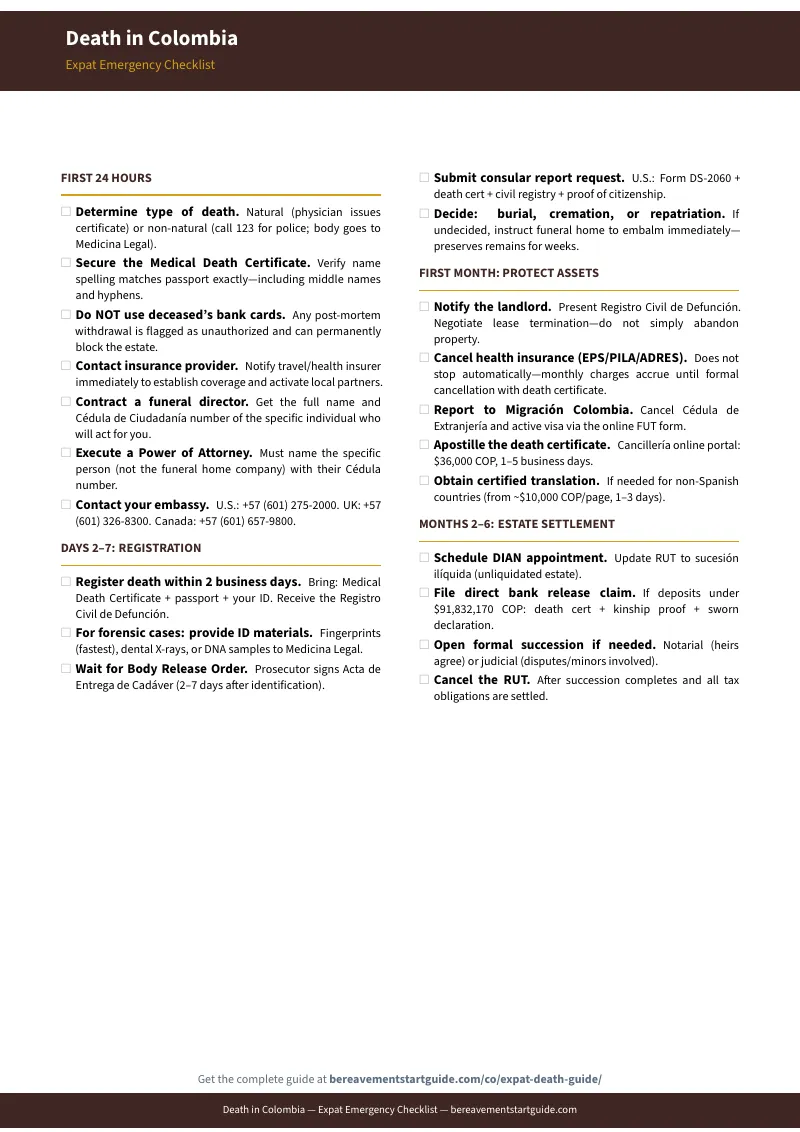
The free Emergency Checklist gives you the critical first steps — who to call, what documents to secure, and the key deadlines. It is the right starting point if you need to act tonight.
The full guide covers the complete process from death to estate closure — the 48-hour registration clock, Fiscalía investigations, bank freezes, direct release rules, succession, repatriation, tax, and property rights — with a bilingual POA template and document checklist you can use at every stage. For , it replaces hours of fragmented research and potentially tens of millions of pesos in avoidable professional fees.
Frequently Asked Questions
What if the rules change after I buy?
We update the guide when the rules change. Email us any time, even years later, and we'll send you the current edition free.