Someone You Love Just Died in Costa Rica. The Bank Already Froze the Accounts.
The funeral home is quoting you prices in colones. The embassy gave you a phone number and a pamphlet. The autopsy is mandatory — even if the death was completely natural — but nobody explained that until the body was already at the judicial morgue in Heredia. And the joint bank account you assumed would keep working? Frozen. Instantly. Costa Rica doesn't recognize right of survivorship.
You're standing in a country where every form is in Spanish, where the death must be registered through the Tribunal Supremo de Elecciones (not the hospital, not the embassy), and where the Ministry of Health requires a stack of physical tax stamps before remains can leave the country. Google searches send you to forum posts from 2018 or law firm blogs that conveniently stop short of the actual steps — because they want you to hire them at $180 an hour.
The Costa Rica Death Administration System
This guide was built for the specific crisis English speakers face in Costa Rica. Not generic "what to do when someone dies abroad" advice — the precise, Costa Rica-specific procedures that trip up every foreign family: the difference between the medical certificate and the TSE death registration, the Ley 10181 bank beneficiary clause that can unlock frozen funds without probate, the mandatory autopsy rules that apply to cremation even when the death is natural, and the Ministry of Health permit process that must happen before a body can be repatriated or cremated.
It doesn't replace a lawyer or funeral director. It tells you exactly when to hire each one, what questions to ask so you don't overpay, and which steps you can handle yourself — saving you thousands of dollars in professional fees you didn't need to spend.
What You Get
The Complete Guide (12 Chapters + 5 Appendices)
- Emergency Response Protocol — who to call based on where the death happened (hospital, home, accident scene), with separate paths for each scenario and the critical warning about calling 911 for a natural home death (it triggers the OIJ forensic investigation unit and a mandatory judicial autopsy).
- Remains Disposition — side-by-side cost breakdowns for local cremation ($1,300–$1,900), local burial ($1,000+), embalming ($1,800–$2,200), and full repatriation ($2,200–$5,000). Includes airline cargo requirements, the hermetic shipping container mandate, and the Consular Mortuary Certificate process.
- Death Registration with the TSE — the exact process for registering a foreign national's death with the Civil Registry, including the SEDIMEC online system, the forms the funeral director needs, and the 8-business-day timeline for opportune registration.
- Bank Account Protection (Ley 10181) — how Costa Rican banks freeze accounts, why joint accounts don't protect you, the beneficiary designation that bypasses probate entirely, and what to do if the designation wasn't set up before the death.
- Probate Navigation — notarial probate (3–6 months when heirs agree) vs. judicial probate (1–4 years when they don't), statutory attorney and notary fee schedules under Decree 36562-JP, and the sliding-scale formula so you can calculate exact legal costs before hiring anyone.
- Lease Subrogation (Ley 7527) — the little-known law that lets a surviving spouse or cohabitant take over a rental lease, with the exact documentation and timeline required.
- Labor Benefits & Pension Recovery — claiming CCSS survivor pensions, locating pension funds through SUPEN, recovering the Fondo de Capitalización Laboral through Labor Court, and the contribution-quota thresholds that determine eligibility.
- Insurance & INS Claims — filing with the National Insurance Institute and private insurers, the specific documents required for accidental death claims (OIJ forensic file, toxicology reports, traffic accident reports), and what happens when no beneficiary was named on the policy.
- OIJ Forensic Timeline — what the Organismo de Investigación Judicial does with the body, how long the forensic autopsy takes, why the final cause-of-death report can take months, and how it affects your CRODA application.
- Common Mistakes — the errors that cost English-speaking families the most time and money, from assuming embassy resources are sufficient to using a foreign will without understanding exequatur.
- Preventative Planning — everything you can do now to prevent this crisis for your own family, including drafting a Costa Rican will, registering bank beneficiaries under Ley 10181, and structuring corporate assets.
Plus 5 Appendices and 9 Standalone Printable PDFs
- Document Tracker — printable checklist of every document you need across each phase, from the first 72 hours through probate
- Bilingual Template Letters — ready-to-use Spanish/English templates for bank notification, landlord lease subrogation, and employer notification (each also available as a standalone PDF)
- Administrative Call & Email Log — two-page worksheet to track every interaction with government offices, banks, lawyers, and insurers
- Agency Contact Directory — every phone number, email, and office address organized by function
- Emergency Response Protocol — one-page decision tree for hospital, home, and accident-scene deaths
- Remains Cost Comparison — side-by-side cost breakdown for burial, cremation, and repatriation
- Probate Fee Calculator — statutory fee schedule with a fill-in worksheet to calculate exact legal costs
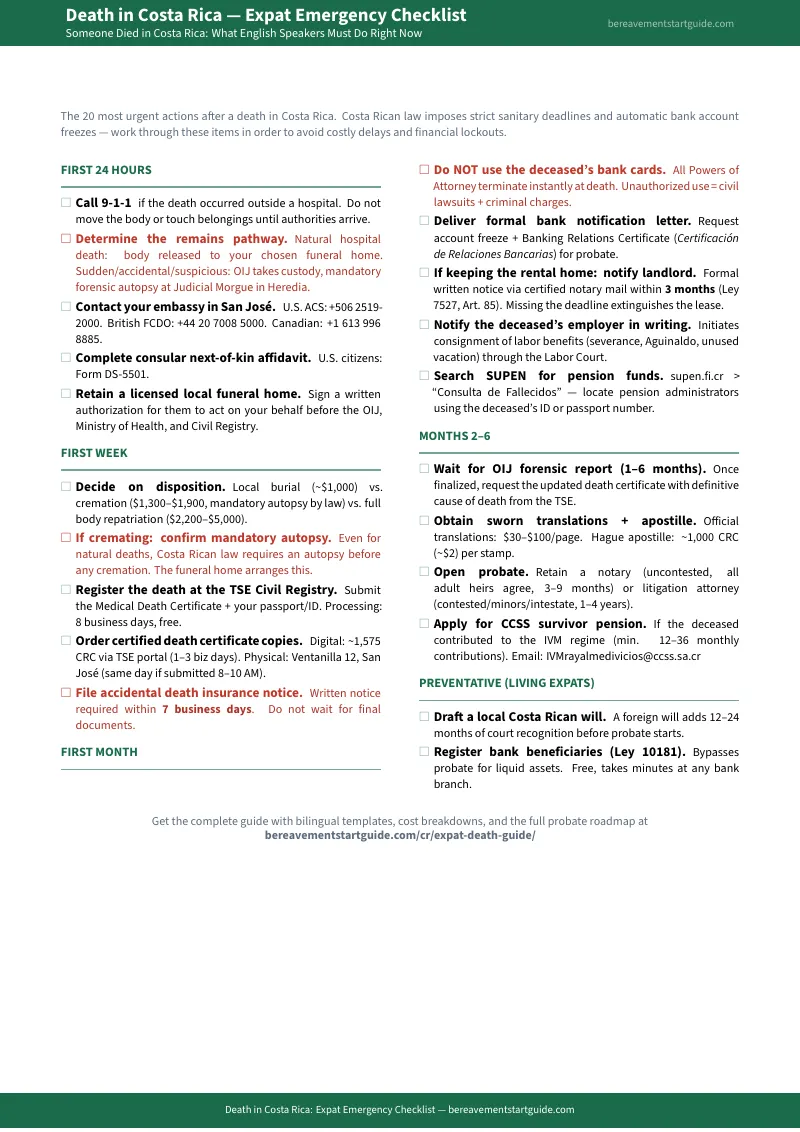
Free Emergency Checklist
Not ready for the full guide? Download the free 20-item emergency checklist — the critical first steps so nothing falls through the cracks in those overwhelming first hours.
Who This Is For
- Expat spouses and partners who need to protect bank accounts and property before the freeze locks everything out
- Adult children managing from abroad who need to decide whether to fly to Costa Rica or handle everything remotely through a local attorney
- Tourists and travel companions dealing with an accidental death and an autopsy process they didn't know existed
- Retirement community members who want to prepare now so their family never faces this unprepared
Why Not Just Use Free Resources?
The US Embassy page explains how to get a CRODA but says nothing about how to stop the bank from freezing your accounts. The TSE website has the death registration forms but is written in dense legal Spanish. Law firm blogs walk you through probate — right up to the point where they want you to call and pay $180 an hour. And expat forums are full of anecdotal advice that's often wrong, outdated, or illegal.
This guide connects the pieces that no single free resource covers: the sequence from emergency response to death registration to bank recovery to probate to pension claims to tax obligations — in one document, in plain English, with the Spanish legal terms you'll need at every counter.
— Less Than One Hour of a Costa Rican Attorney
A single consultation with a bilingual attorney in Costa Rica runs $150–$250. The statutory probate legal fee on a $200,000 estate is nearly $14,000 — set by decree, non-negotiable. This guide doesn't eliminate the need for professional help, but it tells you exactly which steps require a professional and which you can handle yourself. That distinction saves most families thousands.
Every purchase includes a satisfaction guarantee, no time limit. If the guide doesn't help, email hello@bereavementstartguide.com for a full refund.
Frequently Asked Questions
What if the rules change after I buy?
We update the guide when the rules change. Email us any time, even years later, and we'll send you the current edition free.