The hospital gave you 48 hours of free body storage. The registry office wants documents you have never heard of. The bank just froze every account. And every official you call speaks Czech.
When someone dies in Czech Republic, the system does not slow down because you do not speak the language. The examining physician issues a multi-part Certificate of Examination — and each part goes to a different authority. The Civil Registry Office needs the deceased's birth certificate, marriage certificate, and residence permit to issue the Czech death certificate. The hospital covers body storage for exactly 48 hours, then transfers the remains to a commercial provider at your expense. And the body must be buried or cremated within 96 hours unless you initiate formal international repatriation.
Czech inheritance law does something that blindsides families from common-law countries: it transfers every debt the deceased ever had directly onto the heirs, automatically, the instant they die. If you do not formally refuse the inheritance within one month — or three months if you live outside Czech Republic — you are personally liable for those debts. Not from the estate. From your own pocket.
The English-language resources available online are scattered across embassy fact sheets, expat forum threads from years ago, and Czech law firm blogs that explain enough to create urgency before redirecting to retainers starting at €200 per hour. No single source walks you through the full sequence — from the first phone call to the final probate resolution — in plain English, with the actual Czech legal terms you need when you are standing at the counter of a matriční úřad that does not operate in English.
The Czech Death Administration Roadmap — every deadline, every form, every Czech term explained, in the order things actually happen
The Someone Died in Czech Republic: English Speaker's Emergency Guide is a chronological administrative roadmap built for the specific situation of navigating Czech death bureaucracy without fluent Czech. It follows the actual sequence — not alphabetical topics, not a glossary, but the order in which Czech authorities, banks, courts, and funeral directors expect you to act.
Every Czech legal term appears with its English translation the first time it is used. Every deadline is flagged with its legal basis. Every form is identified by its official name. And every step tells you whether you can handle it yourself or whether this is the precise moment you need a notary, a lawyer, or a consular officer.
What's inside
- First 24 hours protocol — who to call in what order, how to get the Certificate of Examination (List o prohlídce zemřelého) from the attending physician, what each of the four parts (B1, B2, B3, A) does, and how to contact your embassy before the first deadline expires
- The 48-hour storage window and 96-hour burial deadline — what happens when the hospital's free storage period ends, how commercial storage providers charge, the legal deadline for burial or cremation, and the only conditions under which it can be extended
- Burial vs. repatriation decision framework — local cremation costs (15,000–30,000 CZK), local burial costs (42,000–78,000 CZK), full international repatriation costs (72,000–82,000 CZK), the Laissez-Passer process, zinc-lined coffin requirements, and the far simpler rules for transporting cremated ashes
- Death certificate walkthrough — the 30-day issuance timeline, the documents the matriční úřad requires, how to request duplicate copies, and the exact process for apostille and sworn translation to make the certificate valid internationally
- Bank account freeze mechanics — how Czech banks handle accounts after death, the critical difference between a Power of Attorney (plná moc, invalidated immediately) and post-mortem disponent rights (dispoziční právo, can survive), how to present documentation to release funds, and how standing orders and SIPO payments continue during probate
- Probate and the court commissioner system — how the district court automatically appoints a notary (soudní komisař) you cannot choose, the statutory notary fee schedule (2% on the first 500,000 CZK, sliding scale above), the mandatory will registry search, and what happens at the preliminary hearing
- Inheritance refusal and the inventory reservation — the one-month domestic and three-month international deadline to refuse inheritance, the irrevocable nature of the declaration, how the inventory reservation (výhrada soupisu) caps your personal liability, and the six statutory orders of succession when there is no will
- Cross-border succession under EU Regulation 650/2012 — which country's law applies, how habitual residence determines jurisdiction, how a nationality choice-of-law clause in the will overrides the default, and when the Special Registry Office in Brno (Zvláštní matrika) gets involved
- Professional services decision matrix — the exact trigger points for when you need a funeral director (always), a consular officer (repatriation and document legalization), a notary beyond the court-appointed one (complex real estate), a lawyer (contested estates only), and a sworn translator (every official document) — so you never pay for help you do not need
Plus 8 printable standalone PDFs — document recovery tracker, contact and document log, expense tracker, notification tracker, emergency contact directory, master timeline, complete document checklist, and template notification letters in both English and Czech — each designed to be printed and used at the matriční úřad, at the bank, or at the notary's office.
Who this is for
- Expats in Czech Republic whose spouse, parent, or family member has just died — and who need to know what to do tonight, not after a week of research
- Family members abroad who just received a call from a Czech hospital, police station, or embassy — and have no idea where to start
- Non-resident heirs who received a letter from a Czech district court or notary and need to understand their obligations before the inheritance refusal deadline expires
- Anticipatory planners with an elderly parent or ill family member living in Czech Republic — preparing now so they are not blindsided later
Why not just use the free resources?
The U.S. Embassy publishes a two-page fact sheet. The Czech government publishes detailed procedural pages — in Czech. Expat forums have threads with advice that references laws that have since changed. And the English-language law firm blogs that rank on Google explain the problem in enough detail to create urgency, then cut off before the procedural steps and redirect to a €200/hour consultation.
No single free source covers the full sequence from death to estate settlement in English, with current Czech law, in the order things happen. This guide does.
The cost of getting it wrong
- Missing the one-month inheritance refusal deadline and becoming personally liable for the deceased's debts — from your own assets, not the estate
- Losing the 48-hour free hospital storage window and paying commercial storage fees that compound daily while you figure out funeral arrangements
- Having the matriční úřad reject your death registration because the marriage certificate was not apostilled — delaying the death certificate, the bank release, and every downstream process
- Assuming your Power of Attorney still works after the death — then discovering the bank has blocked all access because a plná moc is automatically revoked
- Letting pension overpayments accumulate because nobody notified ČSSZ — then having the Social Security Administration claw the money back from the estate
- Paying a private notary thousands of crowns for services the court-appointed soudní komisař provides as part of standard probate
Satisfaction guarantee
If the guide does not give you a clear path through Czech death administration, email us for a full refund. No questions, no hoops. You are dealing with enough bureaucracy already.
Get the free checklist or the full guide
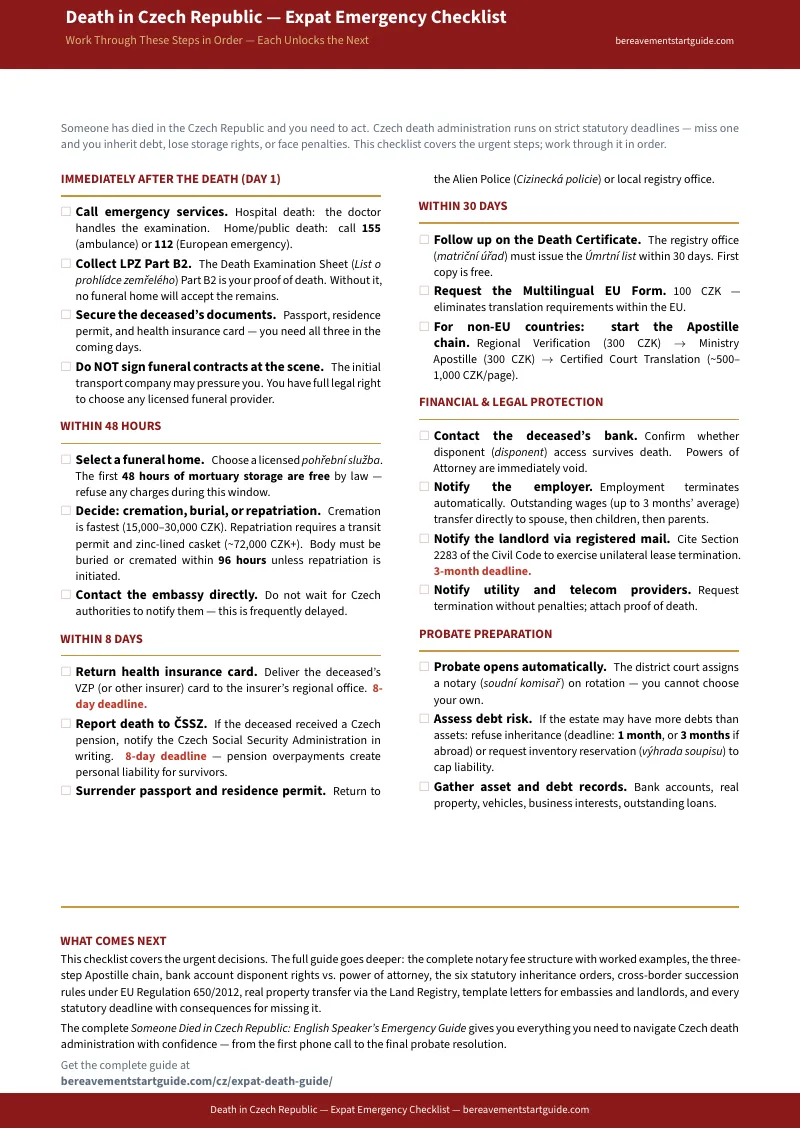
The free Emergency Checklist gives you the critical first steps — who to call, what documents to gather, and the key deadlines. It is the right starting point if you need to act tonight.
The full guide covers the complete process from death to estate settlement — bank freezes, probate, inheritance refusal, repatriation, cross-border succession, and document legalization — with fillable worksheets you can use at every stage. For , it replaces hours of fragmented research and potentially thousands of euros in avoidable professional fees.
Frequently Asked Questions
What if the rules change after I buy?
We update the guide when the rules change. Email us any time, even years later, and we'll send you the current edition free.