
The mairie closes in two hours. The bank froze the accounts this morning. The funeral director's contract is six pages of French legalese. And you have six working days before the body must be buried or cremated.
When someone dies in France, the system does not slow down because you do not speak French. The death must be registered at the town hall within 24 hours. The funeral must be arranged within six working days. The bank locks every sole account the moment it is notified. And the French legal system requires you to engage a notaire for almost any estate — unless you know the exact thresholds where you do not.
The English-language resources that exist are scattered across embassy fact sheets, expat forum threads with outdated information, and funeral home websites that explain just enough to make you anxious before quoting €4,000 for a service package. No single source walks you through the full process — from the first phone call to the final tax return — in plain English, with the actual French terms you need when you are standing at the counter of a mairie that does not operate in English.
The France Death Administration Roadmap — every deadline, every form, every French term explained, in the order things actually happen
The Someone Died in France: English Speaker's Emergency Guide is a chronological administrative roadmap built for the specific situation of navigating French death bureaucracy without fluent French. It follows the actual sequence — not alphabetical topics, not a glossary, but the order in which French authorities, banks, consulates, and funeral directors expect you to act.
Every French legal term appears with its English translation the first time it is used. Every deadline is flagged with its legal basis. Every form is identified by its official name. And every step tells you whether you can handle it yourself or whether this is the precise moment you need a notaire, an avocat, or a consular officer.
What's inside
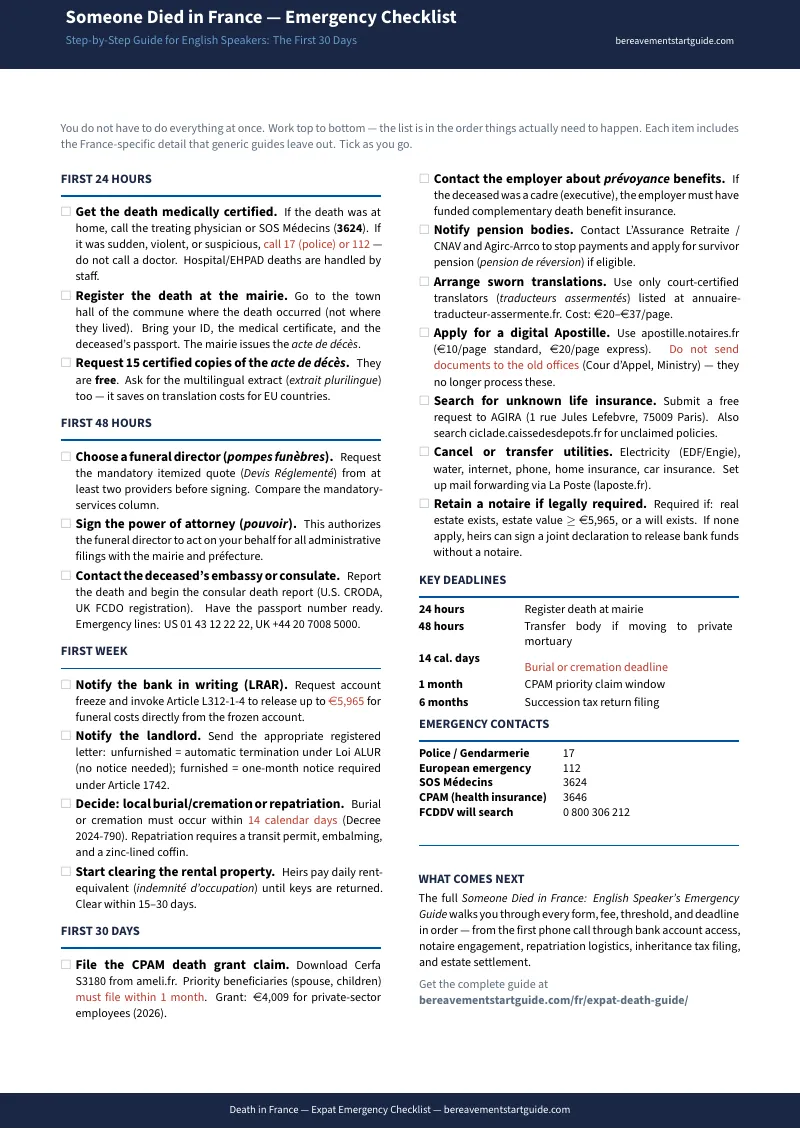
- First 24 hours protocol — who to call in what order, how to get the certificat médical de décès from the attending doctor, what documents to bring to the mairie, how to request 15 certified copies of the acte de décès (they are free), and the critical difference between the medical certificate and the civil death certificate that trips up every English speaker
- Funeral director coordination — the mandatory itemized quote (Devis Réglementé) you are legally entitled to request, how to compare the three columns separating mandatory costs from optional services and third-party fees, and the power of attorney (pouvoir) that authorizes the director to handle all administrative filings on your behalf
- Bank account freeze mechanics — how French banks handle sole accounts, joint "ou" accounts, and joint "et" accounts differently after death, the legal provision that lets you release up to €5,965 from frozen accounts to pay funeral costs, the capped bank estate fees (max €850), and the exemptions for estates under €5,910
- Embassy and consulate protocols — how to report the death to the U.S., UK, Australian, Canadian, or Irish consulate, what a Consular Report of Death Abroad (CRODA) is and how to get one, and what consular services actually cover versus what families wrongly assume embassies will handle
- Repatriation logistics — the zinc-lined coffin requirement, embalming rules for air transit, the prefectural transit permit (permis de sceller), the medical non-contagion certificate, public prosecutor clearance for non-natural deaths, and the full cost breakdown by destination
- Notaire thresholds explained — the three legal triggers that make a notaire mandatory (real estate, estate over €5,965, will or spousal donation), the regulated fee scale for every notarial act (acte de notoriété at €69.23 TTC, property attestation on a progressive scale), and the bypass that lets small estates settle without a notaire at all
- CPAM death grant claim — the €4,009 grant for employees, the larger grants for self-employed workers, the one-month priority window, the two-year absolute deadline, and the exact Cerfa form number (S3180) with step-by-step filing instructions
- Inheritance tax and forced heirship — the six-month filing deadline (twelve months for non-resident deaths), the complete exemption for surviving spouses and PACS partners, the tax-free allowances by relationship (€100,000 for children, €15,932 for siblings), and how Brussels IV regulation lets cross-border families choose applicable law
- Pension and survivor benefits — how to notify L'Assurance Retraite/CNAV and Agirc-Arrco, the overpayment clawback mechanics, and the survivor pension (pension de réversion) that can pay 54-60% of the deceased's pension
- Managing from abroad — how to grant a power of attorney (procuration) to someone in France, how to use registered mail (LRAR) for all critical notifications, and the full decision tree for remote estate administration
Plus 10 standalone printable worksheets — bilingual template letters for the bank and landlord (ready to send via LRAR), a first-24-hours action sequence for the mairie, a bank freeze worksheet, a notaire decision tree, a repatriation checklist, an inheritance tax reference card, a six-month estate timeline, a French legal terms glossary, a call and activity log, and an official resources directory. Each worksheet is a separate printable PDF you can use at the mairie, the bank, or the notaire's office.
Who this is for
- Expat spouses in France whose partner has just died — facing immediate deadlines in a language you may not fully command, in a system designed for native French speakers
- Family members abroad who just received a call from a French hospital, police station, or embassy — and have no idea what happens next or how to manage the estate from another country
- Tourists' next of kin dealing with an unexpected death during a holiday — focused on repatriation, consular assistance, and getting through the first week without costly mistakes
- Anticipatory planners with an elderly parent or ill family member living in France — preparing now so the administrative shock does not compound the grief
Why not just use the free resources?
The U.S. Embassy publishes a two-page fact sheet. The UK FCDO offers general guidance on deaths abroad. Service-Public.fr has comprehensive information — in French, across dozens of separate web pages, in bureaucratic prose. Expat forums like Survive France have community threads with helpful anecdotes, but mixed with outdated advice, expired bank caps, and incorrect legal citations. And the English-language law firm blogs explain just enough to create urgency before redirecting to consultations starting at €250 per hour.
No single free source covers the full sequence from death to estate settlement in English, with current law, in the order things happen, with bilingual templates you can hand directly to French officials. This guide does.
The cost of getting it wrong
- Missing the 24-hour mairie registration deadline and creating complications for the funeral, the bank, and every downstream administrative step
- Not knowing the €5,965 funeral cost release exists — and scrambling for cash while the bank account sits frozen for months
- Paying a notaire thousands of euros for an estate that could have been settled with a simple signed declaration
- Accepting the first funeral director's quote without realizing you are legally entitled to free itemized estimates from multiple providers
- Assuming the embassy will handle everything — then discovering that consular services are limited to a death report and passport cancellation
- Missing the one-month priority window for the CPAM death grant and losing your priority status for €4,009 in benefits
- Filing the inheritance tax return late and accumulating 0.40% monthly interest penalties because nobody explained the six-month deadline
Satisfaction guarantee
If the guide does not give you a clear path through French death administration, email us for a full refund. No questions, no hoops. You are dealing with enough bureaucracy already.
Get the free checklist or the full guide
The free Emergency Checklist gives you the critical first steps — who to call, what documents to gather, and the key deadlines for the first 30 days. It is the right starting point if you need to act tonight.
The full guide covers the complete process from death to estate settlement — 19 chapters on death registration, bank freezes, repatriation, notaire procedures, inheritance tax, pension claims, and bilingual template letters for every major interaction. For , it replaces hours of fragmented research and potentially thousands of euros in avoidable mistakes and unnecessary professional fees.