The doctor handed you a form in Greek. The bank froze the accounts. The funeral director wants a deposit — in cash, today. And you have 24 hours before the first deadline expires.
When someone dies in Greece, the system does not slow down because you do not speak the language. The medical death certificate must be secured. The municipal registry requires you to file within 24 hours — not one business day, not "as soon as practical," but 24 hours from the moment of death. The bank locks every sole account the instant it is notified. And if the death was sudden or unexplained, the police and state prosecutor will order a mandatory autopsy that you have no legal authority to prevent, regardless of your religious beliefs or cultural objections.
Then comes the part that blindsides families from common-law countries: Greek inheritance law automatically transfers every debt the deceased ever had directly onto you. Not from the estate. From your personal assets. If you do not formally renounce the inheritance within four months — or one year if you live outside Greece — you are personally liable for every euro of debt.
The free information that exists online is scattered across embassy fact sheets, Greek government portals that operate almost exclusively in Greek, and expat forum threads with advice from people who went through this years ago under different laws. The English-language law firm blogs explain just enough to generate anxiety, then redirect to retainers starting at €200 per hour. No single source walks you through the full sequence — from the first phone call to the final Cadastre registration — in plain English, with the actual Greek terms you need when you are standing at the Lixiarchio counter where nobody speaks your language.
The Greece Death Administration Roadmap — every deadline, every agency, every Greek term explained, in the order things actually happen
The Someone Died in Greece: English Speaker's Emergency Guide is a chronological administrative roadmap built for the specific situation of navigating Greek death bureaucracy without fluent Greek. It follows the actual sequence — not alphabetical topics, not a glossary, but the order in which Greek authorities, banks, notaries, and funeral directors expect you to act.
Every Greek legal term appears with its English translation the first time it is used. Every deadline is flagged with its legal basis. Every agency is identified by its official name, phone number, and digital portal. And every step tells you whether you can handle it yourself or whether this is the precise moment you need a notary, a lawyer, or a consular officer.
What's inside
- First 72 hours protocol — who to call in what order, how to secure the Medical Death Report (Ιατρική Βεβαίωση Θανάτου), what documents to have ready, the difference between the medical death certificate and the civil death certificate (Ληξιαρχική Πράξη Θανάτου) that trips up every English speaker, and what to do if the prosecutor orders a mandatory autopsy
- Death registration at the Lixiarchio — the 24-hour deadline, the documents the municipal registry requires, how to request multiple blue-stamped originals of the death certificate, and the consequences if the body is buried before registration (spoiler: it requires a court decision)
- Funeral director engagement and pricing — line-item cost ranges for local burial (€1,500–€3,000), cremation at Ritsona (€800–€1,600 in Athens, more from the islands), and full international repatriation (€4,000–€6,500), so you know when a quote is reasonable and when you are being overcharged
- Embassy coordination and the CRDA — how to report the death, surrender the passport, and obtain the Consular Report of Death Abroad for US, UK, and other English-speaking nationals, including the critical requirement that the Greek death certificate must state the cause of death before the consular report can be finalized
- Bank account freeze mechanics — how Greek banks handle sole accounts, joint accounts, and the critical distinction of joint accounts with a survivorship clause under Law 5638/1932, which bypass the freeze entirely and let the surviving co-holder access funds immediately
- Inheritance renunciation (apoipoiisi) guide — the four-month domestic deadline and one-year international deadline, how to file at the competent succession court, what happens when your renunciation passes the inheritance to your minor children (requires prior court authorization), and the 2026 reform that changes everything for deaths after September 16, 2026
- The 2026 inheritance law reform explained — Law 5303/2026 decouples personal assets from estate debts, transforms forced heirship from physical co-ownership into a monetary claim, and establishes a digital Wills Registry — the guide covers what changed, what did not, and exactly which rules apply depending on the date of death
- Probate pathways — how to obtain a certificate of inheritance (kleronomitirio) through the court, when to use a notarial acceptance deed (Apodochi Klironomias) instead, the statutory fee limit of €200 under Law 5095/2024, and the full document checklist for each pathway
- Real estate transfer and the Cadastre — the notarial deed, Land Registry registration, the one-month Cadastre declaration deadline, and the risk of permanent forfeiture if inherited property is not registered during active cadastral survey windows
- Tax filing and pension clawback — the 9-month (resident) or 1-year (non-resident) inheritance tax deadline, the digital e-EFKA funeral expense reimbursement process, pension overpayment clawback mechanics, and how to deactivate the deceased's tax number through the myAADE portal
- Professional services decision matrix — the exact trigger points for when you need a funeral director (always), a consular officer (for international documentation), a notary (real estate transfers and formal wills), a lawyer (contested estates and debt exposure), and a tax adviser (complex assets above exemptions) — so you never pay for professional help you do not need
Plus 4 standalone printable worksheets and reference cards — emergency consular call script, post-mortem action and call log, document preparation checklist, and key deadlines at a glance — each designed to be printed and used at the Lixiarchio, at the bank, or at the embassy.
Who this is for
- Expats living in Greece whose spouse, parent, or family member has just died — and who need to know what to do tonight, not after a week of research
- Family members abroad who received a call from a Greek hospital, police station, or embassy — and have no idea where to start from thousands of miles away
- Non-resident heirs who discovered they have inherited Greek property or financial assets — and need to understand their obligations before the renunciation deadline expires
- Tourists and holiday visitors dealing with a sudden death during a vacation in Greece — facing an unfamiliar system with no local contacts and no time to research
- Anticipatory planners with an elderly parent or ill family member living in Greece — preparing now so they are not blindsided later
Why not just use the free resources?
The U.S. Embassy publishes a two-page fact sheet on deaths abroad. The Greek government publishes detailed procedural pages — in Greek, behind digital portals that require Taxisnet credentials most foreigners do not have. Expat forums have threads with advice from 2019 referencing pre-2026 inheritance rules. And the English-language law firm blogs that rank on Google explain the problem in enough detail to create urgency, then cut off right before the procedural steps and redirect to retainers.
No single free source covers the full sequence from medical certification to Cadastre registration in English, with current 2026 law, in the order things happen. This guide does.
The cost of getting it wrong
- Missing the 24-hour death registration deadline and being forced to register through a formal court decision — weeks of delay, legal fees, and a frozen funeral process
- Automatically inheriting tens of thousands of euros in estate debt because nobody told you about the four-month renunciation deadline — and discovering that under pre-2026 law, your personal assets are on the line
- Paying a lawyer €1,000+ to file an inheritance certificate application you could have submitted yourself at the succession court
- Having the embassy refuse to issue a Consular Report of Death because the Greek death certificate does not state the cause of death — while the autopsy report sits in a court file for months
- Missing the one-month Cadastre registration deadline after accepting inherited property — risking administrative fines and permanent forfeiture of the land to the Greek state
- Letting pension overpayments accumulate in a frozen bank account because nobody notified e-EFKA — then having the state claw the money back from the estate
Satisfaction guarantee
If the guide does not give you a clear path through Greek death administration, email us for a full refund. No questions, no hoops. You are dealing with enough bureaucracy already.
Get the free checklist or the full guide
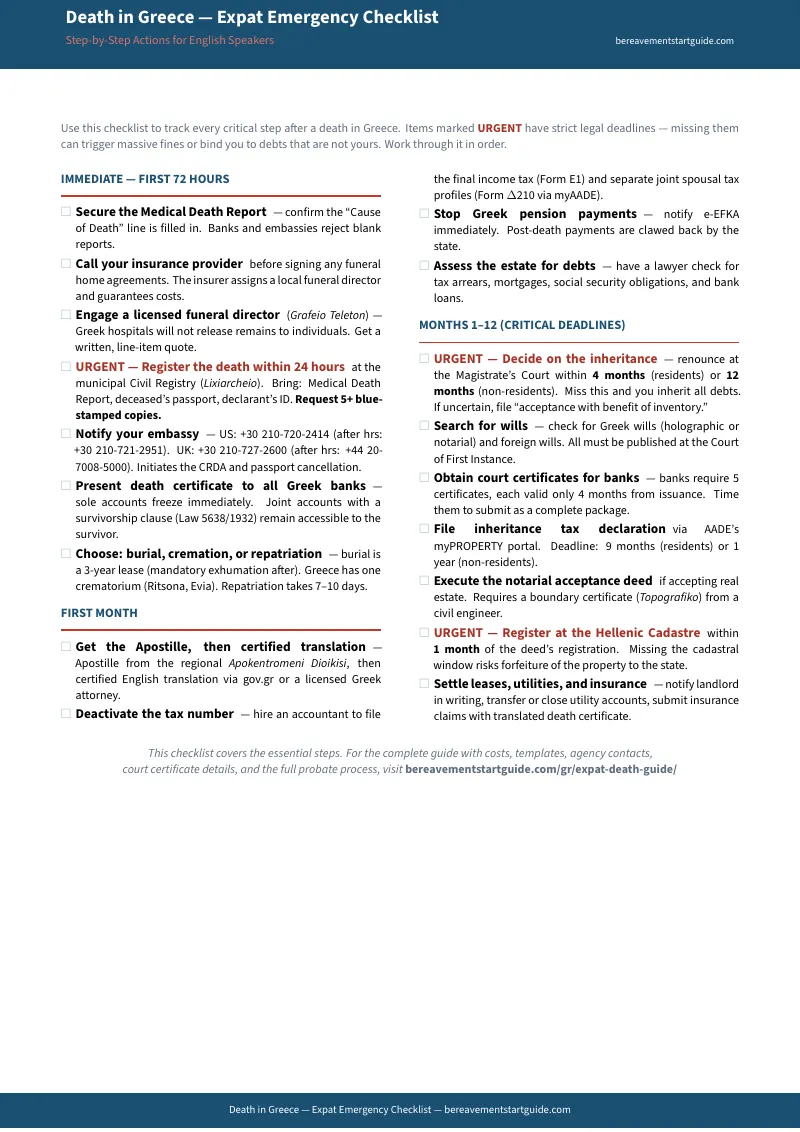
The free Emergency Checklist gives you the critical first steps — who to call, what documents to gather, and the key deadlines. It is the right starting point if you need to act tonight.
The full guide covers the complete process from the first phone call to the final Cadastre registration — bank freezes, inheritance renunciation, repatriation logistics, probate, tax, pension, and property transfer — with printable worksheets you can use at every stage. For , it replaces hours of fragmented research and potentially thousands of euros in avoidable professional fees.
Frequently Asked Questions
What if the rules change after I buy?
We update the guide when the rules change. Email us any time, even years later, and we'll send you the current edition free.