Someone Has Died. The Family Is Already Fighting Over the Body. Your Bank Account Is Frozen.
Within hours of a death in Nigeria, three things happen at once. The extended family arrives to assert control over the burial — citing custom, seniority, or land rights you have never heard invoked before. The deceased's bank accounts freeze the moment the bank receives notification, and being named "Next of Kin" gives you no legal access to a single naira. And the clock starts on a tangle of paperwork that crosses the National Population Commission, a State High Court Probate Registry, and — if the death was sudden — the police and the coroner.
Every family thinks they will figure it out when the time comes. They do not. In Igboland alone, families spend between ₦800 billion and ₦1 trillion annually on burials, with individual budgets routinely reaching ₦15 million. Much of that money goes toward expenses that are driven by social pressure rather than legal obligation — because the family assumed the funeral home, the family elders, or the bank would explain the rules. None of them will. Each has a commercial or customary interest in keeping you in the dark.
Free resources exist. The NPC website has forms. The Lagos State Probate Registry has an online portal. Nairaland has five thousand threads of contradictory advice. But the NPC site does not tell you what happens when the registrar rejects your application because the deceased's NIN does not match the hospital records. The probate registry does not warn you about the 10% estate duty on gross assets that catches every first-time applicant off guard. And Nairaland will confidently tell you things that are legally wrong.
The Nigerian Bereavement Compliance System
This guide integrates every regulatory requirement, customary obligation, and financial claim process into one sequential roadmap — statutory law, customary law, and Sharia, across all regions. It is built around the order in which decisions actually hit you: the first 24 hours, death registration, body release and burial permits, the customary fight over burial location, frozen bank accounts and probate, pension claims, tax obligations, and funeral budgeting.
The result: you stop guessing which government office to visit first, you stop deferring to relatives who cite "tradition" without understanding the court decisions that have overruled those traditions, and you stop paying for services and ceremonies that are socially expected but never legally required.
The "Next of Kin" Trap
The single most expensive misconception in Nigerian bereavement is that the person listed as "Next of Kin" on a bank account can access those funds after death. They cannot. Under Nigerian banking law, "Next of Kin" is an emergency contact — nothing more. The moment a bank is formally notified of a death, every account is frozen. Unfreezing them requires a court-issued Grant of Probate or Letters of Administration, which means filing at the State High Court, paying a 10% estate duty on the gross value of all declared assets, and waiting 3 to 6 months. The guide walks you through the entire LAPRS (Lagos) online application and the equivalent processes in other states, including asset valuation, the 21-day public notice, and the forms that trip up most applicants.
The Customary Burial Dispute
Nigeria's pluralistic legal system means that the right to decide where someone is buried — and who performs the rites — depends on the deceased's ethnic customs. Under Igbo custom, the eldest biological son (Okpara) and the paternal kinsmen (Umunna) control burial decisions. Under Yoruba custom, the surviving spouse and children hold primary authority. Under Benin custom, the eldest male relative leads. Under Islamic law in Northern Nigeria, the closest male relative coordinates burial within 24 hours. When these customs collide with a surviving spouse who married under the Marriage Act — which grants absolute legal priority — the result is a dispute that can freeze the body in a mortuary for weeks while daily refrigeration fees accumulate. The guide maps every major ethnic system, the key Supreme Court and Court of Appeal decisions that override them, and provides mediation templates for resolving disputes without litigation.
The Pension Clock
Under the 2025 PenCom guidelines, pension fund administrators require a specific sequence of documents — death certificate, police extract (for sudden deaths), Letters of Administration — before releasing accrued pension benefits. Missing a step or submitting documents out of order restarts the review. The guide provides the exact document chain for both contributory and non-contributory schemes, including the public service pension and the NSITF.
What You Get
- The Complete Nigeria Funeral Law Guide — 16 chapters covering the pluralistic legal system (statutory, customary, and Sharia), NPC death registration, burial permits, cremation under the Lagos Cremation Law 2013, repatriation, customary burial rights by ethnic group, widows' inheritance protections, LAPRS probate, pension claims, tax obligations, and consumer rights
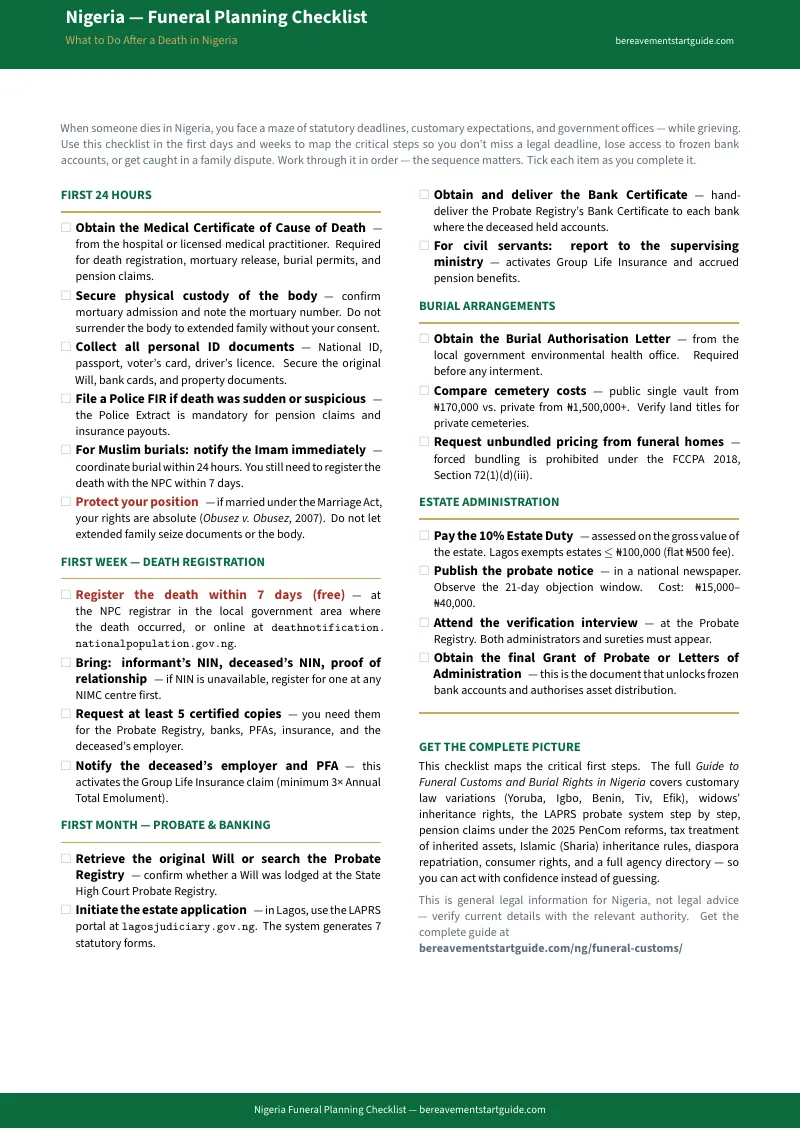
- Funeral Planning Checklist — a printable one-page checklist covering every critical action from the first 24 hours through estate distribution, with deadlines and responsible parties
- NPC Death Registration Walkthrough (standalone printable) — the 7-day free window, late filing procedures, required documents, NIN requirements, and common pitfalls to avoid at the registrar office
- Bank Account Unfreeze Guide (standalone printable) — the 9-step LAPRS probate process, the 10% estate duty calculation, estate duty rates by state, and a fillable account tracking worksheet
- Customary Rights Comparison (standalone printable) — side-by-side breakdown of burial authority under Yoruba, Igbo, Benin, Tiv, Efik, and Hausa-Fulani customs, with the key court decisions that resolve disputes between customary law and statutory marriage rights
- Diaspora Repatriation Roadmap (standalone printable) — the 8-step process with Port Health waiver tiers, Nigerian Consulate permit fees, hermetically sealed casket requirements, and a full cost summary
- Pension and Benefits Claims Guide (standalone printable) — the 2025 PenCom contributory pension process, non-contributory schemes, NSITF, Group Life Insurance, and the exact document chain for each path
- Funeral Budgeting Worksheet (standalone printable) — fillable expense tracker with typical cost ranges, Lagos cemetery cost comparison (₦35,000 temporary to ₦35 million premium vault), and vendor negotiation points
- Consumer Rights Reference (standalone printable) — your FCCPA protections against funeral home price gouging, opaque bundling, and a step-by-step complaint filing guide
- Government Agency Directory (standalone printable) — every office you need (NPC, Probate Registry, Port Health, PenCom, FIRS, AGPT), with portals and a master document checklist
Who This Is For
- Families in the immediate aftermath of a death — surviving spouses, eldest children, or next of kin who need to know what to do right now, in what order, and which documents to secure before extended family interference
- Families facing frozen bank accounts — anyone who has discovered that "Next of Kin" does not mean "can access the money" and needs to navigate the probate process for the first time
- Families in customary burial disputes — surviving spouses whose in-laws are claiming authority over the body, or eldest sons navigating conflicting expectations from the paternal kinsmen and the immediate family
- Diaspora Nigerians coordinating repatriation — families abroad who need to navigate Port Health Services, consulate requirements, and airline cargo rules from a distance
- Executors and administrators — anyone named in a Will or stepping up as an administrator who needs to understand the estate duty, asset valuation, and distribution timeline
Why Free Resources Fall Short
The NPC website will give you a registration form but will not explain what happens when the deceased's NIN does not match hospital records. The Lagos Probate Registry publishes its fee schedule but does not walk you through the 21-day publication notice or the asset inventory format that causes most applications to be sent back. Nairaland forums are full of advice from people who went through the process once, in one state, under one customary system — and assume their experience is universal. A national guide from the UK or US will tell you to "contact the embassy" without mentioning the $79–$249 Port Health Services waiver, the Repatriation Waiver application portal, or the fact that hermetically sealed zinc-lined caskets are not available in many Nigerian mortuaries.
This guide connects every agency, statute, customary system, and financial claim into one sequence — not by replacing legal counsel, but by making sure you know what questions to ask, which deadlines matter, and where the system is designed to take your money if you do not push back.
What This Guide Does Not Do
This guide is an educational and administrative resource, not legal representation. It does not constitute legal, tax, or financial advice, and purchasing it does not create an attorney-client relationship. It does not guarantee eligibility for pension benefits — those determinations are made by the relevant fund administrator. When you need a probate attorney, an estate planning specialist, or intervention from the FCCPA, the guide tells you exactly which professional to engage and why.
— Less Than One Day of Mortuary Refrigeration
Commercial mortuaries in Nigeria charge daily preservation fees that compound quickly — especially when burial is delayed by family disputes, missing documents, or pending probate applications. If this guide prevents just one unnecessary week of mortuary storage, one botched NPC registration that forces a Deputy Chief Registrar application, or one missed pension claim deadline, it has paid for itself many times over. If it gives you the clarity to walk into the probate registry with a complete application on the first attempt, the savings go far beyond the filing fees.
Every purchase includes a money-back guarantee, no time limit. If the guide does not give you the clarity and confidence you need to navigate Nigeria's funeral and estate system, email us for a full refund.
The free Funeral Planning Checklist covers the most critical actions — the ones with hard deadlines and immediate financial consequences. The full guide covers every chapter in depth: the pluralistic legal system, customary burial rights across ethnic groups, the probate process from filing to distribution, pension claims under the 2025 PenCom reforms, diaspora repatriation, cremation, consumer protections, and the complete government agency directory.