The Doctor Handed You a Form in Dutch. The Bank Froze Everything. The Gemeente Wants Registration Before the Burial Deadline. The Notary Quoted €1,200 for a Certificate You Cannot Pronounce. And You Just Learned That Moving a Single Piece of Furniture Could Make You Personally Liable for the Entire Estate's Debts.
Your father died in Amsterdam on a Monday. By Tuesday the funeral director explained that Dutch law requires burial or cremation between 36 hours and six working days after death --- and the clock is already running. You need a burial permit from the municipality. To get the permit, you need the doctor's A-form and B-form. You have never heard of either.
You called the bank. ING froze every account the moment they received the death notification. The debit card stopped working. The standing orders for the apartment rent bounced. Nobody can tell you how to pay the funeral director from the frozen account until you produce something called a Verklaring van Erfrecht --- a Certificate of Inheritance from a Dutch notary. The first notary you contacted quoted €1,200. You do not know if that is normal. It is not. Online notary services start at €395.
Then your sister Googled "Dutch inheritance" and called you back in a panic. She read that simply moving your father's belongings out of his apartment --- or paying one of his bills from your own bank account --- can legally trigger zuivere aanvaarding: unconditional acceptance of the entire estate, including any hidden debts. You froze. You did not know whether touching anything in the apartment was safe.
The Dutch Estate Emergency Navigator is an Inter-Agency Filing Sequence built entirely around Dutch civil law, the 2026 tax framework, and the specific procedural reality that faces English speakers in the Netherlands --- mapping every municipal registration, notarial requirement, bank protocol, court filing, and tax return into one chronological sequence so you never miss a deadline, never overpay a notary, and never accidentally accept debts that are not yours.
What's Inside the Inter-Agency Filing Sequence
A 16-chapter guide, a printable 20-item action checklist, and 8 standalone reference sheets --- covering every Dutch procedure from the doctor's pronouncement to the final tax return, entirely in English:
Chapters 1-3: The First 72 Hours
What makes the Netherlands different from every other country: the strict 36-hour-to-six-day burial window under the Wet op de lijkbezorging. The medical pronouncement process --- calling the huisarts (GP) for an expected death or 112 for an unattended death. Obtaining the A-form (cause of death) and B-form (permission to transport the body). Registering the death at the Gemeente where the person died. Requesting the critical multilingual death certificate extract (Internationaal uittreksel uit de overlijdensakte) that saves you hundreds in translation fees later. The burial plot lease system (grafrechten) and its 15-20 year renewal requirement that catches every foreigner off guard.
Chapter 4: Embassy Liaison and International Repatriation
The complete repatriation roadmap if you need to bring the body home: contacting your embassy, obtaining the Laissez-Passer transit certificate from the municipality of death, the document package required for Mortuarium Schiphol (multilingual death certificate, embalming certificate, freedom-from-infection declaration, waterproof coffin certification for Benelux transit), and the critical rule about passport cancellation --- delay it until repatriation is complete.
Chapter 5: Banking and Account Unblocking
What happens the moment a Dutch bank learns of a death: every individual account, debit card, credit card, and online banking login is frozen immediately. Joint accounts (en/of-rekening) remain accessible to the surviving co-holder, but individual accounts stay locked. The guide includes contact scripts for the Nabestaandendesk (bereavement desk) at ING, ABN AMRO, and Rabobank, plus the specific procedure for getting urgent funeral and medical bills paid directly from the frozen account before you have the Certificate of Inheritance.
Chapters 6-7: Will Search, Inheritance Acceptance, and Notary Selection
How to search the Central Register of Wills (Centraal Testamentenregister --- CTR) --- the free digital search for deaths after September 30, 1994. The three modes of inheritance acceptance that every heir must choose between: zuivere aanvaarding (unconditional --- you inherit everything including debts), beneficiaire aanvaarding (beneficial --- you are liable only up to the estate's asset value, court filing required), and verwerping (rejection --- no assets, no debts, court filing required). The exact actions that accidentally trigger unconditional acceptance. Side-by-side comparison of online notary platforms (starting at €395) versus traditional offices (€600-€1,250+) for the Certificate of Inheritance. How to file a Beneficial Acceptance declaration with the district court (rechtbank) during the 3-month right of deliberation (recht van beraad).
Chapters 8-10: Legal Succession, Property, and Business Settlement
The complete intestacy flowchart (wettelijke verdeling) if there is no will: how assets flow to surviving spouse and children first, then to parents and siblings, then to extended relatives. Why unmarried partners inherit nothing by default without a will or cohabitation agreement (samenlevingscontract) --- and the specific steps to protect a surviving unmarried partner. Property transfer via the Kadaster (Land Registry), mortgage assumption requirements, and the WOZ value trap for inheritance tax. The KVK (Chamber of Commerce) Nabestaandendesk protocol for closing, continuing, or transferring a sole proprietorship (eenmanszaak) or B.V.
Chapters 11-14: Tax Filing (2026 Framework)
Two mandatory tax returns, both explained step by step. The F-biljet: the deceased's final income tax return covering January 1 to the date of death, ordered via the dedicated BelastingTelefoon voor Nabestaanden (0800-235 83 54), due by May 1 of the following year. The erfbelasting (inheritance tax) return: the 2026 exemptions (€828,035 for spouses, €26,230 for children, €2,769 for other heirs), the progressive rate brackets (10-40%), and the new 20-month filing window. Box 3 wealth tax: the 2026 fictitious return rates (1.28% for savings, 6.00% for investments and real estate), the €59,357 tax-free allowance, and how to use the Opgaaf Werkelijk Rendement (OWR) form to pay tax only on verified actual income when the fictitious rate is higher than reality. The 180-day pre-death gift rule.
Chapters 15-16: Cross-Border Complications and Digital Assets
European Certificates of Succession for non-Dutch properties. Converting foreign death certificates through the NetherlandsWorldwide portal. Managing a Dutch estate remotely without a BSN or DigiD. Digital estate management: online banking credentials, crypto wallets, social media accounts, and Dutch digital subscriptions.
Who This Guide Is For
- The expat spouse whose partner just died and who needs to know, right now, which forms to collect from the doctor, how to register the death at the Gemeente, and what NOT to do with the deceased's belongings before consulting a notary --- because one wrong move triggers unconditional debt acceptance.
- The family member coordinating from abroad who cannot fly to the Netherlands immediately and needs to manage bank notifications, notary appointments, and court filings remotely --- including what can be done without a BSN or DigiD.
- The executor named in a Dutch will who does not speak Dutch and is now responsible for the CTR search, the estate inventory, creditor communications, and filing two separate tax returns --- all in a legal system that operates almost exclusively in Dutch.
- The corporate HR team supporting a bereaved international employee who needs a structured, practical English-language resource to hand to someone navigating the worst week of their life in a foreign country.
- The tourist or short-term visitor dealing with a sudden death --- an accident, a medical emergency, a drowning --- who arrived without understanding that Dutch law requires the body to be buried or cremated within six working days, and who now needs the repatriation procedure spelled out clearly.
Why Free Government Pages and Expat Forums Are Not Enough
- Government.nl fragments the process across five agencies. The Gemeente handles registration. The Belastingdienst handles taxes. The Rechtbank handles court filings. The notary handles inheritance certificates. The KVK handles business registrations. Each agency publishes its own isolated set of instructions in Dutch --- none of them tell you how to sequence the steps between agencies, and none of them warn you about the dependencies (you cannot unblock a bank account without the Certificate of Inheritance, which requires a CTR search, which requires the death certificate from the Gemeente).
- Expat forums are empathetic but legally dangerous. Reddit's r/Netherlands and Facebook expat groups are rich in peer-level survival tips. They are also full of advice that conflates Belgian and Dutch inheritance law, misquotes inheritance tax exemptions, and uses outdated filing deadlines. When the stakes are accidental unconditional debt acceptance, "someone on Reddit said" is not a filing strategy.
- Consular guides stop at repatriation. The British Consulate General publishes one of the better English-language resources for deaths abroad. It covers the immediate physical arrangements --- embassy notification, body transport, passport cancellation. It does not cover the Certificate of Inheritance, bank account unblocking, property transfers, the F-biljet, or inheritance tax. The hardest part of dealing with a death in the Netherlands is not the first 72 hours --- it is the six months after.
- Law firm websites explain the problem, then bill €250 per hour for the solution. Dutch law firms and notarial offices publish accurate, detailed articles about estate settlement complexity. Every article ends with a call to action to schedule a consultation. For a straightforward estate --- one property, one bank account, two or three heirs who agree --- the guide walks you through the full process for a fraction of one billable hour.
Free resources give you one agency at a time, in Dutch, with no sequencing and no warnings. The Inter-Agency Filing Sequence maps every municipal registration, notary appointment, bank protocol, court filing, and tax return into one chronological English-language guide --- so you navigate the entire Dutch system without missing a deadline, overpaying a professional, or accidentally inheriting debts that are not yours.
--- Less Than Thirty Minutes of a Dutch Notary's Time
English-speaking families lose weeks and thousands of euros every year --- not because the estate was complicated, but because nobody explained the system in English. A family pays €1,200 for a Certificate of Inheritance when an online notary charges €395 for the same document. An heir accidentally triggers unconditional acceptance by paying a €200 utility bill from their personal account. A surviving unmarried partner discovers they inherit nothing because they never signed a samenlevingscontract. A remote executor misses the F-biljet deadline because they did not know the BelastingTelefoon voor Nabestaanden exists. This guide costs less than any of those mistakes.
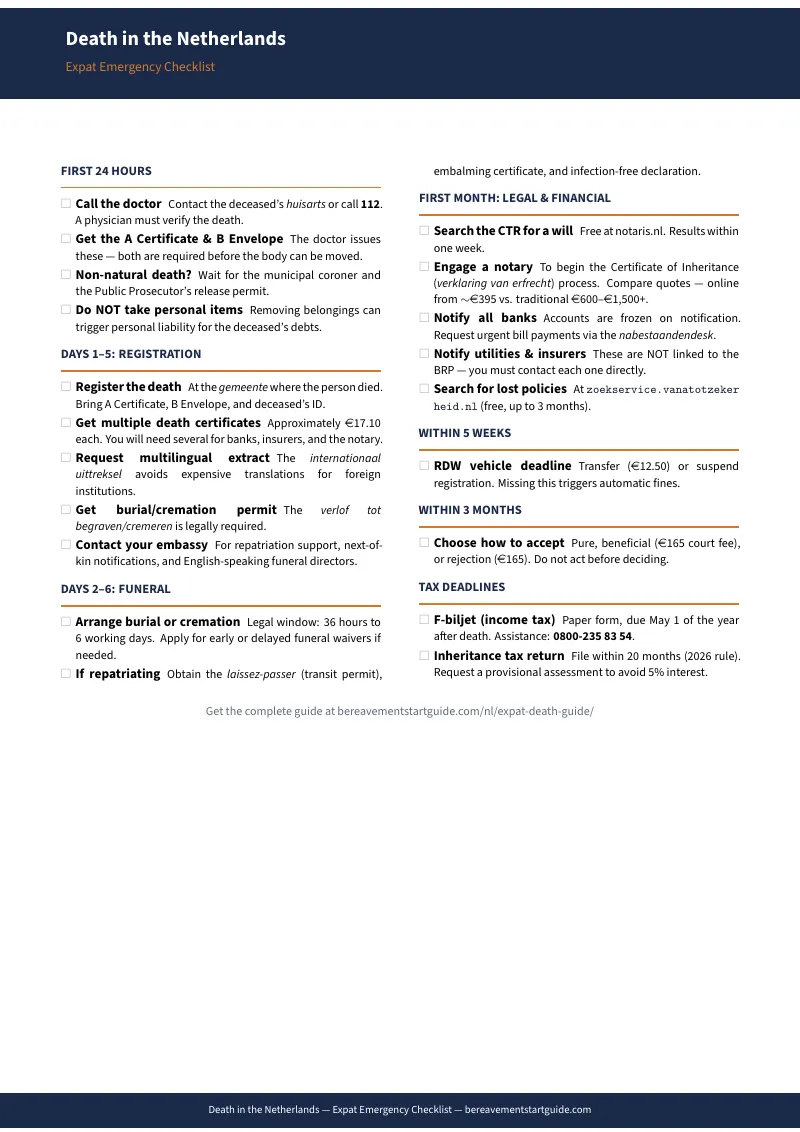
Your download includes the complete 16-chapter guide, the Death in Netherlands --- Expat Emergency Checklist (20 items covering every time-sensitive step), and 8 standalone reference sheets --- inheritance decision tree, bank unblocking scripts, tax filing worksheet, repatriation document package, agency contact directory, costs and fee schedule, key deadlines timeline, and common mistakes reference.
Money-back guarantee, no time limit. If the guide does not give you a clear map of every Dutch procedure, every notary comparison, every tax deadline, and every debt protection option available to English speakers --- email us for a full refund. No questions asked.
Not ready for the full guide? Download the free Death in Netherlands --- Expat Emergency Checklist --- a summary of the 20 most time-sensitive actions, forms, and deadlines. Enough to start the right sequence on day one.
You did not plan for this. But you can plan what happens next. The guide gives you the forms, the deadlines, the notary comparisons, and the filing sequence --- so the next six months are spent settling the estate correctly, not discovering what you missed.