The bank froze your joint account. The funeral director's contract is in Spanish. The probate court requires a seven-stage judicial process. And Panama does not recognize right of survivorship.
When someone dies in Panama, the system does not pause because you do not speak Spanish. The death certificate must be registered at the Electoral Tribunal. The US Embassy needs Form DS-2060 filed to issue a Consular Report of Death. The bank locks every account the moment it learns of the death — not just the deceased's share, the entire balance. And Panamanian law does something that shocks families from common-law countries: it treats your jointly owned property as belonging half to a dead person whose estate must wind through a formal probate court.
If you use the deceased's bank card even once after death — even to pay a hospital bill — you face criminal liability under Panamanian law. If you fail to register the death at the Civil Registry before arranging the funeral, the entire downstream process stalls. And if you sign a funeral director's contract without understanding the repatriation costs, you may commit to $15,000 in transport fees when local cremation and ash repatriation would cost under $2,500.
The English-language resources that exist online are scattered across a two-page embassy FAQ, law firm blogs that explain just enough to justify a $200/hour retainer, and expat forum threads with outdated advice from people who navigated a different system years ago. No single source walks you through the full sequence — from the first phone call to the final Public Registry transfer — in plain English, with the Spanish terms you need when you are standing at a counter that does not operate in English.
The Panama Death Administration Roadmap — every step, every office, every Spanish term explained, in the order things actually happen
The Someone Died in Panama: English Speaker's Emergency Guide is a chronological administrative roadmap built for the specific situation of navigating Panamanian death bureaucracy without fluent Spanish. It follows the actual sequence — not alphabetical topics, not a glossary, but the order in which Panamanian authorities, banks, courts, and funeral directors expect you to act.
Every Spanish legal term appears with its English translation the first time it is used. Every office is identified by its formal name and location. Every form is specified by its official designation. And every step tells you whether you can handle it yourself or whether this is the precise moment you need a licensed Panamanian attorney, a consular officer, or a certified translator.
What's inside
- First 72 hours protocol — who to call in what order, how to get the clinical death certificate from the attending physician, the critical difference between a home death (requires police and Public Prosecutor) and a hospital death, and the exact sequence from hospital to Civil Registry to US Embassy
- Death certificate registration at the Electoral Tribunal — how the clinical certificate becomes a registered Certificado de Defunción, the fees and processing times, how to secure apostilles through the Ministry of Foreign Relations (MIRE), and what happens when the cause of death triggers an autopsy
- Embassy filing and CRODA process — how to submit Form DS-2060, what the electronic Consular Report of Death (CRODA) looks like, Federal Benefits Unit notification for Social Security and VA benefits, and the specific email format the FBU requires
- Repatriation vs. local cremation decision framework — a full cost breakdown showing body shipping ($5,000–$15,000) versus local cremation and ash repatriation ($1,150–$2,550), the four mandatory shipping documents (consular mortuary certificate, apostilled death certificate, transit permit, funeral director affidavit), and why ashes are exempt from the consular mortuary certificate
- Bank account freeze mechanics — how "And" accounts freeze 100% immediately, how "Or" accounts may freeze 50%, why all powers of attorney expire automatically upon death, and the legal consequences of unauthorized account access
- Seven-stage probate walkthrough — the juicio sucesorio from petition to final Public Registry transfer, Municipal Court (under $5,000) versus Circuit Court (over $5,000) jurisdictions, the notary circuit verification bottleneck, mandatory newspaper edict publication, court-appointed expert appraisals, and realistic timelines
- Property transfer and tax clearances — the quarterly paz y salvo barrier on the DGI eTax platform, back-tax obligations that block transfers, the 2% transfer tax and capital gains rules, and the extreme complexity of inheriting Possession Rights properties
- Will types and validation requirements — Open Will, Closed Will, Holographic Will, and Nuncupative Will compared, the two-translator requirement for foreign-language wills, the five-year filing deadline for holographic wills, and when a Private Interest Foundation bypasses probate entirely
- Lawyer fee negotiation guide — the statutory minimums under Agreement No. 49 of 2001 (15% for estates under $50,000, 10% above), court-appointed expert appraisal fees, and how to negotiate below the standard schedule
Plus standalone printable worksheets and reference cards — document tracker, timeline planner, cost comparison sheet, funeral home contact directory, estate inventory worksheet, Spanish-English bank notification letter templates, utility notification scripts, and HOA notification letters — each designed to be printed and used at the Civil Registry, at the bank, or handed directly to your Panamanian attorney.
Who this is for
- Expats in Panama whose spouse, partner, or family member has just died — and who need to know what to do tonight, not after a week of research
- Family members abroad who just received a call from a Panamanian hospital, police station, or the US Embassy — and have no idea where to start
- Remote heirs managing an estate from the US, Canada, or UK without flying to Panama — who need to understand the Power of Attorney process and how to instruct a local lawyer
- Proactive retirees with property, bank accounts, or corporate holdings in Panama — structuring their affairs now so their heirs avoid the seven-stage probate pipeline
Why not just use the free resources?
The US Embassy publishes a two-page fact sheet with funeral home contacts and a Form DS-2060 link. The Panamanian government publishes detailed procedural pages — in Spanish. Expat forums have threads with contradictory advice about joint accounts and survivorship rights. And the English-language law firm websites that rank on Google are deliberately incomplete: they explain the probate problem in enough detail to create urgency, then redirect to estate planning packages starting at $1,350.
No single free source covers the full sequence from death to estate settlement in English, with current law, in the order things happen. This guide does.
The cost of getting it wrong
- Using the deceased's bank card after death and facing criminal liability for unauthorized asset dissipation under Panamanian law
- Paying $15,000 for full body repatriation when local cremation and ash repatriation would have cost under $2,500
- Losing months of delay because the notary circuit verification was not started — every notary in the district must certify that no will exists before the petition is admitted
- Signing a lawyer engagement at 15% of estate value without knowing the fee is negotiable and that Agreement No. 49 sets a minimum, not a fixed rate
- Assuming your jointly-owned condo will transfer automatically to you — then discovering that Panama has no right of survivorship and the deceased's half is now locked in probate court
- Missing the quarterly tax clearance window and having to restart the paz y salvo application, adding months to the property transfer
Satisfaction guarantee
If the guide does not give you a clear path through Panamanian death administration, email us for a full refund. No questions, no hoops. You are dealing with enough bureaucracy already.
Get the free checklist or the full guide
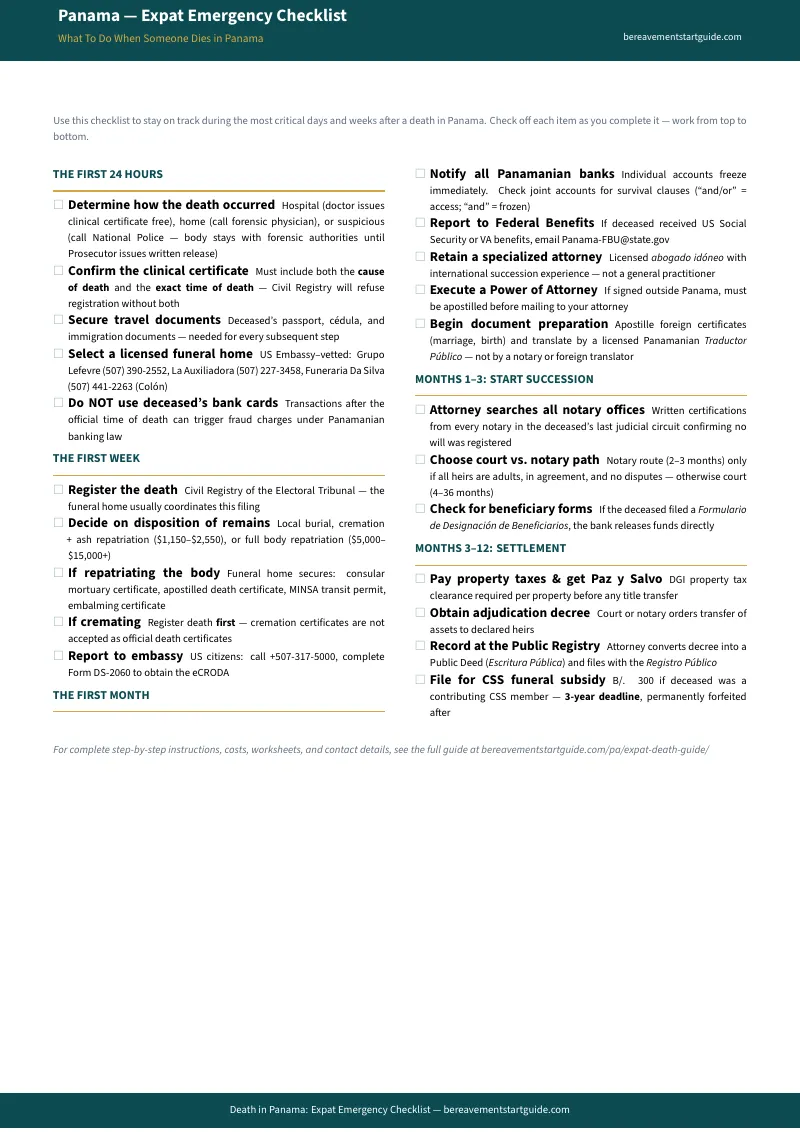
The free Emergency Checklist gives you the critical first steps — who to call, what documents to gather, and the key deadlines. It is the right starting point if you need to act tonight.
The full guide covers the complete process from death to estate settlement — bank freezes, probate courts, repatriation, property transfers, wills, and tax clearances — with fillable worksheets you can use at every stage. For , it replaces hours of fragmented research and potentially tens of thousands of dollars in avoidable mistakes.
Frequently Asked Questions
What if the rules change after I buy?
We update the guide when the rules change. Email us any time, even years later, and we'll send you the current edition free.