
You Shouldn't Have to Learn Philippine Inheritance Law While Grieving
Someone you love has died in the Philippines. And now you're staring at a bureaucratic maze that doesn't care about your grief: the Local Civil Registrar wants one form, the Philippine Statistics Authority wants another, the BIR wants a tax return within a year or they'll hit you with a 25% surcharge plus 12% annual interest, and the bank just froze every account.
You don't know which office to visit first. You don't know which deadline will cost you hundreds of thousands of pesos if you miss it. And the free information you're finding online is either scattered across a dozen government websites — or dangerously wrong (no, you cannot quietly use the deceased's ATM card — that's criminal fraud under Philippine law).
The Philippine Estate Settlement Navigator
This guide gives you the complete sequence — every office, every form, every deadline — in the order you actually need them. Not a generic checklist. A step-by-step roadmap built for the unique intersection of Philippine inheritance law, BIR tax rules, and consular procedures that English-speaking families face.
Written for expats, dual citizens, and overseas families who need to navigate a system designed for people who already know how it works.
What's Inside
- The First 24 Hours Protocol — exactly what to do at the hospital, at home, or after a suspicious death, including Muslim burial rights under RA 12160 that hospitals are legally required to follow
- Death Certificate Mastery — the difference between LCR and PSA copies, why one misspelled name will stall your entire estate, and how to file corrections before it's too late
- Embassy and Consular Playbook — Report of Death filing procedures, the eCRODA process for US citizens, the 12-month delayed registration penalty, and how to coordinate from abroad
- Bank Access Under the TRAIN Law — the legal one-year window to withdraw funds at a 6% flat withholding tax, the exact documentation banks require, and why skipping this process and using an ATM card exposes you to criminal prosecution for estafa
- Estate Tax Filing Guide — the flat 6% rate, how to maximize the ₱5 million standard deduction and ₱10 million family home deduction, and the post-amnesty penalty regime that now hits late filers with a 25% surcharge on day one
- EJS vs Judicial Settlement Decision Framework — eligibility criteria for the extrajudicial route, the newspaper publication requirement, the Heir's Bond and surety co-signer hurdle, and the RMC 94-2021 donor's tax trap that catches families who partition unevenly
- Property and Vehicle Transfer Sequence — from the BIR's electronic Certificate Authorizing Registration (eCAR) through the Registry of Deeds' new Transfer Certificate of Title, with every step between
- Foreign Heir Land Ownership Rules — the constitutional ban, the single hereditary succession exception, and the "will trap" that accidentally voids bequests to foreign spouses who exceed their legitime
- Repatriation Procedures — transit permits, hermetically sealed casket requirements, non-contagious disease certificates, airline cargo coordination, and realistic cost estimates for Manila-area mortuary services
- Remote Management Toolkit — apostille vs consularization, Special Power of Attorney templates, and how to coordinate an estate settlement from another country without making expensive trips
- Complete Agency Directory — contact details, office hours, and website links for every government office, embassy, and institution referenced in the guide
Who This Is For
- Expats living in the Philippines who have lost a spouse, parent, or family member
- Tourists dealing with an unexpected death during travel
- Overseas Filipino families coordinating an estate from abroad
- Dual citizens navigating both Philippine and foreign legal systems
- Executors, administrators, or family members appointed to handle the estate
Why Not Just Hire a Lawyer?
Philippine estate attorneys charge ₱50,000 to ₱250,000 as a flat acceptance fee — or 1 to 3% of the estate value. For judicial settlement, fees climb to ₱150,000–₱600,000. Most of that billable time is spent waiting for you to find basic documents and figure out which office to visit next.
This guide doesn't replace a lawyer. It replaces the expensive confusion that comes before one. Gather your documents, verify your eligibility for the extrajudicial route, understand your tax obligations, and hand your attorney a complete package — instead of paying them to explain what the BIR wants.
What Free Resources Get Wrong
Government websites give you forms — scattered across offices that don't communicate with each other. One agency's requirements contradict another's timeline. Community forums share workarounds that are flatly illegal. And generic international death-abroad guides don't cover EJS procedures, TRAIN Law bank withdrawals, the RMC 94-2021 donor's tax trap, or the constitutional rules around foreign heir land ownership.
This guide provides the unified, chronological sequence that connects all of these fragmented steps into a single actionable roadmap.
The Estate Tax Amnesty Has Expired
The estate tax amnesty under RA 11956, which let families settle historical estate taxes without penalties, expired on June 14, 2025. Every day of delay now compounds: 25% surcharge on the basic tax due, plus 12% annual interest from the date of death. On a modest estate, that penalty alone can exceed what you'd spend on professional help.
— Less Than One Hour of Attorney Fees
Philippine estate attorneys bill ₱2,500 to ₱5,000 per consultation hour. This guide costs less than a single appointment — and it prepares you for every appointment that follows.
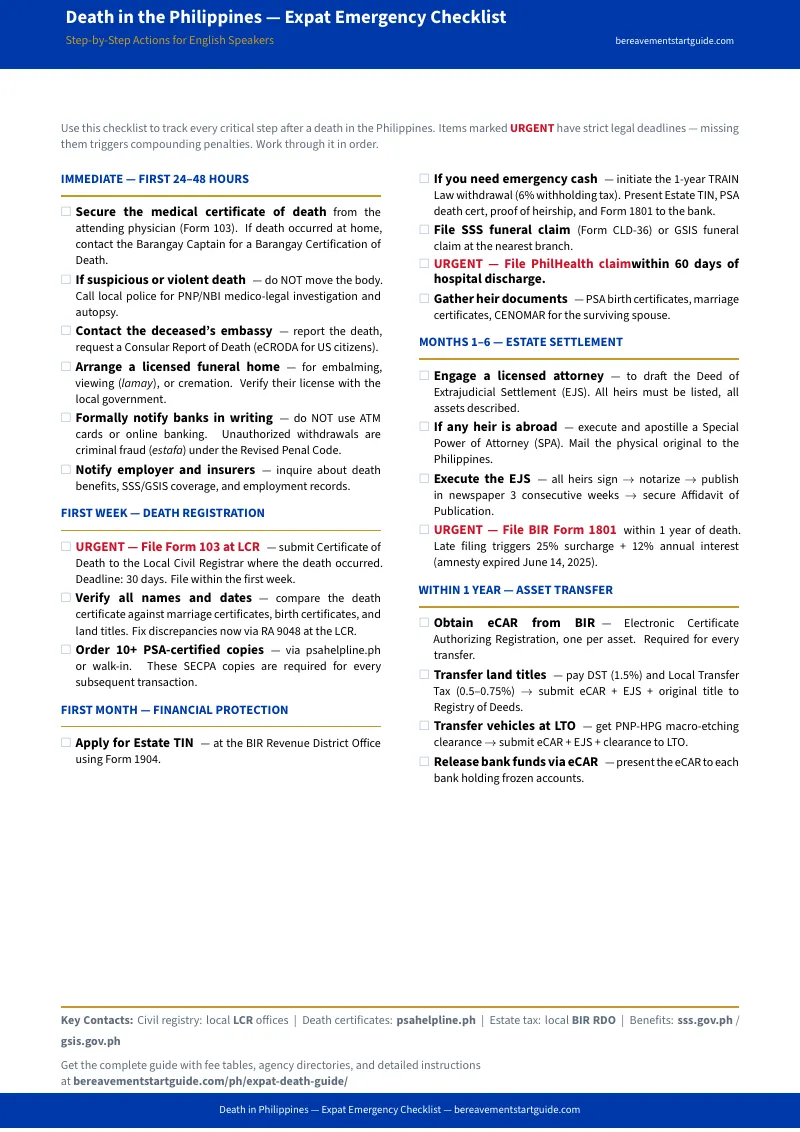
Includes the free emergency checklist as a quick-reference one-pager, the complete 14-chapter guide, and 10 standalone printable PDFs you can take to the bank, the BIR, the Registry of Deeds, the embassy, or your attorney.
12 PDFs — Print What You Need, When You Need It
- guide.pdf — The complete 14-chapter guide
- checklist.pdf — One-page emergency checklist (also included free)
- first-24-hours.pdf — Emergency protocol by death scenario
- document-checklist.pdf — Fillable master document tracker
- bank-access-guide.pdf — TRAIN Law withdrawal procedures for the bank
- estate-tax-guide.pdf — BIR Form 1801 filing roadmap
- ejs-decision-framework.pdf — EJS vs judicial settlement decision guide
- property-transfer-sequence.pdf — Land and vehicle transfer steps
- repatriation-procedures.pdf — Document checklists for shipping remains
- remote-management-toolkit.pdf — SPA, apostille, and cost framework
- estate-settlement-timeline.pdf — Pin-to-wall timeline with checkboxes
- agency-directory.pdf — Every agency, embassy, and form on one sheet
100% Satisfaction Guarantee
If the guide doesn't help you navigate the Philippine estate settlement process more confidently, email us for a full refund. No questions, no conditions.
Frequently Asked Questions
What if the rules change after I buy?
We update the guide when the rules change. Email us any time, even years later, and we'll send you the current edition free.