Your Parent Just Died. The Funeral Director Is Quoting $15,000. Your Aunties Are Arguing Over Whether to Call a Monk or a Taoist Priest. And You Don't Even Know Which Dialect's Rites Your Family Follows.
The hospital released the body two hours ago. Your eldest uncle insists on a Taoist priest with the proper Hokkien rites. Your mother wants Buddhist monks because "it's more peaceful." Your cousin in Melbourne is texting frantically asking what colour to wear on the plane. Someone needs to book the void deck before the Town Council office closes. And you just discovered that the funeral director's "standard package" includes $2,800 in paper offerings that may not even be correct for your family's dialect tradition.
You are not a funeral director. You are not a Taoist priest. You are a grieving person who has been handed a project-management role that requires cultural knowledge your generation was never taught — because in Chinese families, talking about death has always been met with "choy!" and a quick change of subject.
The Traditional Chinese Funeral — Singapore & Malaysia guide is a Dialect-Aware Funeral Planning System built for the specific bureaucratic, cultural, and logistical realities of organising a Chinese funeral on either side of the Causeway. Not a replacement for your funeral director or clergy. An independent reference that sits beside them — so you know which rites are mandatory for your dialect, which line items are optional upsells, and exactly how the permits, timelines, and taboos work before anyone can take advantage of your grief.
What's Inside the Dialect-Aware Planning System
A 19-chapter guide, a printable Quick-Start Checklist, and step-by-step decision tools — covering everything from the first phone call after death through the 100th-day memorial, built specifically for Singapore and Malaysia's cross-border regulations and the five major dialect traditions:
The First Hours: What to Do Before the Funeral Director Arrives
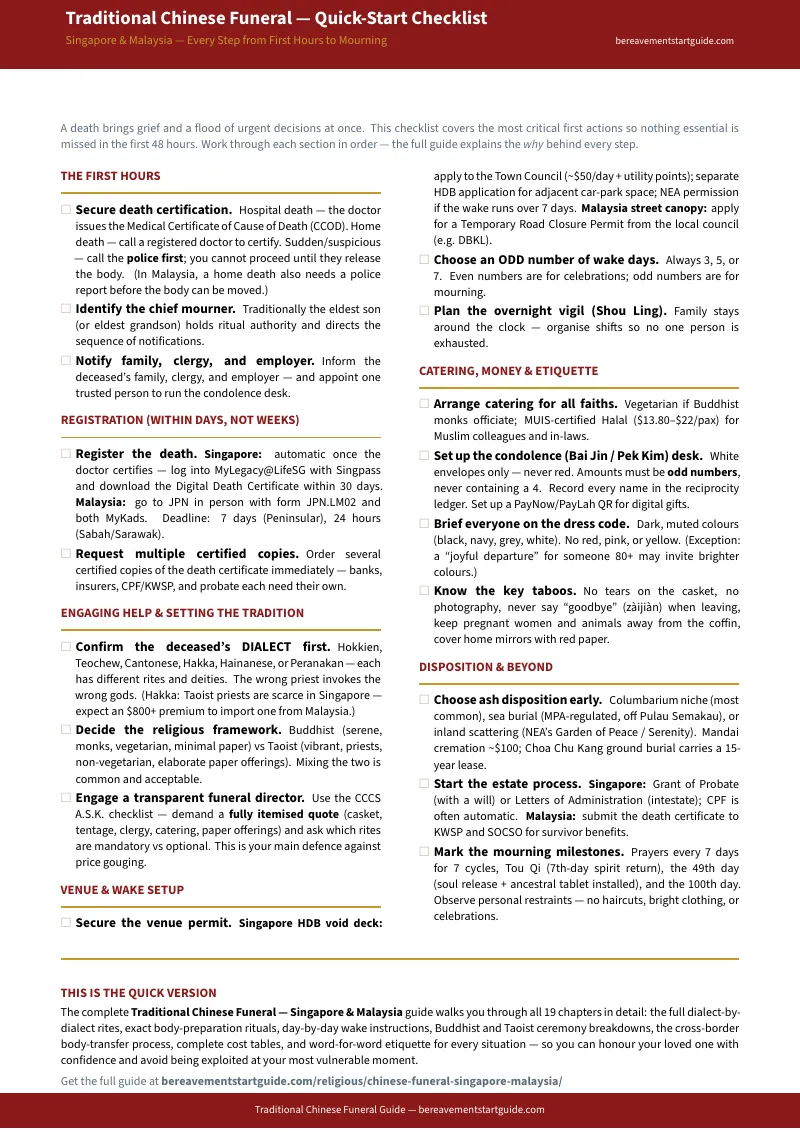
The sequence from death certification to body release is different depending on whether the death happened in a hospital, at home, or under suspicious circumstances — and radically different between Singapore and Malaysia. In Singapore, death registration is fully digital via LifeSG and Singpass. In Malaysia, you must physically visit the JPN office with the JPN.LM02 form and both MyKads — within 7 days in Peninsular Malaysia, but within 24 hours in Sabah and Sarawak. A home death in Malaysia requires a police report before anyone can legally move the body. The guide walks you through both countries' sequences so you do not lose critical hours following the wrong country's procedure.
Dialect-by-Dialect Rite Comparison: Hokkien, Teochew, Cantonese, Hakka, Hainanese
This is where most families make their most expensive mistake. Each Chinese dialect group has specific, non-interchangeable funeral rites — different prayers, different offerings, different ceremonial sequences. Hokkien funerals feature the "Breaking of the Bridge" ritual and elaborate paper effigies. Teochew rites prioritise solemn silence and traditional suona instruments, with no post-funeral prayers. Cantonese ceremonies include the "Breaking the Netherworld Gate" and a coin placed in the deceased's mouth. Hakka funerals centre on the "Returning of the Tablet" ceremony — but Singapore currently has no local Hakka Taoist priests, forcing families into a trilemma: pay an $800+ premium to import a priest from Malaysia, compromise with a generic Buddhist ceremony, or face the disappointment of conservative elders. The guide gives you the comparison tables to confirm your family's tradition before the funeral director engages the wrong clergy.
Buddhist vs Taoist: The Decision That Shapes Everything
These are not interchangeable traditions, despite what some funeral packages suggest. Buddhist funerals are contemplative — monks reciting sutras, strictly vegetarian offerings, minimal paper burning, focused on the cycle of rebirth. Taoist funerals are expressive — priests performing protection rituals, non-vegetarian offerings, elaborate paper houses and effigies burned to provision the deceased in the afterlife. Many families blend elements of both, which is acceptable — but you need to know which elements mix and which create theological contradictions. The guide explains the core differences so you can make this decision with your family instead of having a funeral director decide for you.
Venue Permits: HDB Void Deck, Malaysian Street Canopy, and the Rules Nobody Tells You
In Singapore, the HDB void deck is the most common and affordable wake venue — but it is heavily regulated. You apply through the Town Council (roughly $50 per day plus $4 to $15 per point for water and electricity). Need adjacent car-park space for attendees? That is a completely separate HDB application. Wake running longer than 7 days? You need prior written NEA permission via their ePortal. In Malaysia, a street-front canopy wake requires a Temporary Road Closure Permit from the local council. The guide consolidates every permit requirement so nothing falls through the cracks while you are managing grief and family.
The Vendor-Question Checklist: Your Defence Against Price Gouging
Funeral directors know you are making decisions under extreme time pressure and emotional distress. The guide includes the exact questions to ask before signing anything: demand a fully itemised quote separating casket, tentage, clergy fees, catering, and paper offerings. Ask which rites are mandatory for your dialect and which are optional add-ons. Use the CCCS A.S.K. approach to compare across providers. Families who use structured vendor checklists routinely save thousands by identifying unnecessary line items before the contract is signed.
Condolence Money (Bai Jin / Pek Kim): The Complete Etiquette
Determining the correct condolence amount is one of the most paralysing anxieties for attendees. Too little is an insult. Too much creates an uncomfortable debt of reciprocity. The rules are strict: amounts must always be odd numbers, presented in a plain white envelope (never red), and handed to the condolence desk for recording in the reciprocity ledger. The guide includes relationship-by-relationship tables with current Singapore dollar ranges, PayNow/PayLah digital payment protocols, and the cultural reasoning behind every rule — so attendees arrive confident instead of frantically searching forums on their phone.
Taboos, Superstitions, and the Things Elders Will Notice
Pregnant women should avoid the funeral (or carry ginger and tie a red string around the belly). Mirrors in the home must be covered with red paper. Animals must be kept away from the coffin. No tears should fall on the casket. Never say "goodbye" (zàijiàn) when leaving the wake. When the casket is closed, attendees must turn their backs. The red thread given at the exit must be discarded before reaching home. These are not quaint superstitions — they are expectations that conservative elders enforce, and violations cause real family conflict. The guide explains each taboo with its cultural origin so you understand what to observe and how to brief non-Chinese relatives and colleagues.
Cross-Border Body Transfer: Singapore ↔ Malaysia
If the deceased died in Singapore but the family wants burial or cremation in Malaysia (or vice versa), the bureaucratic requirements multiply. Exporting a body from Singapore requires an NEA export permit, clearance from the Centre for Disease Control, and a Malaysian police burial permit on the receiving end. The guide maps the complete cross-border process so families making this emotionally charged decision understand exactly what paperwork, costs, and timelines are involved.
Catering for a Multi-Faith Wake
The rise of interfaith marriages means funeral catering can no longer default to non-Halal Chinese food. If Muslim colleagues and in-laws will attend, you need MUIS-certified Halal catering — funeral mini-buffets start at $13.80 to $22 per person. The guide provides sourcing guidance and script templates for explaining these dietary accommodations to traditional elders who may view them as a breach of custom.
Mourning Calendar: From the 7th Day to the 100th Day
Chinese mourning follows a structured calendar that most modern families have never been taught. Prayers every 7 days for 7 cycles. The 7th-day Tou Qi (spirit return) — when the deceased's spirit revisits the home. The 49th day, when the soul is released and the ancestral tablet is formally installed. The 100th day, marking the transition from active mourning. During this period, family members traditionally refrain from haircuts, bright clothing, celebrations, and weddings. The guide explains each milestone so families know what to observe and what to expect.
Who This Guide Is For
- The adult child who just became chief mourner — thrust into organising a funeral for a tradition your parents never explained, while managing grief, family politics, and a funeral director who is already pricing packages before you know which dialect's rites to follow
- The diaspora relative flying home from overseas — who needs a crash course in wake etiquette, dress code, condolence money amounts, and the taboos that conservative elders enforce, before landing at Changi or KLIA
- The non-Chinese spouse or in-law — who wants to show respect without accidentally violating religious boundaries, needs to know which rituals to participate in and which to respectfully observe from the side
- The colleague or friend attending a Chinese wake for the first time — who wants clear guidance on what to wear, how much Bai Jin to give, how to behave at the condolence desk, and what the red thread means
- The Hakka family in Singapore — facing the acute priest shortage and needing to understand the options, costs, and compromises before the funeral director makes the decision for them
- The executor managing both the funeral and the estate — who needs the administrative checklists for death registration, CPF/KWSP notification, and the Grant of Probate process alongside the cultural planning
Why Free Information Will Not Get You Through This
The information exists. It is scattered across funeral home marketing pages, government portals, academic papers, and desperate Reddit threads. Here is what you encounter when you try to plan a Chinese funeral using free sources alone:
- Funeral home websites are lead-generation funnels. Casket Fairprice, Harmony Funeral Care, and Nirvana Asia Group publish helpful-looking guides that end with "contact us for a quote." Their content accurately describes the differences between Buddhist and Taoist packages — then steers you toward premium services. They will not tell you which of their line items are optional add-ons for your specific dialect tradition.
- Government portals cover paperwork, not culture. LifeSG tells you how to download a digital death certificate. The HDB website explains void deck booking procedures. The JPN website outlines Malaysia's registration forms. None of them mention which prayers to arrange, how to handle a Hakka priest shortage, or what happens when Buddhist and Taoist elements are mixed in the same ceremony.
- Reddit and HardwareZone threads are subjective and contradictory. Threads on r/askSingapore are filled with genuine but unverified advice. One poster says the red thread absorbs negative energy. Another dismisses it entirely. One claims Bai Jin should always be $50 minimum. Another says $30 is fine for acquaintances. Acting on the wrong advice from an anonymous forum risks offending the family at the most sensitive possible moment.
- Academic resources are ethnographic studies, not checklists. Publications from the SFCCA and National Heritage Board provide excellent historical and cultural context — but they read as anthropological research, not as actionable guides you can use while coordinating a funeral in 48 hours.
Free resources give you fragments from a dozen sources that contradict each other on critical details — the correct Bai Jin amount, whether the pregnant cousin should attend, which paper offerings your dialect actually requires. The Dialect-Aware Planning System puts every Singapore and Malaysia regulation, every dialect comparison, every taboo, and every vendor question into one document, in the order you actually need them.
— Less Than One Delivery of Wake Catering
A basic funeral package in Singapore starts around $3,000. In Malaysia, even budget arrangements begin at RM 6,000. Paper offerings alone can run $500 to $2,800 depending on the funeral director's recommendations — some of which may not even be appropriate for your dialect tradition. This guide costs less than a single catering delivery for the wake and gives you the independent reference to make every decision — permits, clergy, vendors, offerings, etiquette — from knowledge rather than confusion.
Your download includes the complete 19-chapter guide, the printable Quick-Start Checklist, and 4 standalone reference sheets — the Dialect-Rite Comparison (2-page side-by-side for all 5 dialects), the Vendor-Question Checklist (the exact questions to ask before signing), the Bai Jin Etiquette Card (relationship-by-relationship amounts and rules), and the Taboo Quick Reference (what conservative elders enforce, on one printable page). Everything a grieving family needs to honour the deceased correctly without being exploited. Instant download, no account required.
Money-back guarantee, no time limit. If the guide does not give you clarity on your dialect's specific rites, confidence in managing the funeral logistics, and a clear framework for every cultural and administrative decision from the first hour through the 100th day, email us for a full refund. No questions asked.
Not ready for the full guide? Download the free Quick-Start Checklist — an 18-item action list covering death certification, dialect confirmation, venue permits, vendor questions, Bai Jin setup, key taboos, and disposition decisions. Enough to get through the first 48 hours tonight.
You did not ask for this responsibility. But the customs are knowable, the permits are documented, and the decisions are manageable when you have the right reference beside you. The guide gives you that reference — so you can grieve while still honouring your loved one the way your family's tradition requires.