
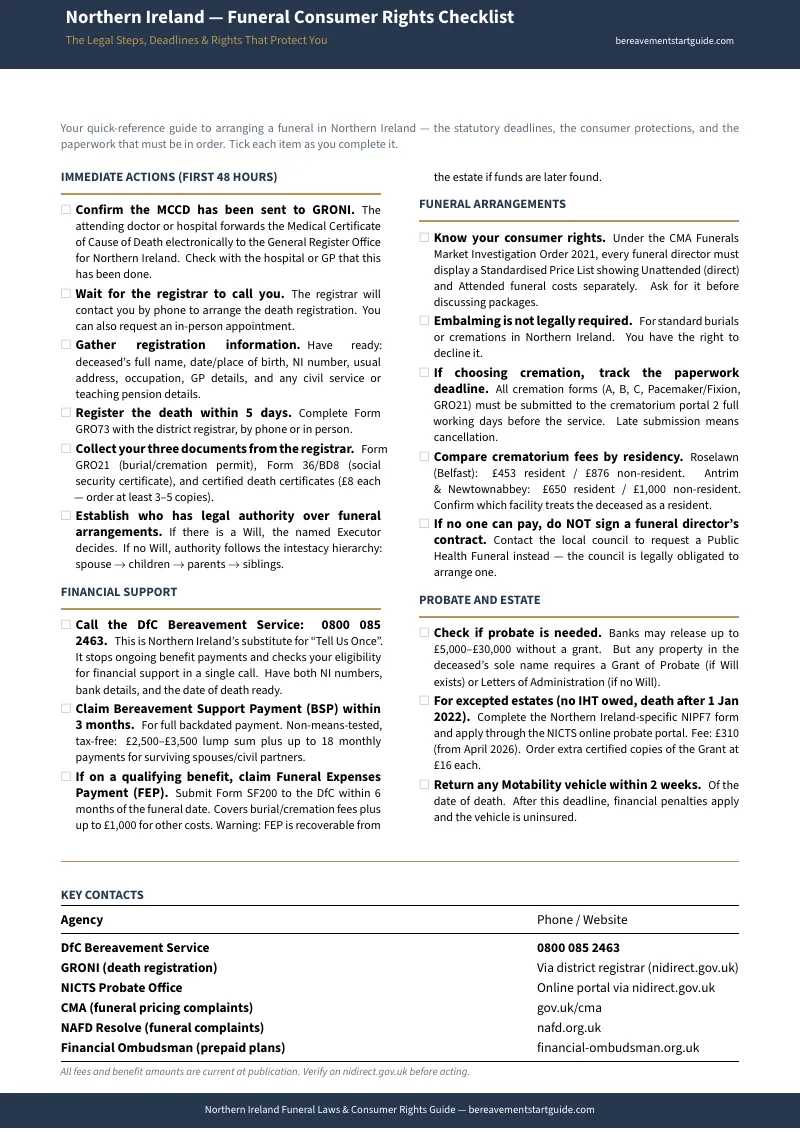
The funeral director quoted £3,400. Your brother wants a church service, your sister wants direct cremation. The coroner has the body. And you have five days to register the death at GRONI before the paperwork stalls
After a death in Northern Ireland, the administrative system closes in fast. The General Register Office receives the Medical Certificate of Cause of Death electronically — and then the family waits for a registrar to make contact so the death can be registered within the five-day statutory window. Until registration is complete, there is no Form GRO21. Without Form GRO21, no cemetery or crematorium in Northern Ireland will proceed. Everything stops.
Meanwhile, online guidance is written for England and Wales. It references forms that don't exist here, quotes fees that don't apply, and describes a Medical Examiner system that Northern Ireland hasn't adopted. The funeral director's website looks helpful — until you realise it systematically omits your right to arrange a funeral independently, transport the body yourself, or refuse embalming entirely. And the Competition and Markets Authority's Funerals Market Order 2021 gives you powerful consumer protections — but only if you know how to use them.
Northern Ireland has just two crematoria. Roselawn charges £453 for Belfast residents and £876 for non-residents. Antrim & Newtownabbey charges £650 for residents and £1,000 for everyone else. A residency proof you didn't know you needed can cost your family an extra £400 on cremation alone — and that's before the medical fees for Forms B and C, which the crematoria require before they'll even look at your booking.
The NI Funeral Compliance System — every form, every right, every fee, current for 2026
The Northern Ireland Funeral Laws & Consumer Rights Guide replaces the patchwork of government pages, charity leaflets, and funeral director sales funnels with one chronological system built entirely for Northern Ireland law. We call it the NI Funeral Compliance System because the real barrier isn't information — it's that the information is scattered across GRONI, Belfast City Council, the Coroner Service, the CMA, the FCA, and the Department for Communities, and none of them reference each other.
This guide connects every step. From the moment someone dies to the final statutory notification, it tells you what you must do, what you can refuse, what each step costs, and exactly when to push back against a funeral director who is quoting beyond what the law requires.
What's inside
- The GRONI registration process demystified — the electronic MCCD transfer, how the registrar contacts you, the five-day legal mandate, and how to acquire Form GRO21 (the document without which no burial or cremation can proceed)
- Cremation paperwork hierarchy — Form A (your application), Form B (attending doctor's certificate), Form C (confirmatory medical certificate), the Pacemaker and Fixion form, the medical referee's Form F, and the Coroner's Form 20 that overrides all of them. Which forms cost money, who signs them, and the 48-to-72-hour submission window that Roselawn and Antrim enforce
- Crematoria pricing and residency rules — the full fee schedules for both Northern Ireland crematoria, the residency proofs each requires, and how to avoid the non-resident surcharge that catches unprepared families
- CMA Compliance Scorecard — a printable checklist based on the Funerals Market Investigation Order 2021, so you can verify any funeral director is displaying the legally mandated Standardised Price List and not bundling services you haven't asked for
- Executor authority and family dispute resolution — who has the absolute legal right to arrange the funeral when there's a will versus when there isn't, the intestacy hierarchy under Northern Ireland law, and how to resolve sibling disputes without hiring a solicitor
- Independent funeral arrangements — the legal basis for arranging a funeral without a commercial funeral director, transporting the body in a private vehicle, keeping the deceased at home, and refusing embalming (which is not a legal requirement in Northern Ireland)
- Home and private land burial compliance — verifying title deed covenants, the 30-metre spring clearance, 10-metre field drain clearance, 1-metre water table clearance, and how to satisfy environmental health without a formal planning application
- Coroner interactions and repatriation — when the Coroner Service assumes jurisdiction, what happens during a post-mortem, Form 20 for cremation after coronial investigation, and the "Out of Northern Ireland" certificate required for cross-border transport to the Republic of Ireland or further
- Prepaid funeral plan verification — how to check FCA authorisation post-July 2022, whether the plan carries Financial Services Compensation Scheme protection, and what to do when a provider enters administration or refuses to honour the contract
- Financial support for funeral costs — Social Fund Funeral Expenses Payment eligibility and application, the non-means-tested Child Funeral Fund, Bereavement Support Payment, and the local council's statutory duty to provide a Public Health Funeral when no one can pay
- Religious and cultural requirements — expediting GRONI registration for faith traditions requiring rapid burial, requesting early release from the coroner, and navigating Northern Ireland's limited crematoria capacity when religious timelines create scheduling pressure
- Complaint escalation framework — NAFD complaints process, CMA pricing violations, Trading Standards referrals, and FCA channels for prepaid plan disputes, with pre-written complaint templates
Plus 13 standalone printable worksheets and reference cards: First 48 Hours Checklist, Cremation Document Tracker, CMA Compliance Scorecard, Funeral Cost Comparison Worksheet, Crematoria Fee Quick-Reference Card, Prepaid Plan Audit Checklist, Cross-Border Repatriation Timeline, Complaint Filing Templates, Funeral Authority Decision Tree, Agencies Notification Tracker, Home Burial Compliance Checklist, Forms Fees & Deadlines Reference, and Cremation vs. Burial Decision Matrix.
Who this is for
- Executors and next of kin arranging a funeral in Northern Ireland who need the NI-specific process — not English guidance that references wrong forms, wrong fees, and a Medical Examiner system that doesn't exist here
- Families in a dispute over burial versus cremation, the service location, or who has the right to make funeral decisions — and who need the Northern Ireland legal hierarchy spelled out before it escalates to court
- Budget-conscious families who suspect a funeral director is overcharging, want to verify CMA compliance with the Standardised Price List, or need to access the Funeral Expenses Payment before committing to fees they cannot afford
- Cross-border families managing a death across the Northern Ireland and Republic of Ireland border — who need the Coroner's "Out of NI" certificate process, embassy documentation, and zinc-lined coffin requirements mapped step by step
- DIY and independent funeral planners who want to arrange a funeral without a commercial director, keep the body at home, or conduct a private land burial — and need the exact legal framework to push back against institutional resistance
- Caregivers and professional helpers supporting a family through a terminal diagnosis who want to pre-verify prepaid plans, organise paperwork, and ensure the transition to the executor is seamless when the time comes
Why not just use the free government pages?
The nidirect.gov.uk pages are accurate for the specific thing each page covers. But they are scattered across dozens of URLs with no connecting thread. They tell you to register the death within five days but don't explain what happens when the coroner holds the body and the GRONI timeline is disrupted. They mention Form GRO21 but don't walk you through the cascading cremation paperwork — Forms A, B, C, the Pacemaker form, the medical referee's Form F — that must be submitted to one of only two crematoria in the entire jurisdiction.
Belfast City Council and Antrim & Newtownabbey Borough Council publish their cremation fees and application forms. But the user experience assumes you already understand the process. The language is bureaucratic. No narrative thread connects the registrar's output to the crematoria's input to the coroner's override.
UK-wide sites like Which? and Citizens Advice are worse. They confidently reference English cremation forms that Northern Ireland has never used, quote English court fees for probate that don't apply here, and describe a Medical Examiner scrutiny system that NI hasn't implemented. Following their instructions doesn't just waste your time — it sends you down the wrong procedural path at the worst possible moment.
This guide sits in the gap: the empathy of a bereavement charity with the form-by-form precision of a funeral law specialist, for .
The cost of not knowing
- Accepting a funeral director's bundled quote without checking CMA compliance — and paying hundreds of pounds more than the unbundled rate
- Missing the residency proof for Roselawn or Antrim — and paying the non-resident cremation surcharge that doubles the fee
- Being told by the funeral home that you must use their services — when Northern Ireland law gives you the right to arrange everything independently
- Submitting cremation paperwork out of sequence and having the crematoria reject the booking, delaying the service by days while the medical referee's schedule fills up
- Discovering after the funeral that a prepaid plan lacked FCA authorisation and carried no FSCS protection
- A family dispute over burial versus cremation freezing arrangements entirely — while daily mortuary fees accumulate
The guide costs a fraction of any single one of these mistakes.
— less than a single hour of a solicitor's consultation
Solicitors charge £150 to £300 per hour. Funeral directors charge hundreds for an arrangement meeting. The NI Funeral Compliance System gives you the legal standing, the consumer protection tools, and the procedural knowledge to handle the funeral with confidence — and tells you exactly when professional help is genuinely needed, so you only pay for the moments that require it.