You searched for "how to do probate." The internet gave you English forms, English fees, and English law. None of it works in Northern Ireland.
Someone has died, and you've been named as the executor — or there's no will and the family is looking at you. You sit down to figure out probate and immediately hit a wall of guidance written for England and Wales. It tells you to fill out form PA1P. It quotes a flat £300 court fee. It walks you through HMRC form IHT205 for reporting the estate value. And every word of it is wrong for Northern Ireland.
In Northern Ireland, the correct form is NIPF1 if there's a will, or NIPF2 if there isn't. The court fee is £261 for the grant plus £65 for a personal application — £326 total. And for deaths after January 2022, the IHT205 form no longer exists; the estate value goes on a completely different document called the NIPF7 Estate Summary. Submit the wrong form to the Probate Office at the Royal Courts of Justice in Belfast and your application is "stopped." Average wait to clear a stopped application: 15 weeks. Fifteen weeks of frozen bank accounts, unpaid bills, and siblings asking why you haven't sorted things out yet.
The alternative is hiring a solicitor. Fees typically run 1% to 5% of the estate value — that's £1,500 to £10,000 or more — for a process that, with the right instructions, a careful executor can handle in an afternoon at the kitchen table.
The Belfast Registry Blueprint
This guide replaces the guesswork with a single, chronological system built from the ground up for Northern Ireland law. The Belfast Registry Blueprint walks you through every form, every threshold, and every deadline in the exact order the Probate Office expects — so your application is accepted the first time, not returned with a query that adds months to the process.
At its core is the NI Bank Probate Threshold Matrix: a single reference table showing what each Northern Ireland bank actually requires before releasing funds. Danske Bank will release up to £50,000 without probate. AIB sets its limit at £25,000. Progressive Building Society enforces a tiered system — up to £5,000 without probate, £5,000 to £25,000 with a solicitor's signature, and a full grant above £25,000. Bank of Ireland draws the line at £30,000. No more spending hours on hold with bereavement departments trying to extract these numbers one at a time.
Every figure is current for 2026, reflecting the fee adjustments under SR 2026/35 effective April 2026. Every instruction references Northern Ireland legislation, Northern Ireland forms, and the Northern Ireland Courts and Tribunals Service — never England and Wales.
What's inside
- Module 1 — Securing the Estate in the First 48 Hours. What to do before you touch a single form: registering the death at GRONI, ordering extra death certificates, contacting the NI Bereavement Service, securing vacant property, and notifying the right agencies first. Why the NI Bereavement Service only covers social security — and the full list of organisations you still need to contact yourself.
- Module 2 — Valuing the Estate and Navigating Bank Thresholds. How to build the estate inventory for the NIPF7. The NI Bank Probate Threshold Matrix covering Danske Bank, AIB, Bank of Ireland, Progressive Building Society, Ulster Bank, and others. Which accounts you can release without a court application and which ones require the full grant. How to use Small Estates Indemnity forms to access funds quickly.
- Module 3 — NIPF Forms Demystified. Field-by-field, plain-English walkthroughs for NIPF1 (Grant of Probate with a will), NIPF2 (Letters of Administration without a will), and the NIPF7 Estate Summary that replaced HMRC form IHT205. The exact documents you need to attach, and the mistakes that get applications stopped.
- Module 4 — Surviving the Probate Portal and Belfast Registry. How to submit your application digitally. What to expect from the oath or statement of truth. The difference between applying at the Royal Courts of Justice in Belfast and the Londonderry district registry. Realistic timelines: 2 to 4 weeks for clean applications, and how to stay out of the 15-week stopped queue.
- Module 5 — Paying Debts, Taxes, and Distributing to Beneficiaries. The correct order for paying creditors and HMRC before distributing a single pound to beneficiaries. How to place statutory notices in the Belfast Gazette to protect yourself from unknown debts. Building estate accounts that keep every beneficiary informed and shield you from personal liability.
Plus 8 printable worksheets and reference cards
- NIPF Form Pre-Submission Checklist — every document, every signature, every attachment confirmed before you press send
- NI Bank Probate Threshold Quick-Reference Card — every major NI bank's release limit on one page
- Estate Inventory and Valuation Tracker — asset and debt worksheets that feed directly into your NIPF7
- Executor's Liability Protection Checklist — statutory notices, debt clearance sequence, and distribution sign-off
- 90-Day Probate Timeline — realistic milestones from death certificate to final distribution
- Notification Tracker — record every organisation you contact (no Tell Us Once in NI)
- Forms, Fees and Contacts Quick Reference — every official form, current fee, and phone number on one page
- Estate Accounts Template — income, expenditure, distribution tables with beneficiary receipts
Who this is for
- Named executors holding a will and facing the NIPF1 for the first time — the guide gives you a line-by-line walkthrough and a pre-submission checklist so your application clears the Belfast registry without a query.
- Family members without a will who need to apply for Letters of Administration using NIPF2 — the guide explains the priority order under the Administration of Estates (NI) Order 1955 and the additional documentation the court requires.
- Surviving spouses unsure whether a specific account needs probate or just a death certificate and indemnity form — the bank threshold matrix gives you the answer in under a minute, potentially saving months of unnecessary court process.
- Property heirs dealing with real estate held as Tenants in Common — the guide covers the intersection of probate and the Land Registry of Northern Ireland, including LR Form 17 and the assent process.
- Caregivers and family helpers supporting someone through the process — the printable checklists and plain-English explanations mean you can hand this to anyone, regardless of their legal confidence.
Why not just use the free government pages?
The nidirect.gov.uk pages are accurate — for the specific thing each page covers. But they are scattered across dozens of URLs with no connecting thread. They tell you that you need to complete the NIPF7, but they don't walk you through it field by field. They list the court fees but don't explain the £10,000 small estate exemption or how it interacts with the banks' own thresholds, which range from £5,000 to £50,000 depending on the institution. They suggest hiring a solicitor to complete the forms — which is exactly the £2,000+ expense you're trying to avoid.
UK-wide sites like Which? and Co-op Legal Services are worse. They confidently direct Northern Ireland readers to form PA1P (wrong jurisdiction), quote English court fees (wrong amount), and reference HMRC form IHT205 (abolished for NI deaths after January 2022). Following their instructions doesn't just waste your time — it gets your application rejected and pushes you into the 15-week stopped queue.
This guide sits in the gap: the empathy of a bereavement charity with the form-by-form precision of a probate paralegal, for .
A simple guarantee
If the guide doesn't make the probate process clearer and your next steps more certain, reply to your receipt at any time and we'll refund you in full. You keep the free checklist. You're already carrying enough — the financial risk shouldn't be yours too.
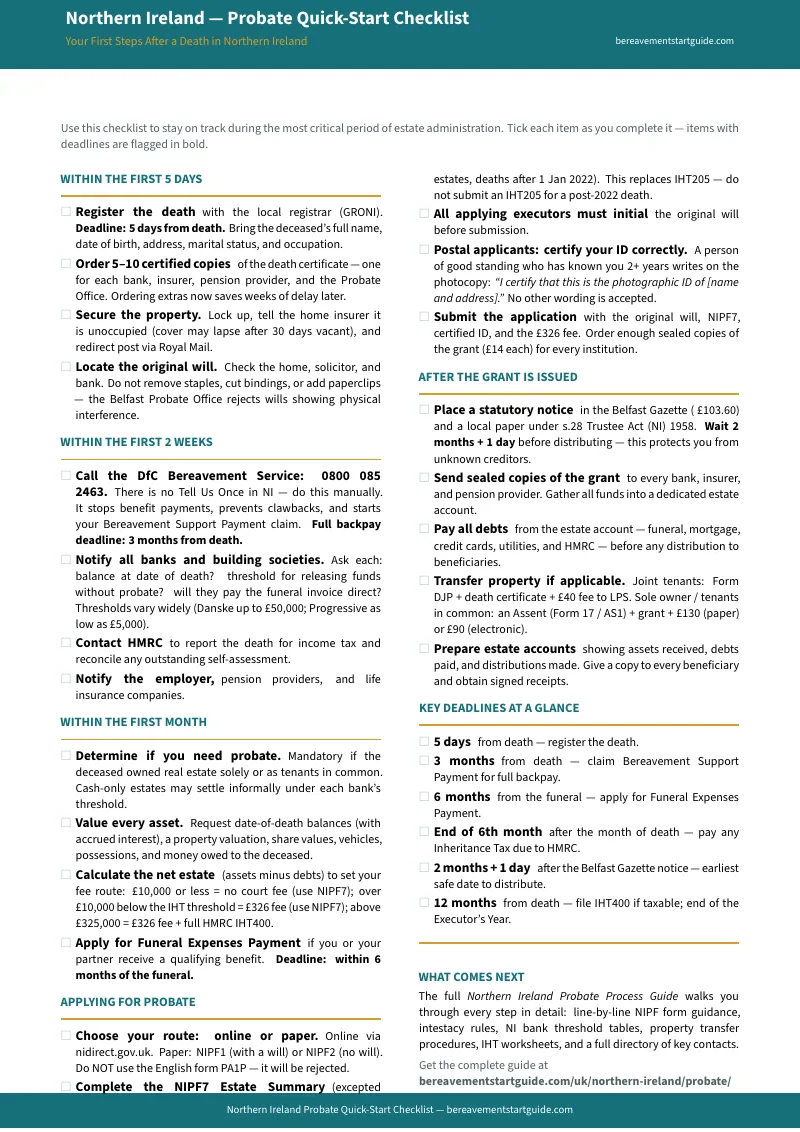
Start with the free Quick-Start Checklist to see the quality and NI-specific detail for yourself. When you're ready for the full system — every form walkthrough, every bank threshold, every deadline — upgrade to the complete guide.
One clear system through the Belfast Probate Registry. — less than a single hour of a solicitor's time. So you can settle the estate correctly, avoid the delays that cost families months, and keep the money where it belongs.