
You're navigating Confirmation through the Sheriff Court, calculating Prior Rights and Legitim, working out whether the estate qualifies as "small" under the £36,000 threshold — and doing all of it while grieving
After a death in Scotland, the administrative system starts immediately. Bank accounts freeze. Direct debits bounce. And the legal framework you're navigating is not the English probate system — it is an entirely separate jurisdiction with its own courts, its own forms, its own terminology, and its own traps. You don't apply for "probate." You apply for Confirmation through the local Sheriff Court. You don't deal with a coroner — you deal with the Procurator Fiscal. The death must be registered within 8 days, not 5. And the distinction between "heritable" and "moveable" property — a concept that doesn't exist south of the border — determines almost everything about how the estate is administered.
The free government pages on MyGov.scot tell you each step exists. But they're fragmented across dozens of pages that assume prior legal knowledge. The Scottish Courts and Tribunals Service explicitly refuses to give legal advice on large estates. Law firm blogs like Jones Whyte and Scullion Law publish just enough to create anxiety before funnelling you toward consultations starting at £1,500. And the definitive legal textbook — Currie on Confirmation of Executors — costs £188.70 and is written for practising solicitors, not grieving families.
The Scotland Estate Settlement Roadmap — every form, every deadline, every Scotland-specific trap, in the order they actually happen
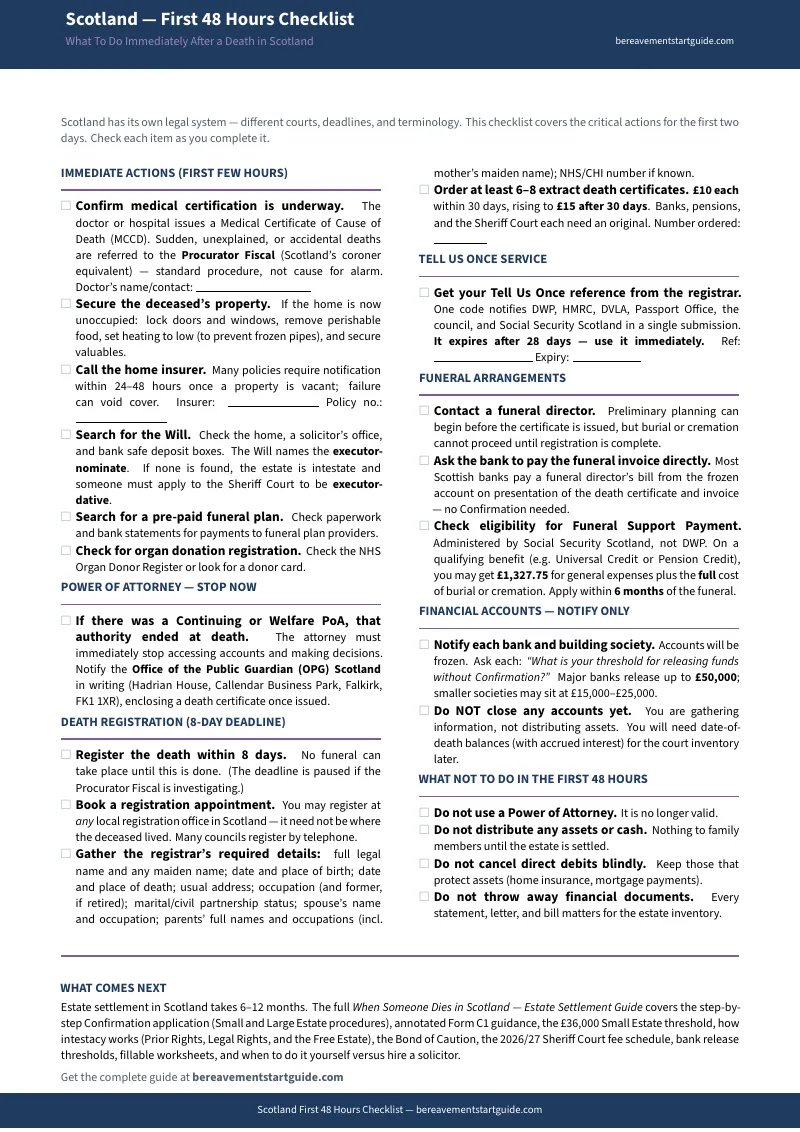
The Estate Settlement Guide for Scotland turns fragmented government websites into a single chronological roadmap. It walks you through every step — from the first 48 hours through final distribution — with the specific forms, fees, thresholds, and deadlines that apply under Scots law.
This is not a generic UK guide with "England and Wales" in the body and "Scotland" in the title. It's what we call the Scotland Estate Settlement Roadmap — a chronological administrative playbook built around the specific institutions Scottish families actually deal with: the Sheriff Court, the Procurator Fiscal, the Office of the Public Guardian Scotland, the Bond of Caution, Prior Rights, Legal Rights (Legitim), and the Trusts and Succession (Scotland) Act 2024 changes that most online guides haven't caught up with.
What's inside
- The 48-hour triage checklist — what must happen before the registrar appointment (Procurator Fiscal notification if required, securing the property, locating the Will), what can wait, and the critical home insurance notification if the property will be unoccupied for more than 30 days
- Death registration and the 8-day window — the statutory deadline for registering the death with the local registrar in Scotland, what documents to bring, how to obtain extracts (certified copies) of the death certificate, and what happens if the Procurator Fiscal orders a post-mortem that extends the timeline
- Tell Us Once vs. what it actually misses — the boundary between government agencies (DWP, HMRC, DVLA, Passport Office) and the banks, building societies, insurers, and utilities that Tell Us Once does not notify — because assuming it covers everything is the single most expensive mistake families make
- The 2026 bank threshold matrix — every major UK bank's internal Confirmation limit in one table: Barclays, NatWest, Santander, and Lloyds at £50,000; Bank of Scotland at £25,000–£50,000 depending on account type; Yorkshire and Skipton Building Societies at £30,000; Coventry and Leeds at £25,000; Principality at £15,000; NS&I as low as £5,000 — plus the mechanism for releasing funeral funds directly to the funeral director before Confirmation is granted
- Small Estate vs. Large Estate decision tree — exactly how the £36,000 threshold is calculated (gross moveable estate only — debts cannot be deducted, and any heritable property immediately disqualifies), when you can use the free Sheriff Clerk service, and the Bond of Caution trap that kicks in if you hire a solicitor for a small intestate estate
- Form C1 Confirmation Inventory walkthrough — field-by-field instructions for completing the official estate inventory, the heritable vs. moveable classification that trips up most applicants, and the 2026 Sheriff Court fee schedule including the 3% uplift
- Heritable vs. Moveable property guide — the fundamental distinction in Scots law that controls whether you qualify for the small estate procedure, how Prior Rights are calculated, and how Legal Rights apply — with practical examples showing how a house, a car, a pension, and a bank account are each classified
- Prior Rights calculation scenarios — the surviving spouse's automatic statutory rights to the dwelling house (up to £473,000), furniture and plenishings (up to £29,000), and cash (£50,000 with children, £89,000 without) — with worked examples showing exactly how each right is applied against the estate
- Legal Rights (Legitim) calculator — how the one-third/one-half shares of the remaining moveable estate are calculated for the surviving spouse and children, including the critical rule that Legal Rights can be claimed even when a Will explicitly attempts to disinherit them
- Bond of Caution guide — what it is (pronounced "kayshun"), when it's required (intestate estates), how much it costs (~£400 average, varies by estate value), the exemption for small estates handled through the Sheriff Clerk, and the documented court ruling confirming that sheriffs have no power to waive it
- Intestacy rules for Scotland — the complete Prior Rights → Legal Rights → Free Estate hierarchy, with step-by-step calculations showing how the estate is divided when there is no Will
- Executor personal liability shield — the mandatory 6-month creditor waiting period, the consequences of distributing too early (personal liability for undiscovered debts), and the defensive documentation that protects you from beneficiary claims
- Trusts and Succession (Scotland) Act 2024 — the key changes to Scottish succession law and what they mean for executors administering estates from 2024 onwards
- Bereavement Support Payment and the 3-month deadline — the £2,500 or £3,500 lump sum plus up to 18 monthly payments, the strict claim window (full entitlement within 3 months, reduced after, void after 21 months), and eligibility for surviving spouses, civil partners, and cohabiting partners with children
- Funeral Support Payment (Social Security Scotland) — Scotland's own funeral assistance scheme administered by Social Security Scotland rather than the DWP, eligibility based on qualifying benefits, and how it interacts with the estate
- Property transfer after death — survivorship destinations in Scottish property law, how to transfer heritable property through the Confirmation process, and the Registers of Scotland requirements
- OPG Scotland and Power of Attorney — how Powers of Attorney registered with the Office of the Public Guardian Scotland terminate automatically at death, the executor's obligations regarding incapacity documentation, and what to do with the OPG registration
- Digital assets protocol — email accounts, social media memorialisation, cryptocurrency, and subscription cancellation — with the legal constraints on accessing password-protected accounts
- Agency Notification Tracker — a printable master list of every organisation you need to contact, with reference numbers, contact details, and completion checkboxes
Plus standalone printable worksheets and reference cards — each designed to be printed separately and used at your desk, at the bank, or at the Sheriff Court: Agency Notification Tracker, Bank Threshold Matrix, Small Estate Decision Tree, Form C1 Preparation Checklist, Asset and Liability Inventory (heritable/moveable split), Prior Rights Calculator, Legitim Calculator, Bond of Caution Decision Guide, Beneficiary Communication Log, Executor Liability Shield, and Estate Settlement Timeline.
Who this is for
- Adult children named as executor-nominate who have limited bereavement leave, no legal training, and need to know exactly what to do and in what order — without spending weeks bouncing between MyGov.scot, the SCTS website, and law firm blogs that withhold the final steps
- Surviving spouses who need to access frozen accounts, exercise Prior Rights on the family home, and secure the Bereavement Support Payment within the strict 3-month window — before monthly instalments start being forfeited
- Executors-dative navigating intestacy who have been thrust into a labyrinth of Prior Rights, Legal Rights, and the Bond of Caution — and need to understand the mathematical formulas before committing to a solicitor who charges more than the Bond itself
- Budget-conscious executors who want to handle Confirmation themselves rather than pay a solicitor 1-3% of the estate value — and need a proven DIY pathway that covers the Scotland-specific traps the generic guides miss
- Proactive planners and elder caregivers preparing now for an elderly parent's eventual death — checking whether the family property triggers a large estate, understanding bank Confirmation thresholds, and consolidating accounts to simplify the future executor's task
Why not just use the free government pages?
The government pages are accurate — they're just fragmented across dozens of MyGov.scot pages that don't connect into a sequence. The Scottish Courts and Tribunals Service provides the blank Form C1 but explicitly forbids its staff from helping you complete it for large estates. Citizens Advice Scotland provides empathetic overviews but redirects you to a solicitor for anything beyond a basic small estate.
And the law firms — Jones Whyte, Scullion Law, Miller Samuel Hill Brown — publish just enough free content to emphasise the dangers of executor mistakes, then funnel you toward consultations starting at £1,500. They deliberately withhold the DIY templates because informed executors don't hire solicitors.
This guide connects the fragmented system into one chronological roadmap. It gives you the practical depth of Currie on Confirmation without the £188.70 price tag or the assumption that you have a law degree. It's the difference between reading the index of a legal textbook and having step-by-step directions written for the person actually doing the work.
The cost of not knowing — in Scotland specifically
- Assuming the £36,000 small estate threshold means you can deduct debts first — it doesn't, it's the gross moveable estate, and any heritable property disqualifies you entirely
- Hiring a solicitor for a small intestate estate and triggering the mandatory Bond of Caution (~£400) that would have been waived if you'd used the free Sheriff Clerk service instead
- Distributing the estate at month four and having a creditor surface at month five — making you personally liable for the debt because you didn't observe the 6-month waiting period
- Missing the 3-month Bereavement Support Payment window and forfeiting monthly instalments worth up to £6,300 over 18 months
- Miscalculating Prior Rights or Legitim and facing a legal challenge from a spouse or child who can claim their Legal Rights even against an explicit Will
- Having a Confirmation application rejected by the Sheriff Court for a preventable error on Form C1 and waiting months for resubmission while bank accounts remain frozen and bills accumulate
- Paying a solicitor £1,500–£5,000 for straightforward Confirmation work that most executors can complete themselves with the right instructions
The guide costs a fraction of any single one of these mistakes.
— less than a single hour of a Scottish solicitor's time
Every solicitor in Scotland charges more per hour than the entire cost of this guide. The Scotland Estate Settlement Roadmap gives you the administrative playbook to handle the estate yourself — and tells you exactly when a solicitor is genuinely needed, so you only pay for the moments that require one.