The funeral director is asking you to make decisions right now — and Scottish law gives you rights that nobody is explaining
Within hours of a death in Scotland, the administrative system activates. A medical certificate must be issued. The death must be registered within 8 days. The Death Certification Review Service randomly selects 12% of all death certificates for mandatory review — delaying Form 14, the document without which no funeral can legally proceed. And the funeral director in front of you is presenting a bundled quote that may not comply with the CMA Funerals Market Investigation Order requiring itemised pricing.
You are making decisions worth thousands of pounds while grieving. The average funeral in Scotland costs over £4,200. The Funeral Support Payment from Social Security Scotland covers £1,327.75 at most — and only if you qualify. The gap between what the state provides and what funeral directors charge is where families lose money they cannot afford to lose.
The free government pages on MyGov.scot describe each step in isolation. But they do not tell you what happens when the Procurator Fiscal takes jurisdiction over the body and freezes your timeline. They do not explain that being named Executor does not give you legal authority over the funeral unless an Arrangements on Death Declaration exists. They do not warn you that the DCRS review can delay registration by three working days with no recourse. And they do not mention the CMA Order that gives you the legal right to demand an unbundled, itemised price list from any funeral director in Scotland.
The Scotland Funeral Law Navigator — every right, every form, every Scotland-specific trap, in the order they actually happen
The Scotland Funeral Laws & Consumer Rights Guide turns fragmented government websites, charity advice pages, and law firm blogs into a single chronological roadmap. It walks you through every step — from the first phone call through the final statutory forms — with the specific rights, deadlines, and cost-protection strategies that apply under Scottish law.
This is not a generic UK funeral guide with "Scotland" in the title. It is what we call the Scotland Funeral Law Navigator — a crisis-management manual built around the specific institutions Scottish families actually deal with: the Procurator Fiscal, the Death Certification Review Service, the CMA Funerals Order, the Burial and Cremation (Scotland) Act 2016, and the 2025 Funeral Director Code of Practice that most funeral homes hope you do not know about.
What's inside
- The first 48 hours protocol — who to call first (GP vs. 999 vs. NHS 24), how to secure the Medical Certificate of Cause of Death, what to do if the Procurator Fiscal assumes jurisdiction, and the DCRS random review that can freeze your timeline for up to three working days
- Death registration and the 8-day deadline — the strict statutory window (which includes weekends and bank holidays), what documents to bring to the registrar, how to book remote appointments, and the critical importance of Form 14 — the certificate without which no funeral director can proceed
- Who is legally in charge of the funeral — the Section 65 nearest relative hierarchy under the Burial and Cremation (Scotland) Act 2016, the dangerous myth that Executors control funeral decisions, how Arrangements on Death Declarations override the hierarchy, and the Section 68 Sheriff Court application when families cannot agree
- Consumer rights under the CMA Order — the legally mandated Standardised Price List every funeral director must display, the specific questions to ask before signing anything, how to compare unbundled quotes, and the complaint mechanisms if a funeral director refuses transparency
- Funeral Support Payment application walkthrough — the £1,327.75 flat-rate payment from Social Security Scotland, the reduced £162.05 rate when a prepaid plan exists, qualifying benefit requirements, and the step-by-step application process
- Cremation Form A1 field-by-field guide — the updated statutory form under the 2024 Regulations, hazard declarations (pacemakers, radioactive implants), legal entitlement requirements, and the common errors that delay cremation authorisation
- Burial Form BF1 and lair rights — the 2025 Burial Management Regulations, local authority application requirements, how to transfer lair ownership after the lair holder dies, and the Notary Public declaration process
- Procurator Fiscal investigations — what happens during a COPFS investigation into a sudden or unexplained death, how long the body is retained, interim certificate procedures, and your rights regarding communication and the release of remains
- Cross-border and repatriation procedures — the "Furth of Scotland" certificate for exporting remains, DCRS approval for importing a body into Scotland, international transport paperwork, and the differences between Scottish and English/Welsh death administration
- Home burial on private land — the legal requirements under the 2016 Act, SEPA groundwater assessments, local authority authorisation, and the private burial register obligations
- The Funeral Director Code of Practice — the March 2025 statutory standards for the care of the deceased, your rights as a consumer, how to identify breaches, and the formal complaint procedure through the Inspector of Funeral Directors
- Direct cremation and low-cost options — what direct cremation involves, legal requirements, cost comparison against traditional funerals, and the public health funeral obligation under Section 87 when no family member can arrange or afford the funeral
- Religious and cultural fast-track options — how to request advance registration for faiths requiring burial within 24 hours, out-of-hours registrar access, and navigating DCRS review delays when time is critical
Plus standalone printable worksheets and reference cards — each designed to be printed separately and used at the funeral director's office, at the registrar, or at your kitchen table: Consumer Rights Checklist, CMA Price Comparison Worksheet, Funeral Cost Tracker, Form A1 Preparation Checklist, Form BF1 Preparation Checklist, Procurator Fiscal Communication Log, Repatriation Document Checklist, and Funeral Planning Timeline.
Who this is for
- Grieving spouses and partners who are being asked to make funeral decisions within hours of a death — and need to know their consumer rights, their legal authority under the 2016 Act, and the exact cost-protection mechanisms Scottish law provides
- Adult children arranging a parent's funeral who are navigating sibling disagreements, discovering that Executor status does not equal funeral authority, and trying to honour their parent's wishes without a formal Arrangements on Death Declaration
- Low-income families who need to understand the Funeral Support Payment, the CMA Order's price transparency requirements, direct cremation as a dignified low-cost option, and the council's public health funeral obligation — before committing to a funeral director's quote
- Cross-border families dealing with a death in Scotland while living in England, Wales, or abroad — navigating a legal system with no Coroner, different registration deadlines, and repatriation paperwork they have never encountered
- Proactive planners and caregivers preparing for an elderly parent's eventual death — drafting an Arrangements on Death Declaration, auditing prepaid funeral plans against the 2016 Act, and understanding lair transfer requirements before they become urgent
Why not just use the free government pages?
The government pages are accurate — they are just scattered across MyGov.scot, Healthcare Improvement Scotland, National Records of Scotland, Social Security Scotland, and individual council websites. Each page describes one step in isolation. None of them explain what happens when systems collide: when the DCRS delays Form 14, the Procurator Fiscal takes jurisdiction, and the funeral director is pressuring you to sign a bundled quote — all in the same week.
Citizens Advice Scotland provides empathetic overviews but redirects you to a funeral director for anything specific. Law firms like Harper Macleod and Thorntons publish enough to create anxiety about the Section 65 hierarchy — then funnel you toward consultations. Trade associations like SAIF and NAFD represent the funeral industry, not you.
This guide consolidates 15+ government and legal sources into one chronological manual. It gives you the consumer protection depth of the CMA investigation report, the legal precision of the 2016 Act, and the practical urgency of a crisis-management checklist — written for the person arranging the funeral, not the professional studying the law.
The cost of not knowing — in Scotland specifically
- Accepting a bundled funeral quote without requesting the CMA-mandated Standardised Price List — overpaying by hundreds or thousands of pounds on services you did not need and were not clearly disclosed
- Assuming the named Executor controls the funeral — then discovering a closer "nearest relative" has overriding legal authority under Section 65, creating a family dispute that delays the funeral and may require a Sheriff Court application
- Missing the Funeral Support Payment application window — because you did not know Social Security Scotland administers it separately from the DWP, or that a prepaid plan reduces the payment to £162.05
- Filing Form A1 or Form BF1 with incomplete hazard declarations or incorrect legal entitlement claims — delaying the cremation or burial by days while corrections are processed
- Not understanding the DCRS review process — and panicking when Form 14 is not issued within the expected timeframe, cancelling venue bookings and notifying relatives of a delay that may resolve in 24 hours
— less than a single hour of a solicitor's time
A solicitor consultation on Scottish funeral law starts at £150-£250 per hour. The CMA found that families who do not compare funeral director quotes overpay by an average of £1,000 or more. The Funeral Support Payment — which many eligible families never apply for — provides up to £1,327.75.
This guide costs . It pays for itself the moment you use the CMA price comparison worksheet to challenge a single bundled line item — or the moment you successfully file for the Funeral Support Payment you did not know you qualified for.
Every purchase includes a satisfaction guarantee. If the guide does not deliver what you need, email us and we will make it right.
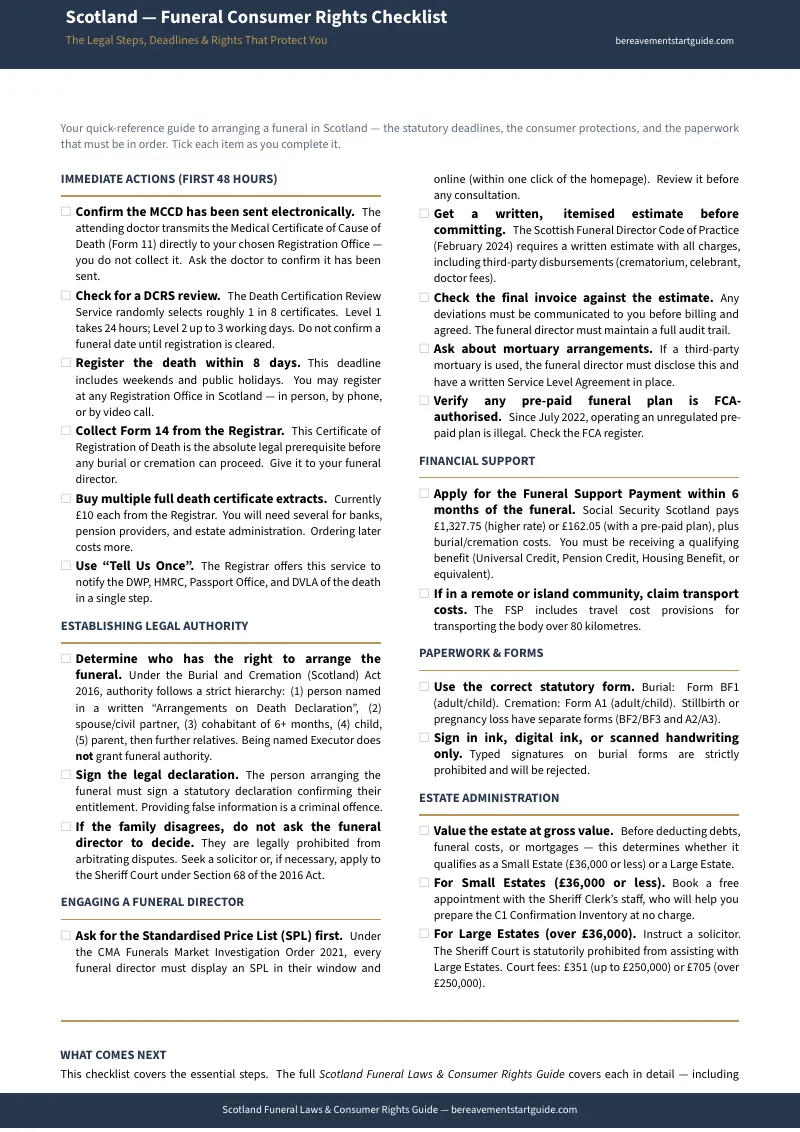
Not ready for the full guide? Start with the free Scotland Funeral Consumer Rights Checklist — it covers the 5 rights MyGov.scot does not clearly explain — and decide from there.