The bank accounts are frozen, the Sheriff Court won't help you with the paperwork, and nobody explained that "probate" doesn't even exist in Scotland
After a death in Scotland, the administrative system hits you from every direction at once. Bank accounts freeze the moment they're notified. Direct debits cancel. And the legal process you're supposed to navigate isn't the English probate system — it's an entirely separate jurisdiction called Confirmation, administered through local Sheriff Courts, using its own forms, its own terminology, and its own traps. You don't file at a probate registry. You submit a Form C1 Inventory to the Commissary Department of the Sheriff Court where the deceased was domiciled. Get the domicile wording wrong — writing "Glasgow" instead of "Sheriffdom of Glasgow and Strathkelvin" — and the application is returned by post, resetting the clock by weeks.
Meanwhile, the system is designed to funnel you toward a solicitor. The Scottish Courts and Tribunals Service explicitly prohibits its staff from helping applicants with large estates — anything over the £36,000 gross threshold. Law firm blogs from Wilson & Fish, Brodies, and Murray Beith publish just enough to create anxiety about the Bond of Caution and executor liability before funnelling you toward consultations starting at £3,000. And the definitive legal textbook — Currie on Confirmation of Executors — costs £188.70 and is written for practising solicitors, not grieving families trying to release a frozen bank account.
The rejection rate for Confirmation applications at major Sheriff Courts fluctuates between 24% and 30%. Most rejections are caused by preventable errors: missing postcodes, blank boxes that should say "none," discrepancies between the death certificate and the C1 form. Each rejection adds weeks to a process that already takes 6 to 14 weeks — weeks during which bank accounts stay frozen, bills accumulate, and beneficiaries wait.
The Scotland Confirmation Navigator — every form, every threshold, every Scotland-specific rule, in the order you actually need them
The Scotland Probate Process Guide turns fragmented government websites into a single chronological pathway. It walks you through everything from determining whether Confirmation is even required, through submitting a flawless Form C1 application, to transferring property and distributing assets — with the specific forms, fees, thresholds, and institutional traps that apply under Scots law.
This is not a generic UK probate guide with "Scotland" in the title and English procedures in the body. It's what we call the Scotland Confirmation Navigator — a step-by-step administrative playbook built around the institutions Scottish families actually deal with: the Sheriff Court Commissary Department, the Bond of Caution, the heritable vs. moveable property distinction, Prior Rights and Legal Rights that can't be defeated by a Will, survivorship destinations that override Wills entirely, and the post-2022 HMRC changes that made Form C5 largely obsolete — even though half the internet still tells you to fill it out.
What's inside
- Do-you-need-Confirmation decision tree — a structured diagnostic that walks you through joint assets with survivorship destinations (which transfer automatically and bypass the Sheriff Court), sole assets below bank thresholds, and the specific scenarios where funds can be released informally — so you don't spend months pursuing Confirmation for an estate that doesn't require it
- The 2026 bank threshold matrix — every major UK bank and Scottish institution's internal Confirmation limit in one scannable table: Barclays and RBS/NatWest at £50,000; Bank of Scotland at £25,000 to £50,000 depending on whether there's a Will; Nationwide at £30,000; Sainsbury's Bank at £20,000; Starling at just £10,000; Aviva up to £200,000 for life policies — plus the mechanism for releasing funeral funds directly to the funeral director before Confirmation is granted
- Form C1 field-by-field walkthrough — annotated instructions for every section of the Confirmation Inventory, the heritable vs. moveable asset classification that trips up most applicants, the exact domicile wording the Commissary Department requires (not just "Edinburgh" — the full Sheriffdom declaration), and the top rejection triggers identified by the Royal Faculty of Procurators in Glasgow
- Bond of Caution navigation guide — what the Bond is (pronounced "kayshun"), when it's required (intestate estates over £36,000 gross), why most insurers refuse to issue directly to the public, the documented Sheriff Court ruling confirming that courts have no discretion to waive it, and the niche direct-to-consumer brokers (Savendale, ArrangeBonds, Title Research) that let you secure the Bond without paying a solicitor's £3,000 retainer
- Prior Rights calculation guide — the surviving spouse's automatic statutory entitlements to the dwelling house (up to £473,000), furniture and plenishings (up to £29,000), and a cash sum (£50,000 if children survive, £89,000 if they don't) — with worked examples showing exactly how each right is applied against the estate before anything else is distributed
- Legal Rights (Legitim) calculator — how the one-third or one-half share of the net moveable estate is calculated for the surviving spouse and children, including the critical rule that Legal Rights cannot be defeated by a Will — children can claim their share even when explicitly disinherited
- Survivorship destination checker — how to read your Scottish property title deed to identify whether the dwelling transfers automatically on death, bypassing both Wills and Confirmation entirely — plus the implications for Prior Rights calculations and estate valuation
- Estate valuation and IHT walkthrough — how to value heritable property (multiple estate agent estimates), the HMRC-mandated "quarter-up" method for valuing listed shares on the exact date of death, the £325,000 nil-rate band plus the £175,000 residence nil-rate band, and when you need the full IHT400 versus the simplified excepted estate pathway introduced in January 2022
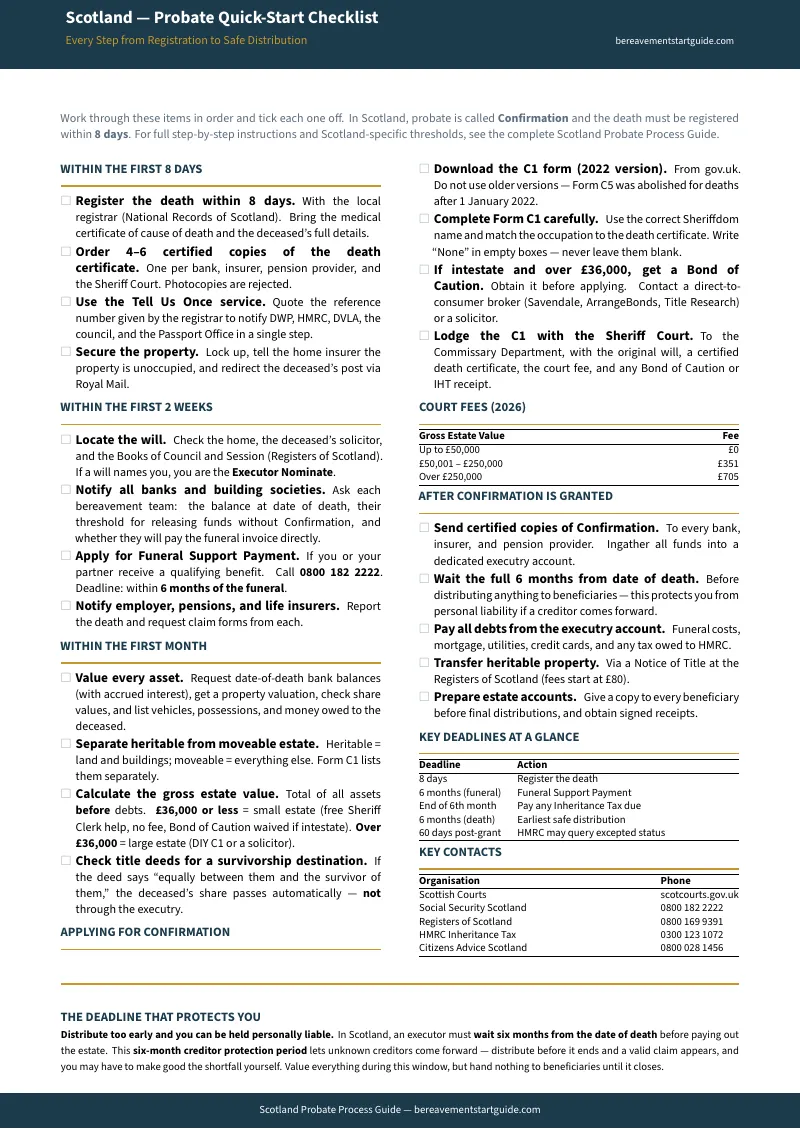
- Sheriff Court fee schedule — the 2026 tiered fees: £0 for estates up to £50,000; £351 for £50,001 to £250,000; £705 for estates exceeding £250,000; plus the £23 dative petition fee, £23 for the first Certificate of Confirmation, and £10 for each subsequent copy — with the strategic reasoning for ordering multiple copies upfront
- Executor Dative application process — the complete pathway for intestate estates: how the Sheriff Court determines priority among competing applicants, the dative petition procedure, the Bond of Caution requirement, and the specific documentation the Commissary Department expects with your application
- The 6-month creditor rule and executor liability — why you must not distribute any assets until six full months after the date of death, the personal financial liability you face if a creditor surfaces after early distribution, and the defensive documentation that protects you from beneficiary pressure
- Post-2022 HMRC changes explained — the abolition of Form C5 for excepted estates, the new thresholds (£3 million for exempt excepted estates, £325,000 standard nil-rate band extendable to £650,000 with a deceased spouse's unused allowance), and exactly which version of Form C1 to use for deaths after 1 January 2022
- Beneficiary communication templates — ready-to-use letters and emails for updating family members on Confirmation progress, explaining the 6-month creditor waiting period to impatient beneficiaries, and formally notifying beneficiaries of their entitlement — so you handle the emotional pressure with the same care as the paperwork
Plus standalone printable worksheets and reference cards — each designed to be printed separately and used at your desk, at the bank, or at the Sheriff Court: Confirmation Decision Flowchart, Bank Threshold Quick-Reference, Form C1 Pre-Submission Checklist, Estate Valuation Worksheet (heritable/moveable split), Bond of Caution Decision Guide, Prior Rights Calculator, Legitim Calculator, Sheriff Court Fee Schedule, Asset and Liability Inventory, Beneficiary Communication Log, and Certificate of Confirmation Tracker.
Who this is for
- Surviving spouses who need immediate clarity on which assets pass automatically through survivorship destinations, which accounts the bank will release informally, and how to exercise Prior Rights on the family home — before monthly bills drain the estate while accounts stay frozen
- Adult children named as executor who are balancing work, family, and sibling pressure to distribute the estate quickly — and need to master Form C1, understand the heritable vs. moveable distinction, and navigate the Sheriff Court without paying a solicitor £3,000 to £4,500 for work most executors can handle themselves
- Cross-border executors based in England who assumed their knowledge of English probate would transfer — and discovered that Scotland has no Letters of Administration, no centralised probate registry, no PA1P or PA1A forms, and an entirely different system of spousal and children's rights
- Small estate DIY executors with estates under £36,000 who want to use the free Sheriff Clerk service but need to prepare thoroughly for the appointment — and who need to understand that hiring a solicitor for a small intestate estate can trigger the Bond of Caution requirement that would have been waived through the Sheriff Clerk
- Caregivers and planners preparing now for an elderly parent's eventual death — checking whether survivorship destinations exist in the property deed, understanding how bank Confirmation thresholds work, and consolidating accounts to make the future executor's job as simple as possible
Why not just use the free government pages?
The government pages are accurate — they're just scattered across three separate systems that don't connect. The Scottish Courts and Tribunals Service provides the blank Form C1 and the fee schedule but explicitly forbids its staff from helping with large estates. MyGov.scot explains each concept in isolation but doesn't sequence them into an actionable pathway. HMRC handles the tax forms and IHT thresholds but doesn't explain the Scottish-specific Confirmation process that wraps around them.
Citizens Advice Scotland provides empathetic overviews but redirects you to a solicitor for anything beyond a basic small estate. MoneySavingExpert's forum threads contain genuinely useful peer-to-peer advice — like the exact domicile wording for Form C1 — but it's buried across years of posts, impossible to verify against current rules, and still references the pre-2022 C5 form requirements. And the law firms that dominate the search results — Wilson & Fish, Brodies, Murray Beith, Jones Whyte — publish excellent high-level explainers but deliberately withhold the templates and step-by-step instructions that would let you handle Confirmation yourself.
This guide connects the three fragmented government systems into one chronological pathway. It gives you the procedural depth of Currie on Confirmation without the £188.70 price tag or the assumption that you've passed the Scottish bar.
The cost of not knowing — in Scotland specifically
- Having your Form C1 rejected by the Sheriff Court for a preventable formatting error — missing postcodes, blank boxes, domicile wording — and waiting months for resubmission while bank accounts stay frozen and bills pile up
- Assuming the £36,000 small estate threshold lets you deduct debts first — it doesn't, it's the gross value, and a single heritable property can disqualify you from the simplified procedure entirely
- Hiring a solicitor for a small intestate estate and triggering the mandatory Bond of Caution (~£270 to £400) that would have been waived if you'd used the free Sheriff Clerk service instead
- Distributing assets at month four and having a creditor surface at month five — making you personally and unlimitedly liable for the debt because you didn't observe the mandatory 6-month waiting period
- Missing the 3-month Bereavement Support Payment window and forfeiting monthly instalments worth up to £6,300 over 18 months
- Miscalculating Prior Rights or Legitim and facing a legal challenge from a spouse or child who can claim their Legal Rights even against an explicit Will that attempts to disinherit them
- Filling out the abolished Form C5 because an outdated website told you to — wasting weeks on paperwork the Sheriff Court no longer requires for excepted estates
- Paying a solicitor £3,000 to £4,500 for straightforward Confirmation work that most executors can complete themselves with the right instructions
The guide costs a fraction of any single one of these mistakes.
— less than a single hour of a Scottish solicitor's time
Every solicitor in Scotland charges more per hour than the entire cost of this guide. The Scotland Confirmation Navigator gives you the step-by-step pathway to secure your Grant of Confirmation without the £3,000 retainer — from determining whether Confirmation is even needed, through submitting a flawless Form C1, to distributing assets safely after the 6-month creditor period. And it tells you exactly when a solicitor is genuinely needed, so you only pay for the moments that actually require one.