
You're dealing with the Birmingham Probate Registry, Welsh Revenue Authority, HM Land Registry, and Council Tax premiums up to 300% — all at once, while grieving
After a death in Wales, the administrative machinery starts immediately. Bank accounts freeze. Direct debits cancel. And the system you're navigating isn't quite England's and isn't quite separate — it's a hybrid that catches even careful executors. Your probate application goes to a centralised hub in Birmingham, not a local Welsh registry. Property transfers are governed by Land Transaction Tax through the Welsh Revenue Authority, not the English Stamp Duty your solicitor might assume. And if the deceased owned a rural property purchased before 1990, there's a real chance the land is unregistered — meaning you need physical paper deeds that may be in a forgotten bank vault or a waterlogged attic.
The free government pages tell you each step exists. But they're split between GOV.UK for probate and HMRC, GOV.WALES for devolved matters, and your local Welsh council for the empty property premiums that can reach 300% of standard Council Tax. No single source connects these systems into a sequence. And the law firm blogs that rank on Google deliberately withhold the final procedural steps to push you toward £2,000–£6,000 retainers.
The Wales Estate Settlement Roadmap — every form, every deadline, every Wales-specific trap, in the order they actually happen
The Estate Settlement Guide for Wales turns fragmented government websites into a single chronological roadmap. It walks you through every step — from the first 48 hours through final distribution — with the specific forms, fees, thresholds, and deadlines that apply when the deceased lived in Wales.
This isn't a generic UK guide with "England and Wales" in the footnotes. It's what we call the Wales Estate Settlement Roadmap — a chronological administrative playbook built around the specific institutions Welsh families actually deal with: the centralised Birmingham probate registry, the Welsh Revenue Authority, Welsh local council empty home premiums, Principality Building Society's £15,000 threshold, and the Discretionary Assistance Fund that only exists in Wales.
What's inside
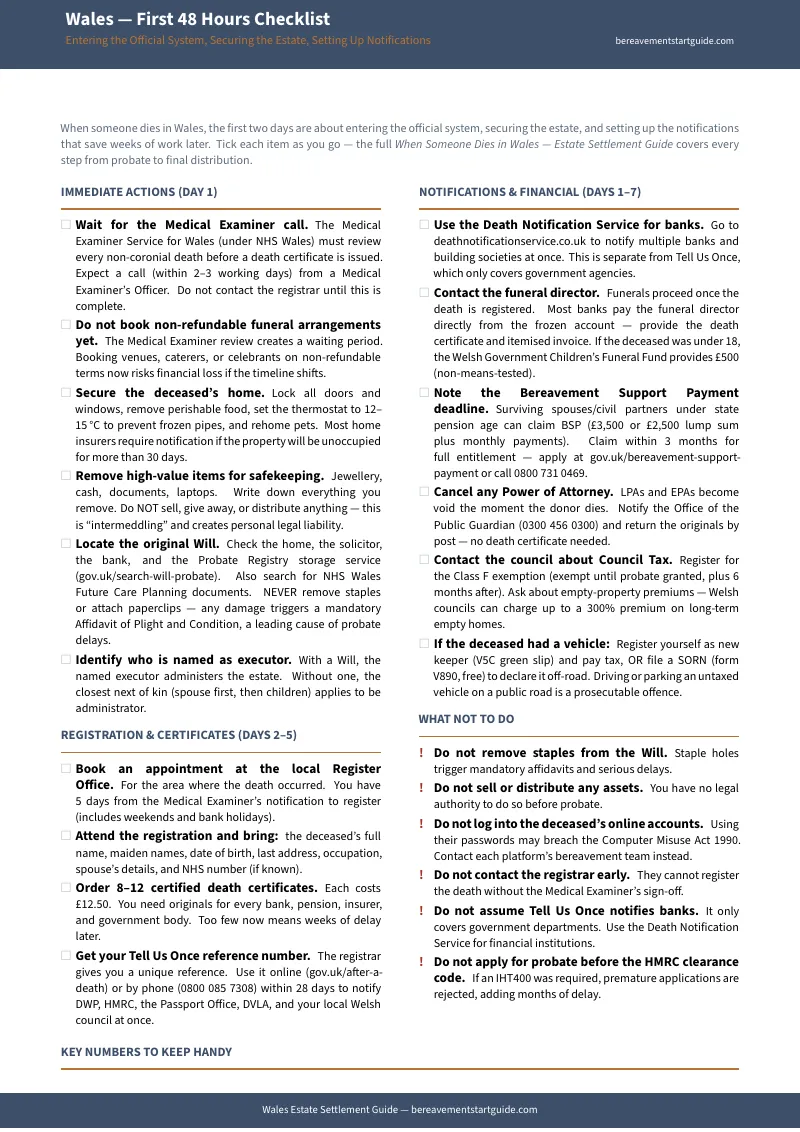
- The 48-hour triage checklist — what must happen before the registrar appointment (Medical Examiner confirmation, securing the property, locating the Will), what can wait, and the critical home insurance notification if the property will be unoccupied for more than 30 days
- Death registration and the 5-day window — the statutory deadline for registering the death at your local Welsh Register Office, what documents to bring, and what happens if a coroner referral extends the timeline to 8 days
- Tell Us Once vs. what it actually misses — the exact boundary between government agencies (DWP, HMRC, DVLA, Passport Office) and the banks, building societies, insurers, and utilities that Tell Us Once does not notify — because assuming it covers everything is the single most expensive mistake families make
- The 2026 bank threshold matrix — every major UK bank's internal probate limit in one table: Barclays, NatWest, Santander, and Lloyds at £50,000; Yorkshire and Skipton at £30,000; Principality Building Society at £15,000; NS&I as low as £5,000 — plus the mechanism for releasing funeral funds directly to the funeral director before probate is granted
- Welsh Council Tax premium defence — the Class F exemption timeline (exempt until probate is granted plus six months), what happens when the grace period expires, and defensive strategies for councils like Gwynedd that charge 100–150% premiums on empty properties — including Class 1/Class 2 applications for properties actively marketed for sale or let
- Probate application walkthrough — PA1P (with Will) and PA1A (without Will) form-by-form instructions for the centralised Birmingham registry, the IHT421 timing trap, and the fee schedule
- Land Transaction Tax guide — why Welsh property transfers use LTT through the Welsh Revenue Authority instead of English Stamp Duty, which transfers are exempt, and how equalisation payments between beneficiaries can trigger unexpected tax liabilities
- Unregistered land protocol — how to identify whether the property is registered with HM Land Registry, what to do if the paper title deeds are missing, and the process for applying for a possessory title when compulsory registration is triggered by the death of a sole owner
- Executor personal liability shield — Section 27 Trustee Act 1925 Gazette notices, beneficiary bankruptcy searches, and the two-month creditor window that protects you from personal financial liability when unknown creditors emerge after distribution
- Bereavement Support Payment and the 3-month deadline — the £2,500 or £3,500 lump sum plus up to 18 monthly payments, the strict claim window (full entitlement within 3 months, reduced after, void after 21 months), and eligibility for surviving spouses, civil partners, and cohabiting partners with children
- Welsh-specific financial support — the Discretionary Assistance Fund (DAF) for emergency hardship, the £500 Welsh Government child funeral contribution, and DWP Funeral Expenses Payment eligibility
- Intestacy rules — the £322,000 statutory legacy for the surviving spouse, the division formula for the remainder among children, and the complete beneficiary hierarchy when there is no Will
- Digital assets protocol — email accounts, social media memorialisation, cryptocurrency, and subscription cancellation — with the legal constraints on accessing password-protected accounts
- Agency Notification Tracker — a printable master list of every organisation you need to contact, with reference numbers, contact details, and completion checkboxes
Plus standalone printable worksheets and reference cards — each designed to be printed separately and used at your desk, at the bank, or when dealing with the council: Agency Notification Tracker, Bank Threshold Matrix, Council Tax Premium Timeline, Probate Pre-Submission Checklist, Asset and Liability Inventory, Beneficiary Communication Log, Land Registry Decision Tree, Intestacy Calculator, Executor Liability Shield, and Estate Settlement Timeline.
Who this is for
- Adult children named as executor who have limited bereavement leave, no legal training, and need to know exactly what to do and in what order — without spending weeks bouncing between GOV.UK, GOV.WALES, and their local council website
- Surviving spouses who need to access joint accounts, transfer the property, and secure the Bereavement Support Payment within the strict 3-month window — before monthly installments start being forfeited
- Budget-conscious executors who want to handle probate themselves rather than pay a solicitor 1–3% of the estate value — and need a proven DIY pathway that covers the Wales-specific traps the generic guides miss
- Remote or overseas family members managing a Welsh estate from London, Bristol, or abroad — who need to understand what can be handled digitally through the Birmingham registry and what requires physical presence in Wales
- Anticipatory caregivers preparing now for an elderly parent's eventual death — checking whether the family property is registered, understanding bank probate thresholds, and consolidating accounts to avoid unnecessary probate requirements
Why not just use the free government pages?
The government pages are accurate — they're just scattered across three separate systems that don't talk to each other. GOV.UK handles probate and HMRC. GOV.WALES handles Land Transaction Tax, the Discretionary Assistance Fund, and the child funeral contribution. Your local Welsh council handles the empty property premiums that can financially devastate an estate if the Class F exemption expires before the property is sold.
No single government source connects these into a sequence. Citizens Advice and Age Cymru provide empathetic overviews but redirect you to a solicitor for anything beyond the basics. And law firms like Co-op Legal Services publish just enough free content to create anxiety before funnelling you toward packages starting at £1,500 or more.
This guide connects the three systems into one chronological roadmap. It's the difference between reading a map of each individual street and having turn-by-turn directions for the whole journey.
The cost of not knowing — in Wales specifically
- Missing the Council Tax Class F exemption deadline and triggering premiums of 100–300% on the empty property — potentially thousands of pounds per year in councils like Gwynedd, Ceredigion, or Anglesey
- Assuming English Stamp Duty rules apply and miscalculating the tax on a Welsh property transfer — LTT rates differ at every threshold
- Discovering the property is unregistered land after accepting an offer from a buyer — delaying the sale by months while you compile an Epitome of Title or apply for possessory title
- Missing the 3-month Bereavement Support Payment window and forfeiting monthly installments worth up to £6,300 over 18 months
- Having a probate application stopped at the Birmingham registry for a preventable error and waiting 12+ additional weeks while assets remain frozen and Council Tax accrues
- Paying a solicitor £2,000–£6,000 for straightforward probate work that most executors can complete themselves with the right instructions
The guide costs a fraction of any single one of these mistakes.
— less than a single hour of a probate solicitor's time
Every probate solicitor in Wales charges more per hour than the entire cost of this guide. The Wales Estate Settlement Roadmap gives you the administrative playbook to handle the estate yourself — and tells you exactly when a solicitor is genuinely needed, so you only pay for the moments that require one.