The Medical Examiner's office hasn't released the paperwork. The funeral director's quote looks nothing like the CMA-required price list. Your sister wants a woodland burial, your father insists on cremation — and you're not even sure who has the legal right to decide
After a death in Wales, everything collides. The Medical Examiner system — only operational since September 2024 — has rewritten the registration timeline that families had relied on for decades. Cremation Forms 4 and 5, which every older guide still references, no longer exist. Local authority fees swing by hundreds of pounds depending on whether you're in Cardiff or Ceredigion. And the funeral industry, despite a CMA investigation that was supposed to bring transparency, still wraps its charges inside bundled quotes designed to prevent comparison.
The free information online makes it worse. Gov.uk covers England and Wales in the same breath but misses the Welsh Government's separate child funeral fund entirely. Citizens Advice explains your rights in principle but offers no tools to enforce them under pressure. Council websites bury their fee schedules inside unnavigable PDFs. And every funeral director's blog exists to funnel you toward their services — systematically omitting your legal right to transport the body yourself, arrange a home burial on private land, or refuse embalming.
The Wales Consumer Defence Toolkit — every Welsh funeral law, every consumer protection, every devolved rule, current as of 2026
The Wales Funeral Laws & Consumer Rights Guide consolidates the CMA pricing rules, the FCA prepaid plan regulations, the September 2024 Medical Examiner system, Welsh coroner protocols, Natural Resources Wales burial regulations, and your common law rights over the deceased into one chronological guide built specifically for Wales. It tells you what you can legally do, what you can legally refuse, and exactly how to enforce both.
We call it the Wales Consumer Defence Toolkit because the real problem isn't a lack of information — it's that the information is fragmented across Gov.uk, Natural Resources Wales, the FCA register, the CMA's enforcement archive, Welsh local authority fee schedules, and decades of common law. No single government page connects the Medical Examiner's office to the crematorium's revised forms to the CMA's pricing enforcement to your executor authority under the rules of intestacy to NRW's groundwater regulations for private land burial. This guide does.
What's inside
- The September 2024 Medical Examiner system explained — the new independent scrutiny process, the revised MCCD pathway, and why the five-day registration deadline now starts when the registrar receives the certificate from the Medical Examiner, not on the date of death
- Cremation Form 4 and Form 5 are gone — the forms were permanently abolished in September 2024, eliminating the approximately £164 fee that families previously paid for two-doctor certification. The guide explains the current Form 1 and Form 10 process so you can catch any funeral director still referencing the old system
- Executor authority and family dispute resolution — who has the legal right to arrange the funeral when there's a Will, when there isn't, and how the intestacy hierarchy works when siblings disagree about burial versus cremation
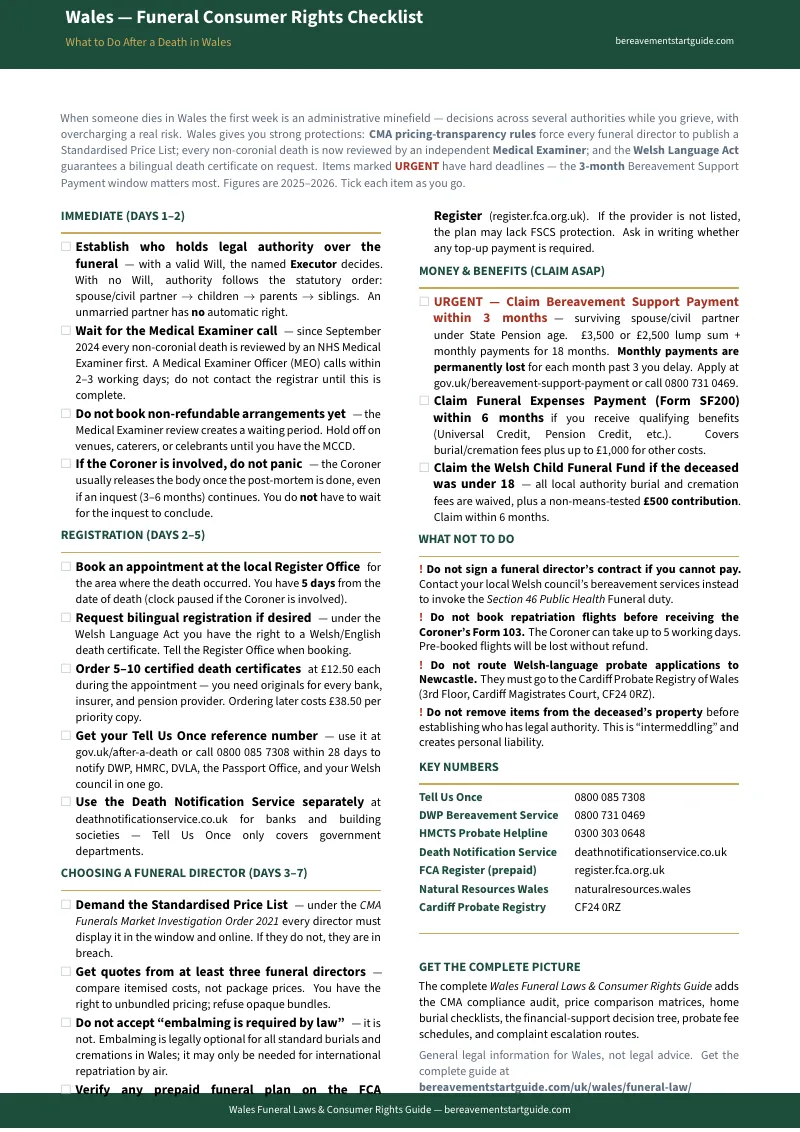
- CMA Compliance Scorecard — a printable checklist to take into any funeral home, based on the Funerals Market Investigation Order 2021, verifying the director is displaying the legally required Standardised Price List and not bundling hidden fees
- Welsh funeral cost comparisons — side-by-side council fee data showing the real spread, from Cardiff's £950 standard cremation and £450 direct cremation to Neath Port Talbot's £1,556 interment fee, so you know whether a quote is fair for your area
- Prepaid funeral plan verification — how to check whether a legacy plan is FCA-authorised since the July 2022 regulatory shift, whether it carries FSCS protection or only trust-based ring-fencing, and what to do if the provider has collapsed
- DIY funeral rights — the legal basis for transporting the body in a private vehicle, keeping the deceased at home, arranging a funeral without a commercial director, and refusing embalming (which is not a legal requirement in Wales, despite what many mortuaries imply)
- Home and private land burial compliance — Natural Resources Wales groundwater rules mapped in plain language: 50 metres from any well or borehole, 10 metres from field drains, 1-metre clearance from the water table, not within a groundwater Source Protection Zone 1, and a minimum of 1 metre of soil cover. Plus the Certificate of Authority for Burial process and Land Registry requirements
- Coroner interactions — when the coroner must be involved, the typical 3-to-6-month inquest timeline in Wales, and the fact that the body is usually released for the funeral long before the inquest concludes
- Welsh financial support — the DWP Funeral Expenses Payment (capped at £1,000 for discretionary items), the Welsh Government's universal £500 Child Funeral Fund contribution (not means-tested), Bereavement Support Payment, and the Section 46 public health funeral duty when no one can afford to pay
- Bilingual certificates and Tell Us Once — how to request a bilingual Welsh-English death certificate, the £12.50 standard fee versus the £38.50 priority service charge, and how Tell Us Once reduces the number of paid copies you need by notifying DWP, HMRC, DVLA, and the local council simultaneously
- Religious and cultural requirements — expediting Medical Examiner review for faith traditions requiring rapid burial, requesting non-invasive post-mortem alternatives, and navigating the coroner when religious timelines conflict with statutory procedures
- Complaint escalation framework — NAFD Resolve for service failures, Financial Ombudsman for prepaid plan disputes, Trading Standards for CMA pricing violations, and pre-written complaint templates demanding a formal response
Plus standalone printable worksheets and reference cards — CMA Compliance Scorecard, Funeral Cost Comparison Worksheet, First Week Funeral Checklist, Prepaid Plan Audit Checklist, NRW Home Burial Site Assessment, Complaint Filing Templates, and more.
Who this is for
- Executors and next of kin arranging a funeral in Wales who need the current rules — not the pre-September 2024 process that most online guides still describe
- Families in a dispute over burial versus cremation, ashes, or who has the right to make funeral decisions — and who need the legal hierarchy spelled out before it escalates
- Budget-conscious families who suspect a funeral director is overcharging, want to verify CMA compliance, or need to access DWP and Welsh Government financial support before committing to fees they cannot afford
- Unmarried partners and non-traditional next of kin who need to understand their exact legal standing when blood relatives attempt to override the deceased's wishes
- DIY and home funeral planners who want to care for the body, arrange transport, or conduct a private land burial in Wales — and need the exact NRW environmental framework to push back against institutional resistance
- Religious communities whose burial traditions require speed that conflicts with Welsh bureaucratic timelines — and who need to know how to legally expedite the process
Why not just use the free government pages?
The government pages are accurate on their own terms. The problem is that funeral administration in Wales spans at least seven separate regulatory bodies — the Medical Examiner's office, the Registrar, the CMA, the FCA, Natural Resources Wales, the Welsh Government, and the Coroner — and none of them reference each other.
Gov.uk tells you to register the death within five days but doesn't explain the Medical Examiner step that now comes first. The CMA published the Funerals Market Investigation Order but doesn't provide a consumer-facing tool to verify compliance. NRW covers groundwater rules for private burial but doesn't explain the Certificate of Authority or the Land Registry requirement. Local council websites list cremation fees but offer no comparative context — and their PDFs are formatted for internal use, not for a family making a decision under extreme time pressure. Citizens Advice covers your rights but gives you no templates to enforce them. And nearly 250 funeral directors were reported for CMA non-compliance in the first year alone — so the rules exist, but enforcement depends on you.
This guide connects all of it. One document. One sequence. Built for Wales.
The cost of not knowing
- Accepting a funeral director's quote without checking CMA compliance — and paying hundreds of pounds more than the transparent market rate
- Paying approximately £164 for Cremation Forms 4 and 5 that were permanently abolished in September 2024
- Being told by a hospital that you must use a funeral director — when Welsh law gives you the right to collect the body yourself
- Missing the Welsh Government's £500 Child Funeral Fund because you confused it with the means-tested DWP payment
- Ordering five priority death certificates at £38.50 each when Tell Us Once could have reduced the number you needed to two
- A family dispute over burial versus cremation escalating because no one understood who holds legal authority under intestacy
- Attempting a home burial on private land without meeting NRW's groundwater distance rules — and facing enforcement action
The guide costs a fraction of any single one of these mistakes.
— less than a single death certificate priority copy
Funeral directors charge hundreds of pounds for a basic arrangement meeting. Solicitors charge more per hour than this entire guide costs. A single priority death certificate is £38.50. The Wales Consumer Defence Toolkit gives you the legal standing, the regulatory tools, and the procedural knowledge to handle the funeral with confidence — and tells you exactly when professional help is genuinely needed, so you only pay for the moments that require it.