The bank has frozen the accounts, the council is charging for an empty house, and nobody can tell you whether your probate application should go to Birmingham or Cardiff
After a death in Wales, the administration hits you from three directions at once. The deceased's bank accounts freeze the moment they're notified. Direct debits cancel. And the probate system you're supposed to navigate isn't the local Welsh process you might expect — your application goes to a centralised hub at the Birmingham Civil and Family Justice Centre, unless you're filing in Welsh, in which case it must be routed to the Probate Registry of Wales at Cardiff Magistrates Court. Choose wrong and your application gets bounced, sending you to the back of a queue that already takes months.
Meanwhile, the council wants to know about the empty property. Welsh local authorities can impose premiums of 100% to 300% on empty homes — and the Class F exemption that protects you isn't automatic. You have to apply for it, and the clock starts ticking from the day the grant is issued. Miss the window, and the estate haemorrhages thousands in avoidable council tax.
The government pages explain each piece in isolation. GOV.UK handles probate forms and HMRC. GOV.WALES handles devolved matters. Your local council handles the empty property premiums. But nothing connects these into a sequence. And the solicitor blogs that rank on Google deliberately withhold the procedural details — they want you anxious enough to pay £2,000 to £8,000 for work most executors can handle themselves.
The Wales Probate Navigator — every form, every threshold, every Wales-specific routing rule, in the order you actually need them
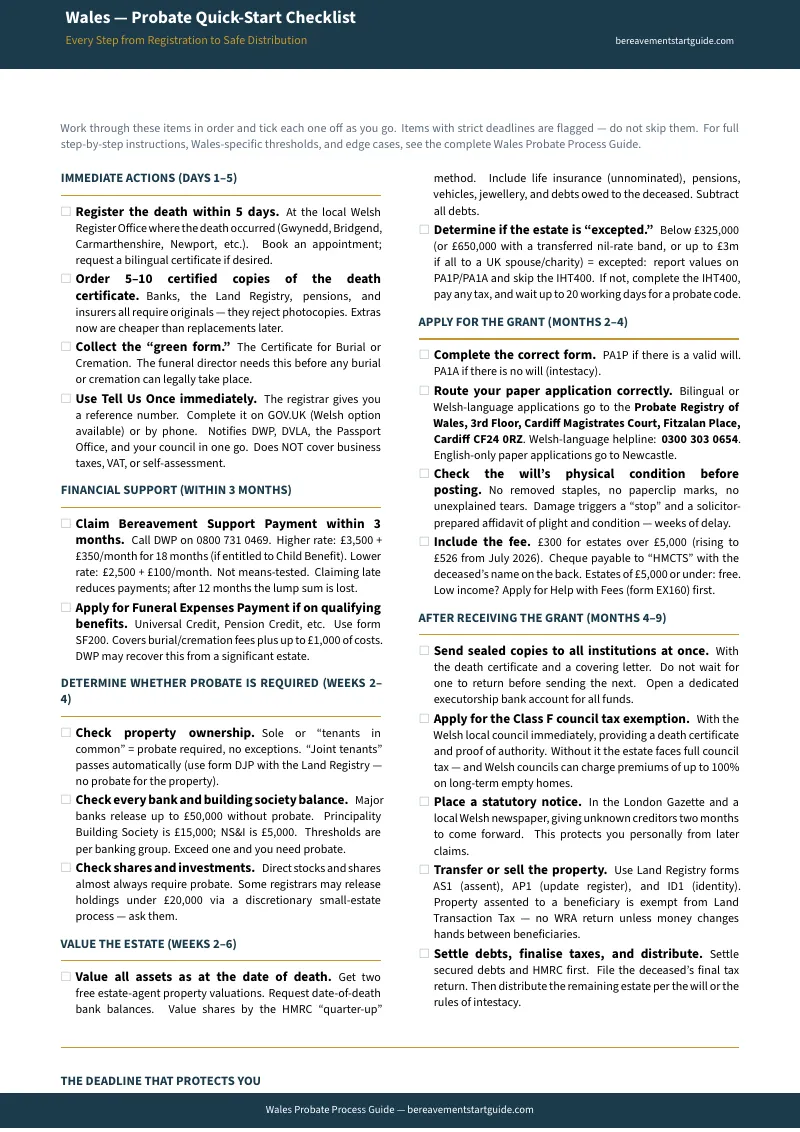
The Wales Probate Process Guide turns fragmented government websites into a single chronological pathway. It walks you through everything from determining whether probate is even required, through submitting a flawless application, to transferring property and distributing assets — with the specific forms, fees, thresholds, and institutional quirks that apply when the deceased lived in Wales.
This isn't a generic UK probate guide with "England and Wales" in the footnotes. It's what we call the Wales Probate Navigator — a step-by-step administrative playbook built around the specific institutions Welsh families actually deal with: the Birmingham centralised registry, the Probate Registry of Wales in Cardiff, Principality Building Society's restrictive thresholds, Welsh council empty home premiums, and the Medical Examiner Service for Wales that scrutinises every non-coronial death before you can even register it.
What's inside
- Do-you-even-need-probate decision tree — a structured diagnostic that walks you through joint assets (which pass automatically via survivorship), sole assets below bank thresholds, and the specific scenarios where you can release funds without a court grant — including the little-known statutory declaration route for small balances at Welsh building societies
- The 2026 bank threshold matrix — every major UK bank and Welsh building society's internal probate limit in one scannable table: Barclays, NatWest, Santander, and Lloyds at £50,000; Yorkshire and Skipton at £30,000; Principality Building Society at just £15,000 for simple closure (£40,000 for full grant requirement); NS&I as low as £5,000 — plus the mechanism for releasing funeral funds directly to the funeral director before probate is granted
- Form-by-form application walkthrough — PA1P (with Will) and PA1A (without Will) instructions field by field, the critical routing decision (English applications to Birmingham, Welsh-language or bilingual applications to Cardiff only), the IHT summary timing trap, and exactly which documents to include with your application — and what must never be attached to the original Will
- The probate fee schedule and the July 2026 increase — the current £300 application fee for estates over £5,000, the impending 75% increase to £526, how to order sealed copies at £16 each, and the EX160 Help with Fees application for low-income executors that can eliminate the fee entirely
- Estate valuation walkthrough — how to value property (multiple estate agent estimates), the HMRC-mandated "quarter-up" method for valuing listed shares on the exact date of death, the £325,000 nil-rate band and £175,000 residence nil-rate band, and when you need the full IHT400 versus the simpler excepted estate forms
- Welsh Council Tax premium defence — the Class F exemption timeline (no council tax while probate is pending, plus six months after the grant is issued), how to apply to your local Welsh council before premiums trigger, and defensive strategies for authorities like Gwynedd, Ceredigion, and Anglesey that charge 100% to 150% on long-term empty properties
- Land Registry property transfer guide — the AS1 form (Assent of whole registered title to a beneficiary) and AP1 form (Change the register) explained step by step, Scale 1 versus Scale 2 fee calculations, the bilingual AS1 option available in Wales, and the process for lodging applications with the HM Land Registry Wales Office in Swansea
- Intestacy rules when there's no Will — the £322,000 statutory legacy for the surviving spouse, the division formula for the remainder among children, the complete beneficiary hierarchy, and the PA1A application process for Letters of Administration
- Bereavement Support Payment and the 3-month deadline — the £3,500 lump sum plus up to £350 monthly for 18 months, the strict claim window (full entitlement within 3 months, reduced rates after, void after 21 months), and eligibility for surviving spouses, civil partners, and cohabiting partners with dependent children
- Executor personal liability shield — Section 27 Trustee Act 1925 Gazette notices, the two-month creditor window, beneficiary bankruptcy searches, and the statutory protections that prevent you from being personally sued by unknown creditors who surface after distribution
- Beneficiary communication templates — ready-to-use letters and emails for updating family members on probate progress, managing expectations during registry delays, and formally notifying beneficiaries of their entitlement — so you handle the emotional pressure with the same care as the paperwork
Plus standalone printable worksheets and reference cards — each designed to be printed separately and used at your desk, at the bank, or when dealing with the council: Probate Decision Flowchart, Bank Threshold Quick-Reference, PA1P/PA1A Pre-Submission Checklist, Estate Valuation Worksheet, Council Tax Exemption Timeline, AS1 Property Transfer Checklist, Asset and Liability Inventory, Beneficiary Communication Log, and Sealed Copy Tracker.
Who this is for
- Adult children named as executor who are balancing full-time work, family responsibilities, and the sudden weight of estate administration — and need to know exactly which forms to file, where to send them, and what happens if something goes wrong
- Surviving spouses who need immediate clarity on which assets pass automatically, which require a court grant, and how to secure the Bereavement Support Payment before the 3-month window closes and monthly instalments start being forfeited
- Families dealing with intestacy who are navigating the estate without a Will — wondering who inherits, how to apply for Letters of Administration, and whether the statutory legacy is enough to keep the surviving spouse in the family home
- Budget-conscious executors who want to handle probate themselves rather than pay a solicitor 1% to 5% of the estate — and need a proven pathway that covers the Wales-specific traps the generic UK guides miss
- Remote or overseas family members managing a Welsh estate from England, Scotland, or abroad — who need to understand the Birmingham registry routing rules, what can be handled online, and what requires physical presence in Wales
Why not just use the free government pages?
The government pages are accurate. They're just scattered across three separate systems that don't connect. GOV.UK handles probate forms and HMRC submissions. GOV.WALES handles devolved matters like the Discretionary Assistance Fund. Your local Welsh council handles empty property premiums — and each council sets its own premium rate independently.
Citizens Advice Cymru and Age Cymru provide empathetic overviews but redirect you to a solicitor for anything procedural. MoneySavingExpert's forum threads are helpful but buried across years of chronological posts — and it's nearly impossible to verify whether advice from 2023 still holds after the 2026 fee changes. Meanwhile, digital platforms like OnlineProbate.co.uk charge £199 for software access but lack the Wales-specific detail on Cardiff routing rules, Principality Building Society thresholds, or council tax premium enforcement under the Housing (Wales) Act 2014.
This guide consolidates all three government systems into one chronological pathway. It's the difference between reading a map of each individual street and having turn-by-turn directions for the whole journey.
The cost of not knowing — in Wales specifically
- Missing the Council Tax Class F exemption and triggering premiums of 100% to 300% on the empty property — potentially thousands per year in councils like Gwynedd, Ceredigion, or Anglesey
- Sending a Welsh-language application to Birmingham instead of Cardiff, or vice versa — and having it returned, losing months in the already-backlogged system
- Assuming every bank releases funds up to £50,000 without probate, then discovering Principality Building Society requires a full grant for balances above £40,000 — freezing the estate's largest savings account indefinitely
- Missing the 3-month Bereavement Support Payment window and forfeiting monthly instalments worth up to £6,300 over 18 months
- Incorrectly valuing shares using the closing price instead of HMRC's quarter-up method — triggering an investigation that delays the entire estate
- Having a probate application rejected at Birmingham for a preventable error and waiting 12+ additional weeks while assets remain frozen and council tax accrues
- Paying a solicitor £2,000 to £8,000 for straightforward probate work that most executors can complete themselves with the right instructions
The guide costs a fraction of any single one of these mistakes.
— less than a single hour of a probate solicitor's time
Every probate solicitor in Wales charges more per hour than the entire cost of this guide. The Wales Probate Navigator gives you the step-by-step pathway to handle the application yourself — from deciding whether probate is needed, through submitting a flawless PA1P or PA1A, to transferring property and distributing assets. And it tells you exactly when a solicitor is genuinely needed, so you only pay for the moments that actually require one.