The benefits exist. The deadlines are running. And in Wales, half the rules come from Cardiff and half from Westminster — with nobody connecting them.
When your spouse or partner dies in Wales, you're not dealing with one government — you're dealing with two. The DWP in Westminster controls Bereavement Support Payment, State Pension inheritance, and Funeral Expenses Payment. The Senedd in Cardiff controls the Discretionary Assistance Fund, council tax premiums on empty homes, and bilingual death registration. Each system has its own forms, its own deadlines, and its own eligibility rules. And neither system tells you about the other.
Miss the Bereavement Support Payment window by a single day and you lose up to £9,800 in tax-free payments. Leave the deceased's property empty without notifying your local authority and Gwynedd charges 150%, Conwy charges 200%, and several other Welsh councils charge up to 400% council tax premiums on top of the standard bill. Fail to claim from the Welsh Discretionary Assistance Fund within the right window and you miss emergency cash that could have covered the funeral deposit the director is demanding this week. The July 2026 probate fee hike from £300 to £526 is already approaching. And none of these deadlines wait for grief.
GOV.UK explains each DWP benefit on its own page. GOV.Wales explains each devolved programme on its own page. The charity sites offer emotional support and high-level overviews. The solicitors charge a minimum of £3,000 and provide just enough complexity to make sure you hire them. Nobody connects the Welsh-specific programmes with the UK-wide entitlements into a single actionable plan. That gap is where families lose money.
The Dual-Layer Navigator — Welsh devolved benefits and UK-wide entitlements mapped together for the first time
The Wales Survivor Benefits Navigator pulls every financial entitlement available to bereaved families in Wales into a single chronological system. It covers both layers — the devolved Welsh programmes that only apply in Wales and the UK-wide DWP and HMRC entitlements that apply across England and Wales — and organises them by the order you actually need to act.
We call it the Dual-Layer Navigator. Instead of bouncing between GOV.UK and GOV.Wales and your local council website hoping you haven't missed something, you work through one document that tells you what to claim, when to claim it, which layer of government administers it, and what evidence each agency needs. Generic UK bereavement guides mention that benefits exist. This guide was built around the operational reality of claiming them in Wales, where devolved policy and Westminster policy collide at every stage.
What's inside
- Bereavement Support Payment claim guide with the 3/12/21-month deadline cliff — the full lump sum (£2,500 or £3,500 depending on dependent children) plus 18 monthly payments worth up to £9,800 total. Claims filed after 3 months receive reduced payments. Claims after 21 months are rejected entirely. The guide walks you through the BSP1 form, the evidence requirements, the cohabiting partner eligibility rules that changed in February 2023, and the Welsh language helpline option for those who prefer to apply in Welsh
- Council Tax Premium Shield — the Welsh empty-property trap decoded — Welsh billing authorities can charge premiums of 300% to 400% on long-term empty properties. The guide maps the Class F exemption that protects properties during probate, the new 12-month post-probate exemption effective in 2025/2026, and the treacherous 6-week occupancy reset rule that catches executors off guard. Temporarily reoccupy the property for less than 6 weeks while clearing it out and the premium applies immediately with no new grace period. This section alone can save thousands of pounds
- Discretionary Assistance Fund fast-track — the DAF is a Welsh-only emergency fund that provides Emergency Assistance Payments for immediate costs after a death. Most families don't know it exists because GOV.UK doesn't mention it — it's administered through the Welsh Government. The guide covers eligibility, application steps, and how to stack DAF emergency payments with the separate DWP Funeral Expenses Payment for maximum coverage
- State Pension inheritance decision tree — the rules depend on whether the deceased reached pension age before or after 6 April 2016, and they are genuinely complex. Pre-2016 survivors may inherit up to 50% of the Additional State Pension, Graduated Retirement Benefits from 1961-1975, and Protected Payments. Post-2016 survivors inherit under different transitional rules. The guide replaces the DWP's scattered web pages with a single visual decision tree that tells you exactly what applies to your situation
- NHS and LGPS pension survivor walkthrough — Wales has a high concentration of public sector workers. The guide decodes the April 2026 retrospective changes to the Local Government Pension Scheme that provide fairer survivor benefits, the NHS death-in-service lump sum versus ongoing adult dependant pension, and the specific forms required for each (AW8, dependant claim forms). Dense actuarial PDFs translated into plain language
- Industrial disease compensation navigator — Wales's coal mining, steelwork, and manufacturing heritage means higher regional incidence of pneumoconiosis and mesothelioma. The guide covers the Pneumoconiosis etc. (Workers' Compensation) Act 1979, the 2008 Diffuse Mesothelioma scheme, the 2026 uprating of 3.8% in lump sums, and the strict 12-month deadline for dependant claims. Mesothelioma general damages can range from £71,730 to £128,990. Awareness of these schemes is remarkably low
- Probate fee deadline accelerator — the standard HMCTS probate fee rises from £300 to £526 on 13 July 2026. The guide provides a document-gathering checklist to expedite your application before the deadline, the exact requirements for date-of-death valuations, and the steps for clearing HMRC inheritance tax paperwork. The concurrent reduction in official copy fees from £16 to £2 is noted, but the primary value is beating the 75% fee hike
- Medical Examiner delay strategy — since September 2024, the statutory Medical Examiner Service adds an administrative layer before death registration in England and Wales. The guide explains how this delay cascades: you cannot access Tell Us Once without the registrar's reference number, you cannot get the death certificate needed by banks to release estate funds, and you may need the Welsh Discretionary Assistance Fund to bridge the gap while waiting
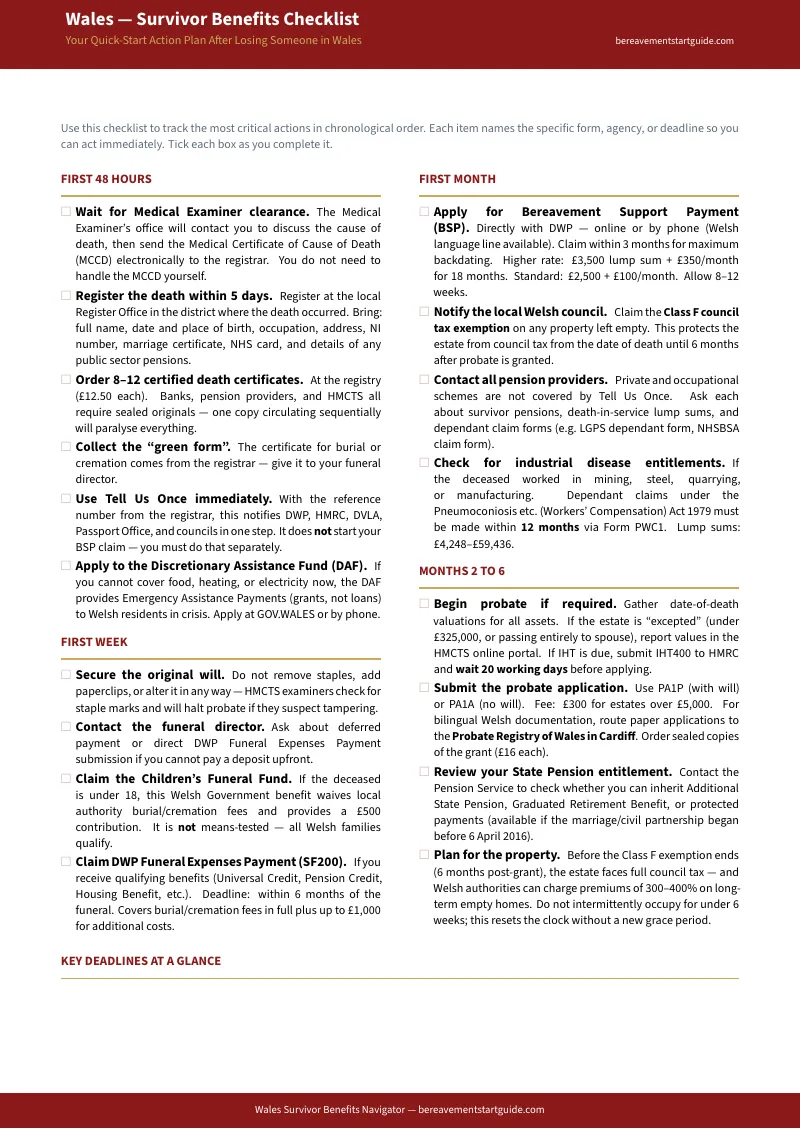
- Post-Tell Us Once notification checklist — Tell Us Once notifies the DWP to cancel the deceased's State Pension and benefits, but it does not initiate your BSP claim, does not touch private pensions, and does not notify banks, utilities, or subscriptions. The guide provides a complete supplementary checklist of every proactive application and notification you must handle separately
- Children's Funeral Fund and child bereavement provisions — if the deceased is under 18, the non-means-tested Children's Funeral Fund covers burial or cremation fees. The Welsh Government also provides a universal £500 contribution. Guardian's Allowance, Child Benefit transfers, and BSP dependent rates are covered in a dedicated section
- Appeals and Mandatory Reconsideration pathway — if the DWP denies your BSP or other benefit claim, you have one month to request a Mandatory Reconsideration. If that fails, you can appeal to the Social Security Tribunal. The guide covers the process step by step, including evidence guidance for cohabitation proof under the 2023 rules
- Master deadline calendar and claim tracker — a single-page visual timeline showing every benefit deadline from the date of death: 3 months (BSP maximum), 12 months (DMPS/industrial disease), 21 months (BSP absolute cutoff), and the council tax exemption windows. Plus a printable tracking sheet for every claim with reference numbers, submission dates, and follow-up dates
Plus standalone printable worksheets and reference cards — each designed to be printed separately and used at your desk, on a call with the DWP, or at the council office: Benefits Deadline Calendar, BSP Eligibility Checklist, Council Tax Premium Shield Checklist, Welsh DAF Application Guide, State Pension Decision Tree, Post-Tell Us Once Notification Tracker, and Claim Status Log.
Who this is for
- Surviving spouses and civil partners in Wales who need to replace lost household income, navigate both Welsh and UK-wide benefit systems simultaneously, and avoid permanently forfeiting payments by missing deadlines they didn't know existed
- Cohabiting partners who became eligible for Bereavement Support Payment under the February 2023 rule change but aren't sure whether they qualify or how to prove the relationship to the DWP — and who may also need the Welsh Discretionary Assistance Fund to bridge the 8-12 week BSP processing delay
- Executors managing Welsh property — adult children who may live outside Wales but are responsible for an estate that includes property in a council area charging 300-400% empty home premiums. One wrong move with the 6-week reset rule triggers thousands in avoidable tax
- Low-income families facing funeral costs — average funeral costs exceed £4,000, and families in Wales have access to both the DWP Funeral Expenses Payment and the Welsh Discretionary Assistance Fund. Most people apply for one or the other. The guide shows you how to claim both
- Dependants of workers who died from industrial disease — the coal, steel, and manufacturing legacy in Wales means higher rates of pneumoconiosis and mesothelioma. DMPS payouts can exceed £128,000 and carry a strict 12-month deadline. Awareness is exceptionally low
Why not just use the free government pages?
The government pages are accurate — they're split across GOV.UK, GOV.Wales, your local council website, and HM Land Registry, with no cross-referencing and no indication of which deadlines run concurrently.
GOV.UK explains that Bereavement Support Payment exists but doesn't mention the Welsh Discretionary Assistance Fund that can bridge the 8-12 week processing gap. GOV.Wales explains the DAF but doesn't connect it to the DWP funeral funding you might also qualify for. The DWP's State Pension inheritance pages spread the pre-2016 and post-2016 rules across multiple interlinked pages that presume you already understand the pension tier structure. Citizens Advice and Age Cymru provide compassionate overviews but direct you to a solicitor or the DWP helpline for anything specific — and Cruse Cymru's direct support has waiting lists. And the solicitor blogs publish enough complexity to generate anxiety without providing the forms, checklists, or step-by-step instructions that would let you handle it yourself — at a minimum fee of £3,000.
This guide connects the devolved Welsh layer and the UK-wide layer into a single sequence. It's the difference between knowing benefits exist and actually claiming them before the deadlines expire.
The cost of not knowing
The financial consequences of missing benefit deadlines in Wales are permanent:
- Filing for Bereavement Support Payment after 3 months reduces your payments — filing after 21 months means you get nothing from a benefit worth up to £9,800
- Leaving an empty property unreported in a Welsh council area and triggering premiums of 300% to 400% on top of standard council tax — because you didn't know about the Class F exemption or the 6-week reset rule
- Missing the Welsh Discretionary Assistance Fund entirely because GOV.UK never mentioned it — while struggling to cover the funeral deposit this week
- Paying the £526 probate application fee when the estate sits below bank thresholds that would have released the funds without probate
- Missing the 12-month deadline for an industrial disease dependant claim worth over £128,000 — because nobody told you the clock was running
- Leaving State Pension inheritance unclaimed because the pre-2016 transitional rules were too confusing to navigate without guidance
- Relying on Tell Us Once and assuming your BSP claim was automatically initiated — then discovering 4 months later that you've already missed the window for maximum payments
The guide costs a fraction of any single one of these losses.
— less than a single death certificate
At £12.50 per certified death certificate copy, you'll spend more on the paperwork the banks require than on the guide that tells you how to claim everything your family is owed across both Welsh and UK systems. The Dual-Layer Navigator gives you the complete picture — every devolved entitlement, every UK-wide benefit, every form, every deadline — so nothing expires while you're still figuring out which government to call first.