The Bank Said You Need a Fiduciary Certificate. The Probate Court Said They Cannot Tell You How to Get One. You Are Holding a Will That Means Nothing Until a Judge in One of Connecticut's 54 Probate Districts Admits It.
You went to the bank with the death certificate and the original will, and the teller said the account is frozen until you produce a Fiduciary Certificate — what Connecticut calls Letters Testamentary. You drove to the probate court and asked the clerk how to get one. She gave you a login for TurboCourt and said the court cannot provide legal advice. She cannot tell you which petition to file, how to answer the questions on the screen, what supporting documents to upload, or what happens after you submit. She told you to consult an attorney.
So now you are home with a TurboCourt login, a frozen bank account, a will that has no legal authority until a probate judge validates it, and a growing suspicion that you are about to make a mistake that will cost months or money or both. Maybe you will attempt the Small Estate Affidavit (PC-212) because someone online said the threshold is $40,000, without realizing that any real estate in the deceased's name alone disqualifies the estate from that shortcut entirely. Maybe you will miss the six-month deadline for filing the CT-706NT estate tax return and discover that Connecticut charges 0.5% monthly compounding interest on the unpaid probate fee — even if the estate owes zero estate tax. Maybe you will distribute assets to the family before the 150-day creditor claim period closes and find out, when a hospital submits a $14,000 bill, that you are personally liable for the shortfall. Or maybe you will hire an attorney for $3,000 to $10,000 to handle a straightforward uncontested estate that Connecticut's probate system was designed to let you administer yourself.
The Connecticut Probate Process Guide is a District-Ready Filing System for every petition, deadline, form, and decision in a Connecticut probate case — from the initial PC-200 application through the final PC-213 Affidavit of Closing. Not a generic overview written for all 50 states. Not a blog post designed to convince you that probate is too complex to attempt without a retainer. A plain-English, Connecticut-specific manual that tells you exactly what the court clerk cannot: which forms to file through TurboCourt, in what order, with what attachments, and which mistakes will cost you money or expose you to personal liability.
What's Inside the District-Ready Filing System
A step-by-step guide, a filing-readiness checklist, and standalone reference sheets — covering every phase of probate in Connecticut from opening the case through final closing, built on the Connecticut General Statutes (Title 45a), the PC form system, and the TurboCourt e-filing procedures that make this process different from any other state:
Before You File: Does the Estate Actually Need Probate?
This is the question that determines whether you spend months in court or bypass the system entirely. Connecticut provides two ways to avoid full probate. First, assets with beneficiary designations, survivorship clauses, or payable-on-death registrations transfer automatically — outside probate. Second, estates with personal property valued at $40,000 or less and no real estate can use the Affidavit in Lieu of Probate (Form PC-212) — no court filing, no hearing, no fiduciary appointment. But there is a hard disqualifier that catches families every time: if the deceased owned any real estate solely in their name, the affidavit cannot be used, regardless of the property's value. A $25,000 house disqualifies the estate just as surely as a $500,000 one. The guide includes a decision tree that walks you through the exact criteria — so you do not file a full probate petition for an estate that qualifies for the shortcut, and you do not attempt the affidavit on an estate that does not qualify.
Connecticut's 54 Probate Districts: Filing in the Right Court
Connecticut does not use county-based probate courts. It operates 54 regional probate districts, each with its own judge. You file in the district where the deceased was domiciled at death. Filing in the wrong district means your petition is rejected and you start over. Towns like Simsbury and Granby share a district. Bridgeport has its own. The guide maps every town to its probate district and explains how to verify your filing location before you submit through TurboCourt.
Filing the Petition: What TurboCourt Requires and What Triggers a Rejection
The filing packet is not a single form. For a testate estate, you need the PC-200 (Petition for Probate of Will and Appointment of Fiduciary), the original will, a certified death certificate, and proof of notice to all interested parties. Connecticut's TurboCourt e-filing system is mandatory for most filings — and it rejects petitions with blank fields, missing attachments, or outdated form revisions. The guide walks you through the TurboCourt interface screen by screen, tells you which fields are required, what document formats the system accepts, and which common errors cause immediate rejection.
The CT-706NT: The Tax Return You Must File Even When No Tax Is Owed
This is the chapter that saves you from the most expensive surprise in Connecticut probate. Connecticut requires every estate to file the CT-706NT estate tax return within six months of death — even if the estate is worth $50,000 and the tax exemption is $15 million. The CT-706NT is not about paying estate tax. It is the mechanism Connecticut uses to calculate your probate court fee. If you do not file it on time, the state charges 0.5% monthly compounding interest on the unpaid fee. That interest starts running from the six-month deadline and does not stop until you file. The guide explains exactly how to complete the CT-706NT, how the probate fee calculation works under CGS Section 45a-107, and how to obtain the judge's Certificate of Opinion of No Tax — the document you need before you can transfer real estate or close the estate.
The Creditor Notification System: The Most Dangerous Phase for Executors
This is the chapter that protects you from personal liability. Within 14 days of your appointment, you must publish a Notice to Creditors (Form PC-234) in a local newspaper. Publication opens a 150-day window for creditors to file claims against the estate. If you skip notice entirely, creditors retain the right to file claims indefinitely. If you distribute assets before the 150-day window closes and a valid claim appears, you are personally responsible for the shortfall. The guide explains the publication requirements, the notice timeline, how to evaluate and respond to creditor claims, and the specific rules that protect executors who follow the statutory sequence.
Clearing Real Estate: The Multi-Agency Handoff That Blocks Home Sales
Transferring real estate in a Connecticut probate requires navigating three separate agencies. First, the probate court must approve the estate tax return and issue a Certificate Releasing Liens (Form PC-205B). Second, the Department of Revenue Services must issue a tax clearance (Form CT-4422). Third, you must record the Certificate of Devise or Descent with the local town clerk's land records — and each of Connecticut's 169 towns maintains its own land records office. If any step is skipped, the title company will reject the sale. The guide sequences the entire process: which forms to file, which agencies to contact, what to bring to the town clerk, and how long each step takes.
Who This Guide Is For
- The executor who just received the will and does not know what to do with it — who needs to understand that a will is legally inert until admitted by a Connecticut probate judge, and that the process between "holding the will" and "having legal authority" involves specific PC forms, a TurboCourt filing, and a court hearing or streamlined notice procedure
- The surviving spouse whose bank account was frozen this morning — who needs a Fiduciary Certificate to unlock those accounts and cannot afford to wait weeks because the TurboCourt petition was rejected for a blank field or a missing attachment
- The family with no will navigating intestate succession — who needs to understand that Connecticut's intestate statute dictates exactly who inherits what, that a surviving spouse with children from outside the marriage does not receive the entire estate, and that the process requires a Petition for Administration instead of a Petition for Probate of Will
- The adult child managing probate from out of state — who is filing in one of Connecticut's 54 probate districts remotely through TurboCourt and needs every form number, every deadline, and the specific procedures for their district in one document instead of calling the court repeatedly
- The executor who thinks the estate qualifies for the Small Estate Affidavit — who needs to verify the $40,000 threshold, confirm that no real estate is involved, and understand that attempting the PC-212 when the estate does not actually qualify wastes time and resets the clock on full probate
- The family trying to decide whether to hire an attorney or handle it themselves — who needs an honest framework: Connecticut's probate system processes thousands of uncontested estates annually through lay executors, but contested wills, insolvent estates, estates facing Medicaid (Title 19) recovery, and complex real estate situations warrant professional help at $300 to $800 per hour
Why Free Resources Will Not Get You Through This
Connecticut probate information exists. The state publishes the PC forms, the probate courts maintain filing procedures, and dozens of law firms blog about the probate timeline. Here is what you actually encounter when you try to navigate probate using free sources:
- CTProbate.gov provides every PC form you need — and no instructions for connecting them. The forms are free. Understanding which form to file first, what to attach, how the 60+ PC forms connect sequentially, and how to navigate the TurboCourt interface without triggering a rejection is not provided anywhere on the state website. The forms exist as isolated PDFs without a narrative.
- Probate court clerks cannot give you legal advice. They can confirm filing fees, verify that your TurboCourt submission is complete, and direct you to the correct courtroom. They cannot tell you whether you should use the PC-212 or the PC-200, how to answer specific questions on the forms, or whether the estate qualifies for the small estate shortcut. If you ask, they will refer you to an attorney.
- Connecticut's 54-district structure means generic "Connecticut probate" information is often incomplete. Each district has its own judge, its own hearing schedule, and its own preferences for supplemental documentation. A guide written for Hartford's probate district may not reflect the procedures in Litchfield or Stamford. None of this is immediately obvious from the state website.
- Attorney blog posts are accurate, detailed, and designed to sell you representation. Every probate firm in Hartford, New Haven, Stamford, and Bridgeport publishes content explaining how complex and dangerous the process is. For contested estates, that is accurate. For the straightforward estate where the will is clear and the heirs agree, those posts never quite tell you that thousands of Connecticut families navigate probate without counsel every year. The post always ends with "schedule a consultation."
- National platforms like LegalZoom miss Connecticut-specific rules. They do not cover the CT-706NT paradox (a mandatory tax return for non-taxable estates), the 54-district mapping, the TurboCourt e-filing system, the PC-205B real estate lien release sequence, or the 0.5% monthly compounding interest penalty for late fee payment. Connecticut is not a Uniform Probate Code state — its statutory probate framework is entirely its own.
Free resources give you isolated forms from the state, refusals from the court, and fear from attorneys. The District-Ready Filing System puts every Connecticut PC form, statute, deadline, and district procedure into one document, in the order you actually need them.
— Less Than Five Minutes With a Connecticut Probate Attorney
A consultation with a Connecticut probate attorney runs $300 to $800 per hour. Full representation for a straightforward uncontested estate costs $3,000 to $10,000. Contested cases run higher. This guide costs less than five minutes of professional legal time and gives you the complete Connecticut-specific probate roadmap — every PC form in sequence, every statutory deadline, every TurboCourt filing procedure, and the decision tree that tells you whether you need full probate at all.
Your download includes the complete step-by-step guide covering testate and intestate probate, the standalone Connecticut Probate Filing-Readiness Checklist, and printable reference sheets: the Probate vs. Small Estate Decision Tree, Executor Duties Timeline (every statutory deadline from Day 1 through closing), the Creditor Notification Guide, the CT-706NT Filing Reference, the Real Estate Transfer Sequence (PC-205B, CT-4422, town clerk recording), a Probate Fee Calculator Worksheet, and a Creditor Tracking Ledger. Instant download, no account required.
Money-back guarantee, no time limit. If the guide does not give you clarity on what to file, when to file it, and what happens next — email us for a full refund. No questions asked.
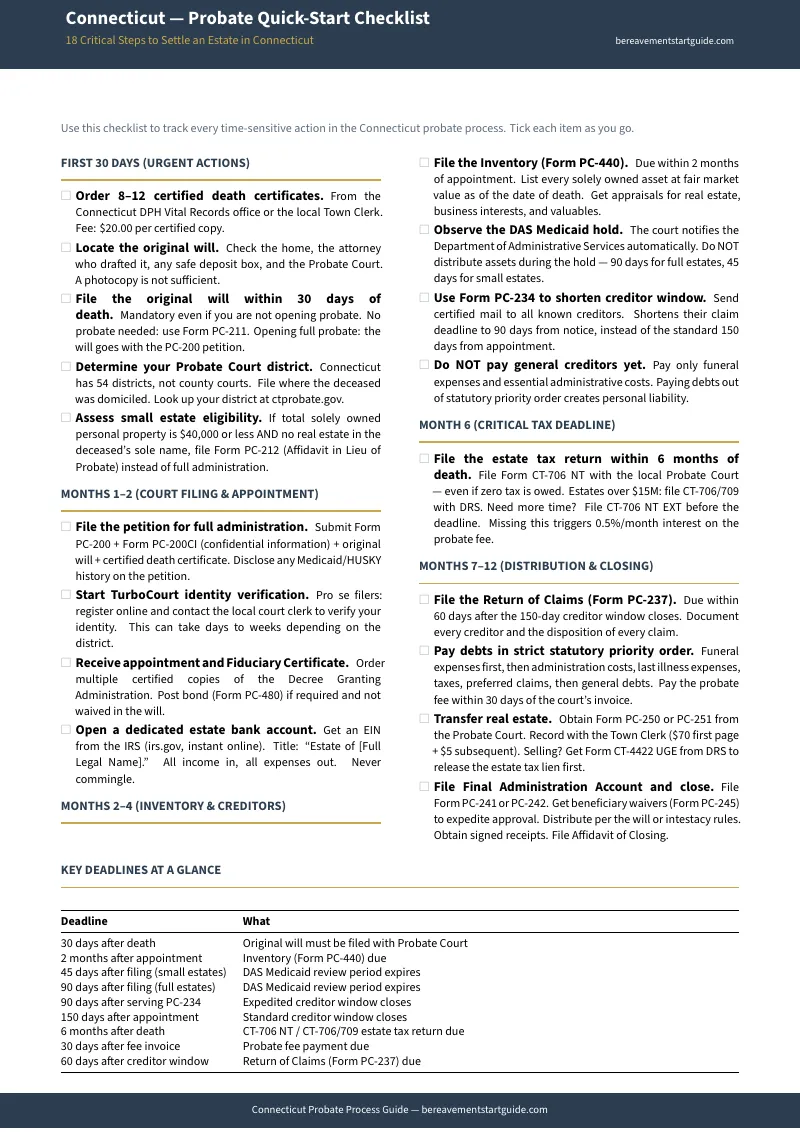
Not ready for the full guide? Download the free Connecticut — Probate Quick-Start Checklist — an overview of the probate process, the key deadlines, the 2026 thresholds, and the essential steps you need to complete. Enough to understand what you are facing and whether you need the full guide.
Probate is not something you were trained for. But Connecticut's probate courts process thousands of uncontested estates every year through lay executors filing their own paperwork. The guide gives you the instructions the court cannot — one PC form at a time.
Frequently Asked Questions
What if the rules change after I buy?
We update the guide when the rules change. Email us any time, even years later, and we'll send you the current edition free.