
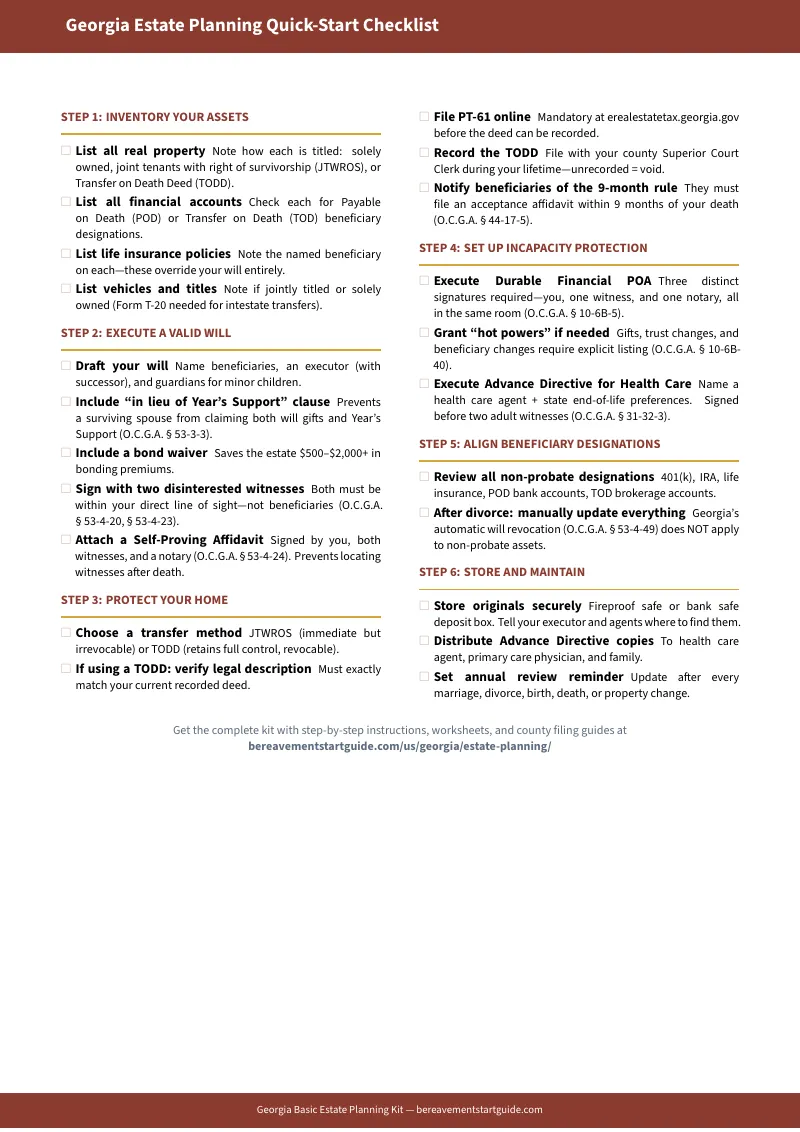
You Assumed Your Spouse Gets Everything. Georgia Law Says Otherwise — And the Witness Rule Nobody Warned You About Could Void Your Children's Inheritance Before the Ink Dries.
Most Georgia families discover estate planning gaps the hard way. A husband dies without a will, and his wife learns she gets one-third of the estate — not all of it. Three children split the rest. The family home, titled only in his name, becomes shared property between a grieving widow and three adult children who cannot agree on what to do with it. Nobody expected the intestacy split. Nobody planned for the forced partition sale.
Or the family that did everything right — hired no attorney, used a national template site, got two witnesses to sign the will. Except one of those witnesses was a daughter named as a beneficiary. Under O.C.G.A. § 53-4-23, her inheritance is legally void. The family discovers this during probate, months after the testator's death, when re-execution is impossible.
Georgia is not like other states. There is no elective share. There is no community property. There is a Year's Support provision that lets surviving spouses claim estate property before creditors — but only if they file within 24 months. There is a Transfer on Death Deed that bypasses probate — but the April 2026 amendments added a 9-month acceptance window that voids the deed if your beneficiary misses it. And there is a "line of sight" witness rule that means your witnesses cannot be in another room when you sign.
The Georgia Basic Estate Planning Kit is a State-Specific Planning Blueprint — not a generic template, but a structured walkthrough that translates Georgia's unique statutes into a clear, step-by-step planning system: what you own, who gets it under current law, and exactly which documents change that outcome.
What's Inside the State-Specific Planning Blueprint
A comprehensive 12-chapter guide, a Quick-Start Estate Planning Checklist, and 10 standalone printable worksheets — covering every planning decision from basic will execution through advanced trust strategies, built specifically for the statutes, court procedures, and county-level filing system that make estate planning in Georgia different from any other state:
Will Execution Under the Line-of-Sight Rule
Georgia requires two witnesses who must physically see you sign your will — not be in the next room, not down the hall. The kit walks through every execution requirement under O.C.G.A. § 53-4-20: who qualifies as a witness, the age-14 competency threshold, and the self-proving affidavit that saves your executor from tracking down witnesses months after your death. Most critically, it explains the witness disqualification trap — if one of your two witnesses is also a beneficiary, their inheritance is void unless you have two additional disinterested witnesses. This single rule has destroyed more family inheritances in Georgia than any other technicality.
Transfer on Death Deeds — 2026 Law Changes
Georgia authorized TODDs to bypass probate for real property, but House Bill 413 (Act 379), signed in April 2026, changed the rules significantly. The kit covers the new capacity standard — contract capacity, not the lower testamentary capacity required for a will. The strict 9-month acceptance window where each beneficiary must individually record a death certificate and acceptance affidavit with the Superior Court Clerk — miss it, and the deed is void. The prohibition on power-of-attorney revocation — only you can revoke a TODD, not your agent. And the mandatory PT-61 electronic filing through erealestatetax.georgia.gov that every county clerk requires before recording.
Year's Support: Georgia's Priority Safety Net
No other state handles surviving spouse protection like Georgia. Under O.C.G.A. § 53-3-1, a surviving spouse or minor children can petition the probate court to set aside estate property — any type, real or personal — for 12 months of support. This claim is paid before all debts, all creditors, and even state tax liens. The kit walks through the 24-month filing deadline, the automatic homestead property tax waiver, the eligibility bars that trigger on remarriage or age 18, and what happens when adult children from a prior marriage object to the petition.
Intestacy Protection: Preventing the Split Nobody Expects
Under O.C.G.A. § 53-2-1, if you die without a will in Georgia, your surviving spouse does not automatically inherit everything. The estate divides equally among spouse and children — with the spouse guaranteed no less than one-third. Stepchildren inherit nothing. Unmarried partners inherit nothing. Georgia stopped recognizing new common-law marriages in 1997. Children born out of wedlock must establish formal legitimization for paternal inheritance. The kit maps every default scenario and shows exactly which documents prevent each outcome.
Non-Probate Asset Coordination
Life insurance, retirement accounts, POD bank accounts, and joint tenancy property all bypass probate — but only if beneficiary designations are current. Georgia's automatic revocation after divorce (O.C.G.A. § 53-4-49) only covers will provisions. It does not cover life insurance policies, 401(k)s, IRAs, or revocable living trusts. Your ex-spouse remains the legal beneficiary on every non-probate asset unless you manually update each one. The kit includes a review worksheet for every account type.
Powers of Attorney and Healthcare Directives
The durable financial power of attorney and the statutory healthcare agent designation under O.C.G.A. § 31-36 — with specific guidance on what happens during and after divorce. Georgia law automatically terminates a spouse's financial POA authority when divorce is filed, but may leave them as your healthcare agent unless you execute a new directive. The kit covers both documents and the divorce-triggered gaps between them.
Probate Process and County Filing
Georgia probate varies dramatically by county. The base petition fee is $206, but additional surcharges for law library, sheriff service, and newspaper publication push the total above $350 in counties like Gwinnett. The kit explains the standard GPCSF petition forms, county-specific surcharges, and the 4-to-18-month timeline your executor faces — so you can plan to avoid as much of it as possible.
Trust Decision Framework
Not everyone needs a trust. For most Georgia families, a will combined with TODDs and beneficiary designations achieves full probate avoidance without the cost. The kit includes a decision framework: when a revocable living trust makes sense (minor beneficiaries, multi-state property, privacy, creditor protection), when an irrevocable trust is worth the tradeoff, and when simpler tools accomplish the same goal for free.
Document Inventory and Annual Review Calendar
A structured system for cataloging every estate planning document — where originals are stored, who has copies, and a calendar for annual reviews. Both are included as standalone printable worksheets you can fill in by hand and keep with your estate planning documents.
Who This Kit Is For
- The married couple who just learned about the intestacy split. You assumed everything goes to the surviving spouse. It does not. If you have children, the estate splits — and if you have children from a prior relationship, the math gets significantly worse. The kit shows exactly what Georgia law does by default and which documents prevent it.
- The homeowner who wants to keep their house out of probate. Georgia probate takes 4 to 18 months and costs families $3,000 to $15,000. A Transfer on Death Deed bypasses that entirely — but the 2026 law changes mean the execution and acceptance requirements are stricter than ever. One missed step and the deed is void.
- The blended family that needs to protect stepchildren. Georgia intestacy law excludes stepchildren who were never formally adopted. If you want your stepchild to inherit anything, it must be in writing — and the witness disqualification rule means getting the execution wrong can void the very gift you intended.
- The recently divorced parent who needs to update everything. Georgia automatically revokes spousal will provisions after divorce. But your ex-spouse is still the beneficiary on your life insurance, your 401(k), and your IRA until you manually change each one. The kit maps every non-probate asset that needs updating.
- The adult child whose parents have no plan. Your parents own a home in Cobb or Gwinnett County, have retirement accounts with outdated beneficiaries, and keep saying they will get to it. The kit translates every Georgia-specific rule into a structured planning conversation you can walk through together.
- Anyone quoted $2,500 to $5,500 for an estate plan who wants to understand what they are buying. The kit does not replace an attorney for complex trusts or business succession. But it gives you the organizational clarity to show up prepared, ask the right questions, and avoid paying $275 to $550 per hour for document gathering you can handle yourself.
Why Free Georgia Forms and National Templates Leave Families Exposed
Georgia probate courts publish standardized GPCSF petition forms. The legal skeleton is there. Here is what is missing:
- No witness guidance. The free forms give you signature lines but do not explain the disinterested witness requirement. Families discover that a beneficiary-witness voided the gift after the testator has died — when re-execution is impossible.
- No TODD coordination. Free forms do not explain the 2026 TODD amendments — the higher capacity standard, the 9-month acceptance deadline, the PT-61 filing requirement. Families file incomplete deeds and discover the transfer was void during probate.
- No Year's Support instructions. County probate courts do not proactively explain this provision. Surviving spouses miss the 24-month filing window and lose their priority claim to estate property — a claim that would have been paid before every creditor.
- No divorce coordination. Free state forms do not warn that automatic revocation only covers wills, not non-probate assets. Divorced individuals leave their ex-spouse as beneficiary on retirement accounts, life insurance, and trusts without realizing it.
- No county-specific guidance. Filing surcharges, newspaper publication requirements, and court procedures vary dramatically across Georgia's 159 counties. Free forms assume one process fits all.
National platforms like LegalZoom, Trust & Will, and Nolo generate documents using standardized nationwide templates. They produce the paperwork. They do not explain the line-of-sight witness rule, the TODD acceptance window, the Year's Support petition process, or the county-level filing variations that determine whether your plan actually works in Georgia.
Your Purchase Is Protected
If the kit does not help you organize a clear, actionable Georgia estate plan, email hello@bereavementstartguide.com for a full refund. No time limit, no questions, no hassle.
Start Planning Today
Download the free Georgia Estate Planning Checklist to see what goes into proper planning under Georgia law — will execution, witness selection, Transfer on Death Deed filing, Year's Support eligibility, and beneficiary designation review. When you are ready for the complete system — the full 12-chapter guide, 10 standalone printable worksheets, plus the checklist — the full kit is . Less than twenty minutes with a Georgia estate planning attorney, and you keep everything forever.
Frequently Asked Questions
What if the rules change after I buy?
We update the guide when the rules change. Email us any time, even years later, and we'll send you the current edition free.