You Looked Up "Idaho TOD Deed" and Found Advice That Could Send Your Home Through Probate. Idaho Banned Those Deeds — And the National Sites Still Haven't Noticed.
You searched for a way to keep your house out of probate in Idaho. The top results told you to file a Transfer on Death deed. You may have even started the paperwork. The problem: Idaho does not allow Transfer on Death deeds for real property. Senate Bill 1399 tried to change that in 2026 — it died in committee on April 2nd. National legal directories like Nolo, LegalZoom, and FamilyEstateGuide still publish articles claiming Idaho permits TOD deeds. If you relied on that advice, your home goes through formal probate when you die.
Or the family in Nampa, in their second marriage, both with children from prior relationships. They assumed everything would go to the surviving spouse. Then they discovered that under Idaho Code §15-2-102, if any children are from a prior relationship, the surviving spouse receives only the first $150,000 plus half the remainder. The stepchildren — who were never formally adopted — inherit nothing under intestacy. The surviving spouse and the biological children now co-own the family home. Nobody planned for that split. Nobody expected the forced partition sale.
Idaho is not like 41 other states. It is one of only nine community property states — everything acquired during marriage is presumed 50/50 regardless of whose name is on the title. It has no Transfer on Death deeds for real property. But it does have Community Property with Right of Survivorship (CPWROS) — a probate avoidance tool that also preserves the full stepped-up cost basis on both halves of community property, a tax advantage that joint tenancy cannot match. Most Idahoans have never heard of it.
The Idaho Basic Estate Planning Kit is a Community Property Planning Blueprint — not a generic national template, but a structured walkthrough that translates Idaho's community property statutes, the TOD deed ban, and the CPWROS advantage into a clear, step-by-step planning system: what you own, who gets it under current law, and exactly which documents change that outcome.
What's Inside the Community Property Planning Blueprint
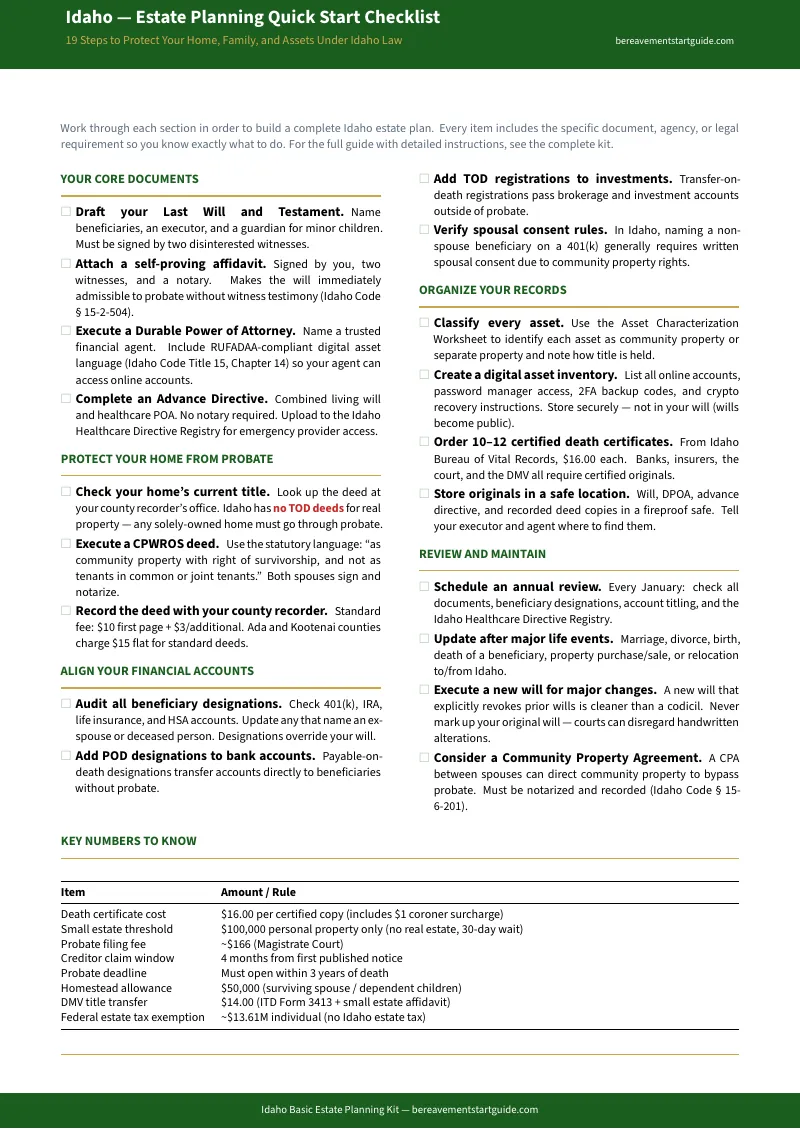
A comprehensive 15-chapter guide, a Quick-Start Estate Planning Checklist, and 8 standalone printable worksheets (10 PDFs total) — covering every planning decision from basic will execution through probate avoidance strategies, built specifically for the statutes, court procedures, and county-level filing system that make estate planning in Idaho different from any other state:
Community Property with Right of Survivorship (CPWROS)
Idaho's most powerful probate avoidance tool — and the one most families never hear about. CPWROS lets married couples title real estate so it automatically transfers to the surviving spouse on death, completely bypassing probate court. The kit explains how to create and record a CPWROS deed, the critical difference between CPWROS and joint tenancy — CPWROS preserves the full stepped-up cost basis on both halves of the property at the first spouse's death, while joint tenancy only steps up the decedent's half. On a $350,000 Boise-area home, that difference can save $20,000 or more in capital gains taxes when the surviving spouse eventually sells.
The TOD Deed Myth — What Actually Works
Multiple national legal websites still claim Idaho allows Transfer on Death deeds for real property. They are wrong. Senate Bill 1399 (the Uniform Real Property Transfer on Death Act) was introduced in 2026 and died in the Senate Judiciary and Rules Committee on April 2, 2026. If you own real estate in Idaho that is not held in trust, joint tenancy, or CPWROS, it must go through formal probate. The kit explains every alternative that actually works — CPWROS, community property agreements, joint tenancy with right of survivorship, and revocable living trusts — with a decision framework for choosing among them based on your family structure and tax situation.
Community Property Agreements
A community property agreement lets spouses confirm that all property — including separate property each brought into the marriage — will be treated as community property and pass to the survivor without probate. The kit explains when this is a powerful simplification tool for second marriages with aligned goals and when it is dangerous — particularly for blended families where children from prior marriages could be disinherited if separate property gets reclassified as community property.
Will Execution Under Idaho Law
The exact statutory requirements for a valid will under Idaho Code §15-2-502: two competent witnesses, testator signature, and the sound mind requirement. Idaho recognizes holographic wills — entirely handwritten and signed — as valid without witnesses, a rare provision that most national guides miss. The kit covers the self-proving affidavit that saves your personal representative from tracking down witnesses years later, the statutory age requirement, and the pretermitted heir rules that automatically include children born after the will was executed.
Idaho Intestacy — The Split Nobody Expects
Under Idaho Code §15-2-102, if you die without a will, your surviving spouse does not automatically inherit everything. If all children are children of both spouses, the spouse gets the first $200,000 plus 50% of the balance. If any children are from a prior relationship, the spouse gets only $150,000 plus 50%. Stepchildren who were never adopted inherit nothing. Unmarried partners inherit nothing regardless of how long they lived together. The 120-hour survivorship rule adds another layer — if the surviving spouse does not survive by five full days, they are treated as having predeceased for inheritance purposes.
Blended Family Estate Planning
Idaho's community property rules create unique risks for blended families. Without explicit planning, a surviving spouse in a second marriage could end up co-owning the family home with stepchildren from the deceased spouse's first marriage — or be forced to sell the home to satisfy the children's share. The kit covers separate property agreements, QTIP trust strategies specific to Idaho's community property framework, and the critical difference between community property and separate property when children from prior relationships are involved.
The Small Estate Shortcut — And Its Real Estate Trap
Idaho allows small estate affidavits for estates under $100,000 — but the threshold applies only to personal property, not real estate. A cabin worth $85,000 in Bonner County still requires formal probate even though it falls under the dollar threshold. The kit explains exactly when the small estate affidavit works, when it does not, the 30-day waiting period before you can file, and the separate process for transferring vehicles through the Idaho Transportation Department using Form ITD-3413.
Powers of Attorney and Healthcare Directives
The durable financial power of attorney, Idaho's statutory healthcare directive under Idaho Code §39-4510, and the living will. A critical warning: every power of attorney expires the instant the principal dies. Families who have been managing a parent's finances under a durable POA are shocked when the bank freezes the account immediately after death and demands Letters Testamentary from a probate judge before releasing any funds — even to pay for the funeral. The kit explains what happens at death, what your personal representative needs, and the specific language Idaho financial institutions expect to see.
Tax Planning and the Full Step-Up Advantage
Idaho has no state-level estate or inheritance tax. But the federal step-up basis benefit for community property is massive and underutilized. When the first spouse dies in a community property state, both halves of the community property receive a full stepped-up basis — not just the decedent's half. On a home purchased for $180,000 that is now worth $350,000, that eliminates $170,000 in potential capital gains. Joint tenancy only steps up the decedent's half. The kit covers portability elections for married couples and IRS filing deadlines your personal representative must meet.
County-Specific Filing Requirements
Idaho probate starts with a $166 base filing fee, but county-specific recording fees and format requirements can trip families up when filing deeds, community property agreements, and probate petitions. The kit provides filing requirements and contact information for Ada, Canyon, Bonneville, Kootenai, Twin Falls, Bannock, and other major counties — so your documents are recorded correctly the first time.
Standalone Printable Worksheets and Reference Cards
In addition to the 15-chapter guide and checklist, your kit includes 8 standalone PDFs you can print individually and bring to appointments, file with your documents, or use as fillable worksheets:
- CPWROS Probate Avoidance Walkthrough — Step-by-step deed creation and recording. Print this and bring it to the county recorder.
- Blended Family Strategy Guide — Property separation agreements, QTIP trusts, and asset characterization tracking for second marriages.
- Small Estate Affidavit Decision Framework — When the $100,000 threshold applies, when real estate forces formal probate, and the vehicle transfer process.
- County Filing Reference — Recording fees, court procedures, and contact information for Ada, Kootenai, Canyon, Bannock, Bonneville, Twin Falls, and other major counties.
- POA Death Transition Guide — What happens when the principal dies, the bank account freeze, and the step-by-step process to obtain Letters Testamentary.
- Beneficiary Designation Audit Worksheet — Fillable worksheet to review every account that bypasses your will.
- Digital Asset Inventory — RUFADAA-compliant inventory for email, financial, cloud storage, and cryptocurrency accounts.
- Annual Estate Planning Review — Annual checklist plus life event triggers that require an immediate plan update.
Who This Kit Is For
- The Treasure Valley couple who assumed everything goes to the survivor. It does not — not automatically, and not without the right documents. If you have children from a prior relationship, Idaho's intestacy rules allocate only $150,000 plus half to the surviving spouse. The kit shows exactly what Idaho law does by default and which documents prevent it.
- The homeowner who searched for "Idaho TOD deed" and found conflicting advice. The advice is wrong. Idaho does not allow Transfer on Death deeds for real property. But CPWROS accomplishes the same goal with a better tax outcome. The kit walks through every step of what actually works.
- The blended family that needs to protect both the surviving spouse and children from a prior marriage. Community property rules mean the new spouse already owns half of everything acquired during the marriage. Without planning, the surviving spouse and the deceased's children from a prior relationship become involuntary co-owners of the family home.
- The caregiver who has been managing a parent's finances and is terrified of what happens at death. The power of attorney dies when the principal dies. The bank account freezes. The funeral still needs to be paid. The kit explains the transition from POA authority to personal representative authority and the specific documents you need.
- Anyone quoted $1,500 to $3,000 by a Boise-area estate planning attorney. The kit does not replace an attorney for complex trusts, farm succession, or multi-state estates. But it organizes everything an attorney needs to see, reduces billable hours significantly, and ensures you understand what you are paying for.
- The adult child whose parents live in Meridian or Eagle and have no plan. They own a home with rising equity, have retirement accounts with outdated beneficiaries, and keep saying they will get to it. The kit gives you a structured planning conversation you can walk through together over a weekend.
Why Free Idaho Forms and National Templates Leave Families Exposed
The Idaho Court Assistance Office (courtselfhelp.idaho.gov) publishes free forms for family law matters. Idaho Legal Aid Services provides income-restricted assistance. The raw legal skeleton is available. Here is what is missing:
- No TOD deed correction. Free state resources do not proactively warn that Idaho does not permit Transfer on Death deeds for real property. Families discover the gap after filing an invalid document — or worse, after someone has died and the home goes to probate court.
- No CPWROS guidance. The most powerful probate avoidance tool available to Idaho married couples is almost never explained in free resources or national template sites. Families default to joint tenancy, losing the full stepped-up basis advantage that community property provides.
- No community property coordination. National platforms treat Idaho like a common-law state. Their templates do not account for the community property presumption, the separate property distinctions that matter in blended families, or the community property agreement option.
- No small estate clarification. The $100,000 threshold sounds generous until families realize it excludes all real property. A modest cabin, a bare lot, even a small mobile home on owned land — all require formal probate regardless of value.
- No POA death transition. Free forms do not explain what happens the moment the principal dies. Caregivers who have been managing finances under a durable POA are blindsided when the bank freezes the account and demands court-issued Letters Testamentary.
National platforms like LegalZoom, Trust & Will, and Nolo generate documents using standardized nationwide templates. They produce the paperwork. They do not explain the TOD deed ban, the CPWROS advantage, the community property tax benefits, or the county-level filing variations that determine whether your plan actually works in Idaho.
Your Purchase Is Protected
If the kit does not help you organize a clear, actionable Idaho estate plan, email hello@bereavementstartguide.com for a full refund. No time limit, no questions, no hassle.
Start Planning Today
Download the free Idaho Estate Planning Checklist to see what goes into proper planning under Idaho law — will execution, CPWROS deed filing, community property agreements, small estate affidavit eligibility, and beneficiary designation review. When you are ready for the complete system — the full 15-chapter guide, 8 standalone printable worksheets, and the checklist (10 PDFs total) — the full kit is . Less than twenty minutes with a Boise estate planning attorney, and you keep everything forever.
Frequently Asked Questions
What if the rules change after I buy?
We update the guide when the rules change. Email us any time, even years later, and we'll send you the current edition free.