Your Spouse Is in the Hospital. The Bank Just Froze You Out.
You've been married for decades. Both names are on the house, the car, the savings account. But when your spouse lands in intensive care at St. Luke's or Saint Alphonsus, none of that matters. The bank tells you they can't let you pay the mortgage. The title company says they can't close on the house sale. The hospital asks who has medical decision-making authority — and nobody does.
In Idaho, marriage does not give you automatic authority to manage your spouse's finances or make their medical decisions during incapacity. Under Idaho Code § 32-912, both spouses must actively participate in any transaction involving community real property. If one spouse can't sign, everything stops.
And here's the part most families don't realize until it's too late: Idaho does not allow transfer-on-death deeds for real estate. There's no shortcut around probate for property held in just one spouse's name. Without a power of attorney and community property agreement already in place, you're looking at a guardianship proceeding — a public, adversarial court process that typically costs $3,000 to $5,000 in legal fees and takes months while bills pile up.
The Idaho-Specific Compliance System
The Idaho Power of Attorney Kit is not a generic form download. It's a step-by-step compliance system built around Idaho's unique combination of community property rules, county recorder requirements, and the state's recently migrated healthcare directive registry.
Every section is written for the person sitting at their kitchen table in Boise, Meridian, Idaho Falls, or Coeur d'Alene — trying to protect a parent with dementia, prepare for a spouse's surgery, or get ahead of the incapacity question before a crisis hits.
What's Inside the Kit
- Durable Financial Power of Attorney Guide — walks you through all 13 categories of financial authority under Idaho Code Title 15, Chapter 12. You'll know exactly which powers to grant, which to withhold, and why the "Hot Powers" (trust creation, gifting, beneficiary changes) need careful consideration before you check the box.
- Healthcare Directive and Living Will — covers the combined Idaho Advance Directive under § 39-4510, including HIPAA authorization so your agent can actually access medical records. Includes instructions for uploading to the state's Department of Health and Welfare registry — the old Secretary of State system was retired, and many families' documents were lost in the migration.
- Bank Acceptance Shield — a pre-drafted letter citing Idaho Code § 15-12-120 that puts your bank on notice. Under the statute, they have seven business days to accept an acknowledged POA or request certification. If they miss the deadline, they're liable for your attorney's fees. Most bank managers have never seen this letter — and they comply immediately when they do.
- 44-County Recorder Guide — Idaho's county recorders enforce different margin requirements, paper sizes, and formatting rules. A document that records perfectly in Ada County might get rejected at the Kootenai County counter because the top margin is half an inch too small. This guide covers every county so you don't learn about the requirements through a rejection notice.
- Community Property Agreement Walkthrough — explains when to use a Community Property Agreement (CPA) vs. retitling as Community Property with Right of Survivorship (CPWROS). Both bypass probate for married couples' assets, but they work differently — and a CPA must be recorded before either spouse's death or it's void.
- Powers Selection Worksheet — a structured decision tool that walks you through each category of financial authority. Instead of guessing which boxes to check on a statutory form, you'll answer plain-English questions about your situation and get a clear recommendation.
- Notary and Execution Checklist — covers the contradiction most families hit: a POA doesn't legally require notarization in Idaho, but every bank, title company, and recorder's office will reject one without it. This checklist tells you exactly what to bring to the notary appointment and how to handle situations where the principal can't physically sign.
- Agent Instruction Letter Template — a fillable template you give your named agent with document locations, financial account details, insurance policies, healthcare providers, and instructions on how to assert authority at banks and institutions.
- Healthcare Registry Upload Guide — step-by-step instructions for uploading your advance directive to Idaho's Department of Health and Welfare registry, including verification and update procedures.
- Financial Thresholds Reference Card — a one-page quick-reference with Idaho's small estate limits, homestead exemptions, probate allowances, key deadlines, recording fees, and contact information for the Medicaid Estate Recovery Unit and other agencies.
Who This Kit Is For
- Adult children caring for aging parents — your parent was just diagnosed with moderate dementia, and the bank already refused to let you pay their utility bills. You need financial authority before cognitive capacity is gone.
- Married couples with community property — you own a home together, and you want to make sure one spouse can manage everything if the other is hospitalized, in memory care, or traveling internationally.
- Families facing a scheduled surgery — the procedure is next week, and you need medical and financial authority in place before the patient goes under anesthesia.
- Anyone who wants to avoid guardianship court — a guardianship proceeding costs $3,000 to $5,000, becomes a public record, and takes months. A power of attorney costs a fraction of that and keeps everything private.
Why Free Forms Fall Short
You can find Idaho POA forms online for free. The Idaho State Bar links to them. LegalZoom and eForms sell templates. So why would you need this kit?
Because the form is the easy part. The hard part is everything around it:
- The Court Assistance Office can't help you. Idaho's CAOs handle divorce, custody, and small claims — they don't stock estate planning or financial POA forms, and they're legally prohibited from giving you advice on filling them out.
- Free templates don't tell you about county recording rules. If your document has the wrong margins, lacks a 2x3-inch blank space on the front page, or is submitted as a copy instead of an original, the county recorder will reject it on the spot.
- Online forms still reference the old healthcare registry. The Idaho Healthcare Directive Registry moved from the Secretary of State to the Department of Health and Welfare. If you follow old instructions, your document goes nowhere — and hospitals won't be able to find it when they need it.
- Generic templates don't address community property. Idaho's community property rules create specific requirements for how a POA must be drafted to cover jointly held real estate. A generic form won't cover this, and your agent won't discover the gap until the title company rejects the transaction.
— Less Than One Hour of a Lawyer's Time
A local Idaho estate planning attorney charges $300 to $1,500 for the same documents. The Idaho Power of Attorney Kit gives you the same statutory compliance and execution guidance — without the billable hours, the office visits, or the weeks of waiting for a consultation.
Every purchase includes a satisfaction guarantee: if your POA is rejected by any Idaho county recorder for a formatting or compliance reason covered in the guide, email us the rejection notice within 60 days for a full refund.
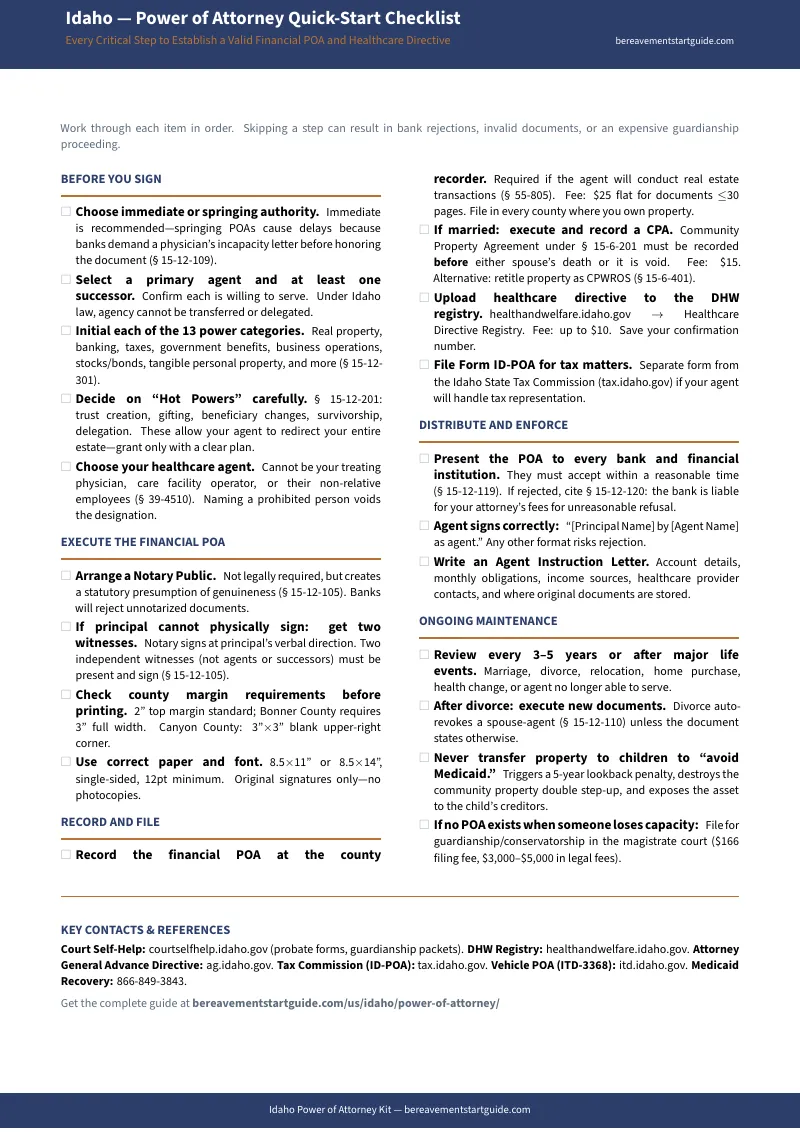
The free checklist gives you a one-page overview of what Idaho requires — enough to understand the process. The full kit gives you everything you need to actually execute, record, and enforce your documents across banks, hospitals, and county offices statewide.
Frequently Asked Questions
What if the rules change after I buy?
We update the guide when the rules change. Email us any time, even years later, and we'll send you the current edition free.