
Illinois Gives You Five Separate Documents, Four Signing Ceremonies, and Zero Instructions
Here's what catches most Illinois families off guard: the state uses two separate statutory powers of attorney — one for property, one for health care — each with its own signing rules, witness requirements, and activation triggers. Add a will, a living will, and a Transfer on Death Instrument, and you're looking at five documents that all need to work together but come from five different state agencies with no shared playbook.
Then there's the estate tax. Illinois freezes its exemption at $4,000,000 — less than a third of the federal limit and not indexed for inflation. A home in DuPage County, a 401(k), and a term life insurance policy can push an ordinary family past the threshold. And because Illinois runs a cliff tax, exceeding $4,000,001 means the state taxes your entire estate from dollar one — not just the overage. The difference can cost your heirs over $100,000.
Most people know they should plan. The problem is that Illinois splits the work across so many separate legal instruments, each with its own execution rules, that doing it yourself means stitching together fragments from county websites, legal aid portals, and outdated blog posts — and hoping you haven't missed a step that invalidates the whole plan.
The Illinois Estate Protection System
The Illinois Basic Estate Planning Kit is a single, structured walkthrough of every document and decision that stands between your family and Illinois probate court.
This isn't a stack of blank forms. It's a step-by-step system that shows you which documents to complete, in what order, and exactly how they interact — so that your will, your TODIs, your powers of attorney, and your beneficiary designations all reinforce each other instead of creating gaps your family has to fix in court.
The kit covers the full scope of Illinois estate planning: wills under 755 ILCS 5/, the self-proving affidavit process, dual statutory powers of attorney, living will declarations, POLST forms, Transfer on Death Instruments with county-specific recording rules, the $4,000,000 cliff tax and when credit shelter trusts are necessary, the new $150,000 small estate threshold with vehicle exclusions, digital asset planning under the Revised Uniform Fiduciary Access Act, blended family protections, and the document execution requirements that differ between Cook County and downstate counties.
What You Get
- Complete Estate Planning Guide — 15 chapters covering wills, TODIs, dual POAs, living will declarations, POLST, the $4M cliff tax, the $150K small estate shortcut, digital assets, blended family protections, document execution requirements, and a family conversation guide. Every form number, deadline, and fee comes from current Illinois statutes.
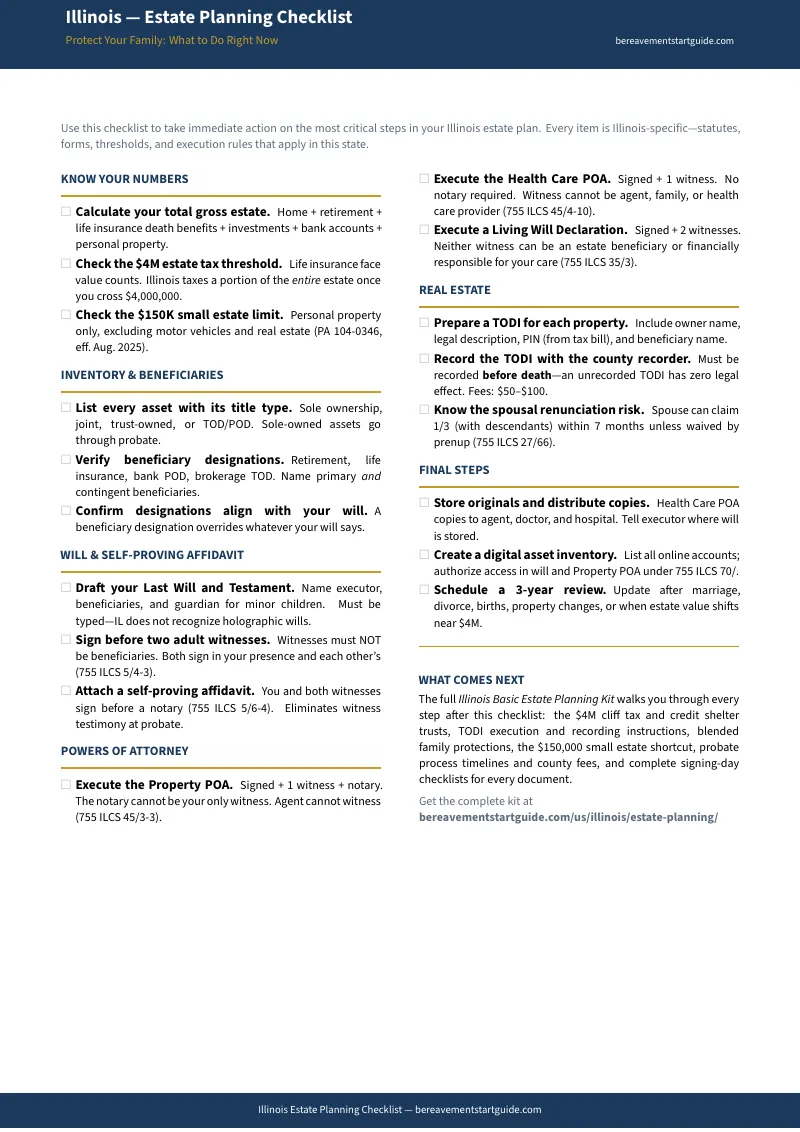
- Quick-Start Checklist — Every document and deadline in priority order, with the Illinois-specific thresholds that determine which steps apply to your situation. Print it, work through it, check items off as you go.
- Document Execution Master Checklist — Printable signing checklists for all five documents — will, property POA, health care POA, living will, and TODI — with witness and notary requirements for each.
- Estate Tax Calculator Worksheet — Step-by-step asset audit to determine whether your estate approaches the $4M cliff and when a credit shelter trust consultation is warranted.
- TODI Recording Instructions — County-specific steps for executing, witnessing, notarizing, and recording a Transfer on Death Instrument before the deadline that matters.
- Blended Family Protection Guide — How to override Illinois intestacy law and protect both biological children and a surviving spouse from accidental disinheritance.
- Digital Asset Inventory — Fillable worksheet to catalog every digital account under the Revised Uniform Fiduciary Access to Digital Assets Act.
- Family Conversation Guide — Scripts for the conversations with your health care agent, financial agent, and executor that most families never have until it's too late.
Who This Is Built For
- Homeowners who need to record a TODI before it's too late — because an unrecorded Transfer on Death Instrument has zero legal effect, and your family will go through full probate for the house
- Parents who need to name guardians for minor children and get both powers of attorney signed while there's still time to choose who makes decisions
- Suburban families whose combined assets are approaching the $4,000,000 cliff — a Naperville home, retirement savings, and a standard life insurance policy can get there faster than most people expect
- Adult children helping aging parents get documents signed while they still have legal capacity — because once capacity is lost, you're looking at guardianship court, not a simple POA
- Blended families who need to override Illinois intestacy law before it splits the estate 50/50 between a surviving spouse and biological children from a prior marriage
- Anyone settling a small estate who needs to know whether the new $150,000 threshold and vehicle exclusion apply — and what to do when real estate makes the Small Estate Affidavit unavailable
Why Not Just Use the Free State Forms?
Illinois Legal Aid Online and the Illinois Courts offer free statutory forms for powers of attorney, TODIs, and small estate affidavits. They're legitimate legal documents.
The problem is what they don't tell you. The POA for Property form doesn't explain when it activates, how to modify the statutory default powers, or what happens if your agent can't serve. The TODI Easy Form doesn't warn you about the spousal renunciation risk — if your spouse isn't the beneficiary, they can file to defeat the transfer entirely. And none of the free forms explain how they coordinate with each other or with your beneficiary designations.
The state gives you the pieces. The kit shows you how they fit together — and which pieces can silently invalidate each other if you get the order wrong.
Why Not LegalZoom or Trust & Will?
Those platforms charge $89 to $499+ for initial document creation, then quietly bill your credit card every year — $49 to $299 annually — just to maintain access to your own files. Cancel the subscription and you lose the ability to edit or re-download documents you already paid to create.
Worse, their nationwide templates often gloss over Illinois-specific rules. They don't flag the unindexed $4M cliff tax. They don't explain why Illinois requires two separate POAs instead of one. They don't cover the new $150,000 small estate threshold with the vehicle exclusion. You're paying premium prices for generic documents that miss the rules that matter most in Illinois.
The Illinois Basic Estate Planning Kit is a one-time purchase. No subscriptions, no annual renewal, no paywall between you and your own estate plan.
— Less Than a Single Hour of Attorney Time
Illinois estate planning attorneys charge $250 to $500 per hour. A basic will package starts at $750 to $1,500. Add powers of attorney and a simple trust, and you're looking at $3,000 to $5,000 before the first document is signed.
The kit doesn't replace an attorney for estates that need credit shelter trusts or complex multi-state planning — and it tells you exactly when that threshold is crossed. But for the vast majority of Illinois families who need clear, legally compliant documents executed correctly, the kit provides immediate protection at a fraction of professional fees.
And if you do hire an attorney later, the asset inventory, beneficiary audit, and execution checklists you've completed become your intake package — saving hours of billable time before the meter starts.
Money-Back Guarantee, No Time Limit
Download the kit, review the checklists and guide. If the plain-English instructions don't clarify the exact steps needed to protect your family under Illinois law — or if you decide to hire a local attorney for a custom trust instead — email us at any time for an immediate, full refund. No questions asked.
Important notice: Bereavement Start Guide is a publisher of educational resources. This kit assists individuals in organizing their estate affairs and completing standard statutory forms. It does not provide personalized legal, financial, or tax advice, does not act as a law firm, and does not establish an attorney-client relationship. For complex assets, multi-state property, or estates approaching the $4,000,000 threshold, consultation with a licensed Illinois estate attorney is strongly recommended.
Frequently Asked Questions
What if the rules change after I buy?
We update the guide when the rules change. Email us any time, even years later, and we'll send you the current edition free.