Social Security Clawed Back the Last Check. IPERS Wants a Death Certificate Before They'll Talk. And Nobody Told You Iowa Can Take the House to Repay Medicaid.
Someone you love just died in Iowa. Within days, Social Security reclaims the deceased's final direct deposit -- and your household checking account suddenly shrinks by a month's income. You call to ask about survivor benefits and get routed through a phone tree with a 90-minute hold. The IPERS office says your spouse was a member but won't discuss payout options until you mail them a certified death certificate. The county assessor's office says something about a property tax credit deadline on June 1, but you don't know which form to file or whether you even qualify.
Then the real shock arrives. A letter from Iowa HHS says the state intends to recover every Medicaid payment made on your spouse's behalf -- including monthly capitation fees paid to managed care organizations for months when no medical services were even used. And unlike most states, Iowa's recovery program reaches beyond probate. Joint tenancy property, payable-on-death bank accounts, Transfer on Death deeds, retained life estates -- all of it is fair game. You thought avoiding probate protected the house. In Iowa, it does not.
You start searching for answers. The Social Security website explains federal survivor benefits but says nothing about how those payments interact with Iowa's SSI rules or IPERS pensions. The Iowa Department of Revenue confirms the inheritance tax was repealed in 2025, but you still cannot figure out whether you need a tax clearance to transfer the house. Iowa Legal Aid has a dense article on Medicaid recovery that reads like it was written for attorneys, not for someone sitting at the kitchen table trying to figure out whether the state can actually take their home. And every probate lawyer you call quotes $200 to $400 per hour before they will explain a single step.
The Benefit Sequencing Method
The Iowa Survivor Benefits Navigator does what no single government website, legal aid article, or attorney consultation does: it puts every survivor benefit, deadline, agency, and protection available to Iowa families into one chronological sequence -- from the hour of death through the final property tax filing a year later.
This is not a collection of links to government websites. It is a rigid, step-by-step administrative sequence built specifically for Iowa. The reason sequence matters: filing for IPERS benefits before addressing a Medicaid recovery claim can expose you to personal liability. Transferring joint tenancy property before obtaining a tax clearance can cloud the title. Missing the four-month window to apply for the spousal support allowance means that money is gone permanently -- the court will not grant an extension. The Benefit Sequencing Method ensures you claim every dollar you are owed, in the right order, without accidentally triggering a disqualification or forfeiting a protection you did not know existed.
What You Get
The Complete Navigator
- First 48 Hours protocol -- ordering 10-15 certified death certificates at $20 each from the county recorder or Iowa HHS Bureau of Health Statistics, notifying Social Security, claiming the $255 lump-sum death payment, securing joint bank accounts (do not close them yet), and locating the will, trust documents, and any Medicaid correspondence
- Social Security survivor benefits -- eligibility ages (60 for surviving spouses, 50 if disabled, any age if caring for a child under 16), how children receive 75% of the deceased parent's benefit until age 18, the family maximum cap, and the critical warning about Iowa's "beneficiary awareness" rule that treats an inheritance as income the moment you become a known beneficiary -- long before the assets are distributed
- IPERS death benefits for public employees -- how to file a claim with Iowa Public Employees' Retirement System, the difference between lump-sum and survivor annuity payouts (Options 1 through 6 translated from actuarial jargon into plain English), the 5-year claim deadline after which benefits are permanently forfeited, the $100,000 line-of-duty death benefit for special service members, and the conservatorship requirement for minor beneficiaries receiving $25,000 or more
- Workers' compensation death benefits -- the exact weekly benefit calculation (80% of spendable earnings, capped at approximately $2,274-$2,350 per week depending on the injury year), lifetime duration for surviving spouses, the two-year remarriage lump-sum option, dependent children's benefits through age 25 if enrolled full-time, and the burial allowance of approximately $13,600 (12 times the Statewide Average Weekly Wage) -- with the warning that insurers routinely dispute the word "reasonable" in the statute
- Health insurance continuation -- federal COBRA for employers with 20+ employees, Iowa's mini-COBRA statute for smaller employers (36 months of continuation coverage), special protections for surviving spouses of State of Iowa employees, and Medicare coordination rules for survivors age 65 and older
- Medicaid Estate Recovery defense -- how Iowa's uniquely aggressive recovery program pursues joint tenancy, POD accounts, TOD deeds, life estates, and annuities in addition to probate assets. The two defenses: statutory deferment (surviving spouse, child under 21, disabled child) and the undue hardship waiver with its strict income and asset thresholds. The 30-day filing deadline for Form 470-4339, the personal liability trap for executors who distribute funds before clearing the claim, and the critical distinction between a deferral (debt postponed) and a waiver (debt forgiven)
- Property tax relief programs -- the Senior and Disabled Property Tax Credit (Form 54-001, June 1 deadline), the $3,250 senior homestead tax exemption for homeowners 65 and older, the Disabled Veteran Homestead Property Tax Credit for surviving spouses receiving VA DIC payments (retained even after remarriage, filed with the county assessor by July 1), and the property tax suspension program for SSI recipients
- VA burial and survivor benefits -- federal burial allowances ($1,002 to $2,000 depending on service connection), the Dole Act expansion for veterans who died in VA-provided hospice at home, the DIC pension for surviving spouses, and Iowa's county-level Commission of Veteran Affairs offices that provide additional localized financial assistance
- Estate transfer options -- the small estate affidavit (personal property up to $100,000 with no solely-owned real estate, 40-day waiting period), simplified probate (under $200,000), and regular probate. The decision framework for choosing your path, and the Medicaid warning that must be cleared before using the affidavit
- Spousal protections under Iowa Code Chapter 633 -- the elective share (one-third of all real and personal property, reaching into revocable trusts), the homestead life estate election, and the 12-month family support allowance that takes priority over unsecured creditors. All three require action within the strict four-month window or they are permanently waived
- Vehicle title transfers -- Form 411083 (with will) and Form 411088 (no will), the odometer disclosure trap that permanently brands a title "Not Actual Mileage" if you sign in the wrong place, and the surviving spouse fee waiver
- Benefits for minor children -- Social Security survivor benefits through age 18, the Iowa probate support allowance for children and college students up to age 22 under Iowa Code 633.376, workers' compensation benefits through age 25 for full-time students, and IPERS conservatorship requirements for minors
- Funeral assistance programs -- workers' compensation burial allowance ($13,600), VA burial allowance ($1,002-$2,000), Social Security $255 lump-sum, Crime Victim Compensation ($7,500 for funeral costs, $3,000 for homicide survivor medical care, $1,000 for crime scene cleanup), and county general assistance
- Complete forms directory and agency contacts -- every form referenced in the guide with the issuing agency, filing context, and direct contact information for Social Security, IPERS, Iowa HHS, Iowa Division of Workers' Compensation, Iowa Department of Revenue, Iowa DOT, the VA, and county offices
4 Standalone Printable Tools
- Critical Deadlines Reference Sheet -- a one-page wall chart listing every dangerous deadline with space to write in your actual dates. The 30-day Medicaid waiver and the 4-month spousal protection deadline are highlighted so you never lose track of the ones that cannot be extended.
- 12-Month Benefit Timeline -- a month-by-month administrative calendar showing exactly what to file, with which agency, from the first 48 hours through month 12.
- Document Gathering Worksheet -- a fillable checklist for tracking down every personal document, financial record, legal paper, and employment record you will need across all benefit claims.
- Forms and Contacts Directory -- a quick-reference sheet listing every Iowa state form, federal form, and agency phone number mentioned in the guide -- so you can make calls without flipping through the full Navigator.
The Free Iowa Survivor Benefits Checklist
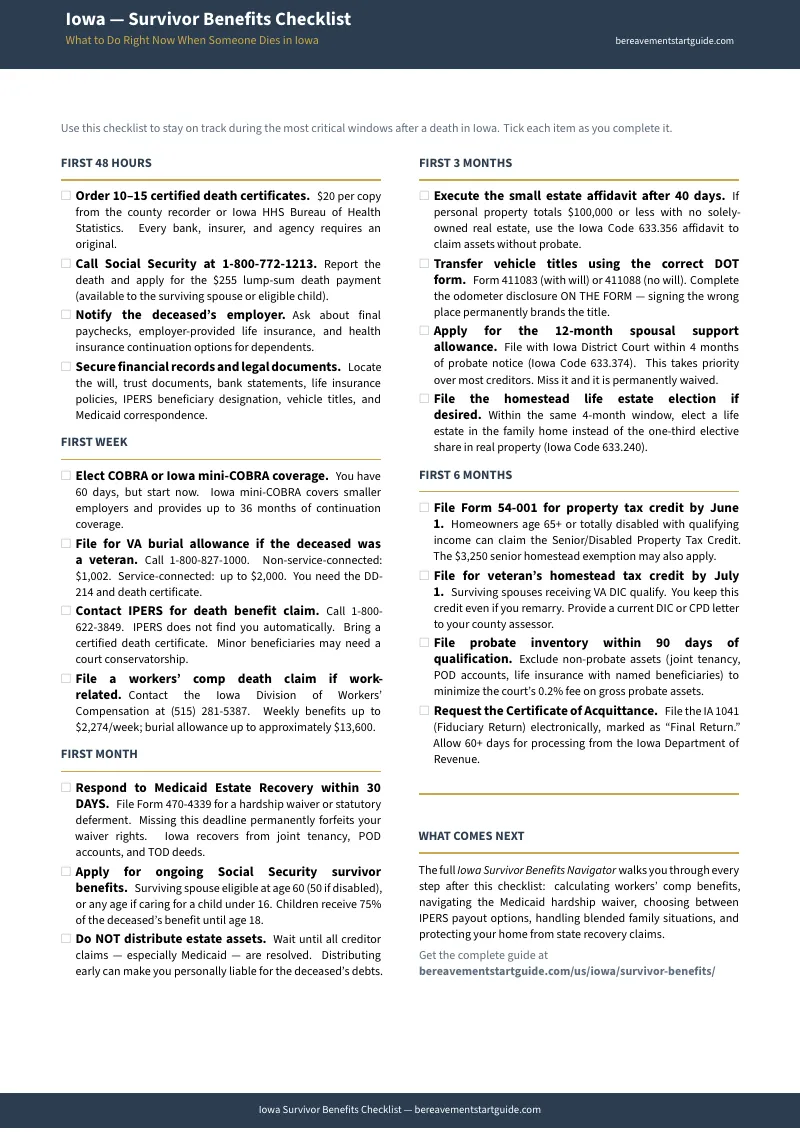
A printable quick-start checklist covering the most time-sensitive actions in the first 48 hours, first week, first month, and first six months -- from ordering death certificates and filing for the $255 Social Security payment through responding to Medicaid recovery notices and meeting the June 1 property tax credit deadline. Available as a free download so you can start immediately while deciding whether the full Navigator is right for your situation.
Who This Is For
- Surviving spouses who need to replace lost household income immediately -- by claiming Social Security survivor benefits, electing the right IPERS payout option, securing property tax relief, and defending the family home against Iowa's Medicaid Estate Recovery program
- Working-age widows and widowers facing the sudden loss of a primary wage earner -- who need to file workers' compensation death claims, elect Iowa mini-COBRA health coverage for the family, and understand weekly benefit calculations that could total hundreds of thousands of dollars over a lifetime
- Adult children settling a parent's estate who need to navigate the IPERS claim process, determine whether the estate qualifies for the small estate affidavit, and protect themselves from personal liability when a Medicaid recovery letter arrives
- Families of veterans who need to claim VA burial allowances, secure the Disabled Veteran Homestead Property Tax Credit through the county assessor, and understand the additional benefits available through Iowa's county Commission of Veteran Affairs
- Parents and guardians of surviving minor children who need to claim children's Social Security benefits, apply for the Iowa probate support allowance, and establish conservatorships for IPERS benefits exceeding $25,000
Why Not Just Use the Free Government Websites?
Every form referenced in this guide is available for free from an Iowa government agency. The IPERS claim forms are on ipers.org. The Medicaid Debt Response Form is on hhs.iowa.gov. The property tax credit application is at your county treasurer's office. The workers' compensation filing instructions are on the Iowa Division of Workers' Compensation website.
What is not free -- and what no government website provides -- is the sequence. The Social Security Administration does not warn you that receiving an inheritance triggers immediate SSI income counting under Iowa's beneficiary awareness rules. IPERS does not explain how choosing a lump-sum payout interacts with your Medicaid exposure. The county assessor does not mention the workers' compensation burial allowance when you ask about property tax credits. The Iowa HHS Medicaid recovery unit does not tell you that deferment postpones the debt but does not forgive it -- and certainly does not explain how a hardship waiver differs from a deferral.
Each agency handles its piece. The Workers' Compensation Division publishes the maximum weekly rate but does not link to funeral assistance programs. IPERS describes payout options in actuarial jargon but does not flag the tax consequences of choosing a lump sum over a rollover. Iowa Legal Aid has thorough Medicaid recovery analysis but presents it in dense legal prose with no interactive checklists or sequenced action plans. And no single government website tells you that missing the four-month spousal support allowance deadline permanently waives your right to estate funds that take priority over almost every creditor.
This guide connects the dots -- putting every benefit, every deadline, every form, and every agency into the order you actually need them.
-- Less Than One Hour of Attorney Time
A single consultation with an Iowa probate attorney runs $200 to $400 per hour. Under Iowa Code 633.197, statutory attorney fees on the estate can reach 2% of the gross value plus $120 -- and attorneys routinely apply for extraordinary fees at higher hourly rates to handle tax issues and non-probate assets. But attorneys handle court filings. They rarely sit on hold with the Social Security Administration, apply for the Iowa Disabled Veteran Homestead Tax Credit, gather the 13 weeks of pay stubs needed to calculate a workers' compensation benefit, or fill out Form 470-4339 to invoke a Medicaid hardship waiver within the 30-day deadline. Those administrative tasks get billed at the same hourly rate -- or they simply do not get done.
The Navigator covers the administrative work that would otherwise consume billable hours or fall through the cracks entirely. Even if you ultimately hire an attorney for the probate filing, completing the benefit claims yourself saves the estate hundreds to thousands of dollars in tasks that do not require a law license.
If the guide does not save you at least ten hours of frustrating research across disconnected government websites, email us at any time for a full refund. No questions asked.
Get the Iowa Survivor Benefits Navigator
Frequently Asked Questions
What if the rules change after I buy?
We update the guide when the rules change. Email us any time, even years later, and we'll send you the current edition free.