You're Settling an Estate in Massachusetts. The State Isn't Making It Easy.
Someone you love has died, and now you're responsible for their estate. You expected grief. You didn't expect to become an unpaid tax accountant, a real estate title detective, and a government paperwork specialist all at once.
Massachusetts has one of the most complex estate settlement systems in the country. The state puts an automatic ten-year tax lien on every piece of real estate the moment the owner dies — even if the estate owes nothing. You can't sell the house, refinance it, or transfer title until you formally clear that lien with the right paperwork at the right county Registry of Deeds. Most families find this out when a closing falls through.
Then there's the tax filings. Massachusetts requires a separate fiduciary income tax return if the estate earns just $100 in income after the date of death. One savings account sitting open for a few months can trigger it. Miss the filing, and penalties stack at 2% per month. Meanwhile, you're also responsible for the decedent's final individual return, and possibly the state estate tax return if the estate crosses the $2 million threshold — a threshold that was $1 million just three years ago, with rules that changed twice since then.
The forms themselves are free on mass.gov. But the forms don't tell you what order to file them in. They don't tell you that your health care proxy expired the instant the death occurred. They don't tell you that a Homestead Declaration won't protect the house from MassHealth estate recovery. And they definitely don't tell you that a surviving spouse in Massachusetts only gets a stepped-up basis on half the jointly owned property — not all of it — because Massachusetts is a common law state, not a community property state like California.
You could spend $300 to $500 per hour asking a probate attorney to walk you through the basics. Or you could arrive at their office already organized, already informed, and cut their billable time in half.
The Massachusetts Estate Tax Settlement System
This is the guide that connects the dots between what the state publishes and what the state actually expects you to do. It covers the full Massachusetts estate tax and settlement process — from the moment of death through final distribution — in plain English, with every step sequenced in the order you need to complete it.
Built specifically for Massachusetts law. Not a generic national overview. Not a lead-generation teaser from a law firm that withholds the details. The actual step-by-step process, with the exact forms, exact fees, exact deadlines, and the Massachusetts-specific traps that catch families every week.
What's Inside
The Real Estate Lien Release Walkthrough
How to draft the Affidavit of No Estate Tax Due, get it notarized, and record it at your county Registry of Deeds for the $105 filing fee — so you can actually sell or transfer the property. Includes separate instructions for Registered Land (Torrens system) properties, which require a different process through the Land Court.
All Four Tax Returns, Mapped and Sequenced
The final individual income tax (Form 1), the fiduciary income tax (Form 2), the Massachusetts estate tax (Form M-706), and the federal estate tax (Form 706). Each one explained: who must file, what threshold triggers it, which form to use, when it's due, and what ID number to file under. The guide separates these clearly so you never confuse one obligation with another.
The $2 Million Threshold — Updated for 2023 and 2024 Reforms
The old $1 million cliff is gone. The new $99,600 credit, the out-of-state property exclusion, and how lifetime gifts get added back to the gross estate. This section walks you through the current law, not the version from three years ago that still dominates most search results.
The $100 Fiduciary Income Tax Trap
Massachusetts triggers a fiduciary income tax filing at just $100 in estate income — far lower than the federal threshold. The guide shows you exactly what counts as estate income (interest, dividends, rent, a final paycheck received after death), how to get the estate's EIN, and how to issue Schedule 2K-1 forms to beneficiaries.
Step-Up in Basis for a Common Law State
What the step-up means, why Massachusetts surviving spouses only get a partial step-up on jointly owned property, why inherited retirement accounts get no step-up at all, and why you need a date-of-death appraisal before you even think about selling.
MassHealth Estate Recovery — The New Rules
The August 2024 overhaul dramatically limited what MassHealth can recover. The $25,000 blanket exemption. The difference between "probate estate" and assets that bypass probate. Why a Homestead Declaration will not protect the house after death. What you still need to file even when the estate is exempt.
Probate Path Selection
Voluntary Administration ($115 filing fee, estates under $25,000), Informal Probate ($390 filing fee, 7-day waiting period), or Formal Probate. How to decide which path fits the estate, what forms to file, and why the Fiduciary Bond is mandatory even when the will waives it.
Creditor Claims and Personal Liability
The one-year creditor claim window, why distributing assets too early can leave you personally liable, and how to scrutinize claims before paying them.
Deadline Timeline and Forms Reference
A consolidated timeline from day one through estate closure, plus a complete forms reference with every MPC form number, DOR form, filing location, and fee amount in one place.
Printable Standalone Tools
Separate PDF worksheets you can print and bring to meetings with attorneys, CPAs, and the Probate and Family Court:
- Tax Deadline Calendar — Every critical deadline on one timeline: the 9-month estate tax filing, the April 15 fiduciary return, the one-year creditor claim period, and the probate petition waiting periods.
- Forms and Fees Reference — One-page reference card mapping every Massachusetts tax and probate form to its filing location, fee amount, and deadline.
- Estate Tax Decision Flowchart — A visual decision tree that walks you through whether the estate triggers the M-706, the fiduciary return, MassHealth recovery, or none of the above.
- Lien Release Walkthrough — Step-by-step instructions for drafting and recording the Affidavit of No Estate Tax Due at the Registry of Deeds, including the separate process for Registered Land properties.
- Probate Path Comparison — Side-by-side comparison of Voluntary Administration, Informal Probate, and Formal Probate — eligibility, forms, fees, and waiting periods for each path.
Who This Guide Is For
- Executors and personal representatives who just received their court appointment and need to know what to do first, second, and third — without paying a probate attorney to explain the basics
- Surviving spouses trying to understand the real estate lien, the partial step-up in basis, and whether the estate triggers any tax filings
- Adult children inheriting property who need to clear the title before they can sell, and want to understand the capital gains implications before they sign anything
- Families dealing with MassHealth who need to know whether the estate is subject to recovery, what the new exemption limits are, and what paperwork to file regardless
- People preparing to meet with a probate attorney or CPA who want to arrive with organized documents and intelligent questions — cutting billable hours significantly
Why Not Just Use the Free Forms on Mass.gov?
The forms are free. The knowledge of how to use them is what's missing.
Mass.gov publishes Form M-706, Form 2, and the MPC probate petition forms. The Department of Revenue sets the thresholds. The Registry of Deeds handles the lien releases. The Probate and Family Court handles the appointments. But nobody connects these agencies into a single process. The DOR doesn't tell you about the probate court's bond requirement. The court doesn't mention the Registry of Deeds recording fees. The Registry won't explain the DOR's tax lien.
National tax sites like TurboTax and NerdWallet cover the federal side well but routinely miss Massachusetts-specific mechanisms — the $100 fiduciary threshold, the common law basis rules, the automatic lien on real property. Local law firm blogs give excellent overviews but deliberately stop short of the step-by-step execution, because that's what they charge $300 an hour to provide.
This guide fills the gap between what's publicly available and what you actually need to get through the process. For , you get the organized, sequenced roadmap that connects every agency, every form, and every deadline into one document.
Start With the Free Checklist
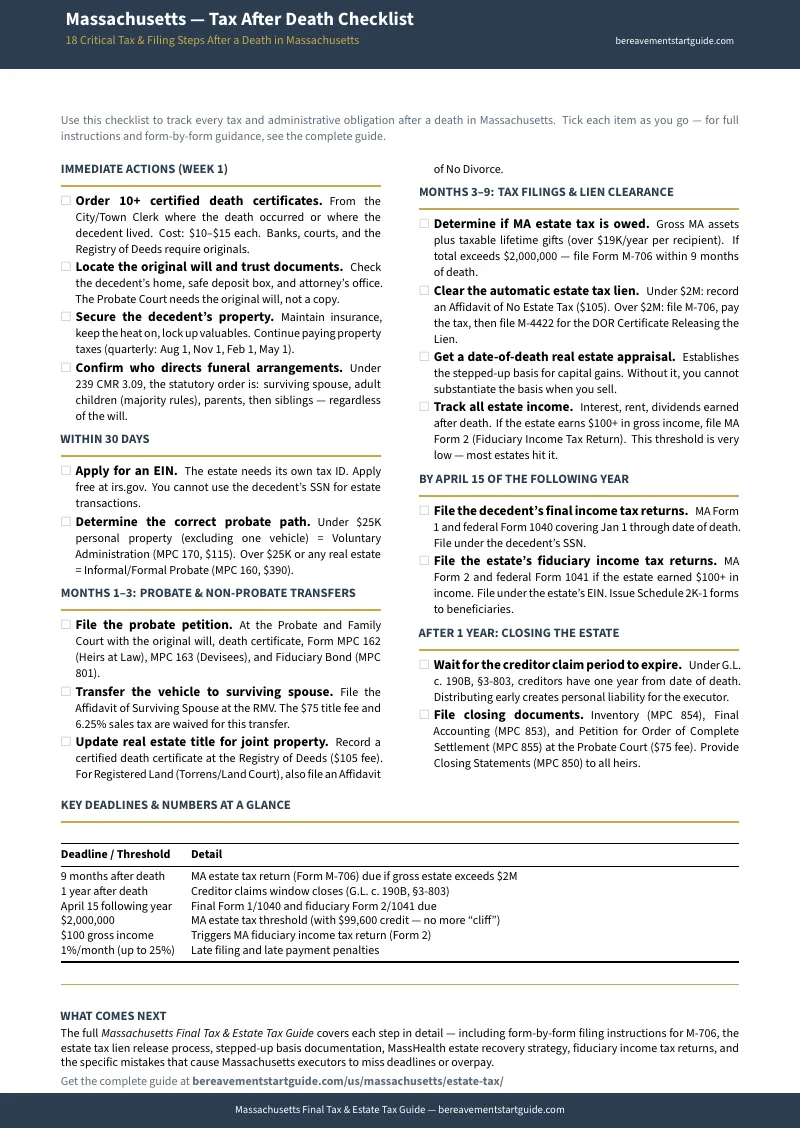
Not sure you need the full guide? Download the Massachusetts Tax After Death Checklist — a free one-page timeline of the five critical deadlines every Massachusetts executor must know. It covers the 7-day and 30-day probate windows, the 9-month estate tax deadline, the April 15 fiduciary filing date, and the one-year creditor claim period.
If the checklist answers your questions, you're set. If you need the step-by-step process behind each deadline — the forms, the fees, the lien release, the tax calculations — the full guide is .
Satisfaction guarantee: If the guide doesn't help you, email hello@bereavementstartguide.com and we'll make it right.
Get the Massachusetts Final Tax & Estate Tax Guide
Frequently Asked Questions
What if the rules change after I buy?
We update the guide when the rules change. Email us any time, even years later, and we'll send you the current edition free.