Your Spouse Just Died in South Dakota. Social Security Sent a Letter Demanding the Last Check Back. The Bank Froze the Joint Account. The County Treasurer Said Something About an April 1st Deadline You Have Never Heard Of. And Nobody Told You That Six Different State Agencies Owe Your Family Money You Have to Apply For.
You are sitting at a kitchen table with a stack of certified death certificates you were not sure how many to order, a folder from the funeral home with a bill you cannot pay from the frozen checking account, and a phone that keeps ringing with questions you do not have answers to. Your spouse handled the finances. Or you handled them together, and now half the system is locked because the account holder is gone. The mortgage is due. The health insurance premium notice arrived. And someone at the Social Security office told you to "come in to apply for survivor benefits" but could not tell you whether that meant the $255 lump-sum payment, monthly income, or both.
Here is what nobody tells you in that first week: South Dakota has no state income tax, no state estate tax, and no state inheritance tax. That means more of your family's money stays intact than in most states. But every dollar of benefits available to you requires a separate application, to a separate agency, with its own forms, its own eligibility rules, and its own deadline. Miss the April 1st property tax freeze application and your assessment goes up permanently. Miss the 6-month Medicaid limitation petition and your personal assets stay exposed to state recovery for the rest of your life. Miss the 60-day health insurance continuation window and you lose the right to keep your spouse's employer coverage. None of these agencies talk to each other. None of them will call you. And the difference between a family that captures every benefit they are owed and a family that leaves thousands of dollars unclaimed is whether someone handed them the complete list — in the right order — before the deadlines passed.
The South Dakota Survivor Benefits Navigator is a Deadline Defense System for every benefit, every application, and every statutory window available to surviving spouses and dependents in South Dakota. Not a sympathy pamphlet. Not a generic federal benefits overview that treats South Dakota like every other state. A structured, chronological manual that tells you exactly which agencies to contact, which forms to file, which deadlines are hard cutoffs versus soft guidelines, and what each benefit is actually worth in dollars — so you stop wondering what you are missing and start claiming what your family is owed.
What's Inside the Deadline Defense System
A 16-chapter guide, the Survivor Benefits Checklist, and a Forms and Contacts Quick Reference — covering every benefit stream from the day of death through the annual property tax cycle, built specifically for South Dakota's statutes, agencies, and the rules that make claiming benefits here different from any other state:
Death Certificates: How Many, Where, and What They Cost
Every benefit claim starts with a certified death certificate — and you will need more than you think. Each bank, each insurance company, each pension fund, each government agency, and each county office requires its own original certified copy. The guide gives you the exact count based on your situation: $15 each from the South Dakota Department of Health or the county Register of Deeds in person, $26.50 each through VitalChek online. Order the right number on the first pass. Coming back for more means weeks of processing time that freezes every other claim in place.
The First 15 Days: Notifications That Cannot Wait
Call Social Security to stop the deceased's payments (any benefit deposited after the date of death will be clawed back), apply for the $255 lump-sum death payment, and begin your survivor benefit application. Notify the employer to trigger COBRA or Mini-COBRA health insurance continuation — you have exactly 60 days to elect coverage, and if the employer had fewer than 20 employees, South Dakota's state continuation law still gives you 36 months. File life insurance claims with every carrier. And critically: check whether the deceased owed anything to the South Dakota Department of Social Services for Medicaid or nursing home care, because that single fact changes your entire pathway through this guide.
Health Insurance Continuation: The 60-Day Window and the 150% Premium Cliff
The death of a covered employee is a qualifying event under both federal COBRA and South Dakota's Mini-COBRA (SDCL 58-18-7.5). Either way, the surviving spouse and dependent children can maintain coverage for up to 36 months. But there is a trap most families do not see coming: premiums are capped at 102% of the group rate for the first 18 months, then jump to 150% for months 19 through 36. The guide tells you exactly when to start shopping ACA Marketplace alternatives — and that South Dakota's Medicaid expansion covers adults up to 138% of the Federal Poverty Level if your household income dropped after the death.
Social Security Survivor Benefits: What You Actually Get and How to Coordinate
A surviving spouse at full retirement age receives 100% of the deceased worker's Primary Insurance Amount. At age 60, that drops to 71.5%. Each eligible child under 18 receives 75% of PIA, subject to the family maximum. And if you are working before full retirement age, SSA withholds $1 for every $2 you earn above the annual threshold. This chapter maps the exact benefit calculations, the earnings limit interaction, and the coordination with SDRS pension benefits for public employees who contributed to both systems. SSA survivor benefit applications cannot be completed online — you must call 1-800-772-1213 or visit a local field office in person.
SDRS Public Employee Pension: The Early Benefit Decision That Lasts Forever
If your spouse was a South Dakota public employee — a teacher, a state worker, county or municipal staff — they were likely a member of the South Dakota Retirement System. The surviving spouse benefit provides 60% of the member's benefit at full retirement age (65 for Foundation members, 67 for Generational members). But you can start collecting up to 10 years early, as young as age 55 or 57 depending on membership class. The catch: a permanent 5% reduction for every full year you take it early. At age 57 with a Generational requirement of 67, that is a 50% reduction — for life. The guide includes the full calculation table and the decision framework that helps you weigh immediate income needs against lifetime benefit value.
Workers' Compensation Death Benefits: The $10,000 Burial Payment Most Families Miss
If the death resulted from a workplace injury or occupational illness, the employer's insurance carrier owes your family significantly more than most people realize. South Dakota mandates up to $10,000 for burial expenses plus transportation costs, ongoing wage replacement at 66 2/3% of the deceased's average weekly wage (payable to the surviving spouse for life), $50 per month for each dependent child, and a $2,000 annual scholarship for up to five years for dependents attending accredited South Dakota post-secondary institutions. The guide walks you through the claim process with the Department of Labor and Regulation and the documentation required.
Veterans Benefits and Crime Victims' Compensation
If the deceased was a veteran, VA Dependency and Indemnity Compensation provides tax-exempt monthly payments starting at $1,699.36 per month (2026 rate), plus $421 per dependent child under 18. The guide also covers VA burial allowances — up to $2,000 for service-connected deaths — and the South Dakota-specific property tax exemptions that can shield up to $200,000 of your home's assessed value if your spouse was a totally disabled veteran. If the death resulted from a violent crime, the Crime Victims' Compensation Program provides up to $15,000 total, including up to $6,500 for funeral expenses — but the application must be filed within one year.
Property Tax Relief: Three Programs, Two Annual Deadlines, Zero Automatic Enrollment
Property taxes are the single largest ongoing liability for fixed-income surviving spouses. South Dakota has three powerful relief programs, and none of them activate automatically. The Assessment Freeze (Form PT38, filed by April 1st) locks your home's assessed value so taxes stop rising — available if you are 65 or older, disabled, or the unremarried surviving spouse of someone who previously qualified, with income under $56,595 and property under $514,500. The Homestead Exemption delays all property tax payments until the home is sold, creating a lien but providing immediate cash flow relief — and any surviving spouse qualifies regardless of age. The Disabled Veteran exemption (Forms PT46a/PT46c, filed by November 1st) can exempt up to $200,000. The guide maps all three side by side with the exact eligibility criteria, forms, and deadlines.
Medicaid Estate Recovery: The 6-Month Deadline That Protects Everything You Own
If the deceased received Medicaid long-term care or nursing home assistance, the Department of Social Services will pursue reimbursement — and South Dakota's expanded recovery program can reach non-probate assets including joint accounts, life estates, and TOD properties. But critical protections exist. DSS cannot recover while a surviving spouse is alive. And within six months of the Medicaid recipient's death, the surviving spouse can file the Petition to Limit Financial Responsibility, permanently capping future state recovery at the value of your estate calculated at the time of the death. Miss that six-month window, and every asset you acquire for the rest of your life remains exposed. This chapter walks you through the petition, the deadline, and when to involve an attorney.
Estate Pathways: Small Estate Affidavit, TOD Assets, and When Probate Is Required
South Dakota provides two separate small estate affidavit paths — one for personal property under $100,000 (30-day waiting period) and one for real property under $50,000 (60-day waiting period, with agricultural land explicitly excluded). The guide includes the decision worksheet that walks you through which pathway applies, the Medicaid clearance check that blocks the affidavit route, and the new Transfer-on-Death vehicle title rules effective July 2025. For estates that require formal probate: the $122 filing fee, the creditor claims timeline, and the complete milestone sequence.
Homestead Protection and Family Allowance: Money While You Wait
While the estate is being settled, you are not left with nothing. The homestead exemption (SDCL 43-45-3) protects the family home from judgment liens and judicial sale, with up to $170,000 in sale proceeds shielded for one year. The family allowance (SDCL 29A-2-403) provides up to $18,000 as a lump sum or $1,500 per month for one year — without court approval — and it has absolute priority over all general creditor claims. Up to $10,000 in life insurance proceeds payable to the estate is exempt from the deceased's debts under SDCL 43-45-6. These are not optional benefits — they are statutory protections that most families never learn about.
Agricultural Land, Trusts, and the Family Farm Exception
South Dakota's anti-corporate farming laws prohibit most business entities from owning farmland. When a farmer or rancher dies, placing the land into a trust or LLC requires qualifying for the family farm exception — a majority of ownership held by family members, with at least one member actively residing on or managing the operation. Generic trust templates from national websites will not satisfy South Dakota's requirements. The guide covers the exception criteria, the forced divestment consequences for non-compliance, dynasty trust options, trust decanting, and USDA Farm Service Agency documentation requirements for out-of-state heirs.
When to Handle It Yourself vs. When to Call an Attorney
Ordering death certificates, claiming life insurance, transferring vehicles with Form MV215, applying for property tax relief, and filing SDRS pension claims are all tasks you can handle with this guide. Medicaid estate recovery with significant debt, real estate deeds with agricultural valuation questions, ancillary probate for non-residents, trust decanting, and indigent burial lien implications — those are the lines where professional counsel is worth the cost. The guide draws that boundary honestly.
Who This Guide Is For
- The surviving spouse whose income just dropped by half — who needs to know exactly which benefits replace lost wages, how to keep health insurance active past the 60-day window, and which property tax programs prevent the family home from becoming unaffordable on a single fixed income
- The elderly widow or widower facing the first tax season alone — who needs the April 1st property tax freeze application, the $18,000 family allowance they did not know existed, and the 6-month Medicaid petition that caps state recovery permanently before it is too late
- The adult child managing a parent's benefits — who is trying to coordinate Social Security, SDRS pension, VA benefits, and property tax relief for a grieving parent who cannot face the paperwork alone, and who needs one document that sequentially covers every agency instead of fourteen different websites
- The family of a worker killed on the job — who needs to file for the $10,000 burial benefit, the 66 2/3% wage replacement, the $50 monthly dependent child payments, and the $2,000 annual college scholarship through the Department of Labor and Regulation before anyone tells them these benefits exist
- The surviving spouse of a public employee — who is staring at the SDRS early benefit reduction table, trying to decide whether to take 60% of the pension now at a permanent 5% annual penalty or wait years for the full amount, and who needs the calculation framework to make a decision they cannot undo
- The veteran's surviving spouse — who qualifies for VA DIC payments, the VA burial allowance, and up to $200,000 in property tax exemptions, but has not been told about any of them because no single agency covers all three
Why Free Resources Will Not Get You Through This
The information exists. It is scattered across fourteen state agency websites, three federal portals, and sixty-six county offices that do not share data or cross-reference each other's deadlines. Here is what you actually encounter when you try to claim survivor benefits using free sources alone:
- State agencies are siloed by design. The Department of Revenue handles property tax relief but knows nothing about SDRS pension timelines. The Department of Social Services manages Medicaid recovery but does not mention the workers' compensation burial benefit. The Department of Labor administers workers' comp claims but has no information about VA benefits. You must visit each agency separately, discover each program independently, and track each deadline on your own.
- Local elder law firms emphasize complexity to justify retainer fees. Attorney blog posts about South Dakota survivor benefits are accurate and detailed — and they are explicitly designed to convince you that the process is too dangerous to attempt without spending $311 to $358 per hour on representation. For contested Medicaid claims and agricultural succession, that is true. For the majority of families, the benefits are straightforward if you know which forms to file and when.
- Funeral homes cover the first two days and nothing else. The bereavement packet from the funeral director mentions the $255 Social Security payment and ordering death certificates. It does not mention the SDRS pension decision that affects your income for life, the property tax freeze that could save you thousands annually, or the 6-month Medicaid petition that protects your personal assets permanently.
- National form vendors sell generic templates that miss South Dakota-specific rules. eForms and US Legal Forms offer survivor benefit checklists that apply equally to all fifty states — which means they miss the $100,000 small estate affidavit threshold, the agricultural land exclusion from the real property affidavit, the new July 2025 vehicle TOD rules, and the expanded Medicaid recovery that reaches joint accounts and TOD properties. South Dakota's rules are not footnotes — they are the rules.
Free resources give you fragments from fourteen different agencies that do not reference each other. The Deadline Defense System puts every South Dakota-specific benefit, application, deadline, and form into one document, in the chronological order you actually need them.
— Less Than Five Minutes With a South Dakota Estate Attorney
A single consultation with a South Dakota probate or elder law attorney costs $311 to $358 per hour. Standard estate representation runs thousands of dollars. National benefit-finder subscriptions charge monthly fees that add up over the years you spend managing ongoing claims. This guide costs less than five minutes of professional legal time and gives you the complete South Dakota-specific roadmap — every benefit, every application, every deadline, every form, and the chronological sequence that ensures nothing falls through the cracks.
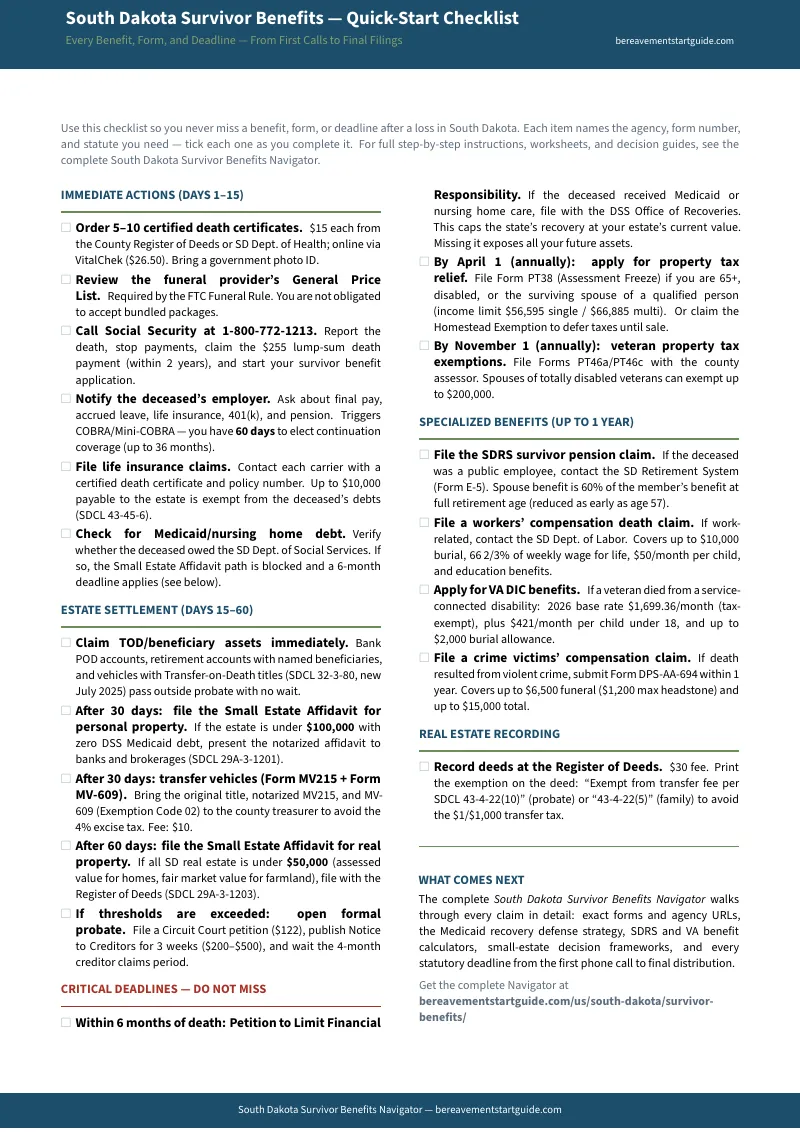
Your download includes the complete 16-chapter guide covering every benefit stream available to South Dakota survivors, the standalone South Dakota Survivor Benefits Checklist with every action item and deadline in one printable reference, and the Forms and Contacts Quick Reference mapping every form number, every agency, and every filing deadline. Instant download, no account required.
Money-back guarantee, no time limit. If the guide does not give you clarity on which benefits your family is owed and confidence that you are claiming them in the right order, email us for a full refund. No questions asked.
Not ready for the full guide? Download the free South Dakota Survivor Benefits Checklist — a printable reference covering the most critical benefit actions, deadlines, and forms for surviving spouses and dependents in South Dakota. It is enough to see what is urgent today and what can wait until next week.
You did not ask to learn any of this. But you can claim what your family is owed. The guide shows you how, one benefit at a time.