The Bank Froze the Account. The Court Clerk Said She Cannot Tell You How to Fill Out the Petition. And Every Website You Found Last Night Says Vermont Has a Small Estate Affidavit. It Does Not.
You went to the bank with the death certificate and the original will, and they told you the account is locked until you produce Letters Testamentary. You drove to the Probate Division of the Vermont Superior Court, and the clerk handed you a form and said she cannot give you legal advice. She cannot tell you which boxes to check, what to attach, or what the filing codes mean on the Odyssey e-filing system. You went home and searched "Vermont small estate affidavit" because several national legal websites said you could bypass probate with a simple sworn statement. You spent two hours looking for a form that does not exist. Vermont has no out-of-court small estate affidavit. Even for estates under $45,000 with no real property, you must still file a formal petition with the Probate Division. Those websites were wrong, and now you have lost a day you did not have.
Maybe you will file the petition using the wrong Odyssey case type code and wait three weeks for a rejection you could have prevented. Maybe you will miss the 30-day deadline to publish the Notice to Creditors and accidentally extend the creditor claim window from four months to three full years. Maybe you will distribute assets before the four-month creditor window closes and discover that you are personally liable for debts the estate should have paid. Maybe you are an out-of-state executor who does not know that Vermont requires you to designate a resident agent before the court will even consider your appointment. Or maybe the estate qualifies for the simplified small estate track, and you are about to spend thousands on a formal process you could have avoided entirely.
The Vermont Probate Process Guide is a Vermont Probate Sequence for every filing, deadline, and decision in a Vermont probate case — from the initial petition through final accounting and estate closing. Not a generic overview recycled for all 50 states. Not a blog post engineered to convince you that probate is too dangerous to attempt without a $5,000 retainer. A plain-English, Vermont-specific manual that tells you exactly what the court clerk cannot: which forms to file, when to file them in what order, how to navigate the Odyssey e-filing system, and which mistakes will cost you months of delay or personal financial liability.
What's Inside the Vermont Probate Sequence
A chronological guide, a filing-readiness checklist, and standalone reference sheets — covering every phase of probate in Vermont from opening the case through formal discharge, built entirely on Vermont Statutes Title 14 and the Vermont Rules of Probate Procedure:
Before You File: Does the Estate Actually Need Probate?
This is the question that saves you six months or costs you six months if you get it wrong. Vermont's small estate procedure applies to estates with a fair market value of $45,000 or less, consisting entirely of personal property — with one narrow exception for timeshare estates. But the threshold is strict and the misconceptions are widespread. Joint accounts with right of survivorship, payable-on-death accounts, and life insurance with a named beneficiary all bypass probate entirely. A vehicle with a Transfer on Death designation (Form VT-007) transfers outside of court for a $35 DMV fee. The guide includes a decision flowchart that walks you through every asset type to determine which path applies — small estate, formal probate, or no court involvement at all — so you do not file a full petition for an estate that qualifies for the simplified track, and you do not attempt the simplified track on an estate that does not qualify.
The Odyssey File and Serve System: What Nobody Explains
All Vermont probate filings go through the Odyssey File and Serve electronic filing platform. You must register for an account, set up a payment method, select the correct county, choose "Probate or Mental Health" as the case category, and then pick the precise estate case type code based on the estimated value and whether a will exists. The codes are specific — "Estate 1 - with Will - $10,000 or less" is different from "Estate 2 - No Will - $10,001 to $50,000" — and selecting the wrong one generates the wrong filing fee and may cause the court to reject your filing entirely. The guide maps every case type code to its correct usage so you file once, correctly, the first time.
Filing the Petition: The Complete Package
The petition is not a single form. It is a package: the original will (if one exists), a certified death certificate, the Petition to Open Decedent's Estate (Form 700-00001 for regular estates, Form 700-00001SM for small estates), the Estate Administration Bond, and the correct filing fee from a sliding scale that runs from $50 for estates under $10,000 to $3,250 for estates over $10 million. The guide covers both testate and intestate paths end to end — the forms are different, the appointment process is different, and the distribution rules are different.
The Fiduciary Bond: What It Costs and How to Eliminate It
Before the court issues your Letters, you must address the bond requirement. A commercial surety bond runs $100 to $500 per year. But if all heirs and interested parties consent, you can file a Waiver of Surety on Estate Administration Bond (Form 700-00004), which eliminates the insurance premium entirely. For small estates, the bond is generally issued without surety unless the judge orders otherwise. The guide explains exactly when you need a commercial bond, when you can waive it, and what happens if the person named as executor refuses or fails to provide one.
The Resident Agent Requirement for Out-of-State Executors
Vermont requires any non-resident executor to designate a Vermont resident to act as their "resident agent" — someone who can accept service of legal process within the state. This catches out-of-state family members completely off guard, especially adult children who returned home after the funeral and assumed they could manage everything remotely. The guide explains this requirement before you file, not after the court rejects your petition.
The 60-Day Inventory: What to Include, What to Exclude, and the Deadline That Gets Executors Removed
Within 60 days of your appointment — 30 days for small estates — you must file the Inventory Schedule (Form 700-00030) listing every probate asset at its fair market value as of the date of death. Not current market value. Not insured value. Not purchase price. Fair market value on the exact date the person died. The guide covers what must be listed, what must not be listed, how to handle real property valuations using the municipal tax assessment, when to hire a professional appraiser, and how to request a court extension if you need more time.
Notice to Creditors: The Four-Month Clock That Protects You
Within 30 days of your appointment, you must publish a Notice to Creditors (Form PE 32) in a newspaper of general circulation where the deceased resided. This starts a four-month window during which creditors must file claims or lose them permanently. If you skip the newspaper publication to save $100 to $300, the creditor window extends from four months to three full years — meaning creditors can come forward long after you have distributed assets. The guide covers the publication process, how to review and disallow invalid claims using Form 700-00003, the strict statutory payment priority for insolvent estates, and why publishing the notice is almost always the safer choice.
Real Estate in Vermont Probate: Town Clerks, Not County Recorders
Vermont records real estate deeds at municipal town clerks' offices, not at a centralized county recorder. This is different from how most states handle it, and it is the single most common point of confusion for out-of-state executors. If the property was held jointly with right of survivorship, the surviving owner records a death certificate at the town clerk where the property is located — $15 per page, no court involvement. If the property was in the deceased's name alone, it must go through probate, and you must obtain a License to Sell before you can list or transfer it. The property transfer tax is 1.25%, and the Vermont Department of Taxes will not release its statutory tax lien until it issues a formal clearance. The guide covers both paths and the specific recording fees for each step.
Medicaid Estate Recovery: Protecting the Family Home
If the deceased was over 55 and received Medicaid-funded long-term care, the Department of Vermont Health Access will file a creditor claim against the estate. The family home is the primary target. But Vermont provides specific exemptions that many executors do not know about: recovery is deferred during the lifetime of a surviving spouse, it is prohibited if the deceased left behind children who are under 21 or permanently disabled, and the caregiver child exemption can protect a home valued under $250,000 if a son or daughter lived there continuously for at least two years and provided care that delayed institutionalization. The guide covers every exemption, the required affidavit, and the hardship waiver process.
Tax Obligations and the Clearance You Cannot Skip
Vermont levies its own estate tax on gross estates exceeding $5 million — and unlike federal law, Vermont does not allow portability of a deceased spouse's unused exemption. For most estates well below the threshold, the guide confirms quickly and clearly that you do not need to file Form EST-191. What you do need is the Tax Clearance: a formal confirmation from the Vermont Department of Taxes that all income, fiduciary, and estate tax liabilities are satisfied. Without it, the Probate Division will not close the estate, and no title insurer will underwrite a real estate transfer. The guide covers the clearance application (Form E-2A), the lien release process through myVTax, and the $15 recording fee with the town clerk.
Closing the Estate: Final Accounting and Discharge
The estate cannot close until you file a Final Accounting showing every dollar that entered and left the estate, with line-item detail for all fees and expenses. The Probate Division must formally approve your accounting before you distribute any remaining assets. If you skip this step, your personal liability as executor never technically ends. The guide covers the accounting format, what the judge looks for, how to petition for formal discharge, and the $90 fee for reopening the estate if new assets are discovered later.
Who This Guide Is For
- The executor who just received the will and has no idea what to do with it — who needs to understand that a will is legally inactive until validated by a Vermont probate judge, and that the process between "holding the will" and "having legal authority" involves specific filings through the Odyssey e-filing system, a potential hearing, a bond, and a judicial decree
- The surviving spouse whose bank accounts were frozen this morning — who needs Letters Testamentary or Letters of Administration to unlock those accounts and cannot afford to wait months because the petition was filed with the wrong case type code or the bond was not arranged
- The out-of-state adult child managing probate remotely — who did not know about the resident agent requirement, cannot walk into the Probate Division for help, and needs every form, every deadline, and every Odyssey filing code in one document instead of calling the court clerk and being told they cannot give legal advice
- The family with no will navigating intestate succession — who needs to understand exactly who the court will appoint as administrator, what bond is required, and how Vermont's statutory inheritance formula divides the estate among the spouse, children, and parents
- The family trying to determine whether the estate qualifies for small estate treatment — who needs the decision flowchart that maps the $45,000 threshold, the personal-property-only requirement, and the specific criteria that separate a simplified court procedure from months of formal administration
- The executor whose loved one received Medicaid — who needs to understand whether the family home is at risk, which exemptions apply, and how the caregiver child affidavit works before the DVHA recovery claim arrives
Why Free Resources Will Not Get You Through This
Vermont probate information exists. It is scattered across the Vermont Judiciary website, the Odyssey File and Serve help pages, attorney blogs designed to generate retainer clients, and national platforms that treat Vermont like a footnote. Here is what you actually encounter when you try to navigate probate using free sources:
- The Vermont Judiciary publishes a free 11-page instructional PDF called "Probating a Vermont Estate" (Form 700-00302). It is dense, legalistic, and presented as a wall of statutory references. It outlines the rules but does not sequence them. It does not tell you which forms to file on which day, what happens after each filing, or how to navigate the Odyssey system. It gives you the ingredients without the recipe.
- The courts operate an Access and Resource Center, but clerks cannot give legal advice. They will hand you forms. They will not tell you how to fill them out, which case type code to select in Odyssey, or whether your specific estate qualifies for the small estate track. That is not rudeness — it is Vermont law.
- National legal directories like SmartAsset, FindLaw, and Justia regularly get Vermont wrong. Multiple sites falsely claim Vermont allows an out-of-court small estate affidavit. It does not. Vermont requires a formal court petition even for estates under $45,000. Following this misinformation will send you looking for a form that does not exist and delay the process by weeks.
- Attorney blog posts are accurate and engineered to sell you representation. Vermont probate attorneys charge $300 to $800 per hour. Every blog post explains how complex and risky the process is, and every one ends with "schedule a consultation." For contested estates, that advice is sound. For the straightforward estate where the will is clear, the heirs agree, and the assets are modest, the post never quite tells you that you can handle the administrative work yourself.
- National platforms like Trust and Will charge $500 or more and lack Vermont depth. They do not cover the Odyssey e-filing system, the town clerk recording system for real estate, the resident agent requirement for non-resident executors, the caregiver child exemption for Medicaid recovery, or the specific filing fee schedule under 32 V.S.A. Section 1434. Vermont has its own rules, and generic platforms do not know them.
Free resources give you fragments from a dozen sources that do not reference each other, do not sequence the steps, and routinely get Vermont-specific procedures wrong. The Vermont Probate Sequence puts every Vermont statute, form, deadline, and filing requirement into one document, in the order you actually need them.
— Less Than Fifteen Minutes With a Vermont Probate Attorney
A consultation with a Vermont probate attorney runs $300 to $800 per hour. Full probate representation typically costs 2% to 4% of the gross estate value. National estate platforms charge hundreds in recurring annual subscriptions. This guide costs less than fifteen minutes of professional legal time and gives you the complete Vermont-specific probate roadmap — every filing requirement, every Odyssey system code, every statutory deadline, and the decision flowchart that tells you whether you need formal probate at all.
Your download includes the complete step-by-step guide covering testate and intestate probate, the standalone Vermont Probate Filing-Readiness Checklist, and printable reference sheets: the Probate Path Decision Flowchart, Executor Duties Timeline (every statutory deadline from Day 1 through the four-month creditor window and beyond), Creditor Claims Management Guide, Inventory Preparation Worksheet, Real Estate Transfer Reference (town clerk recording procedures for both joint-tenancy and sole-ownership properties), and Administrative Cost Budget Worksheet. Instant download, no account required.
Money-back guarantee, no time limit. If the guide does not give you clarity on what to file, when to file it, and what happens next — email us for a full refund. No questions asked.
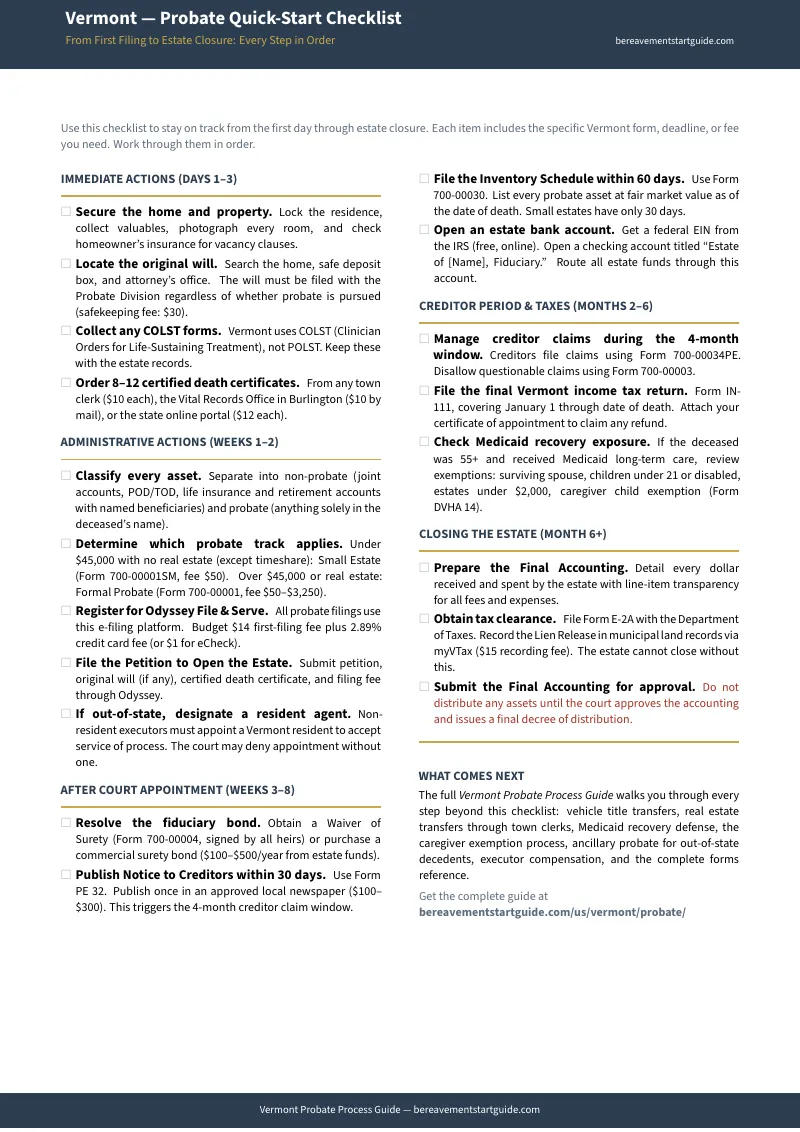
Not ready for the full guide? Download the free Vermont Probate Quick-Start Checklist — an overview of the probate process and the key deadlines, decisions, and documents you need to have ready before you file your first petition with the Probate Division. Enough to understand what you are facing and whether you need the full guide.
Probate is not something you were trained for. But it is something you can get through with the right instructions. The guide gives you those instructions, one filing at a time.