Someone You Love Just Died in Virginia. The Bank Froze the Accounts. The Circuit Court Clerk Handed You a Stack of Forms and Said She Cannot Give Legal Advice. And Nobody Told You That the House Already Belongs to You — Along With Every Debt Attached to It.
The funeral director handled the arrangements. The neighbors brought food. The family gathered, said what needed saying, and then went home. And now you are sitting at the kitchen table with a pile of unopened mail, a checking account you cannot access, and the slow realization that settling this estate means dealing with a legal system that Virginia designed for lawyers, not for grieving families.
Maybe you are the surviving spouse, and the bank told you this morning that the joint account is fine but the individual account — the one with $47,000 in it — is frozen until someone called a "personal representative" shows up with something called a "Certificate of Qualification." Maybe you are the adult child named as executor in the will, and you just learned that before the Circuit Court Clerk will even schedule your probate appointment, you need the original will, a certified death certificate, a list of every heir's name and address, and a check for the probate tax calculated at 10 cents per $100 of estimated estate value. Maybe you live in another state entirely, and someone at the courthouse just told you that nonresident executors in Virginia must post a surety bond unless a resident co-executor is appointed — and nobody mentioned that before you booked a flight.
Or maybe you are looking at the family home and someone told you it "drops like a rock" — that under Virginia law, real estate bypasses the standard probate process and vests in the heirs immediately at the moment of death. That sounds like good news until you learn the rest: under Virginia Code Section 64.2-536, creditors of the deceased can sue you personally for the value of that property if you do not establish a proper legal cutoff through a Debts and Demands hearing with the Commissioner of Accounts.
The Commissioner of Accounts. That is the part nobody warned you about. Virginia does not just give the executor a list of tasks and send them on their way. The Circuit Court appoints a private-practice attorney — the Commissioner of Accounts — to audit every financial filing you make. The 4-month Inventory. The 16-month First Accounting. Every number, every categorization, every margin on every page. The Henrico County Commissioner explicitly requires 10-12 point font and one-inch margins on all four sides of the CC-1670 Inventory form, and will reject and return any submission that does not comply. The official rulebook — the Manual for Commissioners of Accounts published by Virginia CLE — costs $324. And none of this information appears in one place anywhere that a normal person would think to look.
The When Someone Dies in Virginia — Estate Settlement Guide is a Commonwealth Settlement System for every legal, financial, and administrative step between the funeral and final distribution. Not a law textbook. Not a generic checklist from a national website that thinks Virginia works like every other state. A structured, Virginia-specific manual that separates what must be done in the first 48 hours from what can legally wait four months — so you stop guessing, stop panicking, and start working through this in the right order.
What's Inside the Commonwealth Settlement System
A comprehensive guide, the First 48 Hours Checklist, and printable reference sheets — covering every stage from the moment of death through final asset distribution, built specifically for Virginia statutes, Circuit Court procedures, and the Commissioner of Accounts system that makes settling an estate here different from any other state:
The First 48 Hours: Death Certificates and Immediate Actions
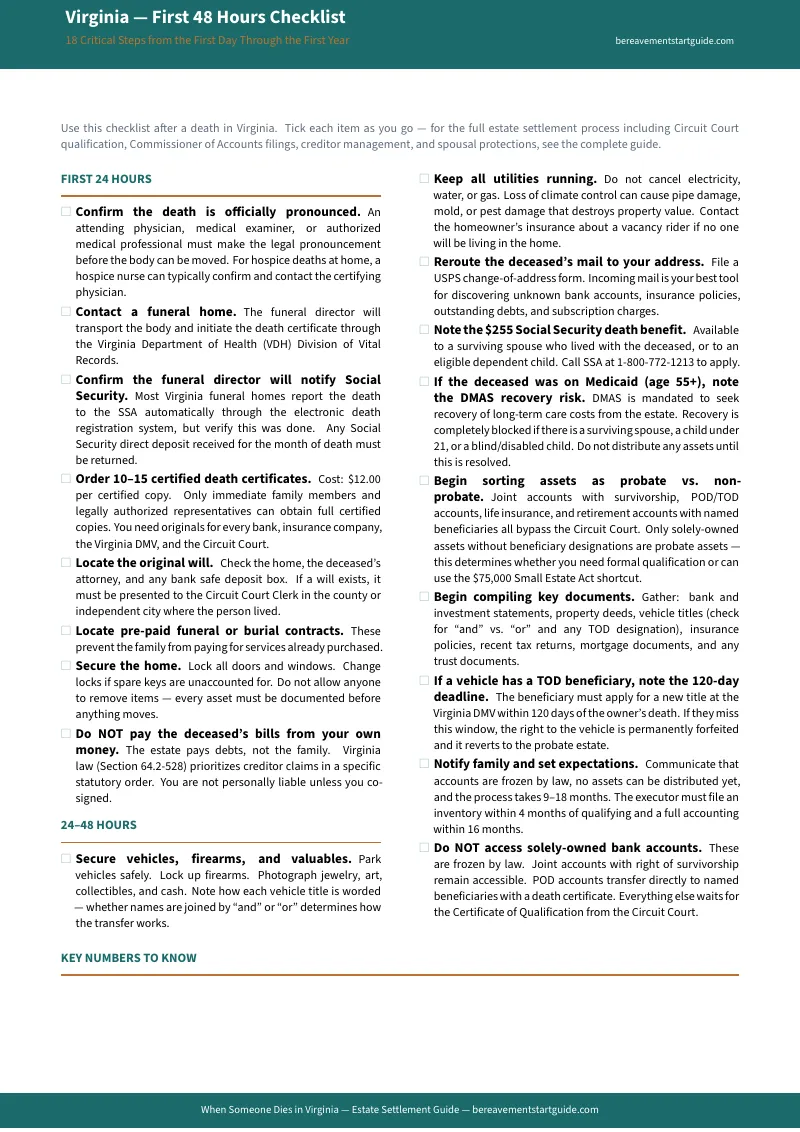
The funeral director is going to ask you how many certified death certificates to order from the Virginia Department of Health, and most families guess wrong. You need originals — not photocopies — for every bank, every insurance company, the Circuit Court Clerk, the Virginia DMV for each vehicle, and the IRS. The guide gives you the exact calculation based on the deceased's assets. This chapter also covers what to do today, what to do tomorrow, and what to absolutely not do — including the single most important rule in this entire guide: do not pay any of the deceased's bills with your own money. Virginia Code Section 64.2-511 allows a named executor to pay reasonable funeral expenses from the estate before officially qualifying at the courthouse, but that is the only exception.
The First Week: Securing the Estate and Getting Organized
Before the Circuit Court gives you legal authority over anything, you have a common-law duty to prevent assets from being lost, stolen, or damaged. This chapter covers locking the home, securing vehicles and valuables, rerouting mail (your best forensic tool for discovering unknown accounts and debts), canceling subscriptions that drain the estate, and the family meeting where you set the single most important expectation: no one takes anything from the house until the court says so. For blended families, this chapter addresses why establishing boundaries early prevents the disputes that otherwise escalate into contested probate litigation.
Banking and Financial Accounts: Unlocking Frozen Money
When a bank receives notice that an account holder has died, individual accounts are frozen immediately. Being the deceased's spouse or child does not override the freeze. But not every account is locked. Payable-on-Death accounts transfer directly to named beneficiaries with just a death certificate. Joint accounts with right of survivorship stay open. And Virginia's Small Estate Act lets families claim personal property worth up to $75,000 through an expedited affidavit process that bypasses the Circuit Court and the Commissioner of Accounts entirely — but only after waiting 60 days from the date of death. The guide maps every account type, what unlocks it, and what paperwork you need — so you stop getting turned away at the bank counter.
The "Drops Like a Rock" Real Estate Protocol
This is where Virginia is genuinely dangerous for families who do not know the rules. Real property bypasses probate and vests immediately in the heirs at law or the devisees named in the will at the exact moment of death — unless the will specifically grants the executor the power to sell the property. That immediate transfer looks like good news until you learn about Virginia Code Section 64.2-536: an heir who takes possession of inherited real estate can be sued personally by the deceased's creditors up to the full value of the property, even if no formal probate estate was ever opened. Years later. A credit card company. A medical provider. The guide walks you through exactly how to file a Real Estate Affidavit with the Circuit Court (the recording fee is typically $42 or more), how to update the chain of title in the local land records, and how to initiate the Debts and Demands hearing through the Commissioner of Accounts that creates a clean, defensible legal cutoff date — forcing all creditors to present their claims within a specific window or forfeit them permanently.
The Big Decision: Small Estate Act vs. Formal Probate
Not every estate needs a full probate proceeding. Virginia's Small Estate Act allows families to claim personal property if the total probate estate does not exceed $75,000. Many families mistakenly believe the old threshold of $50,000 still applies — the legislature raised it. And many more families falsely conclude their estate exceeds $75,000 because they are counting the wrong assets. The value of real estate, life insurance policies with named beneficiaries, retirement accounts with beneficiary designations, and Payable-on-Death bank accounts are all excluded from the calculation. The guide includes a diagnostic worksheet that walks you through each criterion. If you qualify, you file a Small Estate Affidavit after the mandatory 60-day waiting period. If you do not qualify, the guide tells you exactly why and walks you through formal probate step by step.
Formal Probate: Every Milestone from Qualification Through Distribution
If the estate requires formal probate, this chapter walks you through every step: scheduling your appointment with the Circuit Court Clerk, bringing the original will, a certified death certificate, the List of Heirs with names and addresses, the estimated estate valuation, and payment for the probate tax (10 cents per $100 of estate value plus local surcharges). It covers receiving the Certificate of Qualification (often called Letters Testamentary), the mandatory 30-day notice to all heirs and beneficiaries, opening an estate bank account with its own EIN, the 4-month deadline to file the CC-1670 Inventory with the Commissioner of Accounts, and the 16-month deadline for the First Accounting. For intestate estates — where there is no will — it explains Virginia's intestate succession rules and how the court appoints an administrator.
The Commissioner of Accounts: Surviving the Audit
Virginia's Commissioner of Accounts system is what separates this state from almost every other. The Circuit Court appoints a private-practice attorney to audit every financial filing the executor makes. The Commissioner maintains their own office, charges their own fees, and demands absolute precision. The CC-1670 Inventory form must be completed with specific font sizes and margin requirements. Mathematical errors, miscategorized assets, or formatting violations result in immediate rejection, mandatory refiling, and potential personal summons. The guide provides step-by-step instructions for completing the CC-1670 correctly, categorizing assets the way the Commissioner expects, and meeting every filing deadline — so your paperwork is accepted on the first submission, not the third.
The Out-of-State Executor Problem
Virginia's proximity to Washington D.C. and the general mobility of American families means a large number of executors live outside the Commonwealth. If you are an out-of-state executor, you face a statutory hurdle that catches families off guard: Virginia Code Section 64.2-1426 mandates that a nonresident executor must post a surety bond unless a resident co-executor is appointed or the bond requirement is waived by the court. This chapter gives you the complete playbook for managing a Virginia estate remotely — from procuring the surety bond to consolidating paperwork so that when you do travel to the Virginia courthouse, you arrive with everything needed to finalize matters in a single visit.
Vehicle Title Transfers: The VSA-24 Shortcut
Vehicle transfers require dealing with the Virginia DMV, which operates on its own rules and its own forms. If a formal executor has not been appointed, heirs can transfer a Virginia-titled vehicle using Form VSA-24 (Authority to Transfer Virginia Title Certification). But the instructions are strict: the form cannot be used if the vehicle is titled out of state or if formal qualification on the estate is expected. For vehicles with Transfer on Death designations, the named beneficiary has exactly 120 days from the date of death to claim the title — miss that window and the right is forfeited, plunging the vehicle back into the general estate. The guide walks through every scenario, every form, and the sales and use tax exemptions available to inheriting heirs.
Government Notifications: SSA, VA, IRS, and Virginia Agencies
Each agency operates on its own timeline with its own forms and its own consequences for delay. The funeral director typically handles the initial notification to the Social Security Administration, but the executor has a fiduciary duty to verify that notification was made. Social Security payments deposited for the month of death will be clawed back if the deceased did not survive the entire month — do not spend those funds. The guide covers every agency, every form, every deadline, and the $255 lump-sum death benefit payable to a surviving spouse or qualifying child.
The Augmented Estate and the Surviving Spouse's Elective Share
When a decedent attempts to disinherit a spouse, or leaves a disproportionately small inheritance, Virginia law empowers the surviving spouse to claim an elective share of the "augmented estate." For individuals who died after January 1, 2017, the calculation pulls in not just probate assets but also non-probate transfers, trust assets, life insurance payouts, and joint accounts. The percentage the surviving spouse can claim scales with the length of the marriage — from 3% for marriages under one year to 100% for marriages of 15 years or more. The filing deadline is strict: no later than six months after the will is admitted to probate or the administrator qualifies. The guide breaks down the calculation, the timeline, and what both executors and surviving spouses need to know to protect their rights.
Medicaid Estate Recovery: What DMAS Can and Cannot Claim
If the deceased was 55 or older and received Medicaid benefits for long-term nursing home care or community-based services, the Department of Medical Assistance Services is mandated to seek recovery from the estate. This is where families get blindsided. But Virginia law contains explicit exemptions that many families do not know exist. The state cannot pursue recovery if there is a surviving spouse, a child under 21, or a blind or disabled child. Hardship waivers are available for estates that qualify as a "homestead of modest value" — defined as worth 50% or less of the median home price in that specific county. The guide spells out exactly which assets are vulnerable, which are absolutely protected, and how to respond to a DMAS recovery notice.
Creditor Management: The Debts and Demands Shield
The estate pays debts, not the family. But when creditors start calling, most families do not know that Virginia law gives the executor a powerful tool. Initiating a Debts and Demands proceeding through the Commissioner of Accounts forces all creditors to present their claims within a specific window — any creditor who fails to file within that window is permanently barred from collecting. The guide provides the exact process, the legal priority order for paying debts when the estate cannot cover everything (Virginia Code Section 64.2-528 dictates the strict priority, with funeral expenses first), and the framework for managing demands without making mistakes that create personal liability.
When You Need a Lawyer — and When You Do Not
This guide does not pretend that every estate can be settled without professional help. If the estate involves contested wills, the augmented estate elective share calculation, business interests, significant Medicaid recovery claims, or real property with disputed title, you need a licensed Virginia probate attorney. This chapter is honest about exactly when that threshold is crossed. It is also honest about the cost: Virginia probate attorneys typically charge $300 or more per hour, and estate administration fees can run up to 4% of the total estate value. For the many families whose estate falls below the $75,000 Small Estate Act threshold, or whose assets pass entirely through non-probate channels like POD accounts, joint survivorship, and Transfer on Death vehicle designations, this guide handles the entire process.
The Complete Timeline: Every Statutory Deadline in One Calendar
From Day 1 through Month 18 and beyond, every Virginia statutory deadline in one sequential reference. The 30-day notice to heirs. The 4-month Inventory filing. The 6-month elective share deadline. The 16-month First Accounting. The probate tax, the recording fees, the DMV's 120-day TOD window. Every deadline that matters, in the order it appears, with clear language about what happens if you miss it.
Who This Guide Is For
- The surviving spouse whose partner just died and whose bank accounts were frozen this morning — who needs to know which accounts stay accessible, which ones require the Certificate of Qualification from the Circuit Court, and whether the $75,000 Small Estate Act can unlock everything without a lawyer or an expensive probate proceeding
- The adult child named as executor who lives out of state — who just learned that Virginia requires nonresident executors to post a surety bond under Code Section 64.2-1426, and who needs the complete sequence of fiduciary duties, Commissioner of Accounts deadlines, and court filings in one document so they can handle as much as possible in a single trip
- The family with no will who just learned that Virginia's intestate succession laws will decide everything — who needs to understand exactly who inherits what, whether the "drops like a rock" real estate rule applies to the family home, and whether the Small Estate Act shortcut applies to their situation
- The person who just got rejected at the bank trying to access their deceased parent's checking account — who needs to know whether a POD designation, a joint account, or the $75,000 Small Estate Affidavit can bypass probate entirely, or whether the Certificate of Qualification is the only path forward
- The family dealing with Medicaid recovery who received a notice from DMAS demanding reimbursement for nursing home costs — who needs to understand the explicit statutory exemptions that may block the state's claim entirely
- The blended family where children from a first marriage and a surviving second spouse are both trying to figure out who gets what — who needs to understand the augmented estate, the elective share calculation, and the six-month filing deadline before it expires
Why Free Resources Will Not Get You Through This
The information exists. It is scattered across the Virginia court system website, county-specific Circuit Court Clerk pages, the Virginia DMV, the Department of Medical Assistance Services, and federal agency sites that do not reference each other. Here is what you actually encounter when you try to settle an estate using free sources alone:
- The Virginia court system gives you blank forms and tells you it cannot give legal advice. The vacourts.gov website publishes the CC-1670 Inventory form and other filing templates. But the content covers only the court's procedures — it says nothing about how to transfer a vehicle at the DMV, how to deal with Medicaid estate recovery, how to navigate the "drops like a rock" real estate problem, or how to calculate whether you qualify for the Small Estate Act. Every page explicitly states the court cannot provide legal advice. The forms are free. Knowing which form to file, in what order, and how to avoid the formatting traps that trigger rejections from the Commissioner of Accounts is not free.
- National legal sites like Nolo and FindLaw miss Virginia's Commissioner of Accounts system. They provide excellent plain-English summaries of standard probate processes. They do not adequately explain the Commissioner of Accounts audit structure, the strict CC-1670 formatting requirements, the Debts and Demands proceeding that creates a legal cutoff for creditors, the 120-day TOD deadline at the DMV, or the augmented estate elective share calculation. Virginia is not a footnote — it is a Commonwealth with its own rules.
- Local probate attorneys highlight complexity to justify retainer fees. Virginia estate attorneys publish blog posts that are accurate and detailed — and deliberately designed to convince you that the process is too dangerous to attempt without paying $300 an hour for representation. They emphasize executor liability under Section 64.2-536, the personal summons risk from the Commissioner of Accounts, and the mathematical complexity of the augmented estate. For contested estates and complex situations, that is true. For the majority of straightforward estates, the answer costs a fraction of what an attorney charges.
- The official Commissioner of Accounts manual costs $324. The Manual for Commissioners of Accounts, published by Virginia CLE, is the actual rulebook the Commissioner uses to audit your filings. It costs $324. Most families do not even know it exists, much less that the rules inside it dictate whether their paperwork will be accepted or rejected.
- Funeral homes give you surface-level advice that ends at the cemetery. Bereavement pages from Virginia funeral homes tell you to order death certificates and notify Social Security. They do not explain the VSA-24 vehicle transfer form, the 120-day TOD deadline, the CC-1670 Inventory, the Debts and Demands hearing, or the Small Estate Act threshold. Their advice stops exactly where the hard questions begin.
Free resources give you fragments from a dozen different sources that do not reference each other. The Commonwealth Settlement System puts every Virginia-specific statute, form, deadline, and procedure into one document, in the order you actually need them.
— Less Than Five Minutes With a Virginia Probate Attorney
A single consultation with a Virginia probate attorney costs $300 or more per hour. Full estate administration fees can run up to 4% of the estate's total value. The official Commissioner of Accounts manual costs $324. National estate software platforms charge recurring subscription fees. This guide costs less than five minutes of professional legal time and gives you the complete Virginia-specific roadmap — every statute, every deadline, every form, and the decision tree that tells you whether you even need an attorney at all.
Your download includes the complete guide, the standalone Virginia First 48 Hours Checklist, and printable reference sheets: the Small Estate Act Decision Tree, CC-1670 Inventory Filing Guide, "Drops Like a Rock" Real Estate Protocol, VSA-24 Vehicle Transfer Walkthrough, Commissioner of Accounts Filing Checklist, Debts and Demands Hearing Guide, Medicaid Recovery Exemption Worksheet, Augmented Estate Quick Reference, Statutory Deadline Calendar, Creditor Priority Reference, Account-Closing Checklist, and Government Notification Tracker. Instant download, no account required.
Money-back guarantee, no time limit. If the guide does not give you clarity on what to do next and confidence that you are doing it in the right order, email us for a full refund. No questions asked.
Not ready for the full guide? Download the free Virginia First 48 Hours Checklist — covering everything that must happen in the first two days after a death in Virginia: death certificates, securing the home, notifying Social Security, what not to pay, and what to gather. It is enough to get through tonight and tomorrow.
You did not ask for this job. But you can do it. The guide shows you how, one step at a time.