Wisconsin Has No Estate Tax and No Inheritance Tax. So Why Did the Circuit Court Reject Your Petition to Close the Estate?
You did everything right. You filed the will. You opened probate. You sold the house, paid the debts, and distributed the remaining assets to the beneficiaries. Then the judge rejected your closing petition because you never filed Schedule CC — the Request for Closing Certificate for Fiduciaries — with the Wisconsin Department of Revenue. You had never heard of Schedule CC. Nobody mentioned it during probate. Nobody mentioned it when you filed the final income tax return. Nobody mentioned it when you filed the fiduciary return. The Department of Revenue says processing takes up to 120 days. The estate you thought was finished cannot close for another four months.
Meanwhile, a letter arrived from the Department of Health Services. Your mother received Medicaid-funded care for three years. The state is filing a recovery claim — not just against the probate estate, but against the house that passed by survivorship, the joint bank accounts, and the trust assets. Wisconsin is one of the few states with expanded Medicaid estate recovery. The DHS can reach assets that never went through probate. You already distributed most of them.
And then your brother called. He sold the inherited cabin for $340,000. His accountant told him he owes capital gains tax on $190,000 of appreciation. But Wisconsin is a community property state — which means both halves of marital property should have received a step-up in basis at the first spouse's death. The gain might be zero. Except nobody got an appraisal at the time of death, so now there is no documentation to prove the stepped-up value. The tax savings that Wisconsin's community property law was designed to provide just evaporated because nobody told you to get the appraisal in the first ten days.
A Wisconsin estate attorney charges $250 to $450 per hour. A CPA preparing the fiduciary returns charges $500 to $1,500. Neither one will tell you about Schedule CC, the double step-up, or the DHS recovery letter in a single conversation — because each issue belongs to a different professional silo. You need someone to connect all of it into one sequence. You need the Fiduciary Filing Sequence.
Introducing the Wisconsin Final Tax & Estate Tax Guide
This is the guide built around the one thing no free resource, government website, or law firm blog provides: the Fiduciary Filing Sequence — a strict chronological workflow that tells you which form to file in which order, which documents feed into the next form, and which deadlines cannot be missed without reopening the estate or triggering personal liability for the executor.
Free articles tell you Wisconsin has no estate tax and stop there. Government websites scatter the obligations across the Department of Revenue, the circuit court system, the Department of Health Services, and county offices — each agency knowing its own forms and nothing about the others. Law firm blogs explain just enough to make you call for a $350/hr consultation. None of them answer the question you are actually asking at midnight: "What do I file next, and what happens if I get the order wrong?"
The Fiduciary Filing Sequence gives you the answer. It maps the final Form 1, the fiduciary Form 2, Schedule CC, the federal Form 706 portability election, the DHS Medicaid recovery response, and the Transfer by Affidavit into a single timeline — with the dependencies between them made explicit, so you never file out of order and never discover a requirement after the deadline has passed.
What's Inside — and the Exact Problem Each Part Solves
The "No Estate Tax" Reality Check
A plain-English breakdown of what Wisconsin actually requires after a death: no state estate tax (abolished 2008), no inheritance tax (abolished 1992), but a final income tax return, a fiduciary income tax return, a closing certificate, potential Medicaid recovery, and federal estate tax obligations that exist regardless. Solves: the dangerous assumption that "no estate tax" means "no tax filings" — the mistake that leads to penalties, rejected closing petitions, and personal liability for the executor.
The Double Step-Up in Basis Strategy
Wisconsin is a community property state. Under IRC Section 1014(b)(6), both halves of marital property receive a step-up to fair market value at the first spouse's death — not just the decedent's half. A house purchased for $150,000 that is worth $450,000 at death gets a full $450,000 basis for both spouses. An immediate sale generates zero capital gains. But this only works if you document the fair market value with a certified appraisal immediately after death. Solves: the family that sells inherited property and pays tens of thousands in capital gains tax they never owed — because nobody told them Wisconsin's community property status unlocks a tax benefit that separate-property states cannot offer.
Schedule CC — The 120-Day Choke Point
Schedule CC (Request for Closing Certificate for Fiduciaries) is unique to Wisconsin. It must be filed separately from Form 2 — through the DOR TAP portal or by mail — and processing takes up to 120 days. The circuit court will not close the estate without it. Most executors discover its existence only when the judge rejects their closing petition. Solves: the four-month delay that blindsides executors who thought they were finished, by getting Schedule CC filed early in the timeline instead of at the end.
The Fiduciary Form 2 Walkthrough
If the estate earns $600 or more in gross income during administration — bank interest, rental income, dividends, capital gains from selling the house — a Wisconsin Form 2 fiduciary return is mandatory. Wisconsin does not conform to the federal Section 199A QBI deduction, so any deduction taken on the federal 1041 must be added back on Schedule B. The guide walks you through every line that differs from the federal return. Solves: the executor who files Form 2 by copying the federal numbers and gets an adjustment notice from the DOR three months later because of the QBI add-back they did not know about.
The Medicaid Estate Recovery Defense
Wisconsin operates an expanded Medicaid estate recovery program. The Department of Health Services can recover from non-probate assets: survivorship marital property, joint tenancy, TOD accounts, and trust assets. Most states limit recovery to probate assets only. The guide explains the exact scope of DHS authority, the exemptions that protect surviving spouses and minor children, the hardship waiver process, and the certified mail requirement before using Transfer by Affidavit. Solves: the family that assumes a TOD deed or joint account bypasses Medicaid recovery — then receives a claim letter for assets they already distributed.
Transfer by Affidavit for Small Estates
Wisconsin Form PR-1831 allows heirs to transfer assets without court involvement when solely owned probate assets total $50,000 or less. But the form requires certified mail notice to the DHS Estate Recovery Program — a requirement that most online summaries omit entirely. Skip the DHS notice and the affidavit can be challenged. Solves: the small estate that could have avoided probate entirely but either did not know about PR-1831 or filed it incorrectly because of the missing DHS notice step.
Federal Form 706 and Portability
The federal estate tax threshold is $15,000,000 for 2026 deaths — made permanent by the One Big Beautiful Bill Act. Most Wisconsin estates fall well below this. But filing Form 706 voluntarily to elect portability transfers the deceased spouse's unused exemption to the survivor, effectively doubling the threshold to $30,000,000. The nine-month deadline is absolute. Solves: the surviving spouse with a combined estate that may grow past the exemption in the next decade — who does not realize the portability election window closes nine months after death and never reopens.
The First 10 Days — Urgent Steps
A sequenced list of actions that directly affect the estate's tax position: ordering certified death certificates at the $3 additional-copy rate, filing the original will within 30 days (failure is a misdemeanor), ordering appraisals for the double step-up, and identifying whether a Power of Attorney expired at death — which it did, because in Wisconsin they all do. Solves: the family that waits weeks to start, then discovers the $3 copy rate has expired, the will filing deadline has passed, and the Power of Attorney they were relying on is worthless.
Who This Is For
- Executors and personal representatives who need to know which Wisconsin tax returns to file, in which order, by which deadlines — before the circuit court rejects a closing petition or the DOR assesses a penalty.
- Surviving spouses who need to understand the community property double step-up in basis before selling any marital property — because the appraisal must happen now, not when the property is listed.
- Beneficiaries who were told Wisconsin has "no death tax" and want to know what that actually means for the assets they are receiving.
- Families facing a DHS Medicaid estate recovery claim who need to understand the expanded estate definition, the exemptions, and the hardship waiver process.
- Out-of-state family members managing a Wisconsin estate remotely who cannot tell which forms go to the DOR, which go to the circuit court, and which go to the DHS — and in what order.
- Anyone who discovered Schedule CC after the judge rejected their closing petition and needs to understand how to file it, how long it takes, and what to do while waiting.
Why Free Government Websites Won't Get You Through This
The information exists. The Wisconsin Department of Revenue publishes Form 2 instructions, the circuit court system publishes probate forms, the DHS publishes Medicaid recovery procedures, and the IRS publishes Publication 559. Here is what you actually encounter when you try to use them:
- The DOR publishes Form 2 instructions in statutory language for accountants. The instructions assume you already understand Wisconsin fiduciary modifications, the QBI add-back on Schedule B, and the interaction between Form 2 and the federal 1041. They tell you which lines to fill in. They do not tell you whether your estate needs to file in the first place, or that Schedule CC must be filed separately, or that processing takes 120 days.
- The circuit court system publishes probate forms — with no connection to tax filings. The Register in Probate will tell you which court forms to file. They will not tell you that the fiduciary return must be completed before you request the closing certificate, or that the closing certificate must be received before you petition to close. Court staff do not advise on tax filings. Tax staff do not advise on probate procedure. You are the only person connecting the two systems.
- The DHS Medicaid recovery notice arrives with no context. The letter tells you the state is filing a claim. It does not explain that surviving spouses are exempt while alive, that a hardship waiver exists, or that the expanded estate definition reaches joint tenancy and trust assets that are protected in other states. It tells you how much is owed. It does not tell you what your defenses are.
- National estate tax websites say "Wisconsin has no estate tax" and move on. SmartAsset, Nolo, and every "state estate tax guide" correctly reports that Wisconsin has no estate tax or inheritance tax. None of them mention Schedule CC, the DHS certified mail requirement for Transfer by Affidavit, or the double step-up in basis that makes Wisconsin one of the best states in the country for inheriting marital property.
- Law firm blogs explain the complexity — and end with a phone number. Every estate planning firm in Milwaukee, Madison, and Green Bay publishes content about executor liability, Medicaid recovery, and tax filing requirements. The posts explain enough to create urgency. They never explain enough to act. Every post ends with a consultation invitation at $250 to $450 per hour.
Free resources give you DOR instructions written for CPAs, court forms with no tax context, Medicaid recovery letters with no defense strategy, and law firm blogs that end with a billable-hour phone number. The Fiduciary Filing Sequence puts every tax return, court filing, agency notice, and deadline into one document, in the order you actually need them.
— Less Than Fifteen Minutes With a Wisconsin Estate Attorney
A consultation with a Wisconsin probate or estate attorney runs $250 to $450 per hour. A CPA preparing the federal 1041 and Wisconsin Form 2 fiduciary returns charges $500 to $1,500 depending on estate complexity. A single phone call to the Department of Revenue to ask about Schedule CC will keep you on hold for longer than it takes to read the chapter that explains the entire process. This guide costs less than fifteen minutes of professional legal time and gives you the complete Fiduciary Filing Sequence — every return, every form, every agency notice, and the chronological order that determines whether the estate closes cleanly or reopens with penalties.
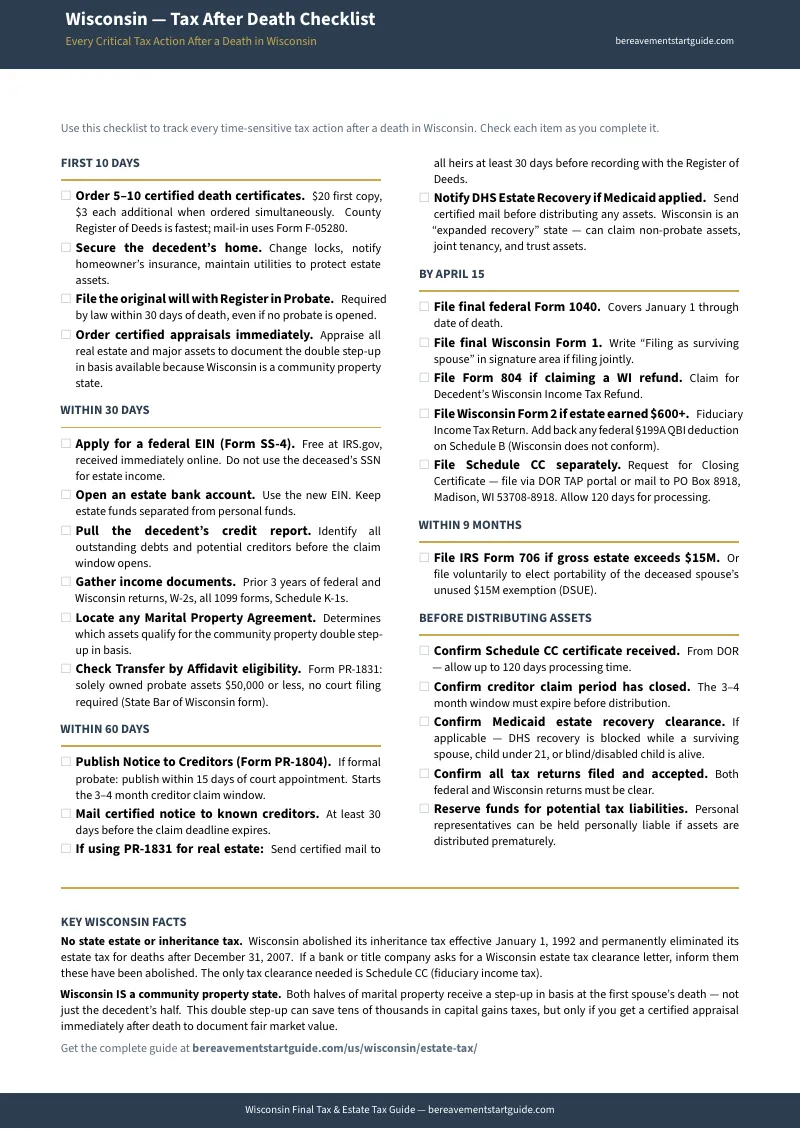
Your download includes 6 printable PDFs: the complete 14-chapter guide with 3 appendices, the standalone Wisconsin — Tax After Death Checklist across 6 timeline sections, a Key Forms Reference card listing every form with where to get it and where to file it, a Key Contacts directory of every agency you will deal with, a Community Property Classification reference showing which assets qualify for the double step-up, and a Probate Path Decision Tree that tells you which probate pathway fits your estate. Instant download, no account required.
If this guide doesn't give you a clearer path through Wisconsin's tax and estate filing requirements than anything you found for free, reply to your receipt at any time and we'll refund every cent. No forms, no questions.
Two Ways to Start
Start free: Download the Wisconsin — Tax After Death Checklist. It covers the key deadlines, the critical forms, and the most common mistakes — enough to understand which filings apply to your estate and whether you need the full guide.
Go deeper: The full Wisconsin Final Tax & Estate Tax Guide () walks you through every filing in the Fiduciary Filing Sequence — the double step-up in basis documentation, the Schedule CC 120-day timeline, the Medicaid expanded-estate defense, the Transfer by Affidavit DHS notice requirement, and the complete probate-to-closing roadmap. Fourteen chapters, three appendices, plus 4 standalone reference cards you can print and bring to meetings.