Your Spouse Died in Wisconsin. Social Security Clawed Back the Last Direct Deposit. The Pension Board Says the Death Benefit Is Half What You Expected Because Your Spouse Was "Inactive." The Health Insurance Runs Out in 30 Days. And Nobody From Any Agency Called to Tell You What You Are Owed.
You assumed the benefits would come to you. That someone at Social Security would see the death certificate and start your survivor payments. That the pension your spouse earned for twenty-three years with the county would transfer to you automatically. That the health insurance would continue while you figured things out. None of that happened. What happened is the bank reversed your spouse's last Social Security deposit because of a rule nobody explained -- the "month of death" rule, which says a person is not entitled to benefits for the month they die, even if the payment was already sitting in your account. The Department of Employee Trust Funds sent a form letter saying your spouse's WRS death benefit is limited to employee contributions only because your spouse had separated from service two years before dying. And the HR department at the old employer said you have 30 days -- not 60, because the company has fewer than 20 employees -- to elect Wisconsin State Continuation coverage or lose health insurance permanently.
Here is what makes Wisconsin survivor benefits uniquely treacherous. The state has nine separate agencies that control different pieces of what you are owed, and not one of them tells you about the others. The Department of Employee Trust Funds handles WRS pension death benefits but will not mention that you might qualify for workers' compensation death benefits through the Department of Workforce Development. The Department of Health Services administers WFCAP burial assistance but will not warn you that a life insurance policy over $3,000 disqualifies you from the program. The Department of Veterans Affairs certifies the property tax credit that covers 100% of your real estate taxes, but the credit is claimed through the Department of Revenue on your income tax return -- and neither agency directs you to the other. Meanwhile, the Department of Justice runs the Crime Victim Compensation Program with a $40,000 cap, but you have to report the crime within five days and file Form DJ-CVC-1 within one year, and no victim advocate is required to tell you either deadline. Every benefit has its own agency, its own forms, its own deadlines, and its own eligibility traps. Miss one and you lose it. There is no central office. There is no master checklist. There is no one whose job it is to make sure you get what your family is owed.
The Wisconsin Survivor Benefits Navigator is a Benefits Recovery System -- a sequential, agency-by-agency system that identifies every federal and state benefit available to Wisconsin survivors, tells you which forms to file, which deadlines will lock you out, and which eligibility traps will reduce or eliminate your payments if you do not see them first. Not legal advice. Not a collection of government links you can already find scattered across fifty different state web pages. A single, chronological action plan built around the actual statutes, the actual agency procedures, and the actual dollar amounts -- so you file the right form with the right agency in the right sequence and do not accidentally forfeit benefits because the Department of Employee Trust Funds does not talk to the Social Security Administration and neither of them talks to you.
What's Inside the Benefits Recovery System
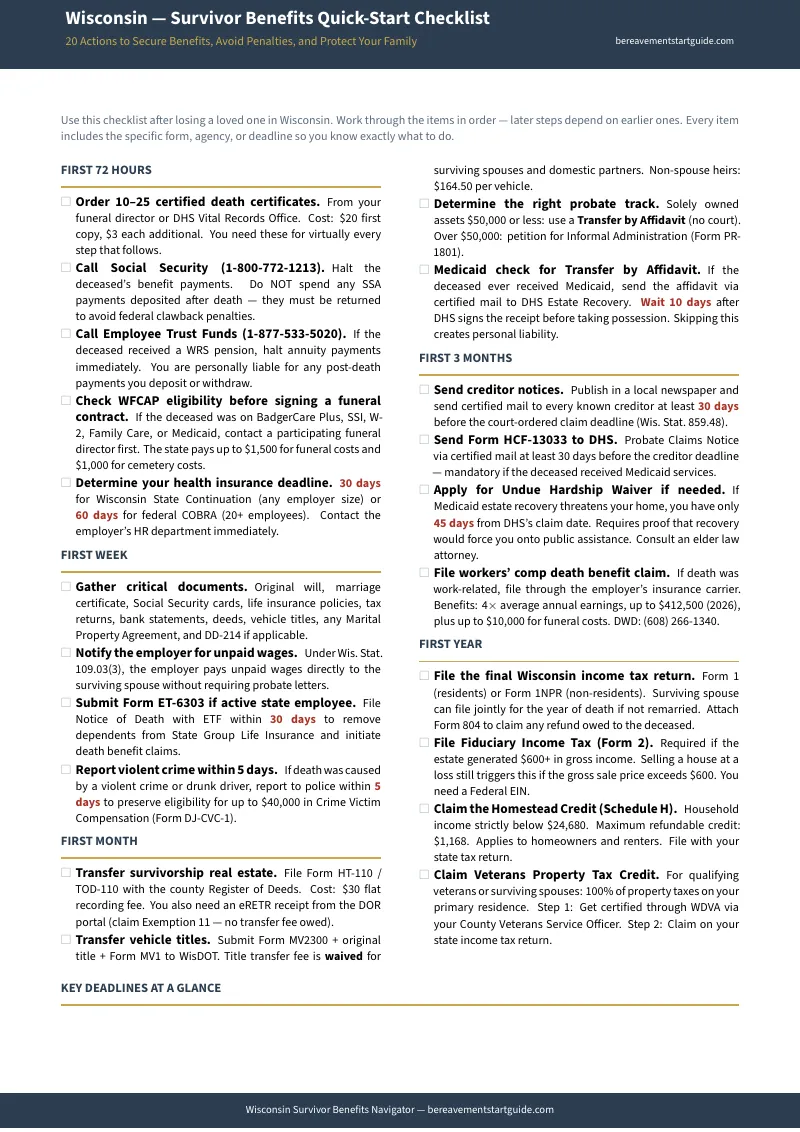
A comprehensive guide and printable Survivor Benefits Checklist -- covering every pension, insurance continuation, government program, tax credit, and financial protection available to Wisconsin survivors, organized by deadline so you act on the most time-sensitive benefits first:
The First 72 Hours: Stopping the Financial Bleeding
The critical actions that must happen before anything else. Ordering certified death certificates from Wisconsin Vital Records ($20 first copy, $3 each additional). Contacting the Social Security Administration to halt the deceased's deposits before the bank reverses them and creates an overpayment liability. Notifying the Department of Employee Trust Funds to stop WRS annuity payments -- because every uncashed check or direct deposit issued after the date of death becomes a strict legal liability if anyone touches the funds. Checking whether the estate qualifies for WFCAP funeral assistance ($1,500 funeral plus $1,000 cemetery) before signing binding contracts with a funeral director -- because WFCAP is a payer of last resort, and private payments can disqualify you. Identifying the 30-day health insurance deadline that applies if the employer had fewer than 20 employees. The guide sequences these actions so you stop the losses before you start claiming what you are owed.
Social Security Survivor Benefits: The Month-of-Death Trap and What You Are Actually Owed
Social Security does not automatically convert the deceased's benefits to survivor benefits. The funeral home reports the death to stop payments, but nobody files your claim for you. The guide covers the lump-sum death benefit ($255, payable only if you apply within two years), widow and widower benefits (available as early as age 60, or age 50 if disabled), surviving child benefits, the mother's and father's benefit for caring for a child under 16, and the month-of-death rule that catches nearly every family off guard. If your spouse dies on January 15 and a payment deposits on February 3, that payment must be returned -- it covers January, and the SSA says your spouse was not entitled to benefits for the month of death. The guide explains the rule, the timeline, the clawback process, and how to file for your own survivor benefits so the gap between the last legitimate payment and your first survivor payment is as short as possible.
WRS Pension Death Benefits: Active vs. Inactive and the Beneficiary Trap
The Wisconsin Retirement System is one of the largest fully funded public pension systems in the country, covering state agencies, universities, local governments, and school districts. But the death benefit your family receives depends entirely on one question: was the member actively employed by a WRS employer at the time of death? If yes, the minimum death benefit is the total account value -- employee and employer contributions plus interest. If the member had separated from service and died before drawing an annuity, only half the account is payable. That distinction can mean tens of thousands of dollars. For retirees already drawing an annuity, the benefit depends on which annuity option was selected at retirement -- and some options provide zero survivor benefit. The guide covers every scenario, the Form ET-2320 and ET-2321 beneficiary designation rules, and the critical warning that a former spouse remains the WRS beneficiary unless the member updated the form after the divorce. Failing to check the beneficiary designation is how families discover at the worst possible moment that the ex-spouse gets the pension.
Workers' Compensation Death Benefits: $397,800 Maximum and the $10,000 Funeral Payment
If your spouse died as the result of a workplace injury or occupational illness, Wisconsin's workers' compensation system pays a primary death benefit equal to four times the deceased worker's average annual earnings, up to a statutory maximum of $397,800 for injuries occurring after January 1, 2025. The maximum weekly rate is $1,326. In addition to the wage replacement, the carrier must pay up to $10,000 directly for funeral expenses. Minor dependents are eligible for supplemental support of up to $132.60 per week from a state-managed children's fund. If the worker had no dependents but left behind parents, the parents receive a flat $6,500 payment. The guide covers the calculation method, the claim filing process through the Department of Workforce Development, the dependency determination, and the deadline structure so you do not leave hundreds of thousands of dollars on the table because you did not know the benefit existed or assumed it was only for construction workers.
Health Insurance Continuation: Federal COBRA vs. Wisconsin State Continuation
The death of a spouse triggers an immediate health insurance crisis, and the rules in Wisconsin are more complicated than most states. Federal COBRA gives you 60 days to elect continuation and provides up to 36 months of coverage -- but it only applies to employers with 20 or more employees. If the employer had fewer than 20 employees, federal COBRA does not apply. You fall under Wisconsin's State Continuation law (Wis. Stat. 632.897), which gives you only 30 days to enroll and caps coverage at 18 months. Miss the 30-day window and your family is uninsured. Under both frameworks, you pay the full premium plus a 2% administrative fee with no employer subsidy. The guide explains which law applies to your situation, the exact enrollment deadlines, who to contact at the employer or insurance carrier, and what to do if the 30-day window is about to close and you have not received the enrollment paperwork.
Crime Victim Compensation: $40,000 Maximum and the Deadlines Nobody Tells You
If the death was caused by a violent crime or a crash caused by an intoxicated driver, the Wisconsin Department of Justice Crime Victim Compensation Program provides up to $40,000 in aggregate compensation. This covers hospital bills, mental health counseling for surviving family members, loss of financial support, crime scene cleanup (up to $1,000), and up to $2,000 for funeral services. But the deadlines are severe and almost universally missed by grieving families: the crime must be reported to law enforcement within five days, and the compensation claim (Form DJ-CVC-1) must be filed within one year. The DOJ has discretion to waive these limits, but the guide covers the filing requirements, the eligibility conditions (the victim must not have contributed to their own death), and the documentation you need so the claim does not get denied on a procedural technicality while your family is trying to survive.
WFCAP Burial Assistance: $1,500 Funeral Plus $1,000 Cemetery and the $3,000 Life Insurance Trap
The Wisconsin Funeral and Cemetery Aids Program is the state's payer of last resort for families who cannot afford funeral costs. If the decedent was enrolled in BadgerCare Plus, SSI, W-2 paid placements, or Family Care at the time of death, WFCAP reimburses up to $1,500 for funeral costs and $1,000 for cemetery expenses. But there is a trap most families walk into: any life insurance policy payout exceeding $3,000 reduces the WFCAP benefit dollar-for-dollar. A $5,000 life insurance policy does not add $5,000 on top of WFCAP -- it eliminates the WFCAP payment entirely. The guide covers the eligibility requirements, the Form F-10141 that must be filed by the funeral director (not the family), the 12-month filing deadline, and the critical rule that families cannot apply directly -- the participating funeral home or cemetery must submit the application.
Veterans and Survivor Property Tax Credit: 100% of Your Property Taxes
If your deceased spouse was a veteran with a 100% service-connected disability rating, died in the line of duty, or had a 100% disability rating based on Individual Unemployability, you may qualify for the Wisconsin Veterans and Surviving Spouses Property Tax Credit. This credit covers 100% of the real property taxes paid on your principal residence, including land up to one acre. It is a full refund, claimed through your state income tax return after obtaining certification from the Wisconsin Department of Veterans Affairs. The guide covers the eligibility requirements, the WDVA certification process, the requirement that you remain unremarried, and the critical step of contacting your County Veterans Service Officer to initiate the process -- because the Department of Revenue will not tell you the credit exists, and the WDVA will not tell you how to claim it on your taxes.
Life Insurance, Marital Property, Vehicle Transfers, and the Transfer by Affidavit
Beyond government benefits, the guide covers every other financial recovery action Wisconsin survivors face. Life insurance claims and the documentation required. Wisconsin's marital property rules under Chapter 766 and the double step-up in basis that can eliminate capital gains tax on appreciated assets. Real estate transfers using Form HT-110 at the county Register of Deeds ($30 recording fee). Vehicle transfers using Form MV2300 with the surviving spouse fee exemption (up to five vehicles with no $214.50 title fee). The Transfer by Affidavit for estates under $50,000 -- including the mandatory 10-day DHS certified mail rule that voids the entire transfer if you skip it. Medicaid Estate Recovery and the safe harbor protections that prevent DHS from seizing the family home while the surviving spouse still lives there. The creditor priority order under Wis. Stat. 859.25 that creates personal liability if you pay debts in the wrong sequence. And the tax obligations that most families never learn about until the Department of Revenue sends a notice -- including the Form 2 fiduciary income tax return triggered at $600 in gross estate income and the Homestead Credit for surviving spouses with household income below $24,680.
The Complete Deadline Master Table: Every Filing Window in One Place
From the 5-day crime reporting deadline through the 30-day health insurance enrollment window, the 60-day federal COBRA election period, the 1-year crime victim compensation filing deadline, and the ongoing tax return due dates -- every deadline consolidated into one chronological reference with the agency, the form number, the consequence of missing it, and the exact sequence so you never discover a deadline after it has passed.
Who This Guide Is For
- The surviving spouse whose income disappeared overnight -- whose partner's Social Security deposits stopped, whose WRS pension payments halted, whose employer-sponsored health insurance ends in 30 days, and who needs to know every benefit available and exactly how to claim each one before the filing windows close
- The widow or widower who was told "the pension transfers automatically" -- who called the Department of Employee Trust Funds and learned that the death benefit is half what they expected because their spouse left state employment two years ago, and who needs to understand the active-vs-inactive rules, the beneficiary designation, and whether any other options exist
- The adult child managing benefits for a surviving parent -- who is coordinating between Social Security, the WRS, the county veterans office, and the Department of Health Services from out of state, and needs a single document that maps every agency, every form, and every deadline instead of fifty separate phone trees
- The family of a worker killed on the job -- who knows workers' compensation should pay something but does not know the benefit equals four times annual earnings up to $397,800, that funeral expenses are covered separately up to $10,000, and that minor children qualify for supplemental weekly payments from a state fund
- The surviving spouse facing a Medicaid recovery claim -- who assumed the family home was protected and then received a certified letter from DHS, and needs to understand the safe harbor rules, the spousal exemption, the 50% marital property limitation, and the 45-day undue hardship waiver process before the state files a lien
- The family of a crime victim who does not know compensation exists -- who has not been told by any victim advocate that the Wisconsin DOJ provides up to $40,000 for families of homicide victims and fatal DUI crashes, and who is about to miss the 5-day reporting or 1-year filing deadline because nobody mentioned it
Why Free Resources Will Not Get You Through This
The government agencies publish their forms. The pension board has a website. The Social Security Administration has a 1-800 number. Here is what you actually encounter when you try to navigate Wisconsin survivor benefits using these free sources:
- The Department of Employee Trust Funds publishes WRS death benefit rules but says nothing about Medicaid Estate Recovery. ETF will process your pension claim. They will not tell you that claiming the pension may trigger a DHS recovery notice if the deceased ever received Medicaid. They will not tell you about the 10-day certified mail rule for Transfer by Affidavit estates. They will not tell you about the Form 2 fiduciary income tax return. Every agency operates inside its own silo, and the gaps between silos are where families lose money.
- The Social Security Administration explains survivor benefits nationally but misses every Wisconsin-specific interaction. SSA.gov will tell you about widow benefits and the lump-sum death payment. It will not tell you about Wisconsin's 30-day State Continuation health insurance deadline, the WRS pension active-vs-inactive distinction, the WFCAP $3,000 life insurance offset, or the Veterans Property Tax Credit. A Wisconsin widow needs both federal and state information sequenced together, and the SSA provides only half the picture.
- UW-Madison Extension focuses on pre-planning, not crisis navigation. The Planning AHEAD program offers excellent 7-session courses on advance directives, ethical wills, and end-of-life planning. But if someone already died and you need to know which form to file with which agency by which deadline, the program is designed for the wrong moment. It teaches you how to prepare; the guide tells you what to do when preparation time is over.
- Law firms design content to generate retainers, not to solve your problem. Wisconsin elder law and probate firms publish articles about Medicaid Estate Recovery and pension claims that deliberately leave the critical procedural steps vague -- then offer $300-per-hour consultations to answer the questions their articles raised. Their content strategy is to make you believe you cannot do this alone. The average Wisconsin probate attorney charges $5,000 to $8,000 to close an estate.
- National platforms like Nolo, Trust & Will, and Atticus lack Wisconsin-specific depth. They cover Social Security survivor benefits generically but miss the WRS pension death benefit rules, the 30-day State Continuation deadline versus the 60-day COBRA deadline, the WFCAP life insurance offset trap, the DJ-CVC-1 crime victim compensation form, and the Veterans Property Tax Credit. Follow their guidance in Wisconsin and you will miss benefits that exist only in this state.
Free resources give you nine different agency websites that do not reference each other and national guides that do not cover your state. The Benefits Recovery System puts every Social Security rule, every WRS pension scenario, every health insurance deadline, every WFCAP eligibility trap, every workers' compensation calculation, every crime victim filing window, every property tax credit, and every Medicaid defense into one document, in the order you actually need them -- with the exact form numbers, the exact dollar amounts, the exact statutory deadlines, and the exact agency contact information so you claim every benefit your family is owed instead of the ones you happened to find on your own.
-- Less Than 15 Minutes With a Wisconsin Attorney
A single consultation with a Wisconsin elder law attorney costs $250 to $400 per hour. A CPA session to handle the Form 2 fiduciary income tax return runs $200 or more. Missing the 30-day Wisconsin State Continuation enrollment window means your family loses health insurance entirely. Failing to report a violent crime within five days forfeits up to $40,000 in victim compensation. Not knowing the WRS active-vs-inactive distinction can cost your family half the pension death benefit. Presenting a Transfer by Affidavit before the 10-day DHS waiting period expires voids the entire transfer. This guide costs less than a single brief phone call with a professional and gives you the complete Wisconsin survivor benefits roadmap -- every agency, every form, every deadline, every eligibility trap, and the filing sequence that ensures you claim everything you are owed.
Your download includes the complete guide, the printable Wisconsin -- Survivor Benefits Checklist, and the deadline master table covering every filing window from the first 72 hours through the first year. Instant download, no account required.
Money-back guarantee, no time limit. If the guide does not give you clarity on which benefits apply to your situation, confidence in filing the correct forms with the correct agencies, and a clear timeline of every deadline from the first week through the first year, email us for a full refund. No questions asked.
Not ready for the full guide? Download the free Wisconsin -- Survivor Benefits Checklist -- a printable action list covering the most time-sensitive benefits, forms, and deadlines. Enough to make sure you do not miss the filing windows that close first while you decide whether you need the full system.
You did not choose this. But the benefits exist, the deadlines are real, and the agencies are not going to call you. The guide puts every benefit, every form, every deadline, and every eligibility rule in one place so you can focus on your family instead of trying to piece together a survival plan from nine different government websites that were never designed to talk to each other.