Someone You Love Just Died in Wyoming. The Bank Froze Their Accounts. The Funeral Director Wants a Number for Death Certificates. And You Just Found Out the Ranch Has Mineral Rights Nobody Mentioned.
You are standing in a place nobody prepared you for. Maybe you were named executor in a will you barely remember reading, and now the funeral home needs you to sign forms you have never seen. Maybe there was no will at all, and because you are the eldest child or the surviving spouse, everyone is looking at you for answers you do not have. Maybe the bank just told you the checking account is frozen and you cannot access a single dollar to pay the electric bill, the mortgage, or the funeral deposit — and the person who would have known what to do is the one who just died.
You are grieving and sleep-deprived, but the paperwork does not wait. The funeral director needs a number for death certificates by tomorrow. The Social Security Administration will claw back any benefits deposited for the month of death if you do not act. Siblings are already asking about the house. A mineral royalty statement arrived in the mail and you do not know what it means. And somewhere in the back of your mind, a terrifying question keeps circling: if I pay the wrong bill, or sign the wrong form, or miss a deadline I do not even know about — am I personally liable?
The short answer: you are not personally responsible for the deceased's debts. But the long answer — the one that involves Wyoming's 30-day mandatory waiting period for small estate filings, a 3-month creditor claim window, an estate threshold that just jumped from $200,000 to $400,000 in July 2025, a new MV-308 vehicle transfer-on-death form, mineral rights that count as real property and require a broker's price opinion to value, and a Medicaid estate recovery program that places TEFRA pre-death liens on homes — that answer is what separates families who settle an estate in months from families who spend years and thousands of dollars untangling mistakes they did not know they were making.
The When Someone Dies in Wyoming — Estate Settlement Guide is a County-by-County Settlement System for every legal, financial, and administrative step between the funeral home and final distribution. Not a law textbook. Not a generic checklist from a national website that does not know Wyoming from Wisconsin. A structured, Wyoming-specific manual that separates what must be done in the first 48 hours from what can legally wait three months — so you stop guessing, stop panicking, and start working through this in the right order.
What's Inside the County-by-County Settlement System
A 20-chapter guide, the First 48 Hours Checklist, and a Quick Reference appendix — covering every stage from the moment of death through final asset distribution, built specifically for Wyoming statutes, district courts, and the state-specific rules that make settling an estate here different from any other state:
The First 48 Hours: Death Certificates and Immediate Actions
The funeral director is going to ask you how many certified death certificates to order, and most families guess wrong. You need originals — not photocopies — for every bank, every insurance company, the district court, the County Clerk for vehicle transfers, every county where the deceased owned property or mineral rights, and the IRS. The guide gives you the exact calculation based on the deceased's assets. The first certified copy costs $25 from Wyoming Vital Statistics Services, each additional copy costs $20 when ordered at the same time, and coming back later for more means weeks of delay. Order the right number now, or pay for it in delays later. This chapter also covers the 3-day death certificate filing deadline (W.S. 35-1-418), what to do if the deceased operated a ranch or farm that needs immediate management, and the single most important rule in this entire guide: do not pay any of the deceased's debts with your own money.
Securing the Estate and Setting Family Expectations
Before any legal authority is established, you have a duty to prevent assets from being lost, stolen, or damaged. This chapter covers locking the home, securing vehicles and valuables, photographing every room, checking homeowner's insurance for vacancy clauses, rerouting mail (your best tool for discovering unknown accounts, mineral royalty statements, and debts), stopping recurring payments, and the family meeting where you set the single most important expectation: no one takes anything from the house until the legal process is complete. For families with agricultural operations — ranches, farms, livestock — this chapter addresses the emergency management steps that cannot wait for probate.
Probate vs. Non-Probate Assets: Understanding What You Are Working With
Not everything the deceased owned goes through the court. Joint bank accounts with right of survivorship stay open. Payable-on-Death accounts transfer directly to the named beneficiary with just a death certificate. Life insurance and retirement accounts with named beneficiaries bypass probate entirely. Transfer-on-Death deeds for real estate bypass probate if they were properly filed before the death. The guide maps every asset type, what controls its transfer, and which ones require court involvement — so you stop worrying about assets that already have a clear legal path.
Wyoming's Three Legal Pathways — The Decision That Changes Everything
This is the chapter that saves families the most money and time. Wyoming offers three entirely different paths for settling an estate, and choosing the wrong one — or defaulting to formal probate when you did not need to — can cost thousands of dollars and months of delay. The guide includes a decision tree that walks you through the exact criteria:
- Affidavit of Distribution — for estates with personal property only, valued under $400,000. No court hearing required. You file a sworn affidavit after the mandatory 30-day waiting period and collect the assets directly.
- Summary Distribution — for estates that include real property or mineral rights, valued under $400,000. Requires a District Court filing ($160), a sworn broker's price opinion for real estate and mineral interests, and newspaper publication — but no full probate administration.
- Formal Probate — for estates over $400,000, contested matters, or situations where the simplified paths do not apply. Full court supervision with a 3-month creditor claim window.
The $400,000 threshold is new — it was $200,000 before July 2025. Most national websites and even some Wyoming attorney blogs still reference the old limit. If the estate falls between $200,000 and $400,000, the guide's decision tree may save your family thousands in legal fees by showing you qualify for the simplified path.
Vehicle Transfers: The New MV-308 Form
Wyoming introduced the MV-308 "Automatic Transfer of a Vehicle Title Upon Death" form effective July 1, 2025 — and most free resources do not mention it yet. If a Transfer-on-Death designation was recorded on the title, the beneficiary presents the death certificate and pays a $12 fee to the County Clerk for a new title. No probate. No affidavit. If no TOD exists, the vehicle transfers through the small estate affidavit process or formal probate. The guide covers both paths, the joint title nuance ("AND" means the deceased's share goes to the estate, "OR" means automatic survivorship), and what to do when the name on the death certificate does not match the name on the title.
Real Estate Transfers: TOD Deeds, Affidavits of Survivorship, and Summary Distribution
Real estate is typically the largest and most complex asset in a Wyoming estate. The guide breaks down the three mechanisms: Transfer-on-Death deeds (W.S. 2-18-103) that bypass probate if filed before death, Affidavits of Survivorship for jointly held property, and Summary Distribution for solely owned property in estates under $400,000. Each path has its own forms, fees, and filing requirements — and the guide covers all of them with step-by-step instructions specific to Wyoming district courts.
Mineral Rights — Wyoming's Unique Challenge
This is the chapter that does not exist in any other state's estate guide. Wyoming mineral rights are classified as real property. They count toward the $400,000 small estate threshold. They cannot be transferred with a personal property affidavit — even if the rest of the estate is simple. Valuing them requires a formal broker's price opinion. Severance and production tax liens held by the County Treasurer survive death and transfer to heirs. If the deceased owned separated mineral rights — surface rights in one name, mineral rights split off decades ago — the estate may need to navigate multiple transfers across multiple counties. The guide explains exactly how mineral rights factor into pathway selection, valuation, and transfer.
Medicaid Estate Recovery: TEFRA Liens, Exemptions, and the Ranch Protection
If the deceased received Medicaid benefits after age 55, the Wyoming Department of Health will seek to recover those costs from the estate. The recovery can reach into jointly held property, life estates, and living trusts — not just probate assets. The guide covers TEFRA pre-death liens, the requirement that homes be sold for at least 80% of fair market value, and the specific delays and exemptions available under Wyoming law: recovery is blocked if a surviving spouse is alive, if a child under 21, blind, or disabled survives, if a sibling with equity interest lived in the home for at least one year, or if a child provided in-home care for at least two years before institutionalization. The hardship waiver — designed specifically to protect working Wyoming farms and ranches that provide the sole source of income for heirs — is explained in detail.
Banking, Insurance, Retirement Accounts, Taxes, and Everything Else
The remaining chapters cover closing bank accounts (including which accounts stay accessible without probate), filing life insurance and retirement account claims, Wyoming's tax obligations (no state estate or inheritance tax, but federal and fiduciary income returns may apply), intestate succession when there is no will, navigating the District Court vs. County Clerk filing distinction, when you actually need an attorney, a complete timeline from Day 1 through Month 12, and a master checklist covering every step in the process.
Who This Guide Is For
- The surviving spouse whose partner just died and whose bank accounts were frozen this morning — who needs to know which accounts stay accessible, which ones require court paperwork, and how to claim the statutory protections that Wyoming law guarantees before any creditor gets paid
- The adult child named as executor who lives in another state, has never been through probate, and is terrified of making a mistake that triggers personal liability — who needs the complete sequence of fiduciary duties, court deadlines, and filing requirements in one document they can work through remotely
- The family with no will who just learned that Wyoming's intestate succession laws will decide everything — who needs to understand exactly who inherits what, whether the house or mineral rights must go through probate, and whether the simplified paths apply to their situation
- The family dealing with mineral rights who just discovered the deceased owned separated mineral interests across multiple Wyoming counties — who needs to understand that mineral rights are real property, they count toward the $400,000 threshold, they require a broker's price opinion, and they cannot be transferred with a personal property affidavit
- The family facing Medicaid recovery who received a letter from the Wyoming Department of Health demanding reimbursement for nursing home costs — who needs to understand TEFRA liens, the assets that are and are not subject to recovery, and whether the hardship waiver protects their family's ranch
- The executor facing creditor letters from companies they have never heard of — who needs to know that the estate pays the debts (not the family), that W.S. 2-7-701 establishes a strict priority order for payment, and that the 3-month creditor window exists specifically to protect them from paying debts prematurely
Why Free Resources Will Not Get You Through This
The information exists. It is scattered across the Wyoming Judicial Branch website, county district court filing pages, the Wyoming Department of Health, the Department of Transportation, and a dozen federal agency portals that do not talk to each other. Here is what you actually encounter when you try to settle an estate using free sources alone:
- The Wyoming Judicial Branch provides forms with no instructions. The probate forms (PPP-02, PPP-04, PRP-02, PRP-04) are available for download. The website explicitly states that court clerks "cannot provide legal advice." You get blank PDFs and a suggestion to hire an attorney. If you are dealing with a $250,000 estate and the attorney quotes $2,500, the math does not work — but the court offers no alternative path.
- National legal sites are dangerously outdated. Nolo, FindLaw, and EstateExec still reference Wyoming's old $200,000 small estate threshold. They do not mention the MV-308 vehicle TOD form introduced in July 2025. They do not address mineral rights valuation. Their Wyoming pages are thin adaptations of generic national content — accurate enough to sound helpful, inaccurate enough to cost you money.
- Wyoming attorney blogs highlight complexity to justify retainer fees. Local probate attorney sites are accurate and detailed — and they are explicitly designed to convince you the process is so dangerous you need to spend $2,500 on representation. For contested estates, that is true. For the majority of straightforward estates under $400,000, the answer costs a fraction of what an attorney charges.
- Funeral homes give you surface-level advice designed to sell services. Bereavement packets tell you to order death certificates and notify Social Security. They do not explain the three legal pathways, the mineral rights complication, the Medicaid recovery program, or the creditor priority hierarchy. Their advice ends where the hard questions begin.
- Nobody connects the pieces. The court handles forms. The DOT handles vehicles. The Department of Health handles Medicaid. Vital Statistics handles death certificates. The County Treasurer handles mineral tax liens. No single free resource sequences all of these into a coherent timeline — which is exactly where families make expensive mistakes.
Free resources give you fragments from a dozen different sources that do not reference each other. The County-by-County Settlement System puts every Wyoming-specific statute, form, deadline, and procedure into one document, in the order you actually need them.
— Less Than Thirty Minutes With a Wyoming Probate Attorney
A single consultation with a Wyoming estate attorney costs $150 to $300 per hour. Standard probate representation runs $2,500 or more. National estate software platforms charge $149 per year in recurring subscription fees. This guide costs less than thirty minutes of professional legal time and gives you the complete Wyoming-specific roadmap — every statute, every deadline, every form, every fee, and the decision tree that tells you whether you even need an attorney at all.
Your download includes the complete 20-chapter guide with a Quick Reference appendix (key forms and resources), the standalone Wyoming First 48 Hours Checklist, and eight printable reference sheets: the Three-Pathway Decision Tree, Vehicle Title Transfer Walkthrough (MV-308 and non-TOD paths), District Court Filing Reference (fees and contacts), Mineral Rights Valuation Worksheet, Statutory Deadline Calendar (every deadline with space for your dates), Creditor Priority Reference (W.S. 2-7-701 hierarchy), Account-Closing Checklist, and Government Notification Tracker (SSA, VA, IRS, Medicaid). Ten PDFs total — instant download, no account required.
Money-back guarantee, no time limit. If the guide does not give you clarity on what to do next and confidence that you are doing it in the right order, email us for a full refund. No questions asked.
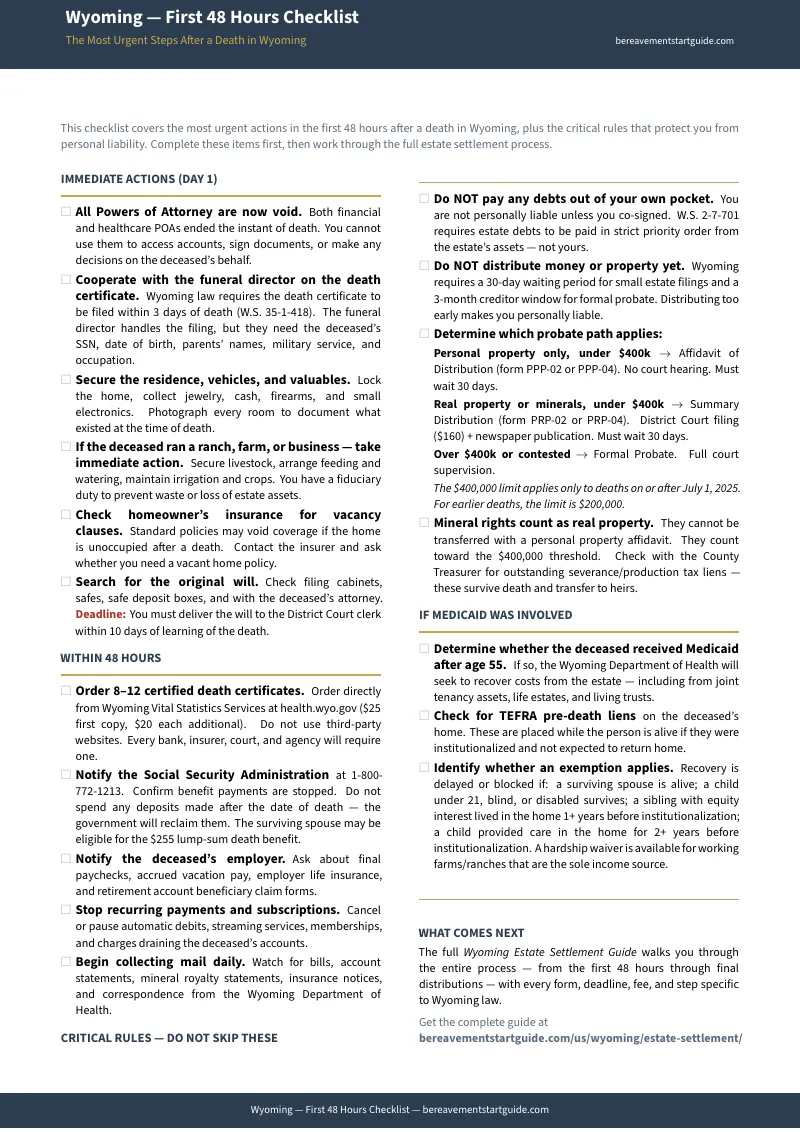
Not ready for the full guide? Download the free Wyoming First 48 Hours Checklist — 18 items covering everything that must happen in the first two days after a death in Wyoming: death certificates, securing the home, ranch and farm emergency management, notifying Social Security, what not to pay, and what to gather. It is enough to get through tonight and tomorrow.
You did not ask for this job. But you can do it. The guide shows you how, one step at a time.