You Were Just Named Executor of a Wyoming Estate. The Bank Froze the Accounts Until You Produce "Letters Testamentary." The Estate Might Qualify for a Summary Distribution That Skips Formal Court. And the Threshold Doubled to $400,000 in July 2025 — But Most Online Resources Still Quote the Old Number.
You did not plan for this. Someone in your family died, and now you are the one the courthouse, the bank, and the insurance company are all waiting on. Maybe you were named in the will. Maybe there is no will, and you are the surviving spouse or the eldest child in the county. Either way, the funeral barely ended and the system already started — the checking account is frozen, the life insurance company wants a court order, and somebody mentioned something about mineral rights you did not know existed underneath the ranch.
Welcome to Wyoming probate. Not one process, but three separate procedural tracks — the Affidavit of Distribution for personal property, Summary Distribution for estates with real estate, and Formal Probate for everything above the line — where the path you choose in the first two weeks determines whether you spend four weeks or fourteen months settling the estate. The District Court has self-help forms on wyocourts.gov, but the Clerk's office is legally prohibited from telling you which forms to use, in what order, or what happens when you file the wrong one. Local probate attorneys charge by statutory formula: 10% of the first $1,000, 5% of the next $4,000, 3% of the next $15,000, and 2% of everything above $20,000. On a $500,000 estate, that is $10,450 in attorney fees alone — before filing costs, publication, appraisals, and bonds.
The Wyoming Probate Process Guide is a Threshold Navigation System for every procedural step between the death certificate and the final discharge. Not a law textbook. Not a generic probate overview that treats Wyoming like every other state. A structured, Wyoming-specific manual built around the July 2025 SF0104 legislation that doubled the simplified estate threshold to $400,000 — covering the exact forms, the exact deadlines, the exact court fees, and the exact decision points that determine whether this estate goes through formal probate or bypasses it entirely.
What's Inside the Threshold Navigation System
A comprehensive 11-chapter guide, a Quick-Start Probate Checklist, and 7 standalone printable worksheets (9 PDFs total) — covering every stage from ordering death certificates through filing the Petition for Final Discharge, built specifically for Wyoming's three-track probate system, the new $400,000 threshold, and the state-specific complications that make probate here different from any other state:
Three Paths, One Decision: Understanding Wyoming's Probate Tracks
Before you file a single form, you need to know which track applies. Wyoming does not have "informal" versus "formal" probate the way Uniform Probate Code states do. Instead, it operates three distinct procedural paths based on what the estate contains and how much it is worth. The Affidavit of Distribution handles personal property under $400,000 — you fill out a notarized form and present it to the bank. Summary Distribution handles estates with real property under $400,000 — you petition the District Court, publish a newspaper notice, and receive a judicial decree. Formal Probate handles everything else. The guide explains which track applies to your estate, the forms required for each, and the consequences of choosing the wrong one.
The $400,000 Threshold: What Changed and What It Means for You
Senate File 0104, effective July 1, 2025, doubled the simplified estate administration threshold from $200,000 to $400,000. This single legislative change moved thousands of Wyoming estates out of expensive formal probate and into the do-it-yourself tracks. But the internet has not caught up — law firm websites, county clerk pages, and national platforms still cite the old number. The guide is built entirely around the current $400,000 law, including the critical distinction between personal property affidavits and real property summary distributions, and the valuation rules that determine which side of the threshold your estate falls on.
Mineral Rights: The Hidden Asset That Changes Everything
Wyoming's split estate doctrine means surface rights and subsurface mineral rights are separate property interests — and both must be included in the estate's gross valuation. A family ranch that looks like a straightforward $300,000 surface property can breach the $400,000 threshold when dormant oil, gas, or coal bed methane rights are added to the calculation. The guide covers how to discover whether the decedent owned mineral interests, how to trace diluted interests through generations of heirs, how to value producing versus non-producing minerals, and the consequences under the Wyoming Royalty Payment Act if you fail to properly transfer mineral title through probate.
The Affidavit Path: Personal Property Under $400,000
The fastest route through Wyoming probate. After a mandatory 30-day waiting period from the date of death, you execute a notarized Affidavit of Distribution using Forms PPP 01 through PPP 04 from the Wyoming Courts self-help portal. The guide walks through every line of these forms — which version to use for testate versus intestate estates, the required attachments, the County Clerk recording fees ($12 first page, $3 each additional), and the exact language banks and transfer agents expect to see before releasing funds.
Summary Distribution: Real Property Under $400,000
When the estate includes land, a house, or mineral interests but the total value stays below $400,000, you petition the District Court for a Decree of Summary Distribution under W.S. 2-1-205. This requires a $160 court filing fee, a sworn broker's price opinion or professional appraisal, publication of a newspaper notice once per week for two consecutive weeks, and mailing actual notice to the surviving spouse, heirs, creditors, and the Wyoming Department of Health. The guide provides the complete sequence, the objection period timeline, and the recording process with the County Clerk after the decree is issued.
Formal Probate: When You Cannot Avoid the Courthouse
For estates exceeding $400,000, contested wills, or situations requiring supervised administration, the guide covers the full formal probate process — filing the Petition for Probate within 30 days, taking the oath of office, posting a surety bond (unless waived), publishing notice for three consecutive weeks, managing the mandatory 3-month creditor claim period, filing the inventory within 120 days, preparing the final accounting, and petitioning for distribution and discharge. Every step includes the specific Wyoming statute, the form or document required, and the fee involved.
Creditor Claims and the Priority That Protects You
Wyoming law imposes a strict hierarchy for paying estate debts. Funeral expenses come first. Administrative costs come second. Federal debts, then state debts, then medical expenses, then everything else. The guide details the complete creditor priority order, the 3-month claim period timeline, and the personal liability exposure if you distribute assets to heirs before the creditor window closes or pay debts out of the statutory order.
Medicaid Estate Recovery: What the State Can Actually Take
If the decedent was 55 or older and received Medicaid-funded long-term care, the Wyoming Department of Health will file a claim against the estate. Wyoming operates an "expanded recovery" program — meaning the state can pursue not just formal probate assets but also joint tenancy property, revocable trusts, TOD deeds, and POD accounts. The guide explains when recovery is prohibited (surviving spouse in the home, minor children under 21, blind or disabled dependents), the TEFRA pre-death lien rules, the 80% fair market value restriction on forced sales, and the exact notification requirements for the Estate Recovery Program.
Ancillary Probate for Out-of-State Executors
Wyoming has significant nonresident property ownership — vacation homes, hunting cabins, and inherited mineral leases. If the decedent lived in another state but owned property in Wyoming, you may need ancillary probate under W.S. 2-11-201. But here is the shortcut most attorneys will not mention: if the Wyoming property is valued under $400,000 and the estate has already been probated in the home state, the Wyoming judge can dispense with local probate entirely. You file a petition with certified copies of the home state's decree of distribution. The guide walks through this specific process step by step.
Transfer on Death Deeds: Avoiding Probate for Future Generations
Wyoming adopted the Transfer on Death deed in 2013, allowing property owners to designate a beneficiary who automatically receives title upon death without going through court. The guide covers the TOD deed requirements, limitations (it applies to real property, not personal property — vehicles have a separate TOD title process), and the execution and recording requirements with the County Clerk. For executors settling the current estate who want to prevent the next generation from going through this process again.
Water Rights: The Asset Nobody Remembers Until It Is Too Late
Wyoming operates a prior appropriation water rights system administered by the State Engineer's Office. If the decedent owned ranch or agricultural land, water rights — including groundwater well permits, reservoir permits, and irrigation ditch shares — must be transferred through probate. The guide covers how to verify water right holdings, the State Engineer's transfer process, and the title defects that develop when water rights are left in a deceased person's name.
Who This Guide Is For
- The executor who just got turned away at the bank trying to access the deceased's checking account — who needs to know whether an Affidavit of Distribution is enough or whether the estate requires formal Letters Testamentary from the District Court
- The surviving spouse of a rancher who assumed the property transferred automatically — who just discovered that severed mineral rights are separate real property interests that must go through probate, and that an undisclosed gas lease could push the estate over the $400,000 threshold
- The out-of-state adult child named personal representative from Colorado, Montana, or Idaho — who needs to manage Wyoming ancillary probate for a vacation cabin or inherited mineral interest without hiring a second attorney
- The family terrified of Medicaid recovery because the decedent spent years in a nursing home on Medicaid — who needs to know the actual exemptions, the forced-sale protections, and whether the family home is genuinely at risk
- The executor reading outdated websites that still say the small estate threshold is $200,000 — who needs confirmation that SF0104 doubled it to $400,000 in July 2025 and guidance on which simplified track applies
- The rural family managing a multi-generational ranch where surface rights, mineral rights, water rights, and grazing leases all belong to different entities — who needs a systematic approach to inventorying, valuing, and transferring every asset class through the correct legal channel
Why Free Resources Will Not Get You Through This
The information exists. It is scattered across the Wyoming Courts self-help portal, twenty-three county clerk offices, the Department of Health's Estate Recovery Program, the State Engineer's Office, the Wyoming Royalty Payment Act, and half a dozen federal agency websites. Here is what you encounter when you try to navigate Wyoming probate using free sources alone:
- The Wyoming Courts self-help portal provides Forms PPP 01 through PPP 05 — with no instructions on which one to use. The forms are downloadable PDFs organized by type (testate, intestate, small estate), but the court is legally prohibited from telling you which form matches your situation, what to write in each blank, or what order to file them. You get the bricks without the blueprint.
- Local attorney websites explain the law accurately — then stop before the actionable steps. Wyoming probate law firms publish clear, empathetic explanations of the Affidavit of Distribution and Summary Distribution procedures. But the final paragraph always redirects to "contact our office for a consultation." The information that would let you complete the process yourself is exactly the information they withhold.
- National platforms miss everything that makes Wyoming different. Nolo, Trust & Will, and FindLaw produce polished state overviews that consistently fail to address split estate mineral rights, the Wyoming Royalty Payment Act, the expanded Medicaid estate recovery program, the ancillary probate shortcut for nonresidents, water rights transfers, and the July 2025 threshold change. Wyoming is a footnote in their fifty-state databases, and the footnote is usually wrong.
- Most online resources still cite the $200,000 threshold. SF0104 took effect in July 2025, but the internet updates slowly. Families reading cached law firm blog posts, old county clerk guides, or undated national articles are making decisions — including paying thousands for formal probate — based on a number that no longer applies.
Free resources give you fragments from a dozen sources that do not talk to each other. The Threshold Navigation System puts every Wyoming-specific statute, form, deadline, and procedure into one document, in the order you actually need them — built entirely on the current $400,000 law.
— Less Than Fifteen Minutes of a Wyoming Probate Attorney's Time
Wyoming's statutory fee schedule means probate attorneys do not negotiate their rates — the fees are set by law. On a $400,000 estate, the attorney's statutory fee is $7,950. On a $500,000 estate, it is $10,450. That is before the $160 filing fee, the newspaper publication costs, the appraisal fees, and the surety bond premium. National estate settlement platforms charge $149 to $199 per estate in annual subscriptions. This guide costs less than the first fifteen minutes of professional legal time and gives you the complete Wyoming-specific roadmap — all three procedural tracks, every required form, every deadline, the SF0104 compliance updates, and the decision trees that tell you whether you even need the courthouse at all.
Your download includes the complete 11-chapter guide, the Wyoming Probate Quick-Start Checklist, and 7 standalone printable worksheets — a threshold decision flowchart, an estate securing checklist, a creditor priority worksheet, a mineral rights discovery checklist, a Medicaid recovery protection checklist, a forms reference card, and a key deadlines reference card. Nine PDFs total, covering the Affidavit of Distribution track, the Summary Distribution track, and the full Formal Probate process, plus Wyoming-specific walkthroughs for mineral rights valuation, Medicaid estate recovery, ancillary probate for nonresidents, water rights transfers, and Transfer on Death deeds. Everything you need to determine your procedural track, execute it correctly, and close the estate. Instant download, no account required.
Money-back guarantee, no time limit. If the guide does not give you clarity on which of Wyoming's three procedural tracks applies to your estate and confidence that you are filing the right forms in the right order, email us for a full refund. No questions asked.
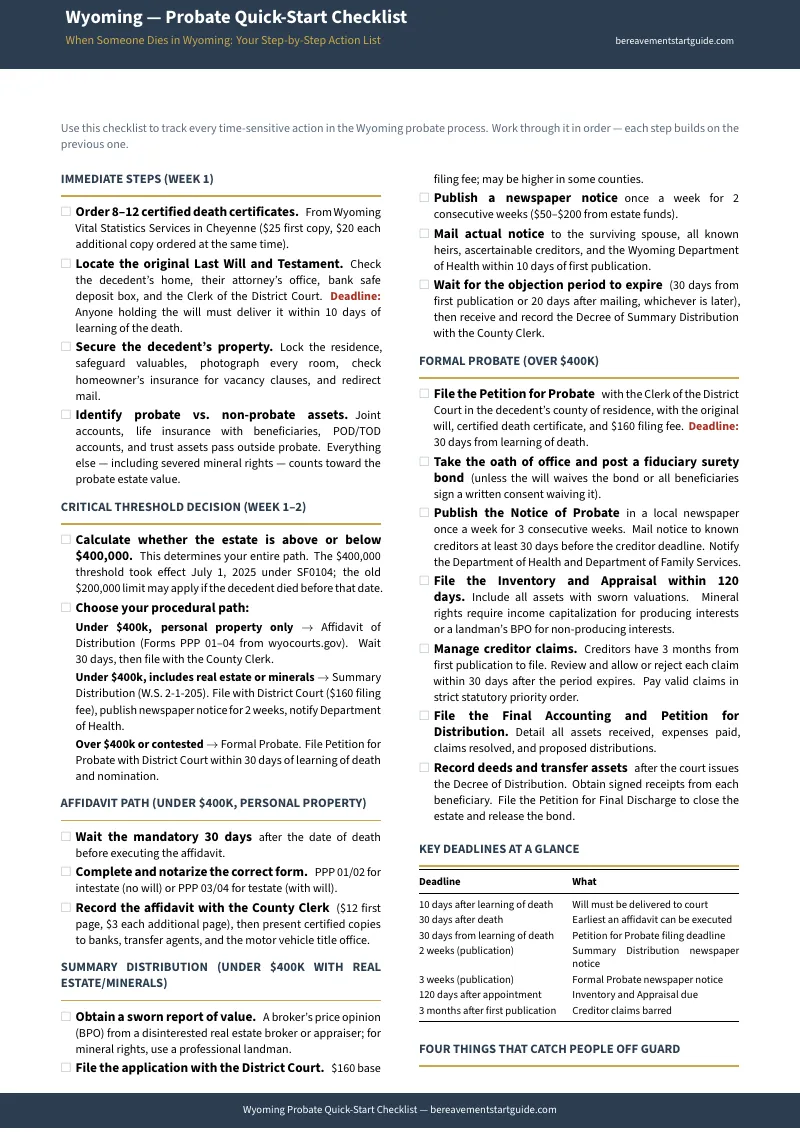
Not ready for the full guide? Download the free Wyoming Probate Quick-Start Checklist — a printable action list covering death certificates, securing the estate, the $400,000 threshold decision, and the critical deadlines for the first 30 days. Enough to get started tonight.
You did not ask for this responsibility. But Wyoming's probate system is knowable, the forms are finite, and the deadlines are clear. The guide shows you the path through it, one step at a time.