Your Spouse Died in Wyoming. Social Security Wants to Claw Back This Month's Deposit. The Pension Office Says the Payout Depends on a Form You Have Never Seen. And Nobody Told You About the Property Tax Exemption That Expires in May.
You are trying to survive the worst week of your life, and every agency you call gives you a different set of instructions that contradicts the last one. Social Security says to call back later. The Wyoming Retirement System says your spouse chose a payout option at retirement and they cannot change it — but they will not tell you what that option was until you prove you are the beneficiary. Workers' Compensation says you have one year from the date of death to file or the claim is gone forever. The County Assessor says the property tax exemption application is due by the fourth Monday in May. The Department of Health sent a letter about Medicaid recovery and you do not know what a TEFRA lien is.
Here is what makes Wyoming different from every other state: no single agency communicates with the others. The funeral director handles the death certificate and notifies Social Security — that is where their job ends. The Retirement System does not tell you about Workers' Compensation. Workers' Compensation does not tell you about the Veterans Property Tax Exemption. The County Assessor does not tell you about the Medicaid hardship waiver that could protect your ranch. And the court clerk is legally prohibited from helping you fill out any of the forms you need to file.
Every one of these benefits exists. Every one of them requires a separate application to a separate agency with a separate deadline. Miss one, and the money is gone permanently. The question is not whether you are entitled to these benefits — it is whether you will discover all of them before the deadlines pass.
The Wyoming Survivor Benefits Navigator is a Benefit Sequencing System — a single document that coordinates every federal, state, and county benefit available to Wyoming survivors into one chronological timeline. Not a list of agencies. Not a generic pamphlet from a funeral home. A structured, deadline-driven roadmap that tells you which benefit to claim first, which forms to file, which agency handles each claim, and exactly when each window closes — so you stop guessing, stop missing deadlines, and start collecting everything your family is owed.
What's Inside the Benefit Sequencing System
A comprehensive guide, the Survivor Benefits Checklist, and standalone reference sheets — covering every benefit stream from the day of death through long-term property protection, built specifically for Wyoming statutes and the agencies that administer them:
The First 10 Days: Immediate Benefits and Critical Notifications
The funeral director files Form SSA-721 with Social Security — but that only stops the deposits. It does not start your survivor benefits. You need to contact the SSA separately to apply for the $255 Lump-Sum Death Payment (Form SSA-8) and monthly survivor benefits (Form SSA-10-BK). If your spouse was receiving WRS pension payments, you must notify the Retirement System immediately — they will recover any electronic deposits made after the date of death, and if you close the bank account before they pull the funds back, you create a debt against yourself. This chapter sequences every notification in the order that protects you from overpayment clawbacks and starts the benefit application clock as early as possible.
Workers' Compensation Death Benefits
If your spouse died from a workplace injury or occupational disease, Wyoming provides up to $5,000 for funeral expenses, an additional $5,000 for related costs, and monthly survivor payments calculated at 80% of the state average wage — potentially $3,436 per month for up to 100 months. But you must file a formal claim with the Department of Workforce Services. The statute of limitations is one year. The guide covers the filing process, the PIERS tracking portal, the child dependency supplements ($150/month per child, adjusted for inflation), and what happens to benefits if you remarry.
Wyoming Retirement System Pension Benefits
The WRS rules are more complex than any other benefit covered in this guide. If your spouse died before retirement, your options depend entirely on whether you are the sole designated beneficiary (you can elect a monthly annuity or a lump sum) or one of multiple beneficiaries (forced into a lump-sum liquidation — no annuity option). If your spouse died after retirement, the survivor benefit is locked to the payout option they selected at retirement. Some options include a "pop-up" provision that adjusts the benefit if circumstances change. For public safety employees (law enforcement, paid firefighters, wardens), the benefit defaults to the spouse regardless of beneficiary designations. The guide explains every scenario, every plan tier, and the self-funded COLA options that may already be built into your survivor payments.
Veterans Benefits and the Property Tax Exemption
If your spouse served in the military, you may be eligible for Dependency and Indemnity Compensation (DIC), Survivors Pension, and burial benefits through the VA. Separately, Wyoming doubled its Veterans Property Tax Exemption to $6,000 in assessed value effective 2025 — and this applies to unremarried surviving spouses. If you do not own property, you can apply the exemption to vehicle registration fees instead. The catch: you must file with the County Assessor by the fourth Monday in May every year, with the DD214 and a notarized affidavit. Miss the deadline and you pay full taxes for that year. The guide includes both the federal VA application process (Forms 21P-534EZ and 21P-530EZ) and the state property tax exemption workflow.
Crime Victim Compensation
If the death resulted from a violent crime, the Wyoming Crime Victim Compensation Program provides up to $15,000 — covering funeral costs (up to $7,000), lost income support, and mental health counseling for family members ($85/hour, up to $12,000). The application must be filed within one year of the death through the Division of Victim Services. The guide covers eligibility, the cooperation requirements, and how to coordinate with local Victim/Witness Programs to strengthen your claim.
Medicaid Estate Recovery: Defending Your Home
If your spouse received Medicaid after age 55, the Department of Health will seek to recover those costs from the estate — including jointly held property, life estates, and revocable trusts created after August 2014. The guide covers TEFRA liens, the exemptions that block recovery (surviving spouse in the home, child under 21 or disabled, sibling with equity interest, caregiver child), and the agricultural hardship waiver designed to protect working Wyoming farms and ranches. This waiver requires documented proof that the property is the sole source of income and shelter — the guide explains exactly what evidence to assemble.
Property Tax Relief, Health Insurance Continuation, and Indigent Burial
The remaining chapters cover every other benefit stream: the Long-Term Homeowners Exemption (50% reduction for residents 65+ with 25 years of Wyoming property tax history), the 25% Homeowners Exemption, the needs-based Property Tax Refund Program, transitioning children to KidCare CHIP, the DFS burial assistance program ($1,000 for Medicaid/SSI/POWER recipients), the County Indigent Burial Program ($1,500), and veteran-specific burial provisions ($1,500 plus $500 transport). Every program includes the eligibility criteria, the forms required, and the filing deadline.
Who This Guide Is For
- The surviving spouse whose income just disappeared — whose partner's pension check stopped, whose joint accounts may be frozen, and who needs to know which benefits replace that income, in what order, and how quickly they can arrive
- The family of a public employee — who knows the deceased was in the Wyoming Retirement System but cannot decipher which payout option was selected, whether a pop-up provision applies, and whether to take the lump sum or the annuity
- The family of a worker killed on the job — who learned about Workers' Compensation death benefits from a coworker but does not know how to file, what the monthly amount will be, or that there is a one-year deadline that cannot be extended
- The ranch family facing Medicaid recovery — who received a letter from the Department of Health and needs to understand TEFRA liens, the exemptions that delay recovery, and whether the agricultural hardship waiver protects their livelihood
- The veteran's surviving spouse — who knows the VA offers something but cannot navigate Forms 21P-534EZ, 21P-530EZ, and the state property tax exemption simultaneously, and who cannot afford to miss the May filing deadline
- The family with no money for a funeral — who needs to know whether the DFS or WCCA burial programs apply, what the caps are, and that the funeral director must initiate the process before arrangements are finalized
Why Free Resources Leave Money on the Table
The information exists. It is scattered across a dozen state and federal agency websites that do not reference each other. Here is what you actually encounter when you try to claim survivor benefits using free sources alone:
- The Wyoming Retirement System website explains payout options but not strategy. It tells you the rules — but it does not tell you that choosing a lump sum when you are one of multiple beneficiaries triggers a massive immediate tax liability that a CPA must manage, or that a sole beneficiary electing the annuity locks in a benefit that may include an inflation-adjusted COLA. The rules are public. The implications are not.
- The Department of Workforce Services does not connect Workers' Comp to other benefits. You can find the form to file a claim. You cannot find guidance on how workers' compensation interacts with Social Security survivor benefits, or that receiving both may require wage credit adjustments to avoid overpayments.
- County Assessor websites list deadlines without context. The fourth Monday in May is published. The fact that an unremarried surviving spouse qualifies using the veteran's DD214, or that the exemption can be applied to vehicle fees if you rent rather than own — that takes digging through Wyoming Statute 39-13-105 and individual county procedures.
- Court clerks cannot help you. Wyoming law prohibits court staff from interpreting statutes, advising on form completion, or recommending legal pathways. You get blank PDFs and a suggestion to hire an attorney.
- Nobody sequences the benefits. Social Security, WRS, Workers' Comp, the VA, the County Assessor, and the Department of Health all operate independently. No free resource tells you which to file first, which deadlines overlap, or which claims must be completed before others can begin.
Free resources give you agency-by-agency fragments. The Benefit Sequencing System puts every claim, every form, every deadline, and every strategic decision into one document, in the order your family needs them.
— Less Than Fifteen Minutes With a Wyoming Attorney
A single consultation with a Wyoming elder law attorney costs $200 to $350 per hour. Benefits specialists charge $150 per hour for exactly the coordination work this guide provides. The Navigator costs less than a single quarter-hour of professional time and gives you the complete benefit-claiming roadmap — every agency, every form, every deadline, every strategic choice, and the sequencing logic that prevents one claim from undermining another.
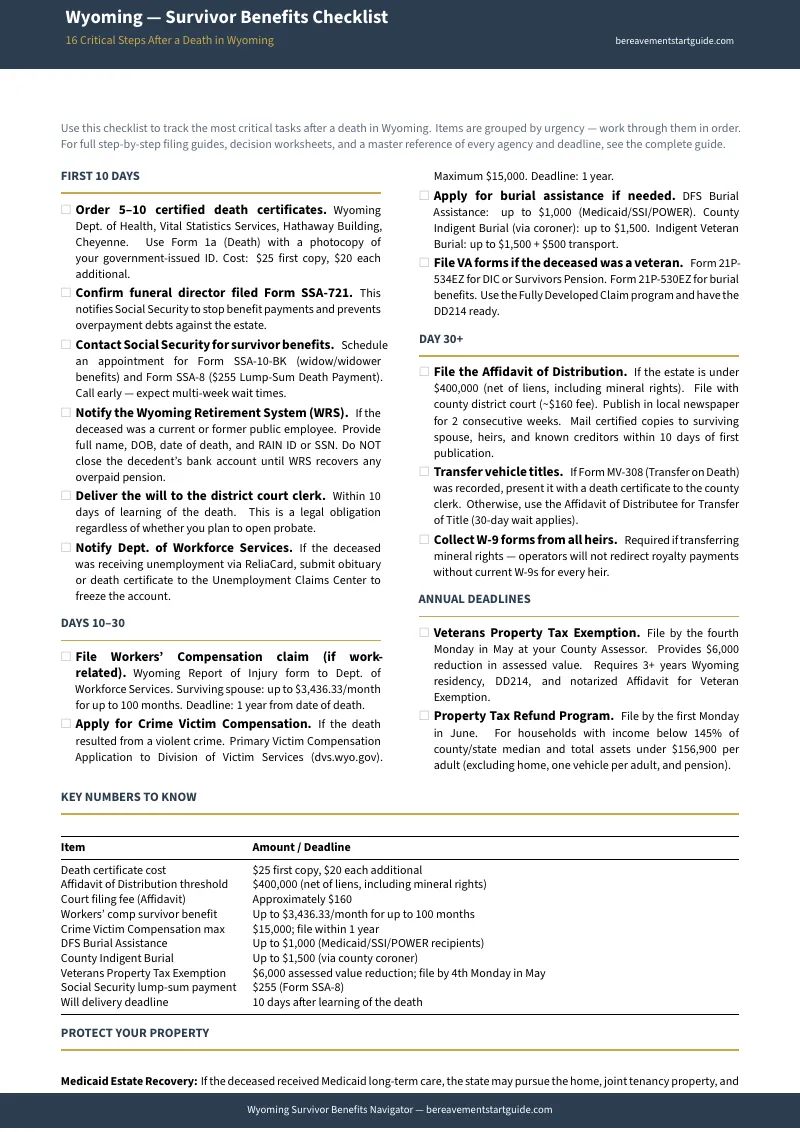
Your download includes the complete guide, the standalone Wyoming Survivor Benefits Checklist, and printable reference sheets: the Benefit Sequencing Timeline (every deadline from Day 1 through Month 12 with space for your dates), the WRS Payout Decision Guide, the Workers' Compensation Filing Walkthrough, the Veterans Benefits Application Tracker, the Property Tax Exemption Calendar, and the Medicaid Recovery Defense Checklist, and the Government Agency Contact Tracker. Instant download, no account required.
Money-back guarantee, no time limit. If the guide does not give you clarity on which benefits you are owed and confidence in how to claim them, email us for a full refund. No questions asked.
Not ready for the full guide? Download the free Wyoming — Survivor Benefits Checklist — a concise overview of every benefit available to Wyoming survivors, including eligibility criteria and filing deadlines. Enough to identify which benefits apply to your situation and what to prioritize this week.
Your spouse handled these things. Now you have to. The guide makes sure you claim everything your family is owed — in the right order, before the deadlines close.