
Someone You Love Just Died in the ACT. The Bank Froze Their Accounts. The Supreme Court Requires a Mandatory Online Probate Notice You Have Never Heard Of. And the Public Trustee Wants 4.4% of Everything to Do What You Could Do Yourself.
You are standing in a place nobody prepared you for. Maybe you were named executor in a will you barely remember reading, and now the funeral director is asking for a deposit while you try to figure out how many certified death certificates to order from Access Canberra — and whether the 15 business days they quote includes postage or just processing. Maybe there was no will at all, and because you are the eldest child or the surviving spouse, everyone is looking at you for answers about a legal process governed by the Administration and Probate Act 1929 that you have never heard of. Maybe the Commonwealth Bank just told you the accounts are frozen and you cannot access a single dollar to pay the electricity bill, the gas, or the funeral that runs between $4,000 and $15,000 depending on which funeral director you contacted.
You are grieving and sleep-deprived, but the paperwork does not wait. The funeral director needs the Medical Certificate of Cause of Death. Services Australia needs notification within days or the estate will owe back overpayments on the pension. Siblings are already asking about the Canberra property. The ATO will eventually demand two separate tax returns. And somewhere in the back of your mind, a terrifying question keeps circling: if I miss a deadline I do not even know about, or distribute assets before the six-month Family Provision claim window closes, or accidentally trigger stamp duty by letting beneficiaries swap assets outside the terms of the will — am I personally liable?
The short answer: the estate pays its debts, not you. But the long answer — the one that involves an ACT Supreme Court that requires you to publish a probate notice online with a strict 14-day-to-3-month validity window, bank thresholds that vary wildly between institutions (CBA at $100,000, ANZ at $40,000, St George at $50,000), filing fees scaled to estate value ($1,124 for estates between $50,000 and $250,000, free for estates under $50,000), and a Public Trustee and Guardian whose capital commission reaches $23,100 on a $600,000 estate — that answer is what separates families who settle an estate in months from families who spend years and thousands of dollars untangling mistakes they did not know they were making.
The When Someone Dies in Australian Capital Territory — Estate Settlement Guide is a Settlement Command Centre for every legal, financial, and administrative step between the funeral home and final distribution. Not a law textbook. Not a generic Australian checklist that does not know the ACT from New South Wales. A structured, ACT-specific manual that separates what must be done in the first 48 hours from what legally cannot happen until the Family Provision claim window closes at six months — so you stop guessing, stop panicking, and start working through this in the right order.
What's Inside the Settlement Command Centre
A 16-chapter guide and the First 48 Hours Checklist — covering every stage from the moment of death through final asset distribution, built specifically for ACT statutes, the ACT Supreme Court, and the territory-specific rules that make settling an estate here different from anywhere else in Australia:
The First 48 Hours: Immediate Actions and Your Rights
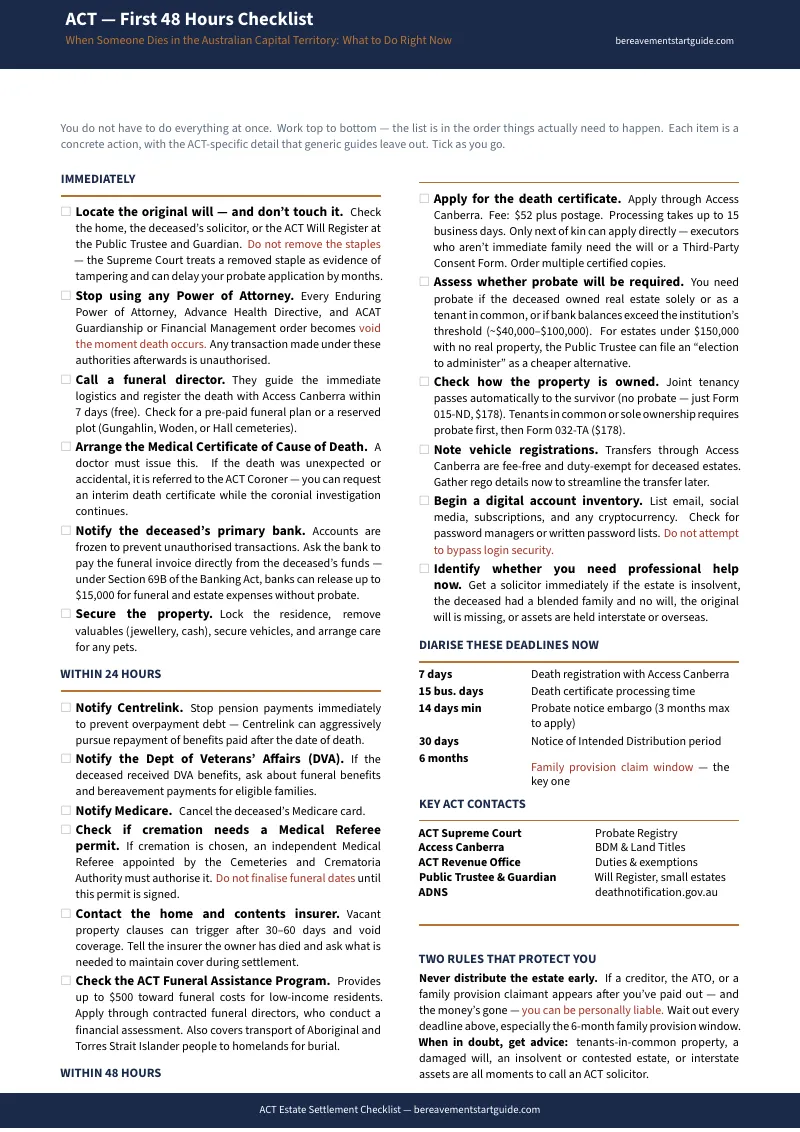
The moment someone dies in the ACT, every Enduring Power of Attorney is legally void. If you managed their finances under an EPA, you no longer have authority. This chapter covers getting the death medically verified, choosing a funeral director (and knowing your rights under ACT consumer protections — they must provide an itemised quote before you sign anything), securing the home and property, and the critical rule most people learn too late: if the family cannot afford a funeral, contact the ACT Funeral Assistance Program about the $500 grant before signing any private contract, and learn how Section 69B of the Banking Act lets you compel banks to release up to $15,000 directly to the funeral home without probate.
Administrative Foundations: Death Certificates, Notifications, and the Asset Inventory
Death certificates from Access Canberra take 15 business days to process, excluding postage — and you need at least four certified originals because banks, the ATO, and the Supreme Court all demand them and will not accept photocopies. The guide gives you the calculation so you order the right number now instead of waiting weeks for extras later. It covers the Australian Death Notification Service (ADNS), the tiered notification system (Services Australia, Medicare, ActewAGL, Icon Water, digital accounts), and building the complete asset and liability inventory that determines whether probate is required and what filing fee tier you fall into.
The Probate Decision: When You Need It and When You Can Skip It
Probate is mandatory if the deceased owned real estate solely or as tenants in common. For bank accounts, it depends on each institution's internal threshold — and those thresholds are corporate policy, not law, meaning they can change without notice. CBA and Westpac generally require probate above $100,000. ANZ often triggers at $40,000. St George mandates it at $50,000. The guide includes the current threshold for every major bank, explains the right of survivorship for joint accounts, covers Binding Death Benefit Nominations for superannuation (which bypass the estate entirely if valid), and maps the exact scenarios where you can settle without going to court.
The ACT Supreme Court Probate Notice: The Step Nobody Warns You About
This is the chapter that does not exist in any free resource. Since March 2022, the ACT requires all probate notices to be published through the Supreme Court's online system — not in a newspaper. The mandatory rule: the notice must be published not less than 14 days and not more than 3 months before you file your formal application. If you miss this window because you were waiting on asset valuations, you must republish and restart the 14-day clock, costing you additional fees and weeks of delay. The guide tells you to publish the notice the same week you receive the death certificate — before you have finished the valuation paperwork — so the 14-day waiting period runs while you are gathering the remaining documents.
Completing the ACT Supreme Court Forms Without Triggering a Requisition
The ACT Supreme Court holds self-represented applicants to the exact same standards as qualified solicitors. Registry staff cannot provide legal advice. If your application is defective, processing halts and you receive a formal requisition. The guide walks you through Form 3.1 (Originating Application) and Form 3.11 (Affidavit of Applicant) line by line, and flags the errors that most commonly trigger requisitions: removing staples from the original will (the Court interprets this as possible tampering), failing to explain why a substitute executor is applying, spelling discrepancies between the death certificate and the will that require specific "also known as" clauses, and listing the nett rather than gross value of the estate in the property inventory.
Transferring ACT Property: Land Titles and the Stamp Duty Exemption
Real estate is typically the largest asset in an ACT estate, and the transfer rules differ completely depending on how the property was owned. Joint tenancy: the surviving owner lodges a Notice of Death by Surviving Proprietor (Form 015-ND) with ACT Land Titles for $178 — no probate needed. Sole ownership or tenants in common: the executor must obtain probate first, then lodge a Transmission Application (Form 032-TA). The guide covers both paths and explains the Section 232D stamp duty exemption under the Duties Act 1999 that saves families thousands — and the trap that voids it. If one sibling is entitled to 50% of a property but wants to buy out the other sibling's share, the buyout portion is not in conformity with the will, and full stamp duty applies on that share. On Canberra property values, the difference between exempt and taxable is catastrophic.
Taxation, Distribution, and Avoiding the Public Trustee
The remaining chapters cover the ATO obligations (the date-of-death individual return and the estate trust return under a separate TFN), the precise order of estate distribution (the Notice of Intended Distribution, the six-month Family Provision claim window under the Family Provision Act 1969, and the personal liability that falls on an executor who distributes too early), avoiding the ACT Public Trustee and Guardian (whose capital commission alone reaches $23,100 on a $600,000 estate — 4.4% on the first $300,000, 3.3% on the next $300,000, plus 6.6% on estate income), intestacy under ACT law, cross-border estates and the Reseal of Foreign Grants (Forms 3.16, 3.17, 3.19, 3.20), pre-death planning (Health Directions, Enduring Power of Attorney), and worksheets for tracking notifications, assets, the probate timeline, and beneficiary communications.
Who This Guide Is For
- The surviving spouse whose partner just died and whose bank accounts were frozen this morning — who needs to know which accounts stay accessible under right of survivorship, how to use Section 69B to get the bank to pay the funeral director directly, and how to lodge Form 015-ND to transfer the family home without going through probate
- The adult child named as executor who has never navigated the ACT Supreme Court and is terrified of triggering a requisition — who needs the complete Forms 3.1 and 3.11 walkthrough, the online probate notice strategy, and a timeline that separates what is urgent from what must wait for the 14-day publication period
- The family with no will who just learned that the Administration and Probate Act 1929 dictates everything — who needs to understand who has priority to apply for Letters of Administration, how intestacy distribution works in the ACT, and whether the Public Trustee and Guardian will become involved
- The executor living interstate or overseas who is managing an ACT estate from Sydney, Melbourne, or abroad — who needs to understand the online probate notice system, the Reseal of Foreign Grants process for interstate probate, and how to handle property transfers remotely through ACT Land Titles
- The financially constrained family who cannot afford a funeral or a solicitor — who needs to know about the ACT Funeral Assistance Program ($500 grant), the Section 69B bank release mechanism ($15,000 for funeral costs without probate), and the filing fee exemption for estates under $50,000
- The proactive planner organising affairs after a terminal diagnosis or aged care transition — who needs to assemble a Health Direction and Enduring Power of Attorney before capacity is lost, and create a death folder so their family never has to scramble through this process blind
Why Free Resources Will Not Get You Through This
The information exists. It is scattered across Access Canberra, the ACT Supreme Court, the ACT Revenue Office, ACT Land Titles, the ATO, Services Australia, and a dozen institutional portals that do not talk to each other. Here is what you actually encounter when you try to settle an estate using free sources alone:
- Government pages tell you what to do but not how to do it. Access Canberra and the ACT Supreme Court publish forms and fee schedules. They tell you that you need to register the death, publish a probate notice, and file Forms 3.1 and 3.11. They do not walk you through the smart form step by step, explain how to phrase your affidavit to avoid a requisition, or warn you about the 14-day-to-3-month notice window that delays everything if you miss it. They assume legal literacy that most grieving families do not have.
- Law firm blogs highlight complexity to justify retainer fees. Canberra firms like Farrar Gesini Dunn and MV Law publish excellent technical breakdowns of probate processing times and family provision claims. All of their content is designed to convince you the process is too dangerous to handle alone — and that you need a retainer starting at $3,000 to $5,000. For contested estates, that is true. For the majority of straightforward estates, the answer costs a fraction of a solicitor's hourly rate.
- The Public Trustee and Guardian publishes transparent fees — but they are enormous. The PTG charges 4.4% capital commission on the first $300,000, plus 6.6% on estate income. On a typical Canberra estate, that is $23,100 or more. Their information pages are designed to persuade you to renounce executorship and hand the estate to them. Families desperately want to keep estate administration private, but free resources do not show them how.
- Bank estate pages protect the bank, not you. CBA, Westpac, ANZ, and St George each publish deceased estate processes. Every one is focused on institutional liability protection. They explain why accounts are frozen. They do not explain how to negotiate early fund releases, how the small estate indemnity process works, or why their thresholds differ from the bank across the street.
- Funeral home content stops after the ceremony. Funeral directors provide empathetic aftercare checklists covering the first week. Their advice ends where the hard questions begin: probate notices, Supreme Court forms, property transfers, ATO obligations, and executor liability.
Free resources give you fragments from a dozen sources that do not reference each other. The Settlement Command Centre puts every ACT-specific statute, form, deadline, and procedure into one document, in the order you actually need them.
— Less Than Fifteen Minutes With a Canberra Estate Solicitor
A single consultation with a Canberra estate solicitor costs $350 to $500 per hour. Standard probate representation starts at $3,000 to $5,000 — and that only covers obtaining the grant. The actual estate administration (closing accounts, transferring property, organising tax returns) is billed separately at hourly rates. The Public Trustee charges $23,100 or more on a $600,000 estate. This guide costs less than fifteen minutes of professional legal time and gives you the complete ACT-specific roadmap — every statute, every Supreme Court form, every deadline, and the online probate notice process that the court requires but nobody explains in plain language.
Your download includes the complete 16-chapter guide, the standalone First 48 Hours Checklist, and print-ready worksheets — Agency Notification Tracker, Asset and Liability Summary, Probate Timeline Planner, and Beneficiary Communication Log. Plus a money-back guarantee, no time limit. If the guide does not give you clarity on what to do next and confidence that you are doing it in the right order, email us for a full refund. No questions asked.
Not ready for the full guide? Download the free Australian Capital Territory — First 48 Hours Checklist — the most urgent actions covering everything that must happen in the first two days after a death in the ACT: death certificates, securing property, funeral assistance eligibility, bank notifications, and what not to do (do not remove the staples from the original will — the Supreme Court may interpret this as tampering). It is enough to get through tonight and tomorrow.
You did not ask for this job. But you can do it. The guide shows you how, one step at a time.