The bank froze every account. The Zivilstandsamt needs documents in German within two days. The landlord's lease keeps running — and every heir is personally liable for the rent. You have no idea which of 26 cantons controls the next deadline.
When someone dies in Switzerland, the system does not slow down because you do not speak the local language. The civil registry needs the medical death certificate filed within two days — in German, French, or Italian, depending on the municipality. The moment a Swiss bank learns of the death, it locks every individual account, every standing order, and every safe deposit box under FINMA rules. Nothing moves until every heir provides unanimous, hand-signed written instructions. That process typically takes months.
Meanwhile, the deceased's lease does not terminate. Under Article 266i of the Swiss Code of Obligations, all rental liabilities pass directly to the heirs — jointly and severally. If the heirs do not send a hand-signed termination letter that reaches the landlord before the end of the month, giving three months' notice to the next customary local termination date, they keep paying rent on an empty flat. One missed deadline can easily cost thousands of francs.
The English-language resources that exist are scattered across the federal portal ch.ch, cantonal court websites in German, expat forum threads with outdated advice, and funeral home blogs that explain just enough to funnel you toward their services. No single source covers the full sequence — from the first phone call to the final tax return — in plain English, with the Swiss-German and Swiss-French terms you need at the counter.
The Swiss Death Administration Roadmap — every deadline, every office, every Swiss-German term explained, in the order things actually happen
The Someone Died in Switzerland: English Speaker's Emergency Guide is a chronological administrative roadmap built for the specific situation of navigating Swiss death bureaucracy without fluent German, French, or Italian. It follows the actual sequence — not alphabetical topics, not a glossary, but the order in which Swiss registries, banks, courts, landlords, and pension offices expect you to act.
Every Swiss legal term appears with its English translation the first time it is used. Every deadline is flagged with its legal basis. Every office is identified by its official name and role. And every step tells you whether you can handle it yourself or whether this is the point where you need a notary, a lawyer, or a consular officer.
What's inside
- First 48 hours protocol — who to call in what order, how to get the medical death certificate (ärztliche Todesbescheinigung) from the attending physician, the two-day civil registry deadline, and the critical difference between the medical certificate and the civil death certificate (Sterbeurkunde) that trips up every English speaker
- Police and prosecutor procedures — what happens when Swiss law classifies the death as unnatural (accidents, assisted suicide via Dignitas or Pegasos), the mandatory forensic investigation, how long the body may be held, and what you need before remains can be released
- Embassy and consular notification — what your embassy can and cannot do (they will issue a Consular Report of Death Abroad and void a passport — they will not liquidate the estate, clear the apartment, or terminate the lease), and how to secure a CRODA for estate closure in your home country
- Bank account freeze mechanics — how the FINMA-mandated freeze works, the unanimity requirement for the Erbengemeinschaft (community of heirs), why joint accounts offer no protection, and the one exception: Pillar 3a pension assets, which bypass probate and pay out directly to designated beneficiaries under statutory priority
- Erbschein application walkthrough — when you need a Certificate of Inheritance, the difference between the Erbschaftsamt and the Bezirksgericht, the three-month reflection period during which heirs can accept or repudiate the estate, court fees from CHF 100 to over CHF 7,000 (scaled to estate value), and the complete document checklist
- Tenancy termination under CO Art. 266i — the extraordinary termination right that most heirs do not know about, the exact letter format (written, hand-signed, unanimous), the deadline structure (end of month, three months' notice, next customary local termination date), and bilingual templates you can send immediately
- Funeral logistics and cost comparison — which municipalities cover basic cremation and burial for registered residents (Zurich, Basel, St. Gallen) versus those that charge (Bern, Lucerne), private funeral home costs (CHF 4,000–8,000), and the full repatriation pathway: Leichenpass, zinc-lined coffin, sanitary certificate, flight coordination, and expected costs
- 2023 inheritance law reforms — the revised Swiss Civil Code effective January 1, 2023, which reduced compulsory portions for descendants from 75% to 50% and eliminated compulsory portions for parents entirely, plus how the transitional rules apply to wills written before the change
- Tax inventory and final return — the 14-day Steuerinventar initiation, the 60-day questionnaire deadline, how inheritance tax varies dramatically across cantons (some exempt direct descendants entirely, others do not), and the spousal exemption that applies in every canton
- AHV/IV survivors' pensions — eligibility for surviving spouses and orphans, the one-year minimum contribution requirement, Scale 44 calculations, the 2024 ECHR ruling granting widowers perpetual pension parity, and how to file with the correct Ausgleichskasse
- Professional services decision matrix — the exact trigger points for when you need a funeral director, a notary, a consular officer, a tax adviser, and a Swiss estate lawyer — so you never pay CHF 350–500 per hour for work you can handle with the right template
Plus 8 standalone printable PDFs — bilingual letter templates (bank notification and landlord termination in German and French), a bank freeze strategy guide, a deadline reference card, a timeline planner, a document tracker with Swiss-German terms, an asset inventory worksheet for the 60-day Steuerinventar, a cantonal authority and fee comparison, and a professional services decision matrix — each designed to be printed and used at the Zivilstandsamt, at the bank, or at the Bezirksgericht.
Who this is for
- Expats in Switzerland whose spouse, parent, or partner has just died — and who need to know what to do tonight, not after a week of translating cantonal websites
- Family members abroad who just received a call from a Swiss hospital, police station, or embassy — and have no idea where to start
- Non-resident heirs dealing with a Swiss estate from outside the country — needing to understand the Erbschein process, bank freeze timeline, and what can be done remotely versus what requires physical presence
- Corporate HR departments in Swiss multinational offices supporting bereaved employee families through the administrative process
Why not just use the free resources?
The Swiss federal portal ch.ch publishes a useful overview — in broad strokes, across all four national languages. Cantonal court websites publish detailed procedural instructions — in German. Expat forums have threads with advice that may reference pre-2023 inheritance law. And the English-language service companies that rank on Google (Epilog Swiss, DeinAdieu) are deliberately structured as lead-generation funnels: they explain enough to create urgency, then redirect to premium estate liquidation packages or lawyer referral networks.
No single free source covers the full sequence from death to estate settlement in English, with current law, with cantonal fee comparisons, in the order things happen. This guide does.
The cost of not knowing the system
- Missing the two-day civil registry deadline because you did not know which Zivilstandsamt has jurisdiction (it is the municipality where the death occurred, not where the deceased lived)
- Paying a Swiss estate lawyer CHF 350–500 per hour to write a bank notification letter and a landlord termination letter — tasks you can do yourself with the bilingual templates in this guide
- Paying months of rent on an empty apartment because the heirs missed the CO Art. 266i extraordinary termination window or sent the letter without all required signatures
- Assuming the embassy will manage the estate — then discovering that consular services are limited to a death report and passport cancellation
- Missing the 60-day tax inventory deadline because nobody told you the Steueramt initiated the process 14 days after the death
- Hiring a private funeral director at CHF 4,000–8,000 without knowing that the municipality covers basic burial or cremation for registered residents at no cost
Satisfaction guarantee
If the guide does not give you a clear path through Swiss death administration, email us for a full refund. No questions, no hoops. You are dealing with enough bureaucracy already.
Get the free checklist or the full guide
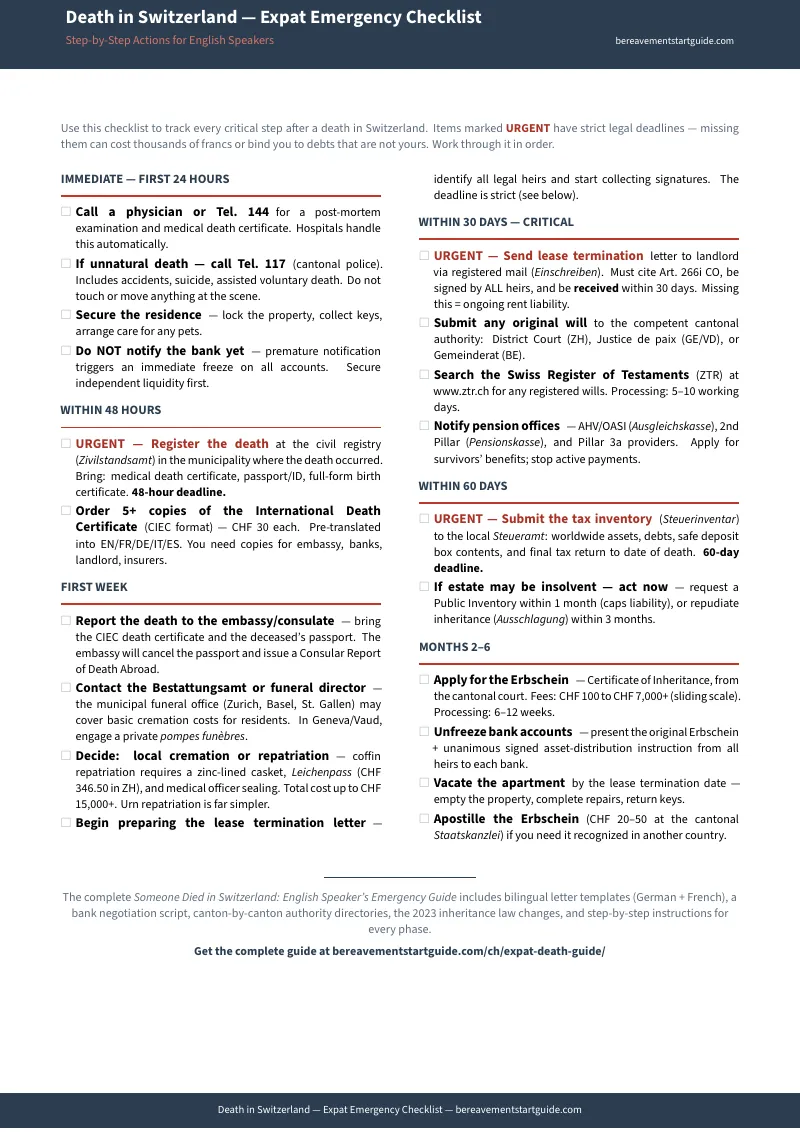
The free Emergency Checklist gives you the critical first steps — who to call, what documents to gather, and the key deadlines. It is the right starting point if you need to act tonight.
The full guide covers the complete process from death to estate settlement — bank freezes, Erbschein, lease termination, repatriation, inheritance tax, and pensions — with bilingual templates and printable worksheets you can use at every stage. For , it replaces hours of fragmented research and potentially thousands of francs in avoidable professional fees.